
by Elsie Clark | Sep 1, 2025 | Avionics, Innovation
Aviation innovators XTI Aerospace have selected the Garmin G700 TXi avionics system for its pioneering TriFan 600 xVTOL aircraft.
Its user-friendly touchscreen interface will provide future xVTOL pilots with essential situational awareness data, including traffic updates, weather maps, and Garmin’s trademark Synthetic Vision Technology (SVT). The avionics system will enhance overall flight safety and monitoring in XTI’s cutting-edge aircraft.
Don Purdy, SVP and Interim President of XTI Aircraft, commented:
This avionics suite is a fantastic match for the TriFan 600. Garmin’s G700 TXi offers the reliability, innovation, and pilot features to efficiently and safely operate the transformational xVTOL aircraft – operating from traditional runways, short runways, heliports and other approved landing areas.
Electrical vertical takeoff and landing (eVTOL) aircraft are currently being piloted for short ‘air taxi’ trips. The eVTOL market is predicted to be worth $4.67 billion by 2030 as demand for sustainable, noise-free flight increases and more companies execute successful tech pilots.
With their flagship TriFan 600 xVTOL, XTI hope to go further and create a more manoeuvrable aircraft that has a range of over 900 miles. Additional developmental tests are scheduled for 2027 as the company aspires to certification from the Federal Aviation Authority (FAA).
To learn more about the future of avionics, book your ticket to attend Aerospace Tech Week 2026.
For more news, see:
by Jessica Brownlow | Jul 22, 2025 | AI & ML, Avionics, Video
As the aviation industry undergoes a digital transformation, AI and multi-core processing are no longer distant concepts – they’re taking off.
At Aerospace Tech Week, we spoke with Richard Richard Jaenicke, Director of Marketing at Green Hills Software, about the progress, challenges, and future of avionics systems.
“It was about four years ago that we got the first multi-core TSO for avionics… Now, with Airbus and Collins Aerospace joining in, we can say that multi-core has really taken hold.”
Jaenicke highlights two major shifts in the avionics landscape over the past 12 months:
- A growing wave of multi-core certifications
- The emerging role of artificial intelligence and autonomy, especially in experimental and military aircraft
But as he points out, AI brings complexity and risk.
“You end up with a pile of weighted weights… you can’t really validate that they came from the requirements or that they implement them.”
Watch the full interview to hear how Green Hills Software is helping shape the future of safe, certifiable AI in aviation.
Questions asked include:
- How has the avionics landscape progressed in the last 12 months?
- What are the key challenges in using AI/ML in avionics systems?
- How can we ensure the safety and security of AI in flight-critical systems?
- What are some near-term applications of AI in commercial or defense aviation?
- What brings Green Hills Software to Aerospace Tech Week, and how does it support
- innovation?
Join us at Aerospace Tech Week Europe 2026!
Subscribe to our free monthly newsletter here.
For more like this see:
by Jessica Brownlow | Jun 4, 2025 | Avionics
A new report estimates the avionics market will be worth $82.33 billion in the next five years. Currently sitting at $56.22 billion, the MarketsandMarkets™ report sees this growth stemming from rising aircraft production, technological innovation, and demand for modernised aviation infrastructure.
Released yesterday, the report states:
“The avionics market is thriving due to rapid advancements in digital technologies, such as artificial intelligence and data analytics, which enhance efficiency and safety. The increased demand for connected and autonomous aircraft, along with a focus on sustainability, is driving innovation in avionics systems. Geopolitical shifts and the expansion of emerging markets are also contributing to a strong market outlook. Airlines and manufacturers are prioritizing cutting-edge solutions to meet evolving industry needs, making the avionics market dynamic and poised for sustained growth. This industry is at the forefront of shaping the future of aviation technology.”
In terms of regional leadership and the competitive landscape, Normal America is predicted to have the largest and most mature avionics market. It is home to key players including Honeywell, Collins Aerospace, Garmin, and RTX who are driving innovation and exports. More specifically, the region has displayed leadership with NextGen air traffic systems and cockpit upgrades.
Looking forward, the opportunities ahead include advanced connectivity, emerging markets, and retrofits for aging fleets. Read the full report for more.
For more like this see:
by Jessica Brownlow | Apr 9, 2025 | Avionics, Innovation
Article by Gabi Davenport, Intel Corporation
In today’s increasingly automated world, the systems we build aren’t just expected to work—they’re expected to work safely, often under extreme conditions and with little room for error. From industrial robotics on the factory floor to autonomous aircraft in our skies, safety isn’t an afterthought—it’s a design requirement.
Nowhere is this more evident than in aerospace, where flight control systems, navigation algorithms, and onboard computing platforms must operate with unwavering reliability. A transient hardware fault, if undetected, can compromise mission integrity or human safety. The challenge is similar across other sectors like autonomous vehicles, smart energy grids, and industrial automation.
As the hardware powering these systems becomes more complex, so do the challenges in ensuring their integrity.
Modern computing systems are built around highly integrated system-on-chip (SoC) architectures that combine compute cores, graphics units, memory, communication fabrics, and power management—all on a single chip. While this integration brings performance and power efficiency, it also increases the surface area for potential faults.
In safety-critical applications like aerospace, the stakes are particularly high. Systems must:
- Continuously monitor for faults, including transient radiation-induced errors (common at altitude),
- Run health diagnostics without interrupting operation,
- Recover gracefully from detected issues,
- Comply with strict standards like DO-254, IEC 61508, or ISO 13849.
Building this resilience requires a shift from reactive fault handling to proactive fault prevention and detection, starting from the silicon layer up.
A recent white paper from Intel (below) highlights one example of this design philosophy in action. The Silicon Integrity Technology outlines integrated features embedded into select Intel® processors to support functional safety.
While Intel’s technology targets a wide range of markets, including industrial automation and autonomous systems, its features map directly to the needs of aerospace computing:
- Dual-Core Lockstep (DCLS): Two cores run identical operations to detect faults, crucial for avionics and flight-critical functions.
- In-Field Diagnostics: Performs self-tests at startup or during operation, which is vital for aerospace systems requiring uninterrupted self-checks.
- Error Detection and Correction (ECC): Protects against radiation-induced errors in high-altitude environments, ensuring data accuracy.
- Integrated Monitoring and Logging: Records and reports faults through standard interfaces, essential for real-time fault management in aerospace systems.
Notably, these capabilities are managed through system firmware and bootloaders, allowing flexibility in how and when they’re used based on mission profiles.
The need for high reliability under constrained conditions is particularly acute in aerospace. Systems often operate in radiation-prone environments, with limited access for maintenance, and must meet strict certification requirements. Integrating diagnostic and error-handling features directly into the processor helps address many pain points.
Engineers can now leverage integrity-aware silicon to build smarter, more efficient safety architectures rather than relying solely on redundant systems (which add cost, weight, and complexity). This shift opens new doors for applications like autonomous drones, satellite systems, and next-generation avionics platforms.
Whether you’re designing for aerospace, industrial robotics, or autonomous vehicles, the goal is to reduce undetected failure rates, enhance fault coverage, and simplify the path to certification.
Conclusion
As embedded systems take on more autonomous roles in our lives and industries, the demand for safety-integrated hardware will only grow. Tools like Intel® Silicon Integrity Technology are helping shift the paradigm—embedding fault detection and system integrity features into the fabric of the processor itself.
These hardware-level innovations will be key to building tomorrow’s safe, resilient systems—whether on the ground, in the factory, or 35,000 feet above it.
For more like this see:
by Jessica Brownlow | Apr 2, 2025 | AI & ML, Avionics, Connectivity, Flight Ops IT, Innovation, MRO IT, Sustainability
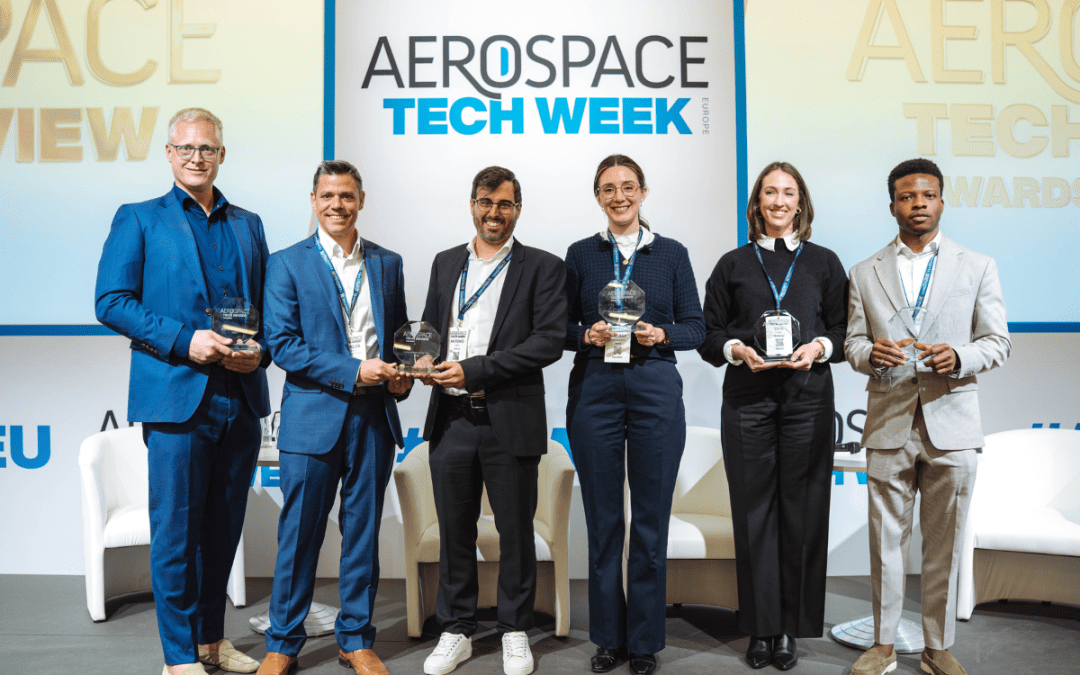
Earlier today, the five winners of this year’s Aerospace Tech Review (ATR) Awards were announced onsite at Aerospace Tech Week Europe in Munich. The awards recognise individuals and companies for their outstanding contributions to the aerospace industry in 2024.
Each category featured three deserving finalists, carefully selected from publication nominations, with the winners chosen by an expert judging panel prior to the event.
Sven Krause announced the results at the close of day one at Aerospace Tech Week Europe, putting a spotlight on the innovators, visionaries, and first-movers who are shaping the future of aerospace.
Top innovator – Individual person who has pushed the boundaries to make a lasting impact on the industry
Winner: Maxime Meijers (Co-Founder & CEO, Estuaire) for his leadership combining atmospheric modeling with real-time operational insights to address the full climate footprint.
Finalists: Victor Oribamise (CEO, Kquika), Eng. Catherine Cordonia (COO, DaS LAB)
Most disruptive start up – Start up that has shaken the industry, bringing a fresh approach to challenges/forward thinking solutions
Winner: AIXI – Founded to help airlines leverage decades of historical maintenance and reliability data to solve real-world challenges.
Finalists: Cosmofoil, JELLYSPACE
Speaking on the achievement, Cameron Byrd, AIXI CEO & Founder said:
“AIXI is empowering airlines to unlock the full value of their maintenance data with industry specific AI models. Our tools have been in production since 2022 and have most notably helped the maintenance and reliability teams at Southwest Airlines. We are thrilled at being recognized as the Most Disruptive Start-Up at Aerospace Tech Week Europe, which emphasizes our industry-leading tools and innovation.”
Best sustainability initiative – Company that has taken exceptional steps to reduce the industry’s environmental impact or significantly raised the standard for sustainability
Winner: Iberia Maintenance for its use of SAF in their test bench, producing renewable energy via solar panels, and broadening its in house repair capabilities to reduce emissions.
Finalists: EL AL, Airbus
Most creative product applying AI – Driving progress and opening up new possibilities
Winner: Kquika’s Trakt System which leverages AI and machine learning to revolutionise aircraft maintenance, addressing the aviation industry’s labor shortage and operational inefficiencies.
Finalists: Skypuzzler’s iDATC, DaS LAB’s Project StopOver
Collaboration of the year – Two or more companies whose collaboration has resulted in significant advancement for the sector
Winner: Airbus & Telefónica who have come together to transform the aerospace sector through the power of 5G technology.
Finalists: Spectrum Control & 3D Glass Solutions, International Aerospace Environmental Group’s Work Group 13
Natalie England, Project Director, Aerospace Tech Week said:
“This is the first year of the ATR Awards and we are thrilled to celebrate some of the remarkable people and products that are pushing the boundaries of what is possible in this dynamic industry. Aerospace Tech Week Europe brings together key players in the industry ecosystem to drive innovation, making it the perfect place to announce the results.”
For more information on Aerospace Tech Week, visit our website and follow us on LinkedIn.
by Jessica Brownlow | Mar 17, 2025 | Avionics, Innovation, Sustainability, Video
At Aerospace Tech Week Europe, Steffen Wenzel, Partner, Head of Aerospace & Defence, h&z Consulting will be chairing a selection of avionics tracks as well as moderating key sessions including a sustainability focused discussion with Anna von Groote, Director General of EUROCAE.
In this brief conversation, Wenzel draws on his 15 years of experience in the aerospace and defence industry to assess the current landscape. The discussion touched on everything from quantum computing to avionics, AI to sustainability.
Wenzel picked out sustainability as one of the industry’s major challenges. Unpacking the variety of solutions that will be necessary to curb emissions, he picked out SAF, hybrid-electric technology, route optimisation, and enhanced air traffic management as near term solutions that are already shaping the landscape.
Speaking about the upcoming event in Munich, Wenzel explained the sessions onsite will be critical in understanding how avionics will develop in the coming years. Sharing a glimpse into what to expect, Wenzel said:
“One area is cross-aircraft collaboration to avoid turbulence, which is an exciting area of innovation. Essentially, aircraft will be able to communicate with each other in real-time to share turbulence data, helping improve passenger comfort and operational efficiency.
Another key topic is Global Navigation Satellite Systems (GNSS) and the innovations they offer to operators. These advancements will improve navigation accuracy and allow for more precise and fuel-efficient routing, which is crucial as we work toward making aviation more sustainable.
On a more technical level, we will also be looking at multicore processors in avionics systems. This is a topic that has been around for some time, but it remains a challenge, particularly when it comes to certification…”
Watch the full conversation below. To join us at ATW Europe book your ticket now!
Questions asked include:
- What are the most exciting opportunities we are seeing with aerospace?
- What are the biggest challenges the industry is facing?
- Can you highlight some of key themes you expect to hear on stage at in April?
For more on Aerospace Tech Week 2025 see:





You must be logged in to post a comment.