
by Elsie Clark | Jan 8, 2026 | Innovation, Sustainability, Video
Boasting more than 600 aircraft that fly to over 250 destinations, the International Airlines Group (IAG) manages some of Europe’s best-known airlines, including British Airways, Iberia, and Vueling. But how can the group manage an effective sustainability strategy across these unique brands?
In an exclusive interview at World Aviation Festival 2025, Jonathon Counsell, Group Director of Sustainability at IAG shared his insight on setting the direction. While aviation’s overall enthusiasm for ESG might have waned from its peak in the mid-2010s, IAG remain committed to their 2050 net-zero emissions target.
We recognise that this is a long-term challenge for us. We have to address our carbon emissions, and we have as an industry a clear roadmap to do that. Fundamentally, climate change is driven by the science, not just politics. So it’s something we have to do.
IAG is currently on track to achieve its 10% sustainable aviation fuel (SAF) target by 2030. US$3.5 billion has been invested so far through partnerships with cutting edge companies such as Infinium, a low-carbon eFuels developer. Counsell sees ‘real value’ in bringing the five member airlines together to share progress and success stories.
It’s quite a close group. We meet every month, and every quarter we have a two-day workshop where we all get together. It’s fantastic to see the sharing of best practice among all the different participants.
IAG’s other investments include ZeroAvia, developers of hydrogen-propelled aircraft. However, Counsell believes in the short term SAF production needs to accelerate to reduce the impact of this hard-to-decarbonise industry, especially while demand continues to outstrip supply.
I truly believe there is a first-mover advantage when it comes to decarbonisation. Our view is that some of the advanced fuels in the second and third generations will be in short supply post-2030. So we think it’s really important that companies get into the market early to secure the regular supply of these SAFs.
🎥 Watch the interview to hear the full conversation on sustainability with Jonathon Counsell.
Questions asked include:
- Do you think that geopolitical change has slowed momentum on sustainability in aviation?
- IAG has committed to net-zero emissions by 2050. What progress have you made on that goal so far? What are the Group’s biggest success stories?
- As an airline group, you have to oversee the sustainability targets of five separate airlines. Is it a challenge bringing all these parties together, or do you see it as an opportunity for greater collaboration?
Jonathon Counsell will be speaking at Aerospace Tech Week 2026. Join us.
For more like this, see:
by Elsie Clark | Nov 12, 2025 | Innovation, Video
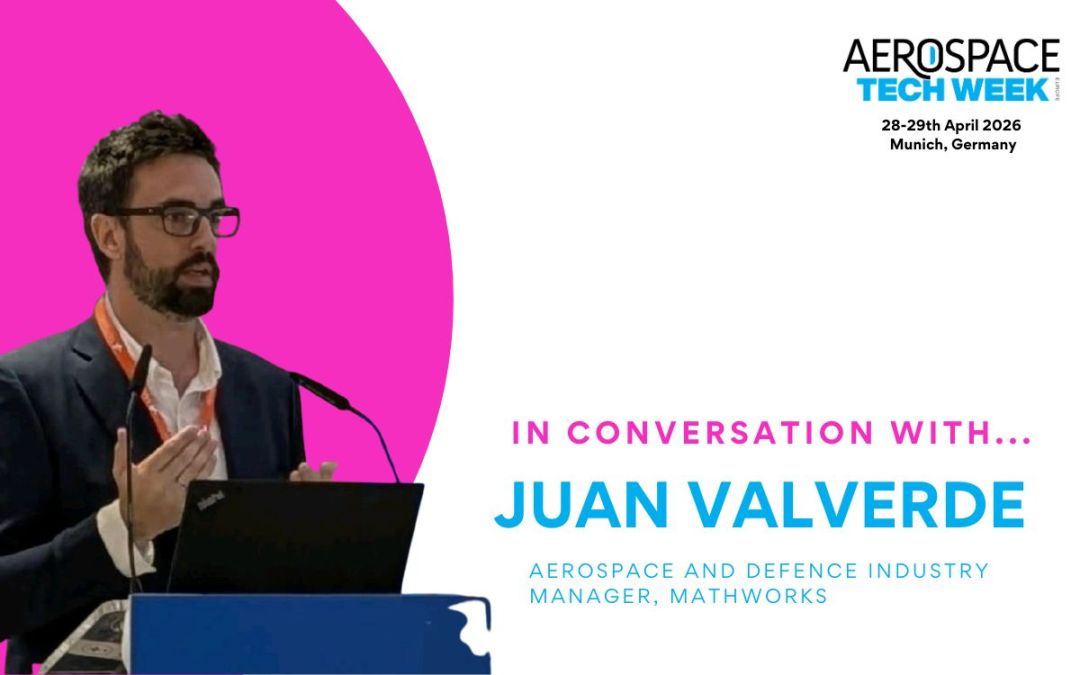
In the race to get new solutions to the market, virtual testing provides critical insights on product development to make aviation as advanced as possible. MathWorks is one company leading the charge in simulation, computing, and engineering platforms that can detect design issues early. At Aerospace Tech Week 2025, Juan Valverde, MathWorks’s Aerospace and Defence Industry Manager, explained where he sees the key challenges and opportunities in virtual testing.
We are in the era of data. Everything is data. How can we convert this into something that’s usable?
Developing high-fidelity models that truly simulate how different systems will perform is no easy task. However, Valverde sees collaboration as essential to driving progress and eliminating potential silos, especially when many companies still rely on paper-based workflows.
When different teams work in isolation, it’s very difficult to identify an error in testing that’s dependent on something that needs to be integrated later. For me, this is a very big gap.
As the industry grows, teams have expanded, sometimes spanning multinational corporations. Valverde wants to see mindset shifts and real investment that will unlock new methodologies to power these bigger projects.
We have many customers working with us and out tools on these challenges. We’d like to continue to understand how we can cover these gaps.
🎥 Watch the interview to hear the full conversation with Juan Valverde.
Questions asked include:
- How have we seen the virtual testing landscape develop in recent years?
- How can new methodologies adapt to the increasingly complex environment we’re seeing?
- How can advanced tech support design and verification processes?
- What are the biggest gaps in aerospace testing right now?
Join us at Aerospace Tech Week 2026 to discuss the future of testing and certification.
For more like this, see:
by Elsie Clark | Oct 15, 2025 | Innovation, Video
A report from CAE predicts that the civil aviation industry will need 1.465 million additional professionals by 2034 to meet passenger demand. Training and upskilling is therefore of the highest priority if airlines and airports want to increase their capacity safely.
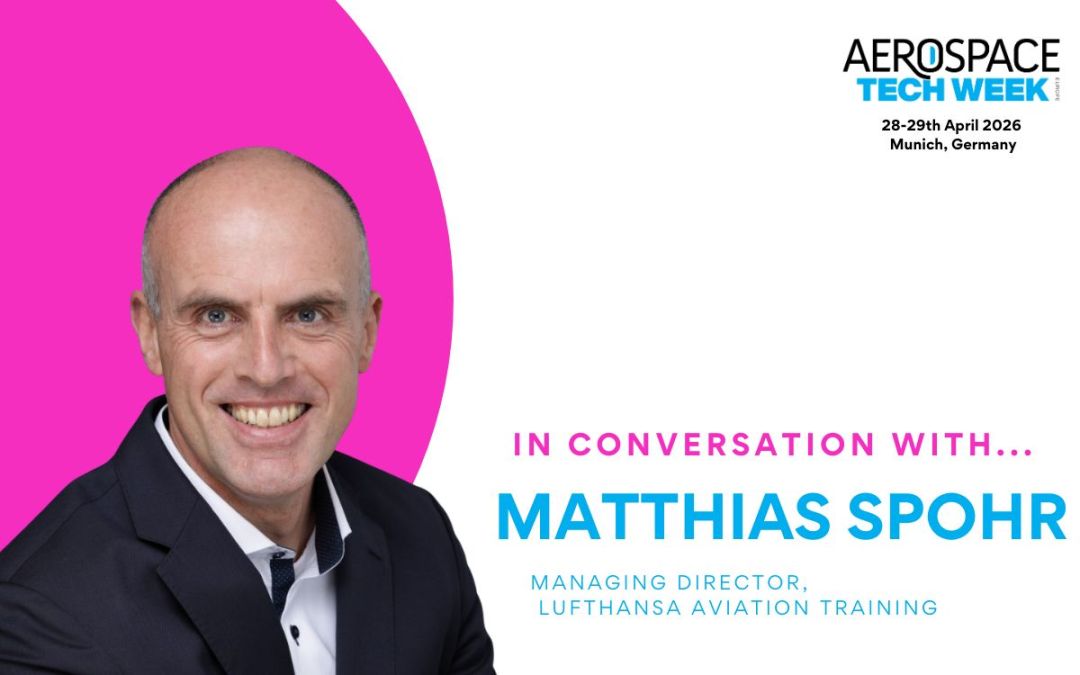
Lufthansa Aviation Training, part of the Lufthansa Group, has been training aviation professionals for more than 60 years. Boasting 50 full flight simulators across six dedicated centres, the company remains at the heart of training Europe’s pilots and cabin crews.
In an exclusive interview at Aerospace Tech Week 2025, we spoke to Managing Director Matthias Spohr about how Lufthansa Aviation Training is adapting for the future, including investments in digital twins.
Responsible for managing over 250 customers, Spohr sees digitisation as a key tool in offering a personalised service to every airline. Despite a strict regulatory environment, Lufthansa Aviation Training has been at the forefront of cutting-edge training technology. Remaining so is key to their strategy moving forward.
The big training devices we have are not 100% personalised to every company or airline we work with. Digital solutions give us the change to have a fully digital twin of how the airline is training, and of course to make training more realistic.
Investments of these kinds, costing in the millions of euros, represent a significant risk. Nevertheless, Spohr believes they are necessary if training is to keep pace with modern expectations. In the future, he believes aviation training will be much more decentralised, perhaps even progressing to a model where studying from home is more common.
Of course we welcome every customer that visits us, but it would be a lot better if we can decentralise and be where the crews are. That will produce savings on the airline side, and on the customer side there will be lower travel costs, more individualised training, and hopefully we can serve more customers.
The use of technology to enhance training and meet students where they are will be essential for aviation to educate and upskill the volume of workers growth forecasts require.
🎥 Watch the full interview to hear Matthias Spohr’s full thoughts on the evolution of aviation training.
Questions asked include:
- How do you see technology shaping training in the industry?
- What can you tell us about how you’re leveraging VR and digital twins?
- How does investment today drive cost savings in the future?
- What’s next in innovation in training?
Join us at Aerospace Tech Week 2026.
For more like this, see:
by Elsie Clark | Sep 8, 2025 | AI & ML, Innovation, Video
From predictive analytics to enhanced scheduling, the aerospace industry now collect more data then ever. But how can Chief Information Officers (CIOs) across the industry leverage that data effectively?
At Aerospace Tech Week 2025, we tapped the expertise of Lauren Edwards, Head of Aerospace and Airlines Practise, from consulting firm Point B. She highlights several priorities for CIOs, including ensuring compatibility between legacy systems and new artificial intelligence (AI) software.
A lot of conversations we’re having are how do we continue to move towards the future while managing and maintaining the information that we have today.
Getting different data systems to ‘talk’ to each other, all while ensuring data cleanliness, presents a challenge for the industry. But when done effectively, the outcomes can be game-changing for customer experience. At the same time, as the workforce ages and workflows incorporate more technology, employees can see significant value too.
We really focus on understanding, and we see the most ROI when your customer experience and your employee experience come together.
🎥 Watch the full interview below to hear more from Lauren on the data landscape for aerospace in the years ahead.
Questions asked include:
- What are the priorities for CIOs in data and privacy in 2025?
- How are data improvements boosting the bottom line for companies?
- What are the major challenges in the landscape?
- What are the untapped benefits of effectively leveraging data and analytics?
Join us at Aerospace Tech Week 2026 to discuss further how data is changing aviation, engineering, and MRO.
To learn 1more, see:
by Elsie Clark | Sep 3, 2025 | AI & ML, Innovation, Video
Artificial intelligence (AI) for aviation is forecast to be a $4.96 billion by 2030 — and infrastructure is set to be the largest solution segment.
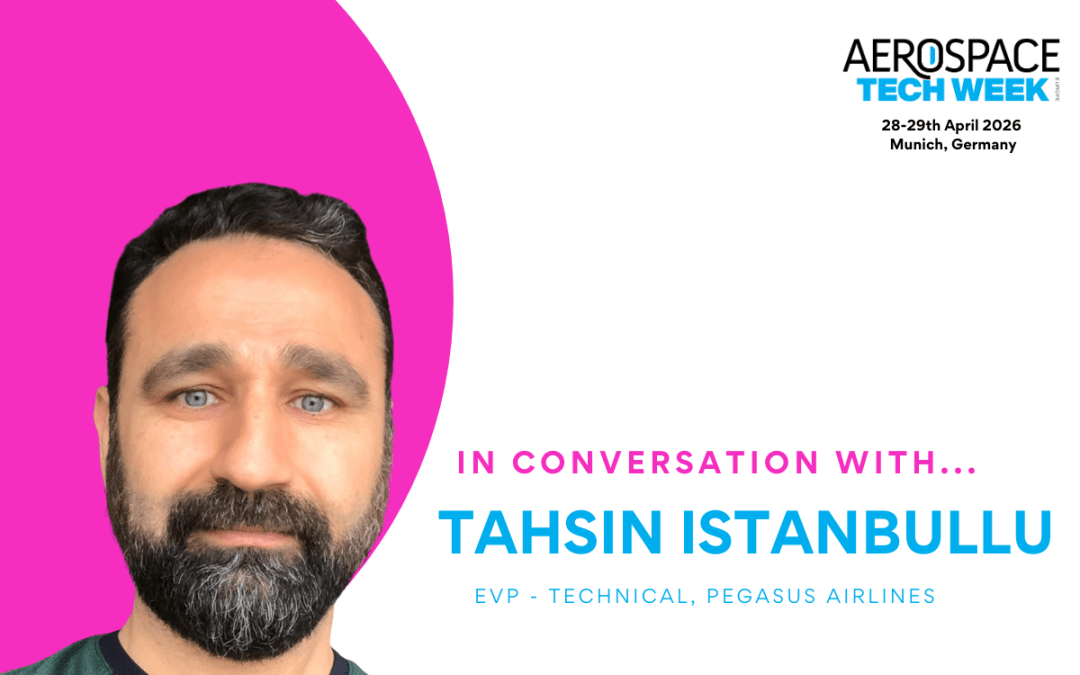
At Aerospace Tech Week 2025, we sat down with Tahsin Istanbullu, Executive Vice President – Technical at Pegasus Airlines, to tap his insights on aviation’s ongoing tech transformation.
Pegasus, a low-cost carrier (LCC) based in Türkiye, operates 37 domestic and 109 international routes. Aiming to become Türkiye’s most on-time airline, adopting tech is key to optimising its operational and maintenance processes.
Everyone is talking about AI, which maybe two years ago people weren’t hearing about. Now everyone is trying to find the right way to use it.
Amid this innovation boom, the range of solutions on offer can be overwhelming. In our exclusive interview, Istanbullu emphasises the importance of planning when integrating new tech.
I think the first challenge is to decide where to start, because the potential [of technology] is huge and promises so much, but you have limited resources.
As well as discussing how AI is reducing downtime and unscheduled maintenance, Istanbullu makes predictions on how he thinks the industry will transform over the next decade. With supply chains continuing to fracture, predictive analytics and maintenance could become essential tools in the aviation industry’s arsenal.
I think in ten years’ time, everybody will be using AI.
🎥 Watch the full interview to hear more about Istanbullu’s predictions for the future of aviation.
Questions asked include:
- How do you see emerging technology reducing aircraft downtime, particularly as the industry struggles with supply chain challenges?
- Are there any specific technologies that you think have the greatest potential?
- What would you identify as the main challenges of innovative tech adoption in the industry?
- Ten years in the future, how will airlines approach fleet maintenance and technical operations differently?
Join us at Aerospace Tech Week 2026!
Subscribe to our free newsletter here.
For more like this, see:
by Jessica Brownlow | Jul 22, 2025 | AI & ML, Avionics, Video
As the aviation industry undergoes a digital transformation, AI and multi-core processing are no longer distant concepts – they’re taking off.
At Aerospace Tech Week, we spoke with Richard Richard Jaenicke, Director of Marketing at Green Hills Software, about the progress, challenges, and future of avionics systems.
“It was about four years ago that we got the first multi-core TSO for avionics… Now, with Airbus and Collins Aerospace joining in, we can say that multi-core has really taken hold.”
Jaenicke highlights two major shifts in the avionics landscape over the past 12 months:
- A growing wave of multi-core certifications
- The emerging role of artificial intelligence and autonomy, especially in experimental and military aircraft
But as he points out, AI brings complexity and risk.
“You end up with a pile of weighted weights… you can’t really validate that they came from the requirements or that they implement them.”
Watch the full interview to hear how Green Hills Software is helping shape the future of safe, certifiable AI in aviation.
Questions asked include:
- How has the avionics landscape progressed in the last 12 months?
- What are the key challenges in using AI/ML in avionics systems?
- How can we ensure the safety and security of AI in flight-critical systems?
- What are some near-term applications of AI in commercial or defense aviation?
- What brings Green Hills Software to Aerospace Tech Week, and how does it support
- innovation?
Join us at Aerospace Tech Week Europe 2026!
Subscribe to our free monthly newsletter here.
For more like this see:




You must be logged in to post a comment.