
by Elsie Clark | May 27, 2026 | Innovation, Sustainability
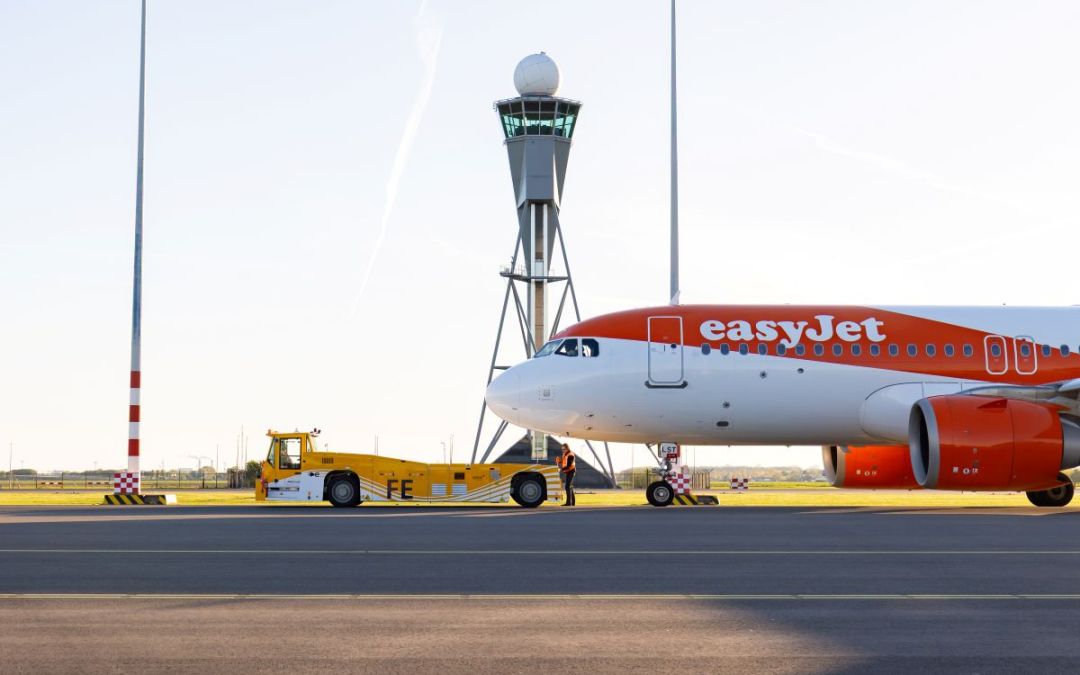
easyJet and Amstedam Schiphol have rolled out an automated TaxiBot system for quieter and more sustainable ground operations.
TaxiBot is a semi-robotic tractor that moves aircraft between gates and the runway. During the process, the aircraft only operates with its Auxiliary Power Unit (APU) rather than the engine, significantly reducing fuel consumption, noise levels, and overall carbon emissions.
Following a successful trial, four easyJet aircraft are being equipped for TaxiBot compatabiity. The airline say the system will save an average of 95 kilograms of fuel and 299 kilograms of CO2 per flight.
David Morgan, Chief Operating Officer at easyJet:
As we continue to modernise our operations, initiatives like this demonstrate how innovation and collaboration across the industry can help reduce aviation’s environmental impact both in the air and on the ground.
TaxiBot is part of the carrier’s programme to reach net-zero carbon emissions by 2050. Amsterdam Schiphol, meanwhile, wants to reach sustainable taxiing operations by 2035. The airport say that widespread deployment of TaxiBot could reduce fuel consumption during taxiing by as much as 65%.
Esmé Valk, Chief People and Transformation Officer at Amsterdam Airport Schiphol, added:
This is how we’re creating a healthier and cleaner workplace, and an ever more sustainable and modern airport that is ready for the future.
Join us at Aerospace Tech Week 2026 to discuss sustainable aviation.
by Elsie Clark | May 5, 2026 | AI & ML, Avionics, Connectivity, Flight Ops IT, Innovation, MRO IT, Sustainability
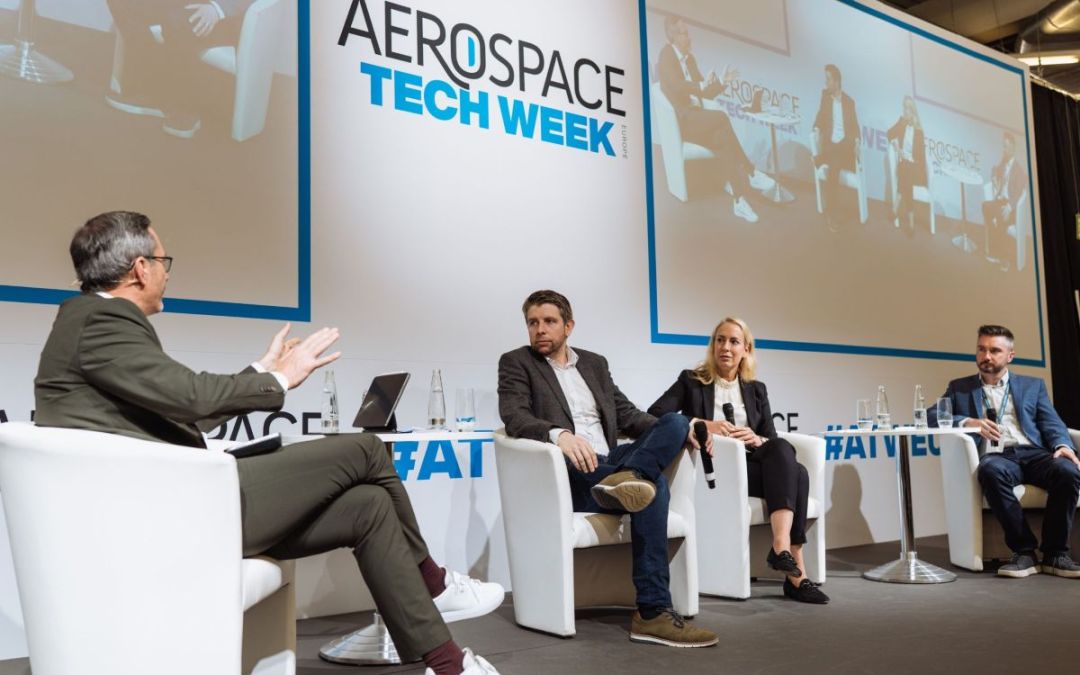
Aerospace Tech Week (ATW) have unveiled the agenda for the next edition of the event, taking place in November. This year the conference will be held in London for the first time, bringing together innovators across the industry while highlighting the UK’s dynamic aviation and aerospace value chain. The agenda covers the technologies disrupting the industry right now, from AI and avionics to digital MRO and sustainable aviation fuel.
Big players attending the event include executives from Airbus, Boeing, easyJet, Lufthansa, Thales, Safran, Leonardo, and many more. And through partnerships with ADS, the Aerospace Technology Institute, EUROCAE, and the European Aerospace Cluster Partnership, we’re making ATW 2026 the most impactful edition of the event yet.
Sessions you won’t want to miss:
Keynote panel: Aerospace 2030: Navigating the roadmap towards a resilient, intelligent, and sustainable aerospace. Featuring:
- Nick Earl VP UK, Safran
- Greg Ombach, Senior VP and Head of Disruptive Research, Technology, and Innovation, Airbus
- Ajay Chakravarthy, Chief AI Officer, Thales
- Giancarlo Buono,Group Director Safety and Airspace Regulation, Board Member, UK, Civil Aviation Authority
Workshop: Next steps for hydrogen propulsion
- Led by Helen Leadbetter, Technical Strategy Lead – Zero Emissions Flight, Civil Aviation Authority
Panel: Mastering data quality for the next steps in predictive maintenance. Featuring:
- Craig Lynch, Predictive Maintenance Specialist, easyJet
- Honor Powrie, Senior Director, Data & Analytics, ge
- Yannick Nkengsa, Manager, Aircraft Software & Data, Air Canada
Keynote panel: Towards sustainable skies: Strategies and innovations to green the future of aerospace. Featuring:
- Jonathon Counsell, Group Director of Sustainability, IAG
- Julien Manhes, Head of SAF & CDR, Airbus
- Stéphane Albert, Associate Director, Strategic Sustainability, Pratt and Whitney
- Steven Gillard, Regional Director, Europe & METACA Sustainability + Chair of UK Jet Zero Task Force, Boeing
Presentation: From requirements to practice: The WG-72 toolbox for Part-IS cybersecurity compliance.
- Anna Guégan, Senior Technical Programme Manager, EUROCAE
Keynote panel: Connected sovereign skies: Engineering a resilient UK & European airspace. Featuring:
- Sven Graeble, EVP, Head of Strategic Space Initiatives, Airbus Defence and Space GmbH
- Gareth Hetheridge, CIO & Director of Digital, Leonardo
Talent summit, in conversation with Women In Aerospace: Practical advice for forging a career in Aerospace. Featuring:
- Mamatha Maheshwarappa, Head of R&D, UK Space Agency
- Chiara Palla, Coordinator & Program Manager, Women in Aerospace UK Chapter
Excited yet? Check out the full agenda here.
And don’t forget to register your attendance to join us in London in November.
For more like this, see:
by Elsie Clark | Apr 27, 2026 | Innovation, Sustainability
Now operational in Kent, UK, Clean Planet Technologies has opened a facility that can convert used plastics into sustainable aviation fuel (SAF). The first plant of its kind in the world, the process takes waste that cannot be recycled and turns it into fuel, producing 75% less carbon than regular jet fuel.
Clean Planet Group say that around 80% of the 5 million tonnes of plastic the UK produces each year go to waste. Its Sustainability Aviation Centre is supported by the Department of Transport’s UK SAF Clearing House, with fuel output to be certified by the American Society for Testing and Materials (ASTM).
CEO Bertie Stephens commented:
This pilot opens up new ways to make sustainable aviation fuel, just as existing feedstocks such as energy crops are becoming harder to secure. It also positions the UK as a leader in turning waste plastics into SAF, supports UK and European SAF targets and is helping clear the path to commercial‑scale plants later this decade, and remove plastic waste from the environment.
The process begins by shredding the plastic waste into equal pieces, which pass through pyrolysis units to melt them into a synthetic crude oil. This product is then purified, distilled, and hydroprocessed to remove impurities and meet SAF specifications.
The UK government has currently set a SAF mandate of 10% for the aviation industry, which will rise to 22% in 2040. Dr. Katerina Garyfalou, Chief Operating Officer at Clean Planet Technologies, added:
The Sustainability Innovation Centre is set up to demonstrate our patented waste-plastics-to-SAF process at pilot scale, supporting fuel testing, validation and progression. The important thing is that our pilot facility will support the growth of others, helping the UK to meet its SAF mandate.
Join us at Aerospace Tech Week 2026 to discuss sustainable aviation.
by Elsie Clark | Apr 9, 2026 | Innovation, Sustainability
Oak Ridge National Laboratory (ORNL) have developed a new process that could significantly cut the cost of sustainable aviation fuel (SAF) production.
The US-based research team have found a method of turning ethanol into jet fuel components in a single step, radically simplifying a process that usually requires multiple stages. Off the back of this discovery, Biofuel company Gevo are licensing the technology from ORNL to test the process on a larger scale.
Andrew Sutton, senior scientist in the Manufacturing Science Division at ORNL, said:
This partnership will streamline the transition of ORNL’s catalyst technologies from lab scale to pilot-scale reactors. By demonstrating industrial viability, our goal is to accelerate the commercialisation of this technology in the US, boosting global competitiveness and domestic production of aviation fuel.
SAF is derived from plant- or waste-based feedstocks. From these materials, ethanol is then converted to olefins, which are in turn transformed into fuel. By developing a one-step method for turning ethanol into olefins, ORNL could significantly accelerate the efficiency of SAF production while also reducing costs.
Many aviation industry calculations for net zero rest on the assumption that SAF will scale to meet commercial demand. As air travel only increases in popularity, finding innovative ways to boost production fast are critical to mitigating climate change. Industry body IATA has warned that aviation needs to build momentum on SAF or airlines risk falling well short of their sustainability targets.
Join us at Aerospace Tech Week 2026 to discuss sustainable aviation.
For more like this, see:
by Elsie Clark | Mar 18, 2026 | Sustainability
The UK’s ‘Jet Zero’ taskforce have published their first annual report after the government introduced sustainable aviation fuel (SAF) targets at the beginning of 2025.
The mandate sets guidelines for achieving 10% SAF blending by 2030. Supported by a Revenue Certainty Mechanism and a £63 million Advanced Fuels Fund, aviation minister Keir Mather said at the Sustainable Skies World Summit that the progress made so far was ‘encouraging’. He added:
We must be clear eyed that there is still a long way to go on this journey and there are real challenges ahead but there are enormous opportunities too.
The green transition is not only about protecting our planet but also about strengthening our economy and our resilience. In an uncertain world, energy security has never been more important and that is why we must keep building momentum, boosting the production and deployment of SAF, backing technological renovation, improving efficiency and building robust carbon markets.
Alongside scaling SAF, the UK government is expanding the Hydrogen Challenge programme and launching a £240 million fund for next-generation aerospace technologies. Sustainable Aviation also announced a £2 million greenhouse gas removals (GGR) initative alongside the report, with estimates suggesting that the UK’s aviation industry will need 20 to 30 million tonnes of carbon removed each year by 2050.
Duncan McCourt, Chief Executive of Sustainable Aviation, said:
The UK aviation industry is working hard to address its climate impact. Scaling Greenhouse Gas Removals is essential for hard-to-abate sectors, and this Advanced Market Signal is the aviation industry acting now to help stimulate the growth of the GGR sector.
We have also made clear today that the aviation industry supports action to address the non-CO₂ impact of aviation. By accelerating research, trials and collaboration, we can deliver practical solutions that reduce aviation’s full climate impact.
Join us at Aerospace Tech Week 2026 to discuss sustainable aviation.
by Elsie Clark | Mar 9, 2026 | Innovation, Sustainability
Equilibrion and Rolls Royce have signed a memorandum of understanding (MoU) to develop British sustainable aviation fuel (SAF) production through nuclear power.
The Rolls Royce small modular reactor (SMR) can support the deployment of cost-effective, sustainable energy. Equilibrion’s proprietary Eq.flight SAF production system, meanwhile, is designed to minimise energy use during the SAF production process. Each Rolls Royce SMR has the potential to produce 160 million litres of SAF a year, representing a significant contribution to the UK’s SAF target, set at 22% of aviation fuel by 2040.
Caroline Longman, Director at Equilibrion, said:
Aviation will only meet its climate commitments if SAF becomes available in large, dependable volumes. Nuclear‑derived fuel production offers the reliability, scalability and low carbon intensity needed to deliver that future. Delivering nuclear‑enabled SAF also creates long‑term, high‑quality employment—each Eq.flight facility has the potential to generate around 10,000 skilled local jobs over its lifetime.
IATA has previously warned that SAF production systems are lagging far behind what is necessary to meet net-zero targets, with supply meeting only 1% of global demand. Nuclear-powered production would not only accelerate the supply chain but lower the carbon footprint of the entire SAF process. Alan Woods, Director of Strategy and Business Development for Rolls-Royce SMR, addded:
Our SMR technology is designed to provide clean, affordable and dependable low‑carbon energy, exactly the qualities required to unlock large‑scale Sustainable Aviation Fuel production. The technical and economic assessment completed with Equilibrion will enable them to demonstrate how nuclear can power one of the most ambitious decarbonisation challenges in aviation.
Join us at Aerospace Tech Week 2026 to discuss sustainable aviation.




You must be logged in to post a comment.