
by Elsie Clark | May 5, 2026 | AI & ML, Avionics, Connectivity, Flight Ops IT, Innovation, MRO IT, Sustainability
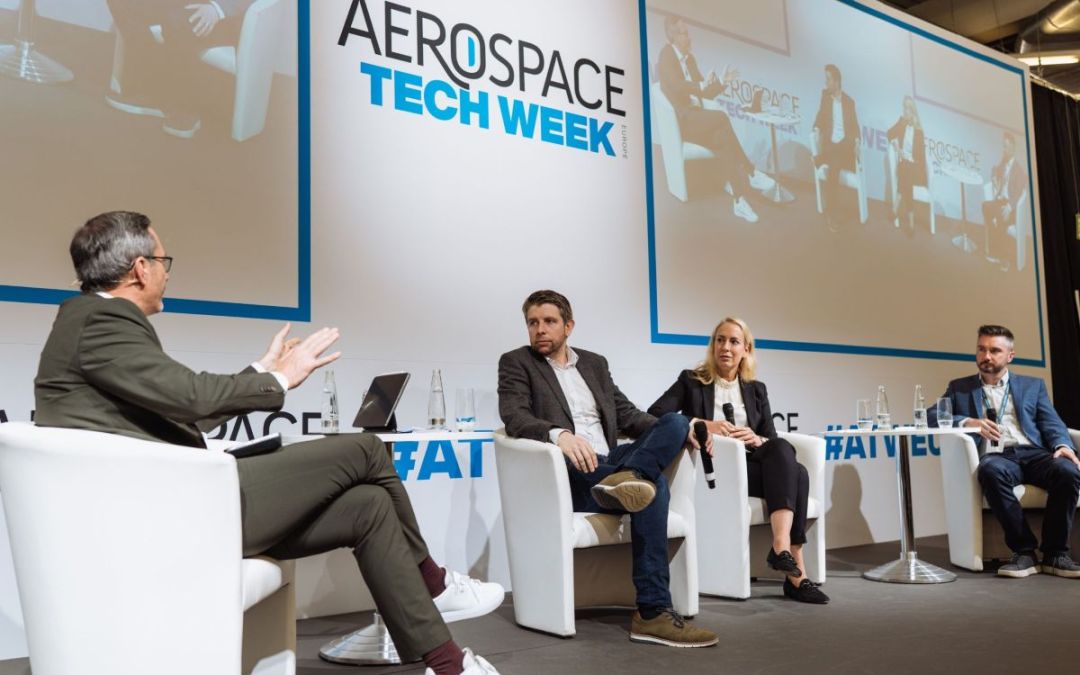
Aerospace Tech Week (ATW) have unveiled the agenda for the next edition of the event, taking place in November. This year the conference will be held in London for the first time, bringing together innovators across the industry while highlighting the UK’s dynamic aviation and aerospace value chain. The agenda covers the technologies disrupting the industry right now, from AI and avionics to digital MRO and sustainable aviation fuel.
Big players attending the event include executives from Airbus, Boeing, easyJet, Lufthansa, Thales, Safran, Leonardo, and many more. And through partnerships with ADS, the Aerospace Technology Institute, EUROCAE, and the European Aerospace Cluster Partnership, we’re making ATW 2026 the most impactful edition of the event yet.
Sessions you won’t want to miss:
Keynote panel: Aerospace 2030: Navigating the roadmap towards a resilient, intelligent, and sustainable aerospace. Featuring:
- Nick Earl VP UK, Safran
- Greg Ombach, Senior VP and Head of Disruptive Research, Technology, and Innovation, Airbus
- Ajay Chakravarthy, Chief AI Officer, Thales
- Giancarlo Buono,Group Director Safety and Airspace Regulation, Board Member, UK, Civil Aviation Authority
Workshop: Next steps for hydrogen propulsion
- Led by Helen Leadbetter, Technical Strategy Lead – Zero Emissions Flight, Civil Aviation Authority
Panel: Mastering data quality for the next steps in predictive maintenance. Featuring:
- Craig Lynch, Predictive Maintenance Specialist, easyJet
- Honor Powrie, Senior Director, Data & Analytics, ge
- Yannick Nkengsa, Manager, Aircraft Software & Data, Air Canada
Keynote panel: Towards sustainable skies: Strategies and innovations to green the future of aerospace. Featuring:
- Jonathon Counsell, Group Director of Sustainability, IAG
- Julien Manhes, Head of SAF & CDR, Airbus
- Stéphane Albert, Associate Director, Strategic Sustainability, Pratt and Whitney
- Steven Gillard, Regional Director, Europe & METACA Sustainability + Chair of UK Jet Zero Task Force, Boeing
Presentation: From requirements to practice: The WG-72 toolbox for Part-IS cybersecurity compliance.
- Anna Guégan, Senior Technical Programme Manager, EUROCAE
Keynote panel: Connected sovereign skies: Engineering a resilient UK & European airspace. Featuring:
- Sven Graeble, EVP, Head of Strategic Space Initiatives, Airbus Defence and Space GmbH
- Gareth Hetheridge, CIO & Director of Digital, Leonardo
Talent summit, in conversation with Women In Aerospace: Practical advice for forging a career in Aerospace. Featuring:
- Mamatha Maheshwarappa, Head of R&D, UK Space Agency
- Chiara Palla, Coordinator & Program Manager, Women in Aerospace UK Chapter
Excited yet? Check out the full agenda here.
And don’t forget to register your attendance to join us in London in November.
For more like this, see:
by Elsie Clark | Apr 30, 2026 | Connectivity
The New Zealand government is enacting a wide-ranging series of reforms to modernise its civil aviation infrastructure. 23 projects are preparing to take off, with the South Pacific country claiming 20 years of changes will be made in two years.
These include implementing new International Civil Aviation Organization (ICAO) guidelines and other rules to improve overall security and safety. Additionally, the government is making it easier to recognise overseas approvals of aircraft maintenance providers and parts. Removing red tape in this way will reduce costs and turnaround times for airlines in a complex supply chain environment.
Associate Transport Minister James Meager explained:
Supported by robust sector engagement and consultation, we’ve identified many long-standing issues which have presented barriers for aviation, and prioritised what needs to be resolved first.
The reforms are supported by the New Zealand Airports Association, who say the plans will reduce risk, improve connectivity, and cut costs for customers and businesses. CEO Billie Moore commented:
For airports, the programme will address longstanding issues around safety, security and quality infrastructure investment. Our number one priority – Runway End Safety Area requirements – has a consultation already underway. We are also pleased to see runway strip widths included in the programme, as well as important initiatives for sector partners – from a comprehensive review of pilot licensing, to the recognition of overseas approvals for aircraft maintenance providers and parts, which will deliver major cost reductions for airlines operating in New Zealand.
Join us at Aerospace Tech Week 2026 to discuss the future of civil aviation infrastructure.
For more like this, see:
by Elsie Clark | Apr 13, 2026 | Connectivity
Delta Air Lines CEO Ed Bastian has revealed the area of aviation where he believes AI will have the biggest impact: air traffic control.
Speaking on the Fortune 500: Titans and Disruptors of Industry podcast, Bastian said the journey from Atlanta to New York takes longer today due to inefficiencies in air traffic management. He added:
All that technology investment that we put in AI is not going to change that, unless it’s focused on, how do you unlock the sky.
US air traffic control systems have come under increasing strain in recent years. Bastian notes that the technology is in need of an update, while staffing shortages have been compounded by recent government shutdowns.
The Trump administration, under Transportation Secretary Sean Duffy, have announced a comprehensive overhaul into American ATC systems. The US$31.5 billion plan includes building six new ATC towers and implementing new radio and radar systems. The Federal Aviation Administration (FAA) has also confirmed that they are developing machine learning and LLMs to analyse incident reports and develop a comprehensive picture of risk patterns.
Bastian’s comments come in the wake of several high-profile air traffic incidents across the US. Most notably, in March shortage of ATC personnel at LaGuardia airport resulted in two deaths and multiple injuries after an Air Canada plane crashed with a ground services van while landing on the runway.
Join us at Aerospace Tech Week 2026 to discuss the future of ATC, flight ops, and AI.
For more like this, see:
by Elsie Clark | Mar 23, 2026 | Connectivity
An aircraft has crashed with a ground vehicle at New York’s LaGuardia airport, resulting in multiple casualties.
The incident occurred on the evening of 22 March as an Air Canada Express landed. A CRJ-900, the aircraft recorded speeds of 39kmph as it hit the firefighting vehicle, which was on the tarmac attending to a separate incident. Both pilots were killed and several people seriously injured. As a result, the Federal Aviation Administration (FAA) announced they would close until it was safe to resume operations. The airport serves as a regional hub and handles around 30 million passengers a year, causing significant disruption to aviation across the Americas.
Photographers captured severe damage to the nose of the CRJ-900 as a result of the incident. Recent years have seen a notable uplift in ground and airborne collisions across the US, which have largely been blamed on a shortage of air traffic personnel. In October 2025, LaGuardia was the scene of another incident where two regional Delta jets collided at a taxiway intersection. Clipped wings and scrapes between aircraft have also taken place at Chicago O’Hare and San Francisco airports in the past year.
The ATC shortage has been exacerbated by the current government shutdown, which means many air traffic controllers are working without pay. Reports suggest that the controller managing the Air Canada flight was simultaneously responsible for overseeing a fire risk on a United aircraft due to a lack of staff.
Join us at Aerospace Tech Week 2026 to discuss the future of ATC, flight ops, and safety.
For more like this, see:
by Elsie Clark | Mar 20, 2026 | Connectivity
Ongoing airspace closures in the Middle East has placed strain on air traffic controllers, with staff in some regions now managing twice the number of aircraft than usual.
Due to ongoing US-Israel attacks, Iranian airspace remains completely closed. While very restricted schedule of flights are now operating out of the UAE and Qatar, the authorities in Bahrain and Kuwait are yet to open their skies. As strategic stopover points on flights between Europe and APAC, the closure of these strategic aviation hubs has changed the map of aviation operations.

High traffic corridors are emerging as aircraft avoid the conflict zone. Source: FlightRadar, accessed 20/03/2026
The major airlines in this region, including Emirates, Etihad, and Qatar Airways, usually operate 1,500 flights a day, spanning 389,000 seats. Traffic that would pass through the Gulf is now being forced to reroute, placing a strain on aircraft management but also air traffic control. ATC staff in Egypt and the Caucuses are now managing significantly more flights than they would do usually as flights are remapped to avoid the conflict zone.
Individual controllers usually manage around six flights at a time. But in the current emergency environment, they may handle twice that number. Former controller Brian Roche told the BBC:
The controllers at the moment are working unbelievable shifts, [dealing with] unbelievable amounts of traffic.
While ATC protocols are ready to handle sudden upsurges in traffic, it’s uncertain how long the current pressures will continue, with the conflict showing no signs of abating. Controllers might be highly trained to manage stressful scenarios, but the toll of intense concentration should not be underestimated. Aviation authorities need to be sure that staff are well-supported during this stressful period to ensure operations continue to run smoothly in spite of the disruption.
Join us at Aerospace Tech Week to discuss the intersection of ATC and technology.
For more like this, see:
by Elsie Clark | Mar 5, 2026 | Connectivity, Innovation
The UK government has issued £30 million in funding as it expands its low-earth orbit (LEO) satellite programme.
Run by the UK Space Agency, the investment supports British businesses developing innovative satellite components and technologies. LEO satellites are becoming increasingly critical infrastructure because they offer more complete global connectivity than ever before, including in rural or mountainous areas. The biggest company in the sector, Starlink, have already become one of aviation’s critical partners, supplying high-speed inflight WiFi to a growing list of airline customers.
LEO satellite use goes well beyond streaming films at 30,000 feet and can support a range of aerospace applications, including avionics, flight operations, and air traffic control. Enhanced weather forecasting, navigation, and positioning have pushed the LEO satellite market to a £40 billion global market value that is growing by 10% year-on-year (YOY).
Space Minister Liz Lloyd said the £30 million investment would position the UK at the heart of this growing supply chain. A first funding round worth £18 million has already supported eight British companies and 26 highly skilled jobs. Lloyd commented:
Space is now the cornerstone of our modern economy. Satellite constellations have revolutionised how we operate, digitalising industries, optimising logistics and connecting all corners of the globe.
This new funding will support the development of smarter satellites with better hardware, the use of AI to make data delivery faster and improved connections between spacecraft.
This is part of the government’s commitment to keeping UK companies at the forefront of satellite communications, delivering economic growth and strengthening our defence and national security.
UK Space Agency CEO Dr Paul Bate added:
UK companies are developing world-class satellite communications technologies, from advanced antennas to optical links that can transmit data between satellites at the speed of light.
Our first C-LEO funding round is delivering real results, and this second call will help even more businesses take their innovations from prototype to product, ready to be integrated into the constellations of tomorrow
Join us at Aerospace Tech Week 2026, where we’ll be hosting key partners from the UK aerospace industry
For more like this, see:





You must be logged in to post a comment.