
by Elsie Clark | Oct 23, 2025 | Connectivity, Innovation
Airbus, Leonardo, and Thales have agreed to a much-anticipated business deal that will see them pool their space businesses together.
Such a project has been under discussion for months now, as the European defence giants seek to establish a rival to SpaceX, Elon Musk’s US-based satellite and space exploration businesses.
Now, the three companies have signed a memorandum of understanding to build a new entity that combines their space businesses. It is hoped that the deal will improve operational agility and consolidate Europe’s position in the aerospace industry by establishing an autonomous alternative to SpaceX’s Starlink, the low-earth orbit (LEO) satellite connectivity project.
In a joint statement, Guillaume Faury, CEO Airbus, Roberto Cingolani, CEO Leonardo, and Patrice Caine, CEO Thales, said:
This proposed new company marks a pivotal milestone for Europe’s space industry. It embodies our shared vision to build a stronger and more competitive European presence in an increasingly dynamic global space market.
By pooling our talent, resources, expertise and R&D capabilities, we aim to generate growth, accelerate innovation and deliver greater value to our customers and stakeholders. This partnership aligns with the ambitions of European governments to strengthen their industrial and technological assets, ensuring Europe’s autonomy across the strategic space domain and its many applications
The new entity will have an annual turnover of €6.5 billion and employ 25,000 people. Regulators are expected to approve the deal, meaning the new business could be operational by 2027. Ownership will be shared between the three companies, with Airbus, Leonardo, and Thales holding 35%, 32.5%, and 32.5% respectively
Each company will contribute to the new entity as follows:
- Airbus: Space Systems and Space Digital businesses
- Leonardo: Space Division, including shares in Telespazio and Thales Alenia Space.
- Thales: Shares in Thales Alenia Space, Telespazio, and Thales SESO.
Full governance structures will be established in due course. The announcement will strengthen and centralise the European aerospace industry, while also offering new opportunities for innovation.
Join us at Aerospace Tech Week 2026 to discuss the future of connectivity and satellites.
For more like this, see:
by Elsie Clark | Oct 22, 2025 | Flight Ops IT, Innovation, Sustainability
According to the latest patent data, innovation in AI for sustainable aviation and aerospace tech has increased by 20% over the past five years.
The Inside Green Innovation: Progress Report from Appleyard Lees found that global patent filings in the sector went up from 254 in 2019 to 307 in 2023. Increasing control of variables such as aircraft altitude, speed, and pressure, as well as advances in onboard systems and digital data processing, are attributed to the growth.
Adam Tindall, UK and European Patent Attorney for Appleyard Lees, said:
Innovations in areas such as aircraft design, propulsion, operational efficiencies and reductions in waste and energy infrastructure – traditionally aimed at achieving business advantage – are now expected also to reduce carbon emissions and meet environmental targets.
As part of this, AI-driven innovation is showing a tangible surge in aviation and aerospace and redefining how organisations are addressing the industries’ challenges.
The report found that Boeing remains the leader in sustainable aerospace development, filing the most patents over the past ten years. Other leaders include Honeywell, GE Aerospace, Airbus, Thales, and the Chinese company SZ DJI Technology. French company Safran was also highlighted as a key developer in fuel efficiency and hybrid propulsion.
The use cases for AI in sustainable aviation development are only increasing. From flight ops to SAF production, the potential for optimisation is extensive. However, the aviation industry must remember that strong data foundations are required for AI insights to be useful and actionable. And while the patent activity is promising, as net-zero emissions targets loom nearer, successful implementation will be just as important as innovation.
Join us at Aerospace Tech Week 2026 to discuss the future of AI, flight optimisation, and sustainability.
For more like this, see:
by Elsie Clark | Oct 16, 2025 | Innovation, Sustainability
Wagner Sustainable Fuels has launched its new operations facility in Toowoomba, Australia.
Developed in partnership with Boeing and FlyORO, the dedicated terminal will blend sustainable aviation fuel (SAF). As Australia’s first Roundtable of Sustainable Biomaterials (RSB)-certified company, Wagner Sustainable Fuels customers are guaranteed chain of custody and SAF authenticity.
Matt Doyle, CEO of Wagner Sustainable Fuels, commented:
This is a defining moment for sustainable aviation in Australia and underscores Wagner Sustainable Fuels’ commitment to provide solutions today for the challenges of tomorrow.
The launch of our Toowoomba Terminal is the start of our plans to deliver decarbonisation benefits and meet the aviation sector’s growing demand through flexible, efficient and scalable SAF blending. With the support from Boeing, we’re focused on bringing large scale SAF and renewable diesel production to Australia and integrating it into the global supply chain through the Brisbane Recycling and SAF Facility, which is currently under planning and development.
SAF blending is a critical to aviation’s sustainable development journey. During the process, ‘pure’ SAF is mixed with standard fossil jet fuel to create a fuel that is compatible with existing infrastructure.
Dr. Kimberly Camrass, Boeing’s Head of Asia Pacific Sustainability, added:
Current global regulations permit commercial aircraft to use up to a 50/50 blend of SAF and fossil jet fuel. This will continue to rise as additional production pathways are certified,
Wagner’s commercial blending terminal is a powerful step forward in aviation decarbonisation, boosting regional employment and opening new export markets. It will also provide important learnings to support the development of robust and scalable SAF supply chains within Australia.
According to the Boeing CSIRO SAF Roadmap, demand for jet fuel in Australia is set to grow by 75% by 2050. The Wagner facility’s partnership with FlyORO will help consolidate SAF’s position as a viable alternative fuel and create more opportunities for sustainable development across APAC.
Jonathan Yeo, FlyORO’s CEO, said:
FlyORO’s modular SAF blending system, AlphaLite, doesn’t just help reduce emissions – it creates a scalable platform for collaboration, co-investment, and transparency across the fuel value chain.
his integrated model complements FlyORO’s broader deployment strategy, including standalone facilities such as the one operating in Singapore. This is how we unlock speed and scale. We’re excited to partner with the leadership of Wagner Sustainable Fuels and Boeing to pioneer a more sustainable flying ecosystem in Australia.
Join us at Aerospace Tech Week 2026 to discuss the scalability of sustainable aviation fuel (SAF).
For more like this, see:
by Elsie Clark | Oct 15, 2025 | Innovation, Video
A report from CAE predicts that the civil aviation industry will need 1.465 million additional professionals by 2034 to meet passenger demand. Training and upskilling is therefore of the highest priority if airlines and airports want to increase their capacity safely.
Lufthansa Aviation Training, part of the Lufthansa Group, has been training aviation professionals for more than 60 years. Boasting 50 full flight simulators across six dedicated centres, the company remains at the heart of training Europe’s pilots and cabin crews.
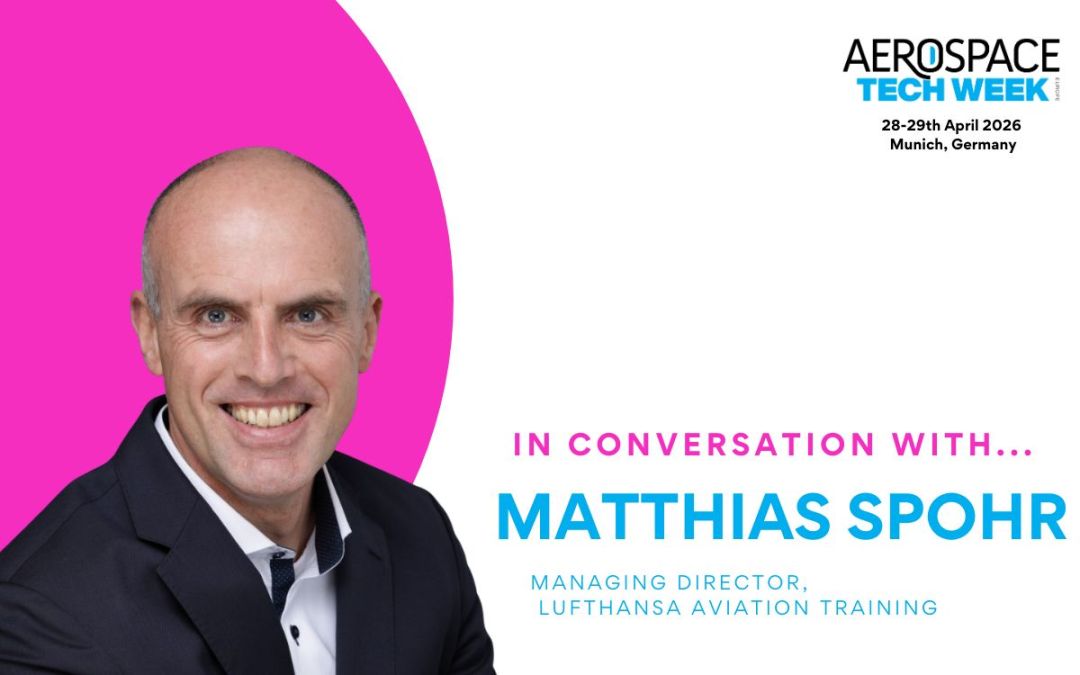
In an exclusive interview at Aerospace Tech Week 2025, we spoke to Managing Director Matthias Spohr about how Lufthansa Aviation Training is adapting for the future, including investments in digital twins.
Responsible for managing over 250 customers, Spohr sees digitisation as a key tool in offering a personalised service to every airline. Despite a strict regulatory environment, Lufthansa Aviation Training has been at the forefront of cutting-edge training technology. Remaining so is key to their strategy moving forward.
The big training devices we have are not 100% personalised to every company or airline we work with. Digital solutions give us the change to have a fully digital twin of how the airline is training, and of course to make training more realistic.
Investments of these kinds, costing in the millions of euros, represent a significant risk. Nevertheless, Spohr believes they are necessary if training is to keep pace with modern expectations. In the future, he believes aviation training will be much more decentralised, perhaps even progressing to a model where studying from home is more common.
Of course we welcome every customer that visits us, but it would be a lot better if we can decentralise and be where the crews are. That will produce savings on the airline side, and on the customer side there will be lower travel costs, more individualised training, and hopefully we can serve more customers.
The use of technology to enhance training and meet students where they are will be essential for aviation to educate and upskill the volume of workers growth forecasts require.
🎥 Watch the full interview to hear Matthias Spohr’s full thoughts on the evolution of aviation training.
Questions asked include:
- How do you see technology shaping training in the industry?
- What can you tell us about how you’re leveraging VR and digital twins?
- How does investment today drive cost savings in the future?
- What’s next in innovation in training?
Join us at Aerospace Tech Week 2026.
For more like this, see:
by Elsie Clark | Oct 2, 2025 | Innovation
The OxCam Advanced Air Mobility (AAM) Corridor will test electric vertical take-off and landing (eVTOL) tech in the UK for the first time.
The project will last six months and aims to prove the viability of an air taxi service between Oxford and Cambridge. The cities, home to internationally-renowned universities, are significant economic and research hubs. However, travelling between them currently takes two-and-a-half hours by train.
An East-West rail link is currently in development, as UK Chancellor Rachel Reeves aims to strengthen ties between Oxford and Cambridge through initiatives she says will be worth £78bn to the UK economy by 2035.
If successful, an air taxi corridor serving the two cities would boost connectivity even further. Laura Peacock, head of innovation at Oxfordshire County Council said:
This is a chance to demonstrate how innovation can be harnessed not just for economic growth, but for real societal and positive environmental impact.
Announcement of the project came shortly after the UK Civil Aviation Authority (CAA) published its eVTOL development model. This framework is designed to make air taxi travel a reality in the country as early as 2029.
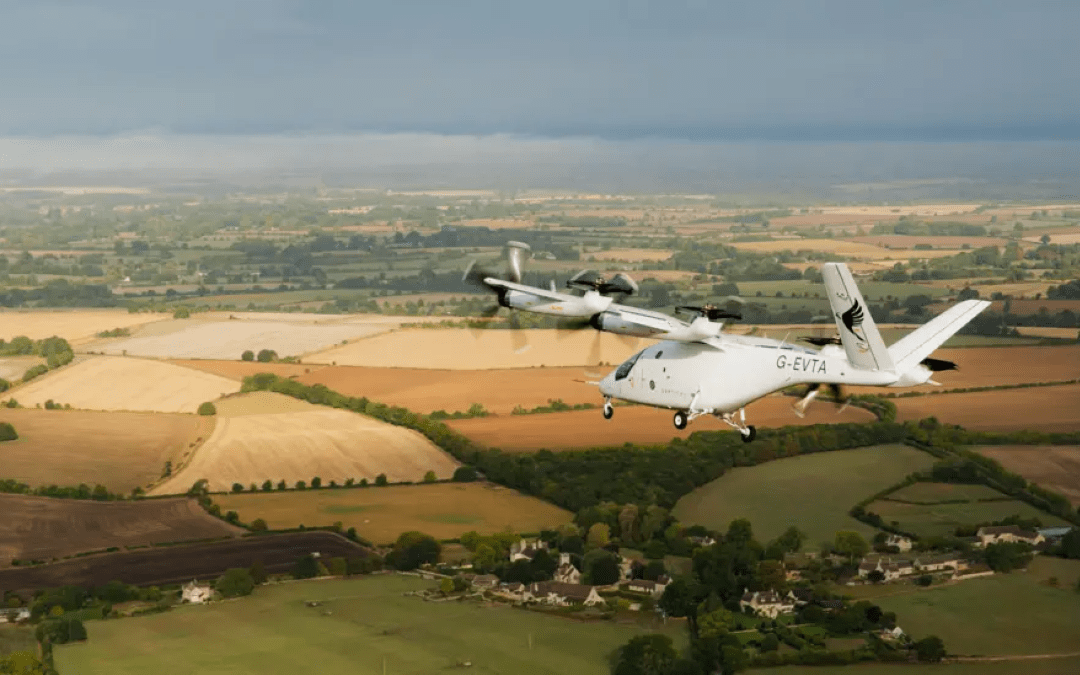
The OxCam AAM Corridor is a joint project between Skyports, Bristow Helicopters, NATS, Vertical Aerospace, and Oxfordshire County Council. A planned ‘A to A’ piloted eVTOL demonstration at Skyports’ Bicester Vertiport next year will see Vertical Aerospace’s VX4 prototype take to the skies. When it takes place, it will be the first piloted passenger flight of its kind in the UK.
Cities such as Dubai and San Francisco, who bill themselves as innovation hubs, have already freed up regulation to facilitate eVTOL testing. The Oxford-Cambridge project represents a significant step in the UK’s position in AAM, as it races to keep pace with international tech developments.
Join us at Aerospace Tech Week 2026 to discuss the future of Advanced Air Mobility.
For more like this, see:



You must be logged in to post a comment.