
by Jessica Brownlow | Oct 23, 2024 | Innovation, Sustainability
Originally published on MOVEMNT
New York City (NYC) has announced an agreement with Atlantic Aviation to prepare for electric vertical takeoff and landing (eVTOL) aircraft operations in the City.
Atlantic Aviation has extended its concession agreement with New York City’s Economic Development Corporation (NYCEDC) and the City of New York for operations at the East 34th Street Heliport for the next five years.
Atlantic plans to soon begin a project to upgrade utility infrastructure and install charging stations at the heliport to support the eVTOL operations.
The East 34th Street Heliport facility provides support for helicopter operations in and around NYC and serves as a key facility to handle flights for the adjacent NYU Langone Health Center.
Atlantic is actively working with partners BETA Technologies, Joby Aviation, Archer Aviation, and others to understand aircraft needs and adapt the site for eVTOL operations.
NYCEDC President & CEO Andrew Kimball stated the department’s ambition for the eVTOL operations to become a “true asset for New Yorkers.”
NYC is reportedly poised to be a key market for early eVTOL operations, and Atlantic’s project at the 34th Street Heliport will play a critical role in the region’s introduction of these innovative aircraft.
“Atlantic Aviation is firmly committed to continuing our position as the leader in innovation and sustainability within the business aviation industry,” said John Redcay, chief commercial and sustainability officer at Atlantic Aviation. “Maintaining our presence at the East 34th Street Heliport and expanding infrastructure there to support eVTOL operations aligns with our commitment to community-beneficial transportation solutions and will support New York City on its journey to facilitating quiet and sustainable aviation operations.
At Aerospace Tech Week Americas, Archer’s VP of Operations will be speaking on the making of an eVTOL. For insights into Archer’s manufacturing journey book your ticket for free now!
For more like this also see:
by Jessica Brownlow | Oct 2, 2024 | Sustainability
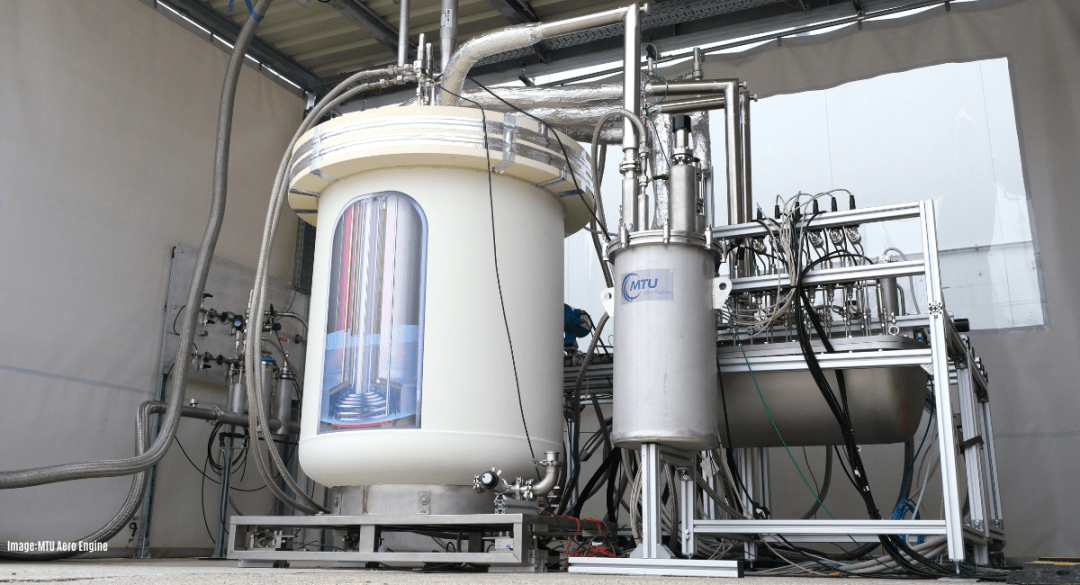
In partnership with MT Aerospace AG, MTU Aero Engines is developing a “complete liquid-hydrogen fuel system for commercial aviation that consists of tanks, sensors, heat exchangers, valves, safety systems, and controls.” This collaboration is pushing towards a more sustainable future for aviation by leveraging the power of hydrogen.
MTU Aero Engines recently completed multi-week testing of a liquid hydrogen fuel system for its Flying Fuel Cell™ (FFC) marking a key step towards making hydrogen-fuelled, zero-emission flights a reality. The recent test was conducted with liquid hydrogen and confirms the system is effective and reliable. Previous tests had only been run with liquid nitrogen.
The press released explained in brief how this work.
“Hydrogen is transported and stored in liquid form at a temperature of about -250°C. The refrigerated LH2 needs to be heated during operation and changed to a gaseous state; then a defined mass flow is fed into the fuel cell.”
Reporting the successful results, Barnaby Law, FFC Chief Engineer at MTU said:
“This concept, including all of the sensors and functions needed in the aircraft, is what we have now validated.”
Looking ahead to the next steps, Dr. Claus Riegler, Senior Vice President Technology & Engineering Advanced Programs at MTU added:
“This is an excellent starting point; it will let us offer an appropriate, reliable, and high-performing LH2 fuel system solution for a wide range of aircraft models.”
Testing of a product-specific full-system FFC will start in 2026.
For more like this also see:
by Jessica Brownlow | Sep 18, 2024 | Innovation, Sustainability
Volar Air Mobility Holding Company Limited (Volar) and Etihad Aviation Training LLC (EAT) recently signed a Memorandum of Understanding (MoU) at the inaugural Advanced Air Mobility (AAM) Symposium of ICAO. The partnership focuses on advancing sustainable aviation through advanced electric aircraft operations.
Together, EAT, a leading Aviation Training centre at the cutting-edge of innovation, and Volar, a Hong Kong-based green air mobility technology company, are looking to “propel the adoption of Green Aviation alternatives in the UAE.”
The agreement seeks to establish a hub for research and development in sustainable aviation practices that can drive the industry forward. During the course of the partnership, both organisations will collaborate with the General Civil Aviation Authority (GCAA) to align with the latest regulatory standards.
Speaking on the announcement, Mr. Saif Aldarmaki, Founding Partner of Volar Air Mobility Industries, said:
“This agreement with Etihad Aviation Training represents a significant step forward in our mission to revolutionise air mobility. By working together, we will push the boundaries of what’s possible in electric aviation and pave the way for a greener, more efficient future.”
EAT shared details of the next steps for the collaboration on LinkedIn, describing training programmes, data analytics, and continued partnership with aviation authorities to support seamless operations for the electric aviation sector.
Earlier this year in May, EAT also partnered with Archer Aviation Partners working to support the electric vertical takeoff and landing (eVTOL) aircraft leader’s efforts to establish urban aircraft mobility operations across the UAE.
At Aerospace Tech Week Americas, the Chief Product Officer at Joby Aviation and the Senior Fellow – Electrical Power Systems, Collins Aerospace are speaking on pioneering electric aircraft and electrical distribution for hybrid electric propulsion systems. Book your ticket now to be a part of the conversation!
For more on sustainability see:
by Jessica Brownlow | Sep 7, 2024 | Innovation, Sustainability, Video
At Aerospace Tech Week, Stefan Rhein, Project Manager Aviation, bavAIRia eV joined for a brief discussion on the rapidly evolving Advanced Air Mobility (AAM) landscape. bavAIRia eV is an association of Bavarian players in civil and military aviation, aerospace and space applications, commissioned by the Bavarian State Ministry for Economic Affairs, Regional Development and Energy to manage the Aerospace Cluster. Its aim is to identify Bavaria’s core competencies in aviation, aerospace and space applications and to strengthen collaboration amongst experts to enhance global competitiveness.
By mapping out the landscape, Rhein and his team identified key areas of improvement necessary to unlock the sector’s full potential. In this conversation, Rhein provided a brief overview of the Bavarian AAM ecosystem, revealing it is both larger and stronger than initially anticipated.
Contextualising the Bavarian landscape within the increasingly competitive global market, Rhein emphasised the importance of “the first mover advantage” and shared a few predictions for 2024 as the industry shifts from concept to commercialisation.
Watch the full interview below for more insights.
Questions asked include:
- Can you start by sharing an overview of what you are currently working on?
- Why is 2024 set to be such a pivotal year for the development of Advanced Air Mobility?
- This is shaping into a competitive landscape; can you highlight some of the critical steps for becoming a leader in this field?
For more on AAM, join us at Aerospace Tech Week Americas to hear from Archer, Joby Aviation, Beta Technologies, and more. Book your ticket for free now!
For more from onsite at Aerospace Tech Week see:
by Jessica Brownlow | Aug 26, 2024 | Connectivity, Innovation, Sustainability
At Aerospace Tech Week, Nicole White, Vice President, Business Development – Connected Aviation Solutions, Collins Aerospace, joined to discuss the connectivity landscape, looking at emerging technologies, challenges, and reaching the “eutopia state” of travel.
The conversation emphasised the current fragmentation of the connectivity ecosystem, highlighting the urgent need to integrate solutions. Additionally, White characterised the digital side of the landscape as still in its infancy, with enormous untapped potential in the data being generated. Explaining the work that still needs to be done here, White said:
“I would say we have the tools, it’s more about how you are processing the data, what insights you’re getting from the data, and then ultimately what decisions it is driving. So when I think about what we’re doing at Collins, we’re really looking at it from three lenses: you’ve got a sustainability element, a passenger experience element, and then ultimately the performance element.”
The conversation also looked at the challenges obstructing the industry from leveraging existing technology to its full potential. Watch the full interview now to learn more about how integrating disparate data systems will enhance the connected ecosystem, and more.
Questions asked:
- How is the connectivity landscape evolving? What emerging technologies are we seeing really make a difference?
- What are the major challenges plaguing the industry when it comes to connectivity and how should we approach tackling these?
To learn more about connected aerospace, join us at Aerospace Tech Week Americas where experts will be discussing how connect aircraft will elevate the industry, smart aircraft, and practical use cases of AI in the connected aerospace environment. Book your ticket for free now!
For from onsite at Aerospace Tech Week see:
by Jessica Brownlow | Aug 14, 2024 | AI & ML, Flight Ops IT, Sustainability
Last year, Alaska Airlines saved 1.2 million gallons of fuel (11,958 metric tons of CO2 emissions) by leveraging AI to optimise its flight paths. After renewing their partnership with Air Space Intelligence (ASI), the airline has offered some insight into how it is using tech to push towards its goal of being the most fuel-efficient US airline by 2025. Founded in 2018, ASI is a software-first company that facilitates complex air operations, developing technology that provides critical decision-making support.
Through advanced algorithms and machine learning, the AI powering ASI’s Flyways AI Platform analyses weather patterns, winds, turbulence, airspace constraints, and air traffic volume to generate optimised route recommendations. These are based on safety, ATC compliancy, fuel consumption, and time considerations, supporting pilots to choosing the best course of action. By promoting efficiency, the technology has on average delivered five per cent fuel savings and emissions reductions for flights over four hours.
Alaska also uses the Flyways Dispatch application to enable dispatchers to actively manage flights and address issues before they can negatively impact operations. Captain Bret Peyton, Managing Director of Network Operations Control at Alaska explained how the real-time insights and decision-making support helps:
“Being a dispatcher requires attention to detail, problem-solving skills, and quick thinking. [This technology] help us optimise our routes, save fuel, and reduce carbon emissions, giving us more confidence and flexibility in our decisions and allows us to focus on delivering excellent service to our guests.”
In Alaska’s case, this partnership illustrates how successfully leveraging AI can drive significant efficiency gains with a plethora of benefits to the industry.
To learn more about the latest in optimising Flight Ops from United, Airbus, IBM, Flair Airlines and more, book your free ticket to Aerospace Tech Week Americas now!
For more like this see:




You must be logged in to post a comment.