
by Jessica Brownlow | Nov 18, 2024 | AI & ML, Avionics, BUZZ, Connectivity, Flight Ops IT, Innovation, MRO IT, Sustainability
At Aerospace Tech Week, we celebrate innovation and excellence across the industry.
These awards put a spotlight on the innovators, visionaries, and first-movers who are shaping the future of aerospace. If there’s a company, individual, or product you want to recognise for their outstanding contributions to the industry in 2024, nominate them below.
Winners of each category will receive a prize package including dedicated social media promotion across our platforms and featured spots on our blog and website. The winners will also get either exclusive blog coverage or an interview, providing a chance to share their story. Each winner will also take home a small trophy as a token of their achievement.
For the winner of the most disruptive start-up category, an additional perk is offered: a small booth at either our US or Europe event, giving them a platform to network amongst key industry stakeholders.
The categories are:
- Top innovator
- Best sustainability initiative
- Most disruptive start-up
- AI visionary
- Collaboration of the year
Be sure to attend the Aerospace Tech Awards Ceremony on Wednesday 2nd April 2025 at 17:10 at after the Aerospace Tech Week closing keynote panel. Get your free ticket
by Jessica Brownlow | Sep 23, 2024 | AI & ML, Flight Ops IT, Video
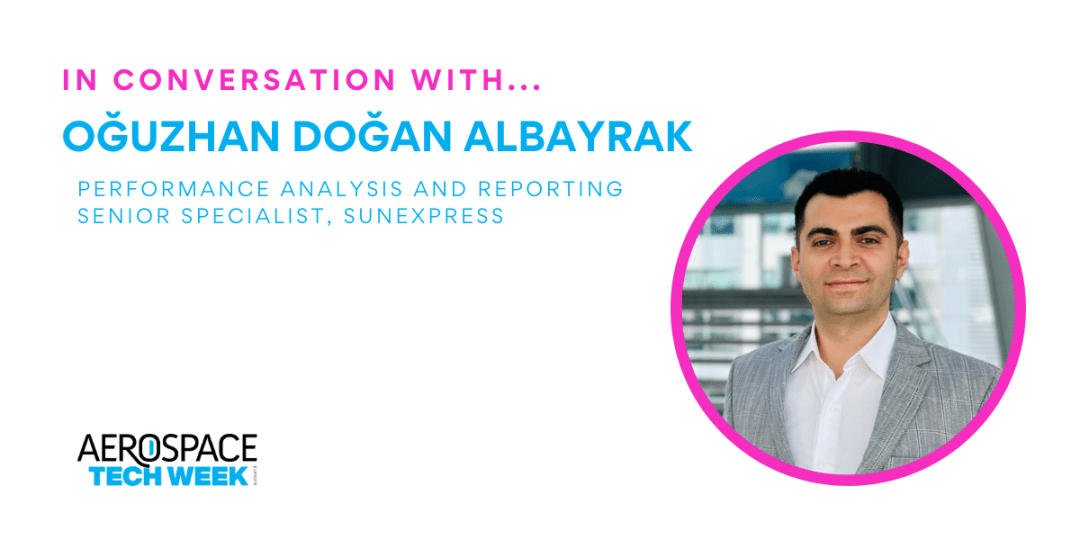
At Aerospace Tech Week, Oğuzhan Doğan Albayrak, Performance Analysis and Reporting Senior Specialist, SunExpress discussed how the airline is using smart solutions to support its growth.
Albayrak discussed SunExpress’ plans to expand from 65 to 166 aircraft over the next ten years, describing artificial intelligence (AI) and machine learning (ML) as essential tools for the scaling up of operations.
During the conversation, Albayrak also shared the tangible benefits of transitioning to an (Integrated Operations Control Centre (IOCC) noting that it improved on-time performance by 6 per cent in 2023. The Operations Control Centre (OCC) is the “mission control centre” of an airline, controlling and overseeing crucial activities. By moving to an IOCC, a more seamless flow of information can be achieved, enabling challenges to be addressed more efficiently and effectively.
Albayrak additionally noted that this model helped manage the airline’s operations during the 2023 earthquake in Turkey which involved over 200 rescue flights.
“As you may know, we had an earthquake in Turkey in 2023. 11 cities were impacted and we had more more than 200 rescue flights. Can you imagine the stress that we faced during that? But [because of our] IOCC, we could manage it in the proper way.”
For more insight including the key challenges with integrating AI and ML solutions, watch the full interview below. To learn more about SunExpress’ transition to IOCC watch this brief interview with its former Head of IOCC.
Questions asked include:
- Can you provide a few specific examples of how the transition to IOCC has transformed operations at SunExpress?
- What are some of the challenges you anticipate with integrating AI and ML solutions into your operations and how are you planning to address these?
- How does the transition to IOCC help to lay the foundations for future developments within your airline? What opportunities does it open up that would otherwise have been closed off?
For more from onsite at Aerospace Tech Week see:
by Jessica Brownlow | Sep 4, 2024 | Connectivity, Flight Ops IT
This week, iTEC Alliance members announced the start of build phase for the iTEC SkyNex Air Traffic Control system. The system builds on the SESAR and CEF funded development projects to support the creation of the Digital European Sky.
The global iTEC Alliance is comprised of eight leading air navigation service providers (DFS in Germany, ENAIRE in Spain, NATS in the United Kingdom, LVNL in the Netherlands, AVINOR in Norway, Oro Navigacija in Lithuania, PANSA in Poland, and NAV CANADA in Canada) collaborating to deliver improved operational performance with a common air traffic management system across the alliance’s control centres.
The next-gen air traffic management system will drive cost efficiency through a common concept of operations based on SEAR, enhanced interoperability, and an ATS system with interchangeable ATS Components supported by open standards. Just some of the benefits the alliance listed were: optimisation of routes and resources, fewer delays, reduction in CO2 emissions, more accurate data, and “significantly” lower costs.
Marcel Bakker, Director of iTEC, discussed this milestone stating:
“The start of the build phase for iTEC SkyNex is a pivotal moment in our journey towards a unified air traffic control system based on open standards. This collaboration underscores our commitment to innovation and efficiency in air traffic management.”
Ultimately, iTEC SkyNex will manage 12 million flights annually, benefitting from increased efficiency and interoperability.
For more like this see:
by Jessica Brownlow | Aug 21, 2024 | Avionics, Flight Ops IT
A recent article by Reuters has drawn attention to a surge in digital attacks known as GPS spoofing. These attacks have the potential to “send commercial airliners off course,” but typically can be resolved with the assistance of air traffic control (ATC). The article cited findings from OPSGROUP, showing a 400 per cent surge in these attacks in recent months with an estimated 900 flights a day encountering them on average. The increase in these incidents raises the associated risk levels.
However, these are not the only digital attacks the industry is currently facing. According to Bridewell’s latest research, 55 per cent of civil aviation cyber decision makers in the United States (US) have reported experiencing a ransomware attack in the past 12 months.
With the industry becoming increasingly reliant on digital technology and automated systems, the rise in digital attacks presents a significant challenge. Recognising this, 72 per cent of respondents in Bridewell’s survey plan to increase their IT security spend from last year, and 98 per cent are using at least one AI-drive tool to enhance their cybersecurity efforts.
The investment in cybersecurity measures must work in tandem with the industry’s digitalisation efforts to ensure safety and security across stakeholders. At Aerospace Tech Week Americas, industry experts from Airbus and IBM will discuss the evolving cybersecurity landscape, looking at threat monitoring and intelligence, as well cyber ranges, and leveraging data for improved maintenance cybersecurity.
Book your ticket for free to get involved in the conversation!
For more like this see:
by Jessica Brownlow | Aug 14, 2024 | AI & ML, Flight Ops IT, Sustainability
Last year, Alaska Airlines saved 1.2 million gallons of fuel (11,958 metric tons of CO2 emissions) by leveraging AI to optimise its flight paths. After renewing their partnership with Air Space Intelligence (ASI), the airline has offered some insight into how it is using tech to push towards its goal of being the most fuel-efficient US airline by 2025. Founded in 2018, ASI is a software-first company that facilitates complex air operations, developing technology that provides critical decision-making support.
Through advanced algorithms and machine learning, the AI powering ASI’s Flyways AI Platform analyses weather patterns, winds, turbulence, airspace constraints, and air traffic volume to generate optimised route recommendations. These are based on safety, ATC compliancy, fuel consumption, and time considerations, supporting pilots to choosing the best course of action. By promoting efficiency, the technology has on average delivered five per cent fuel savings and emissions reductions for flights over four hours.
Alaska also uses the Flyways Dispatch application to enable dispatchers to actively manage flights and address issues before they can negatively impact operations. Captain Bret Peyton, Managing Director of Network Operations Control at Alaska explained how the real-time insights and decision-making support helps:
“Being a dispatcher requires attention to detail, problem-solving skills, and quick thinking. [This technology] help us optimise our routes, save fuel, and reduce carbon emissions, giving us more confidence and flexibility in our decisions and allows us to focus on delivering excellent service to our guests.”
In Alaska’s case, this partnership illustrates how successfully leveraging AI can drive significant efficiency gains with a plethora of benefits to the industry.
To learn more about the latest in optimising Flight Ops from United, Airbus, IBM, Flair Airlines and more, book your free ticket to Aerospace Tech Week Americas now!
For more like this see:
by Jessica Brownlow | Aug 5, 2024 | Flight Ops IT, Sustainability, Video
At Aerospace Tech Week, Marouan Chida, Head of ATM Transformation, EUROCONTROL joined to discuss the changing air traffic management (ATM) landscape, looking at key challenges and opportunities. Summarising the responsibility of ATM, Chida explained:
“ATM is delivering a service, its about letting everybody fly at the best possible trajectory.”
Reflecting on the main drivers of change in the ever-evolving landscape, Chida noted a few developments that have forced ATM systems to look critically at itself and modernise. Firstly, it has been a bottleneck for growth. Secondly, its crucial role to play as the industry prioritises sustainability. Thirdly, the changing requirements of “new entrants” that have joined the game. To continue delivering an effective service, ATM systems will have to take advantage of all the latest tech so as not to downgrade the potential of new aircraft.
Thinking about what the ATM landscape will look like a decade from now, Chida discussed the Digital European Sky and SESAR’s role in innovating and accelerating its delivery. In particular, Chida highlighted the need for scalable systems to support aviation’s exponential growth and the importance of cooperation as new players like air taxis and drones join conventional aircraft.
For all this as well as Chida’s observations on the challenges involved with integrating emerging technologies into existing frameworks, watch the full interview now.
Questions asked include:
- How have we seen the air traffic management landscape develop in recent years and what do you think have been the main drivers of these changes?
- What role is technology playing in the landscape’s evolution?
- How do you tackle integrating emerging technologies into existing frameworks?
- What will the landscape look like in the next 10 years?
In November, Aerospace Tech Week Americas will gather in Atlanta to be inspired by 100 speakers, 60 vendors and over 30 start-ups over 2 incredible days. The conference covers everything Avionics, Connectivity, MRO IT, Flight Operation IT and Testing. Book your ticket for free now.
For more from onsite at Aerospace Tech Week see:





You must be logged in to post a comment.