
Key insights from our top LinkedIn polls





At Aerospace Tech Week, we celebrate innovation and excellence across the industry.
These awards put a spotlight on the innovators, visionaries, and first-movers who are shaping the future of aerospace. If there’s a company, individual, or product you want to recognise for their outstanding contributions to the industry in 2024, nominate them below.
Winners of each category will receive a prize package including dedicated social media promotion across our platforms and featured spots on our blog and website. The winners will also get either exclusive blog coverage or an interview, providing a chance to share their story. Each winner will also take home a small trophy as a token of their achievement.
For the winner of the most disruptive start-up category, an additional perk is offered: a small booth at either our US or Europe event, giving them a platform to network amongst key industry stakeholders.
The categories are:
Be sure to attend the Aerospace Tech Awards Ceremony on Wednesday 2nd April 2025 at 17:10 at after the Aerospace Tech Week closing keynote panel. Get your free ticket here.
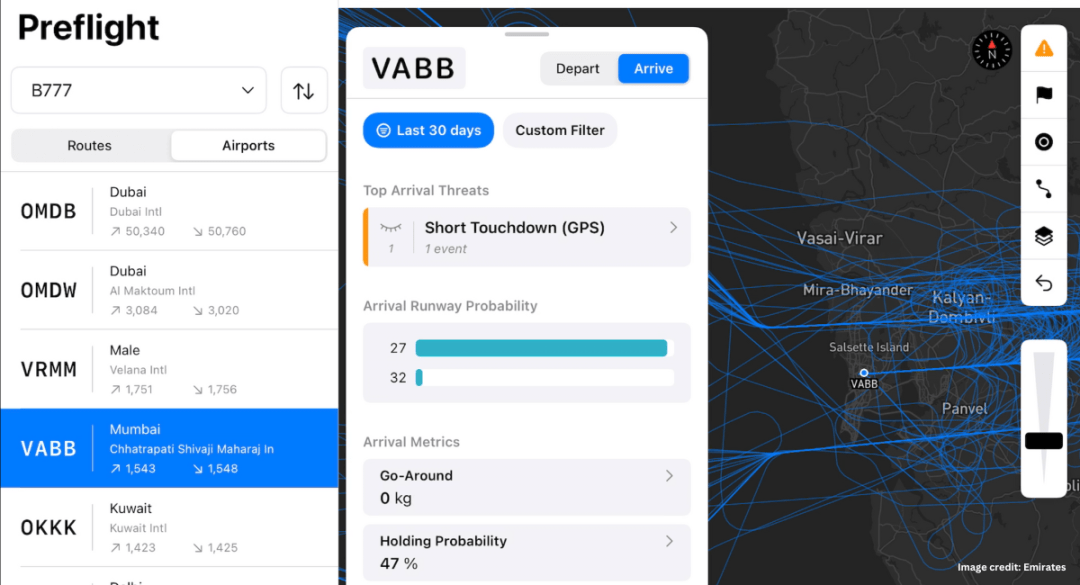
Emirates is giving pilots and flight operations teams the data they need to drive efficiency, enhance security, and reduce fuel burn. The airline recently reported “remarkable improvements” in operational and safety KPIs as a result of GE FlightPulse™.
FlightPulse enables pilots to unlock and consolidate disparate data so that they can make informed, accurate decisions around fuel and risk. Using the analytics application, pilots can access the critical operational data to drive efficiency across the board.
Although Emirates began its FlightPulse project in 2021, it has now been refined to specifically elevate fuel efficiency, safety metrics, operational data & analytics, and research accompanied with insights and statistics.
Captain Hassan Al Hammadi, Emirates’ Divisional Senior Vice President Flight Operations said:
“This tool has brought about a key shift in flight operations data monitoring, where both management and pilots have transparency and visibility of key operational data related to safety and efficiency. This shift resulted in better collaboration and understanding between management and the pilot community in managing safety and efficiency”.
Recently, Emirates released a short video highlighting the logistics of the app.
For more like this see:

A recent article by Reuters has drawn attention to a surge in digital attacks known as GPS spoofing. These attacks have the potential to “send commercial airliners off course,” but typically can be resolved with the assistance of air traffic control (ATC). The article cited findings from OPSGROUP, showing a 400 per cent surge in these attacks in recent months with an estimated 900 flights a day encountering them on average. The increase in these incidents raises the associated risk levels.
However, these are not the only digital attacks the industry is currently facing. According to Bridewell’s latest research, 55 per cent of civil aviation cyber decision makers in the United States (US) have reported experiencing a ransomware attack in the past 12 months.
With the industry becoming increasingly reliant on digital technology and automated systems, the rise in digital attacks presents a significant challenge. Recognising this, 72 per cent of respondents in Bridewell’s survey plan to increase their IT security spend from last year, and 98 per cent are using at least one AI-drive tool to enhance their cybersecurity efforts.
The investment in cybersecurity measures must work in tandem with the industry’s digitalisation efforts to ensure safety and security across stakeholders. At Aerospace Tech Week Americas, industry experts from Airbus and IBM will discuss the evolving cybersecurity landscape, looking at threat monitoring and intelligence, as well cyber ranges, and leveraging data for improved maintenance cybersecurity.
Book your ticket for free to get involved in the conversation!
For more like this see:

In an interview at Aerospace Tech Week, Joel Klooster,
With the number of aircraft in operation set to double between 2022 and 2042, the industry must take action to ensure the already congested airspace can support this scale up.
Klooster described Iris as “the first step in the future of ATM.” Iris is Viasat’s ground-breaking satellite-based data link technology that optimises airspace, easing congestion and reducing delays for airlines. During the interview, Klooster discussed the significance of Iris for efficiently managing flights and providing secure communications and connectivity.
As congestion on existing communication networks increases, the need for an enhanced connectivity solution is evident. Klooster explains that without it, the industry will not be able to support the projected increase in flight volumes.
Questions include:
For more from onsite at Aerospace Tech Week see:

This month, the UK successfully tested “ground-breaking” quantum technology aimed at creating an unjammable back-up for GPS navigation systems.
Although the technology’s “practical implementation” in commercial aviation is still estimated to be 10-20 years away in the UK, this test signals a key milestone for quantum enabled navigation systems.
The research has received nearly £8m in funding from the UK government who are pushing to be seen as a world leader on quantum, and is the “first test of this type of technology in the UK on an aircraft in flight.”
Accordingly to the government press release, the test is part of a project funded by UK Research and Innovation (UKRI) specifically focusing on creating quantum sensors to address the UK’s heavy reliance on GNSS/GPS for location, navigation, and timing data.
Science Minister Andrew Griffith said:
“From passenger flights to shipping, we all depend on navigation systems that are accurate, safe and secure. The scientific research we are supporting here on quantum technology could well provide the resilience to protect our interests.”
The flight tests involved Infleqtion, a quantum information company, and aerospace companies BAE Systems and QinetiQ. The two tests showed the technology offers “exceptional accuracy, and resilience, independent of traditional satellite navigation using GPS.”
Roger McKinlay, Challenge Director Quantum Technologies at Innovate UK, part of UK Research and Innovation (UKRI), said:
“Modern infrastructure is increasingly dependent on highly accurate timing and navigation derived from satellite signals. These flight tests mark the culmination of two excellent projects which Infleqtion has had the vision to create and the deftness in leadership to execute with an outstanding team of collaborators.”
For more like this see:
You must be logged in to post a comment.