
by Elsie Clark | May 19, 2026 | Innovation, MRO IT
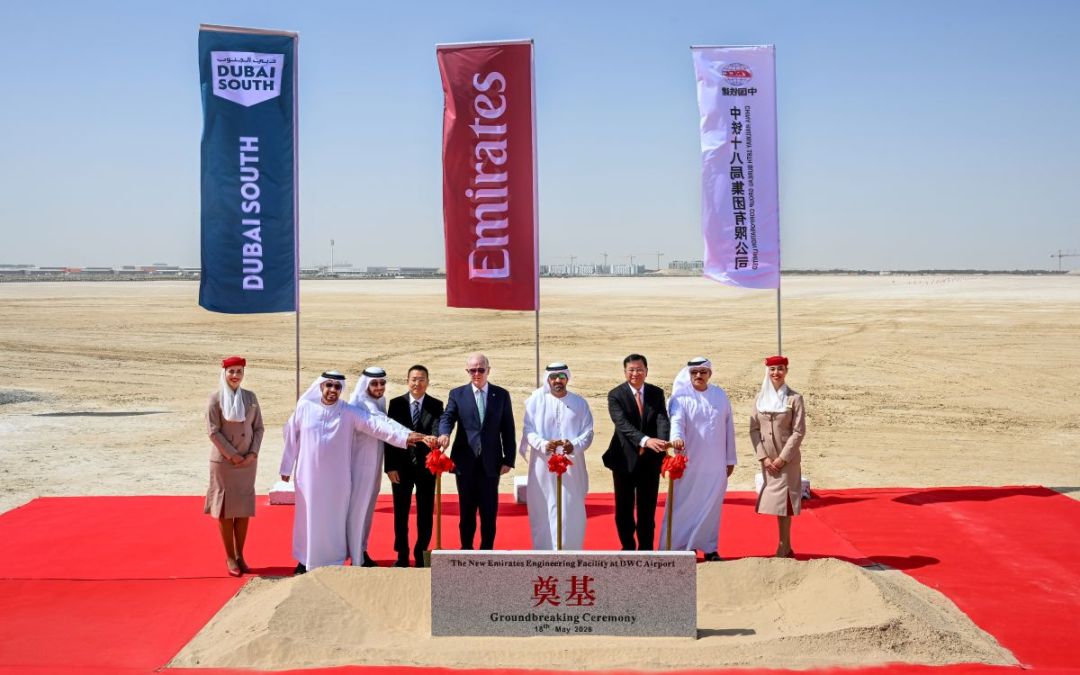
Emirates have begun construction on a high-tech US$5.1 billion MRO facility in Dubai South. Totalling 1.1 million square metres, once complete the building will be one of the world’s largest by volume, as well as the largest steel structure in the Gulf.
China Railway Construction Corporation are leading construction, alongside Artella as project consultants. The ambition is to create an advanced hangar that can simultaneously accommodate 28 wide-body aircraft and two painting hangars.
Ahmed bin Saeed Al Maktoum, Chairman and Chief Executive at Emirates Airline and Group, said:
The new facility strengthens Emirates Engineering’s vertical integration strategy by bringing more skills, infrastructure, parts production, and specialist capabilities under one roof, while positioning the airline to serve as a strategic engineering partner for the future requirements of the regional and global aviation industry.
Alongside the latest MRO tech, the facility will also incorporate sustainability with solar panels across the roof. Construction is scheduled to complete in 2030, with the hangars initially serving as overspill for Emirates Engineering work at Dubai International Airport (DXB).
As supply chain delays continue to impede the delivery of new aircraft, effective maintenance and overhaul have become key priorities for airlines who want to make the most of their existing assets. Emirates continues to target an ambitious growth strategy that will not be possible unless they keep their aircraft in top condition. As a carrier that prides itself on its superior customer service, this MRO investment will reduce turnaround times and delays, ultimately producing a better experience for passengers.
Join us at Aerospace Tech Week 2026.
by Elsie Clark | Mar 20, 2026 | Connectivity
Ongoing airspace closures in the Middle East has placed strain on air traffic controllers, with staff in some regions now managing twice the number of aircraft than usual.
Due to ongoing US-Israel attacks, Iranian airspace remains completely closed. While very restricted schedule of flights are now operating out of the UAE and Qatar, the authorities in Bahrain and Kuwait are yet to open their skies. As strategic stopover points on flights between Europe and APAC, the closure of these strategic aviation hubs has changed the map of aviation operations.

High traffic corridors are emerging as aircraft avoid the conflict zone. Source: FlightRadar, accessed 20/03/2026
The major airlines in this region, including Emirates, Etihad, and Qatar Airways, usually operate 1,500 flights a day, spanning 389,000 seats. Traffic that would pass through the Gulf is now being forced to reroute, placing a strain on aircraft management but also air traffic control. ATC staff in Egypt and the Caucuses are now managing significantly more flights than they would do usually as flights are remapped to avoid the conflict zone.
Individual controllers usually manage around six flights at a time. But in the current emergency environment, they may handle twice that number. Former controller Brian Roche told the BBC:
The controllers at the moment are working unbelievable shifts, [dealing with] unbelievable amounts of traffic.
While ATC protocols are ready to handle sudden upsurges in traffic, it’s uncertain how long the current pressures will continue, with the conflict showing no signs of abating. Controllers might be highly trained to manage stressful scenarios, but the toll of intense concentration should not be underestimated. Aviation authorities need to be sure that staff are well-supported during this stressful period to ensure operations continue to run smoothly in spite of the disruption.
Join us at Aerospace Tech Week to discuss the intersection of ATC and technology.
For more like this, see:
by Elsie Clark | Mar 16, 2026 | MRO IT
The US-Israel attack on Iran has not only caused the cancellation and diversion of tens of thousands of flights: maintenance, repair, and operations (MRO) will also be significantly disrupted.
Iran’s ongoing retaliatory strikes on Gulf states, including Bahrain, Qatar, and the United Arab Emirates (UAE) have constrained supply chains and forced the implementation of emergency risk strategies. As airlines evacuate their fleets out of conflict zones, MRO activity is MENA is now reconsolidating around Saudi Arabia and Turkey. The risk of greater damage to aircraft is leading to an increase in MRO activity, while in the long term the war will exacerbate existing supply chain issues.
MRO demand spikes due to conflict
In the short term, the conflict has led to many airlines relocating their fleets away from the Gulf states. Strikes on sites such as Dubai International Airport have further put expensive MRO facilities at risk. And with many thousands of flights cancelled, more aircraft are on the ground than usual, necessitating a pivot to preservation and storage maintenance.
At the same time, aircraft in the air require more thorough inspection and maintenance than usual. With a higher risk of contact with foreign object debris (FOD), regulators are shortening prescribed maintenance cycles to make sure aircraft remain undamaged. And as flight paths are diverted around the conflict zone, aircraft are taking longer routes than they might do normally. This places extra strain on engines and could bring expensive shop visits forward. Inspections on avionics hardware are also stepping up as incidences of spoofing and GPS disruption continue in and around the warring countries.
Conflict exacerbates supply chain issues
Aviation and aerospace logistics have already been hard hit by the pandemic and other geopolitical events. The closure of the Strait of Hormuz during the current US-Israel-Iran conflict will worsen matters further, disrupting the import and export of critical MRO materials. Transportation via non-maritime means is also surging in price: air cargo costs have gone up by as much as 400%.
MROs will be forced to rely on stockpiles, and in some cases may even be unable to secure the parts needed at a reasonable price. Costs are set to go up, and with the situation remaining uncertain and unstable, it can’t be guaranteed that projects will complete on time.
World leaders are negotiating to end the conflict and reopen the Strait of Hormuz. However, even if the conflict lasts no more than a few weeks, the aftershocks will be felt for months down the line, especially in MRO. Higher prices and extended backlogs can be predicted in an aviation industry that is already suffering from lengthy delays and turbulence across the supply chain.
Join us at Aerospace Tech Week 2026.
For more like this, see:
by Elsie Clark | Mar 12, 2026 | Innovation
Jet fuel prices have topped US$200 a barrel as the fallout from the US-Israel attack on Iran continues to destabilise Middle Eastern oil production.
IATA’s Jet Fuel Price Monitor found that the average price had more than doubled, with costs surging by 58.4% on 6 March compared to the previous week. Strikes on oil production infrastructure in Iran, Qatar, and the UAE have contributed to the spike, as well as Iran’s assertion that they “will not allow even a single litre of oil” through the strategically critical Strait of Hormuz. Jet fuel already accounts for around 40% of an airline’s operating costs.
In response to the growing crisis, the International Energy Agency (IEA) have said they will release emergency reserves of 400 million oil barrels. Several airlines have confirmed they can withstand the shock because they bought their year’s stocks of fuel at a fixed price ahead of time. This includes Air France-KLM, Lufthansa, and Ryanair, all of whom have sufficient stockpiles for fares not to rise too much in the short term.
However, many airlines say they have no choice but to pass higher costs onto customers. Air India and Scandinavian Airlines (SAS) are among the carriers who say additional surcharges will be needed to cover the higher costs of operation during this turbulent period.
Meanwhile, the Gulf region continues to be impacted by air strikes and airspace closures. KLM and British Airways are among the carriers who have paused all journeys to Dubai until the end of March, usually a popular destination with business travellers and tourists. Emirates, Etihad, and Qatar Airways continue to offer an extremely limited schedule of flights aimed at repatriating passengers. Operations at Gulf Air remain completely suspended as of 11 March, since the aviation authorities do not consider it safe to reopen Bahraini airspace. The carrier have even relocated some of its fleet to Saudi Arabia to protect aircraft from potential damage.
For more like this, see:
by Elsie Clark | Feb 18, 2026 | MRO IT
Turkish low-cost carrier Pegasus Airlines have significantly boosted their in-house MRO capabilities with a new US$40 million facility. Situated at Istanbul Sabiha Gökçen Airport, the facility consists of three new hangars, two for maintenance and one for paint. These provide space for simultaneous line and base maintenance for up to five narrowbodies.
By the end of 2026, another hangar will be constructed, enabling base maintenance for a further five aircraft. Güliz Öztürk, chief executive of Pegasus Airlines, said:
Every investment we make in technical infrastructure takes our operational strength one step further. Our aircraft maintenance centre investment at Istanbul Sabiha Gökçen Airport is a strategic milestone in Pegasus’ sustainable growth journey. Our new hangars will not only enable us to manage the maintenance needs of our growing fleet more effectively, but also accelerate our transformation focused on digitalisation and efficiency. By managing our aircraft maintenance processes more quickly and in a more optimised way, we aim to provide our guests with an ever more seamless travel experience.
The facility will support a range of technical processes, from avionics modification to aircraft painting and engine changing. Digitisation has been a key consideration in the construction, with the facility boasting a digital warehouse and tool management system, as well as AI-enhanced occupational health solutions.
Together, the hangars will create 200 jobs. While currently only caring for Pegasus aircraft, in future the airline said they would be open to third-party work as well.
Join us at Aerospace Tech Week 2026!
For more like this, see:





You must be logged in to post a comment.