
by Elsie Clark | Feb 24, 2026 | Innovation, Sustainability
Zero-emissions taxiing is the focus of a new project backed by the UK’s Aerospace Technology Institute and Innovate UK. Led by Airbus, a consortium of partners including Drive System Design (DSD), Evolito, and the University of Southampton will work together to advance an electric wheel taxi system.
Such a solution could reduce taxi emissions by 47%, as aircraft could take off without deploying their main engines. Called Project SONATA, the consortium will develop a low speed, high torque electric motor and other infrastructure to support development.
Commenting on DSD’s involvement, Chris McDonald, the UK Government Minister for Industry, said:
Aviation needs to be sustainable on both land and air to reach Jet Zero, and that’s why this government is backing this innovative project by DSD to electrify aircraft ground operations. The UK’s world class aerospace sector has a key role to play in this race, and that’s why we’re doubling down on support for the sector through our Modern Industrial Strategy, delivering innovation and good jobs.
IATA named climate change-related disruption as one of the aviation industry’s top risks for 2026. The increasing frequency of extreme weather events will make running flights more difficult and less predictable, making improved sustainability an operational necessity. If successful, projects such as SONATA could go some way to mitigating these risks while reducing aviation’s overall environmental impact.
Join us at Aerospace Tech Week 2026, where we’ll be hosting key partners from the UK aerospace industry to discuss key sustainability questions.
For more like this, see:
by Elsie Clark | Feb 23, 2026 | Innovation
Research from Lufthansa Innovation Hub (LIH) finds that airline investment in startups has hit a five-year low.
Airlines completed 31 innovation deals in 2025, down from 39 in 2024 and well below the 2018 peak of 49 deals. Furthermore, only 7 airlines were responsible for 2025’s start-up activity, compared to 11 in 2025. LIH analysis confirms that only 7% of IATA-registered airlines have ever invested in start-ups, prompting them to comment:
For the vast majority of airlines, start-up investing is not a strategic tool. It’s something other industries do.
Data shows 2025 was the year corporate venturing hit an all-time high. Over 3,000 companies worldwide are now investing in start-ups, making airlines’ limited activity in this area especially notable.
United Airlines led the pack in 2025, signing 10 start-up investment deals. International Airlines Group (IAG) and All Nippon Airways (ANA) also invested in 7 start-ups each. LIH note that the share of investment in APAC is growing year-on-year, propelled by the ANA Frontier Fund, launched in 2024, and IndiGo Ventures, the first airline innovation arm based in India that closed a US$52 million fund last year.
Aviation’s cautious nature is not only highlighted by the limited number of airlines investing: of those investments, the majority are increasingly heading to later-stage companies as airlines try to mitigate risk. LIH found that in 2025 mature start-ups received 65% of airline investment, a significant rise from the 41% recorded in 2023.
JetBlue, one of the earliest airlines to fund start-ups, sold its venturing arm, JetBlue Ventures, to SKY Leasing in May 2025 to focus on core airline operations. This demonstrates how even successful funds are at risk when airlines remain focused on near-term profitability.
LIH suggests this mindset could be detrimental to aviation’s performance in the long run. They conclude:
A few selected airlines are still investing, but they’re doing so cautiously, selectively, and increasingly late. That approach may reduce risk in the short term. But it also raises an important question: are airlines still positioning themselves close enough to the next wave of disruption?
Join us at Aerospace Tech Week 2026 to explore our cutting-edge Start-Up Zone.
For more like this, see:
by Elsie Clark | Jan 14, 2026 | AI & ML, Avionics, Connectivity, Flight Ops IT, Innovation, MRO IT, Sustainability
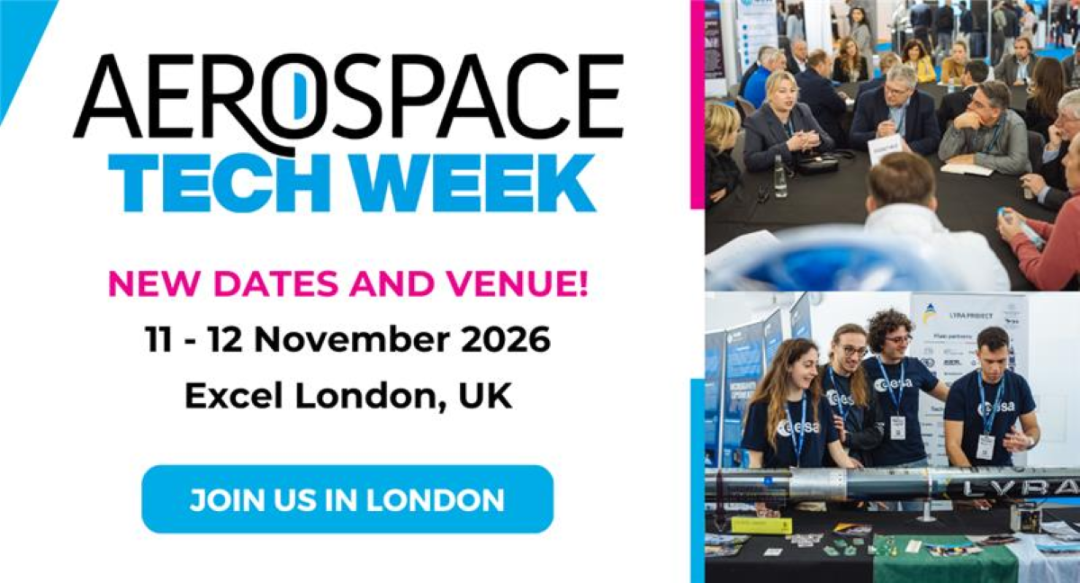
We are excited to announce a significant strategic update to Aerospace Tech Week 2026: the event will now take place in London, UK!
Moving from Munich, Germany to the world-leading Excel exhibition centre means the event can better serve the evolving needs of the aerospace industry. Additionally, new confirmed dates of 11 – 12 November 2026 give us more time to craft our dynamic exhibitor hall and informative agenda.
Lucy Matthews, Senior Conference Producer for Aerospace Tech Week, said:
Moving Aerospace Tech Week to London represents a major step forward for the event. It gives us the opportunity to grow our audience, expand the technical depth of the programme, and deliver our biggest and best edition yet.
Why join us in London?
- A global gateway: Unrivalled international connectivity to attract a truly global visitor base.
- The hub of innovation: Direct access to the UK’s leading aerospace, tech, and investment sectors.
- Enhanced programme: The new dates provide an extended runway to build our most ambitious conference and exhibition to date.
As we prepare for our biggest edition yet, we are now inviting industry leaders to secure their place in the 2026 programme.
Want to be part of the London launch? Whether you are looking to showcase your latest technology on the exhibition floor, lead the conversation as a speaker, or elevate your brand through sponsorship, we want to hear from you.
Click here to speak, sponsor, or exhibit.
Confirmed speakers already including representatives from the UK Ministry of Defence, Oman Air, Airbus, the Civil Aviation Authority, and TAP Maintenance & Engineering.
We look forward to welcoming you and the rest of the global aerospace community to London in November 2026.
About Aerospace Tech Week
Aerospace Tech Week is an event focused on driving innovation and technology advancements in the aerospace sector. Bringing together senior executives and technical leaders, ATW connects the whole value chain of aerospace to discuss, connect, and collaborate on emerging trends, challenges, and opportunities.
In 2026 we are excited to reunite our community of 1,500 industry experts for two inspiring days featuring over 120 speakers. Key topics covered include AI, avionics, flight ops, and sustainability, while our exhibitor and networking programmes spark connections that drive transformations across the industry.
Subscribe to our newsletter to get the latest aerospace news and exclusive interviews straight to your inbox.
by Elsie Clark | Jan 14, 2026 | Innovation
Advanced Air Mobility (AAM) firm Joby Aviation has received the first of two CAE simulators to train its pilots.
Specifically designed for eVTOL operations, the simulators will enable Joby to train as many as 250 pilots a year. Featuring a 300-by-130-degree field of view, state of the art 3D visuals and audio cues recreate a real-world environment as closely as possible.
Alexandre Prévost, President of Civil Aviation at CAE, said:
By leveraging decades of expertise in high-fidelity simulation, we are helping Joby prepare pilots for safe, efficient operations and supporting the industry’s transition to sustainable air transportation.
Joby has worked with CAE on on the simulators since 2022. The culmination of for years of research and development, the systems will be key to advancing Joby’s certification plans in the US. Among other agreements, the company has also made significant progress in the United Arab Emirates (UAE), where it plans to launch a commercial eVTOL service later this year.
Bonny Simi, President of Operations at Joby, added:
These simulators are central to the FAA certification process and are being delivered on time to support pilot training ahead of Joby’s first commercial flights planned for this year. Developing flight fully qualified simulators takes years of work and access to aircraft data, and it is required for Part 135 operations of eVTOL aircraft in the United States.
Join us at Aerospace Tech Week 2026 to discuss the future of Advanced Air Mobility (AAM).
For more like this, see:
by Elsie Clark | Nov 26, 2025 | Innovation
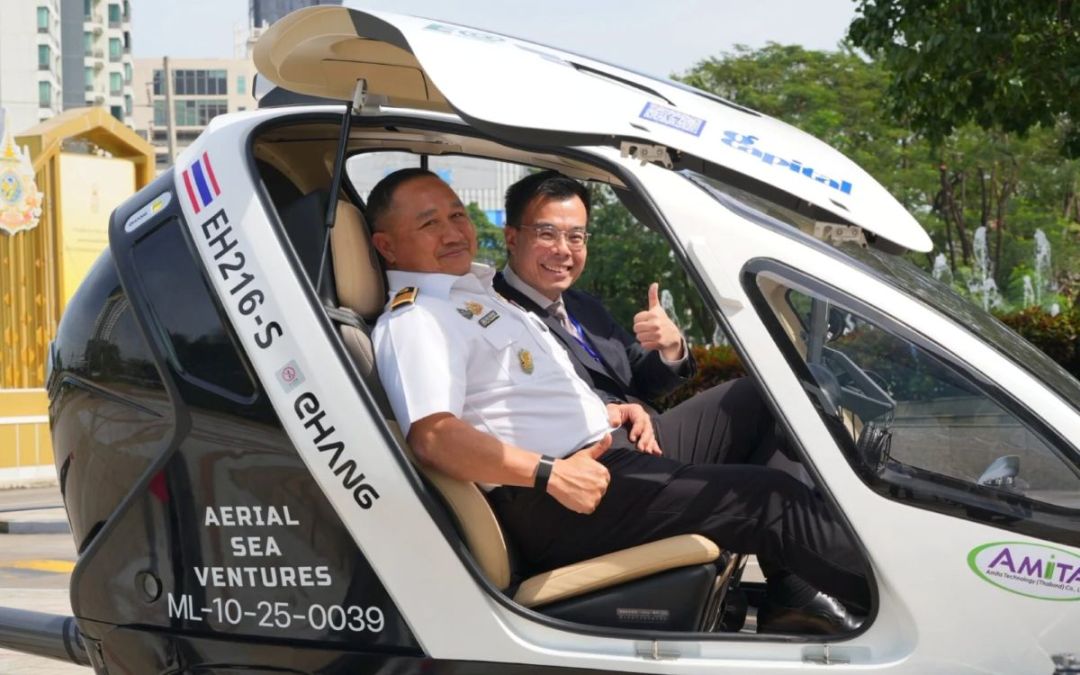
Chinese company EHang has carried out the first-ever urban autonomous passenger eVTOL flight in Bangkok, Thailand.
The pilotless two-seat EHang 216-S executed multiple take-offs and landings in Bangkok’s business district as part of an advanced air mobility (AAM) sandbox initiative. In partnership with the Civil Aviation Authority of Thailand (CAAT), the event represents a significant milestone for autonomous air taxis.
Among the passengers to fly in the aircraft was Air Chief Marshal Manat Chavanaprayoon, the Director General of CAAT, who became the first head of a civil aviation authority to ride the EHang aircraft. Conor Yang, Chief Financial Officer of EHang, said:
With the support of the CAAT, Thailand is highly likely to achieve the world’s first commercial eVTOL operations using an innovative regulatory approach of “sandbox”, creating a demonstration model for Southeast Asia and the world.
This week’s display in Bangkok hopes to prove the commercial potential of the tech in Thailand, a country EHang has identified as a significant potential market. Plans anticipate the company to collaborate with local partners in establishing air taxi services across the capital, as well as at Pattaya, Phuket, and Koh Samui.
Earlier in November, competitors Joby Aviation completed the world’s first crewed eVTOL flight in a demonstration at the Dubai Airshow, as commercialisation of AAM tech becomes imminent.
Join us at Aerospace Tech Week 2026 to discuss the regulation and innovation needed to power AAM.
For more like this, see:




You must be logged in to post a comment.