
by Elsie Clark | Jan 14, 2026 | AI & ML, Avionics, Connectivity, Flight Ops IT, Innovation, MRO IT, Sustainability
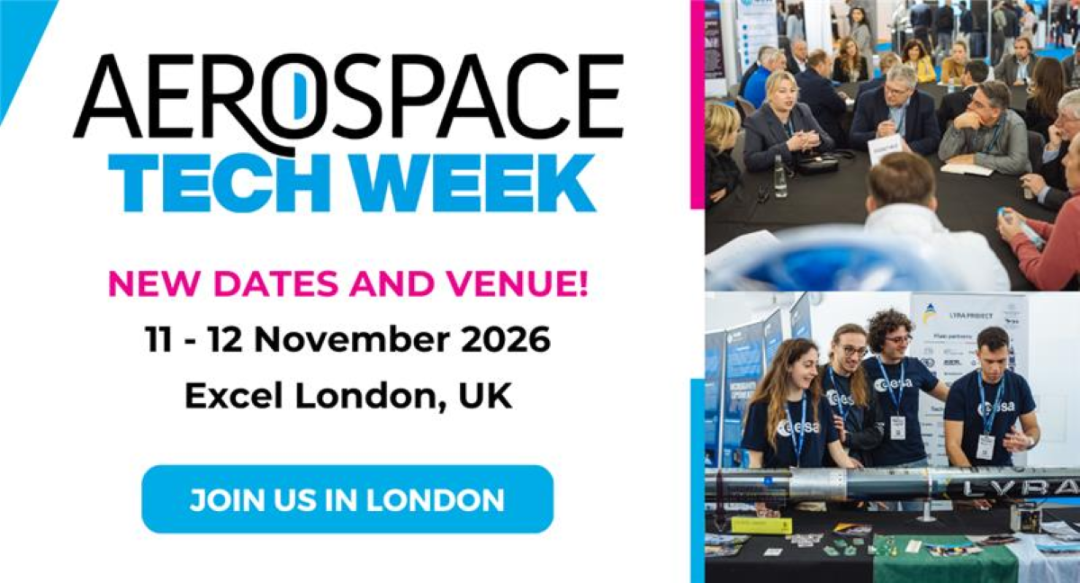
We are excited to announce a significant strategic update to Aerospace Tech Week 2026: the event will now take place in London, UK!
Moving from Munich, Germany to the world-leading Excel exhibition centre means the event can better serve the evolving needs of the aerospace industry. Additionally, new confirmed dates of 11 – 12 November 2026 give us more time to craft our dynamic exhibitor hall and informative agenda.
Lucy Matthews, Senior Conference Producer for Aerospace Tech Week, said:
Moving Aerospace Tech Week to London represents a major step forward for the event. It gives us the opportunity to grow our audience, expand the technical depth of the programme, and deliver our biggest and best edition yet.
Why join us in London?
- A global gateway: Unrivalled international connectivity to attract a truly global visitor base.
- The hub of innovation: Direct access to the UK’s leading aerospace, tech, and investment sectors.
- Enhanced programme: The new dates provide an extended runway to build our most ambitious conference and exhibition to date.
As we prepare for our biggest edition yet, we are now inviting industry leaders to secure their place in the 2026 programme.
Want to be part of the London launch? Whether you are looking to showcase your latest technology on the exhibition floor, lead the conversation as a speaker, or elevate your brand through sponsorship, we want to hear from you.
Click here to speak, sponsor, or exhibit.
Confirmed speakers already including representatives from the UK Ministry of Defence, Oman Air, Airbus, the Civil Aviation Authority, and TAP Maintenance & Engineering.
We look forward to welcoming you and the rest of the global aerospace community to London in November 2026.
About Aerospace Tech Week
Aerospace Tech Week is an event focused on driving innovation and technology advancements in the aerospace sector. Bringing together senior executives and technical leaders, ATW connects the whole value chain of aerospace to discuss, connect, and collaborate on emerging trends, challenges, and opportunities.
In 2026 we are excited to reunite our community of 1,500 industry experts for two inspiring days featuring over 120 speakers. Key topics covered include AI, avionics, flight ops, and sustainability, while our exhibitor and networking programmes spark connections that drive transformations across the industry.
Subscribe to our newsletter to get the latest aerospace news and exclusive interviews straight to your inbox.
by Elsie Clark | Oct 29, 2025 | Innovation, MRO IT
The aviation industry continues to struggle against high labour costs and skilled workforce shortages. And as the aircraft order backlog only goes up, effective maintenance and repair is more crucial than ever in keeping older aircraft in service for longer.
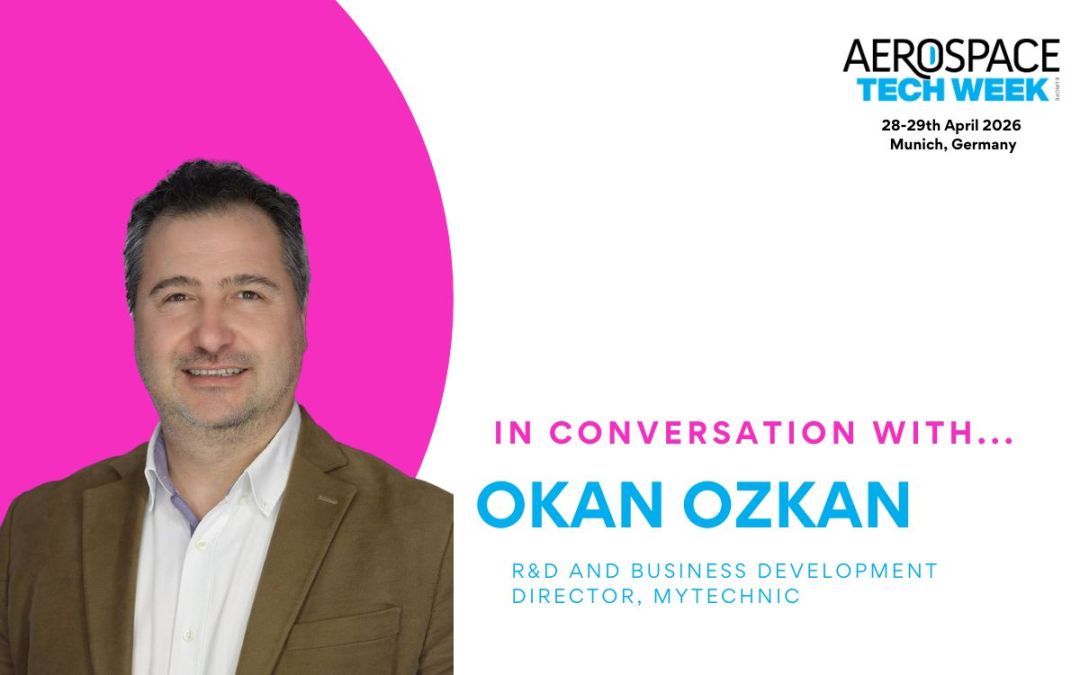
Robotics could play a crucial role in filling these gaps, able to service aircraft to a high standard in collaboration with human overseers. At Aerospace Tech Week 2025, we sat down with Okan Ozkan, R&D and Business Development Director for myTECHNIC, to discuss developments in the industry so far, and where robots could be deployed next.
The challenge facing maintenance workers is considerable. The industry is expected to add 45,900 new aircraft by 2043, but ongoing supply chain challenges have frustrated delivery. Moreover, the influx of new aircraft and keeping old aircraft in service places increasing strain on technicians. Scaling recruitment of these key personnel is a top priority, but with every staff member requiring years of training, other complementary solutions are needed.
Ozkan believes robotics are key to supporting and even improving human output, offering better reliability and accuracy. However, several key adoption challenges remain.
The main difficulty is regulation. If you’re using any robot in the hangar space, you have to ensure that it’s not damaging the aircraft. Safety comes first.
As well as securing regulatory approval, robot capabilities for maintenance remain in the early stages of development. Ozkan explains how deploying robots for autonomous aircraft repair and overhaul remains a long-term goal as the industry explores the full potential of robotic arming technology. In the future, smart robots could service and repair aircraft completely independently.
I like Star Wars, and I remember seeing the robotic technologies on screen for the spacecrafts there. And now I am seeing that time coming in real life because of how robotic technology is growing.
🎥 Watch the interview to hear Okan Ozkan’s full insight on how robotics is developing in aviation MRO.
Questions asked include:
- How are you seeing robotic technology impact aircraft maintenance activity?
- How do you see innovation in robotics having an impact on sustainability?
- How do events like Aerospace Tech Week help drive the industry forward?
Join us at Aerospace Tech Week 2026 to discuss the cutting-edge technologies transforming MRO, including AI and robotics.
For more like this, see:
by Elsie Clark | Oct 17, 2025 | Connectivity, Innovation
The SESAR Joint Undertaking (JU) and the Xunta de Galicia have signed a memorandum of cooperation (MoC) to advance air traffic management (ATM).
By partnering with the Galician government, SESAR JU will explore how regional capabilities can contribute to the Digital European Sky programme. This initiative aims to upgrade ATM infrastructure across Europe to reduce carbon emissions and optimise air traffic flow.
María Jesús Lorenzana Somoza, Regional Minister of Economy and Industry for Xunta de Galicia, commented:
Galicia has long recognised aerospace as a strategic sector for our economy. Through this cooperation with SESAR, we aim to position Galicia as a testbed for innovation and to ensure that our research and industrial capabilities actively contribute to Europe’s technological leadership in aviation.
The Galician partnership is the second regional agreement SESAR JU has orchestrated. As Galicia launches its Strategic Security, Defence and Aerospace Initiative 2025–2030, the region’s expertise in satellites, flight simulation, and unmanned aerial vehicles (UAVs) provides the ideal testing bed for innovative air traffic solutions. Regional collaborations also help the SESAR JU to advance European sustainability and connectivity more holistically.
Andreas Boschen, Executive Director of SESAR JU, added:
This agreement shows how regional innovation ecosystems can contribute to the Digital European Sky. By joining forces with Galicia, we can translate cutting-edge research into tangible benefits for citizens, such as safer, more sustainable, and more connected air mobility.
Join us at Aerospace Tech Week 2026, where we’ll be joined by Heiko Teper, Head of Strategy and Technical Deployment, SESAR Deployment Manager, to discuss ongoing progress of the Digital European Sky initiative.
For more like this, see:
by Elsie Clark | Oct 15, 2025 | Innovation, Video
A report from CAE predicts that the civil aviation industry will need 1.465 million additional professionals by 2034 to meet passenger demand. Training and upskilling is therefore of the highest priority if airlines and airports want to increase their capacity safely.
Lufthansa Aviation Training, part of the Lufthansa Group, has been training aviation professionals for more than 60 years. Boasting 50 full flight simulators across six dedicated centres, the company remains at the heart of training Europe’s pilots and cabin crews.
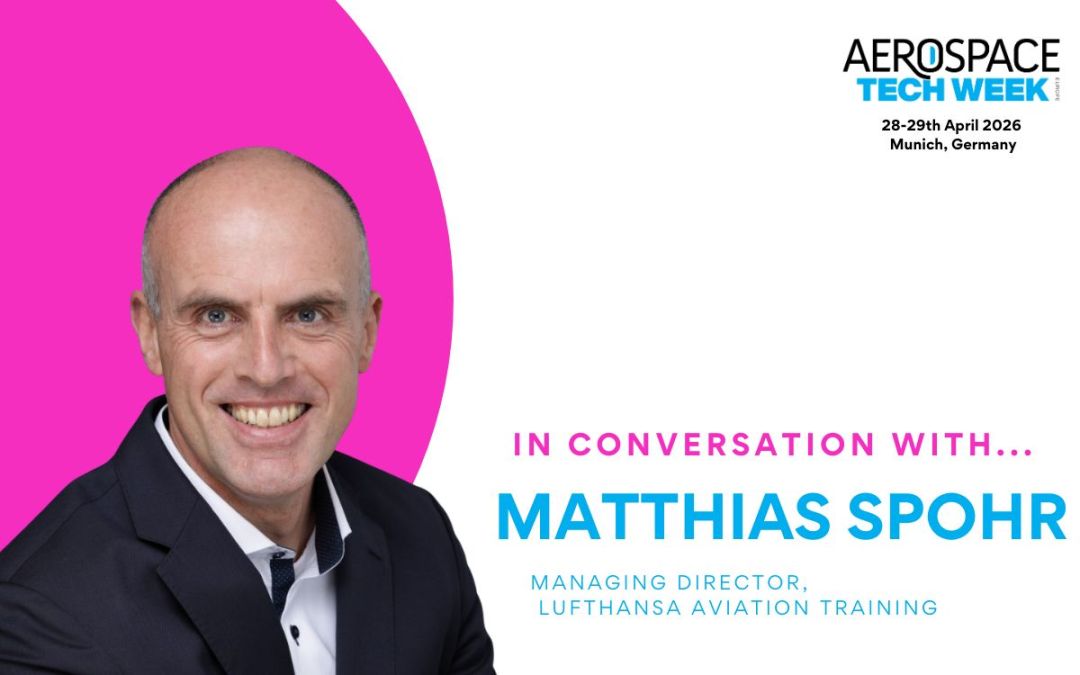
In an exclusive interview at Aerospace Tech Week 2025, we spoke to Managing Director Matthias Spohr about how Lufthansa Aviation Training is adapting for the future, including investments in digital twins.
Responsible for managing over 250 customers, Spohr sees digitisation as a key tool in offering a personalised service to every airline. Despite a strict regulatory environment, Lufthansa Aviation Training has been at the forefront of cutting-edge training technology. Remaining so is key to their strategy moving forward.
The big training devices we have are not 100% personalised to every company or airline we work with. Digital solutions give us the change to have a fully digital twin of how the airline is training, and of course to make training more realistic.
Investments of these kinds, costing in the millions of euros, represent a significant risk. Nevertheless, Spohr believes they are necessary if training is to keep pace with modern expectations. In the future, he believes aviation training will be much more decentralised, perhaps even progressing to a model where studying from home is more common.
Of course we welcome every customer that visits us, but it would be a lot better if we can decentralise and be where the crews are. That will produce savings on the airline side, and on the customer side there will be lower travel costs, more individualised training, and hopefully we can serve more customers.
The use of technology to enhance training and meet students where they are will be essential for aviation to educate and upskill the volume of workers growth forecasts require.
🎥 Watch the full interview to hear Matthias Spohr’s full thoughts on the evolution of aviation training.
Questions asked include:
- How do you see technology shaping training in the industry?
- What can you tell us about how you’re leveraging VR and digital twins?
- How does investment today drive cost savings in the future?
- What’s next in innovation in training?
Join us at Aerospace Tech Week 2026.
For more like this, see:
by Elsie Clark | Sep 18, 2025 | AI & ML, Flight Ops IT, Innovation
Korean Air and Boeing will partner on predictive analytics for proactive fleet maintenance, they announced at the MRO Asia-Pacific 2025 conference in Singapore.
The South Korean national carrier has established an early lead in predictive maintenance, setting up a dedicated team in 2023 that has since developed an in-house MRO solution. The partnership with Boeing will focus on advancing data-driven maintenance from this foundation to optimise fleet availability.
Chan Woo Jung, Senior Vice President and Head of Maintenance and Engineering at Korean Air, said:
We have made substantial progress in enhancing fleet reliability through our Smart MRO strategy, specifically by leveraging predictive maintenance. This strategic collaboration with Boeing will build on that success, taking our capabilities to the next level.
As we continue to expand our fleet, this partnership is key to enhancing our maintenance operations.
The announcement comes after Korean Air signed the largest-ever single aircraft order in history in late August 2025. 103 new Boeing airliners of different types are set to replenish and expand the airline’s fleet as they merge with Asiana Airlines.
The new predictive maintenance partnership with Boeing will support the US$36 billion investment, ensuring that Korean Air get the most out of their new aircraft while minimising passenger disruption.
Boeing’s suite of intelligence tools includes the Insight Accelerator, a custom predictive maintenance solution that helps avoid flight delays and minimises aircraft time on ground (AOG). Powered by machine learning (ML) algorithms, it is the first tool of its kind to launch on the MRO market.
Join us at Aerospace Tech Week 2026, where our dedicated MRO IT panels will be discussing the future of predictive maintenance in aviation.
For more like this, see:



You must be logged in to post a comment.