
by Elsie Clark | Dec 2, 2025 | Connectivity
Austro Control, Austria’s air navigation service provider, has selected ADB Safegate to undertake a comprehensive overhaul of the air traffic control (ATC) systems at Vienna Airport (VIE).
Following a competitive international tendering process, the company chose ADB Safegate’s sophisticated OneControl integrated platform, a cutting-edge tower suite designed to modernise all controller working positions in the Vienna Airport ATC Tower. The advanced system, already in use at major international hubs like Hamburg, is set for commissioning by the end of 2028.
OneControl’s key feature is its ability to unify disparate systems. Traditionally, air traffic controllers work across numerous independent displays for functions like surveillance and flight planning. The new platform integrates all safety-critical information into a single, intuitive interface, providing controllers with immediate and complete situational awareness of aircraft and vehicle movements on the apron, aerodrome, and in the air. This consolidation facilitates faster, more accurate decision-making and is expected to enhance overall safety, streamline operations, and support more efficient, sustainable air traffic management.
Philipp Piber, Managing Director of Austro Control, highlighted the strategic importance of the upgrade, stating:
With OneControl, we are relying on state-of-the-art technology and maximum operational reliability. The system will provide our air traffic controllers with optimal support in the safe and efficient handling of air traffic.
The system also includes features such as advanced conflict detection and automated workflows aimed at reducing controller workload and helping the airport to optimise its airside efficiency.
Vienna Airport handled over 31 million passengers in 2024, its highest numbers since 2019. ATC investment will help make air traffic management at Austria’s aviation hub more streamlined and effective.
Join us at Aerospace Tech Week 2026 to discuss the future of air traffic control.
For more like this, see:
by Elsie Clark | Nov 18, 2025 | Connectivity, Innovation
DSNA, the French air navigation services provider, have executed a successful pilot of SITA’s weather intelligence technology.
During a proof-of-concept at the Reims Area Control Centre, DSNA tested SITA’s Enhanced Weather Awareness System (eWAS) and Mission Watch over 21 days from July to October 2025. Originally developed for airlines, these SITA products provide continuous real-time updates on global weather.
During the pilot, DSNA were able to use that information to plan traffic flow significantly more effectively. The authority reported that they were able to reduce delays by up to 65% and handle 2,700 more flights, resulting in an extra €2 million in revenue.
Gael Barbezier, Head of Operations at Reims ACC, commented:
Weather is one of the biggest challenges for air navigation service providers. Working with SITA allowed us to maintain full safety, avoid any weather-related uncontrolled situations, and adjust capacity precisely to the weather avoiding unnecessary reductions in traffic. It feels like we’ve found the key to bringing stability to something that has always been unpredictable.
Unexpected disruption due to weather events can seriously derail airport operations. Earlier this year, stormy weather and poor visibility led to the closure of Nice Airport after two aircraft nearly collided on the runway. With the number of severe weather events only set to increase due to climate change, it is imperative to find better solutions for managing air traffic whatever the climate conditions.
Yann Cabaret, the CEO of SITA for Aircraft, added:
When controllers, pilots and dispatchers all see accurate, real-time weather information, they can plan and adapt together. That means fewer delays, smoother operations and safer flights for passengers.
Join us at Aerospace Tech Week 2026 to learn more about innovative tech in flight planning and airport management.
For more like this, see:
by Elsie Clark | Oct 27, 2025 | Innovation, Sustainability
Swedavia are the first in Europe to introduce a curved air traffic approaches concept at Stockholm Arlanda Airport.
The Established on RNP (EoR) concept makes it easier for aircraft to approach on a curve, thereby increasing capacity, sustainability, and efficiency. More aircraft can land per hour as the runway queue is reduced, while fewer aircraft on the arrival runway helps limit unnecessary fuel burn.
Susanne Norman, Director of Operations at Swedavia, said:
For us, it is of course gratifying that Swedavia will be the first in Europe to apply the new concept for managing arrivals. Enabling more curved approaches is also the most effective way to support airlines in their transition work, in addition to facilitating increased use of sustainable aviation fuel (SAF).
Launched in partnership with Luftfartsverket, the initiative encourages airlines to invest in tech compatible with curved approaches, which also minimises noise.
Anna Granberg, Director of Operations at Luftfartsverket, commented:
The modernisation of the airspace by Luftfartsverket shows how air traffic control can help reduce the environmental impact of aviation. The traffic flow into Stockholm Arlanda Airport becomes more efficient during peak hours, and arriving aircraft have shorter flight paths with reduced emissions.
To adopt the EoR concept, airports and aircraft need to have bespoke equipment, specially-trained staff, and a permit from the local aerospace authority. Nevertheless, airlines including SAS and Norwegian have celebrated the development. Alexandra Lindgren Kaoukji, Head of External Communication and PR at SAS, said:
SAS welcomes all initiatives that help reduce fuel consumption, noise, and emissions. The introduction of the new approach concept is a step in the right direction towards a more efficient and more sustainable airspace around Arlanda.
Join us at Aerospace Tech Week 2026 to discuss the future of efficient, sustainable air traffic operations.
For more like this, see:
by Elsie Clark | Oct 20, 2025 | Connectivity
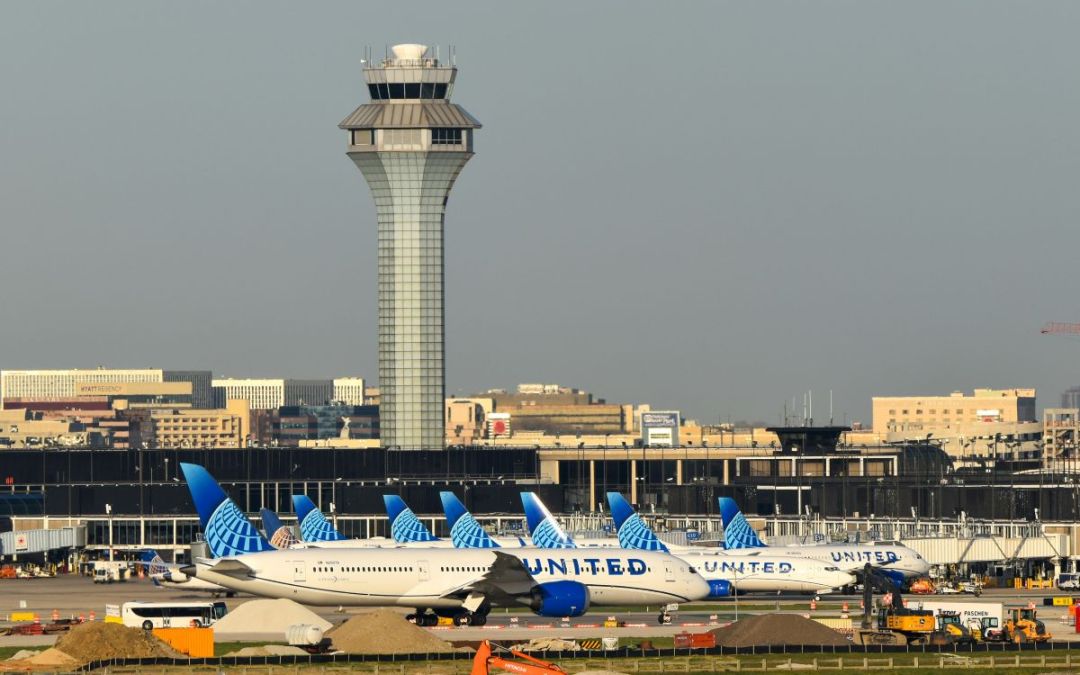
A taxiing Boeing 737 clipped a parked Boeing 767 at Chicago O’Hare International Airport on Friday 16 October.
Both planes belonged to United Airlines. As the 737, carrying 113 passengers and five crew members, passed the 767, which held no passengers, its wing clipped the other plane’s horizontal stabiliser. No one was injured, and a full inspection found no significant damage to either aircraft.
The light impact was reportedly not felt by the 737’s passengers, who were held on the aircraft for just under an hour before deplaning as usual.
The incident is yet another in a series that have affected US airport management as it struggles with a shortage of air traffic control (ATC) staff. On 1 October, at LaGuardia airport two regional Delta jets collided at a taxiway intersection. The crash, which resulted from one plane’s wing hitting the nose and cockpit of the other, injured one flight attendant.
Moreover, September saw another minor collision between United aircraft, this time at San Francisco airport. The incident mirrored another close call for United from May, where one aircraft clipped the tail of another standing stationary.
As of early 2025, the Federal Aviation Administration (FAA) was reporting ATC staff shortages of around 5,000. This year’s rapid recruitment drive has raised concerns about overwork of ATC instructors. Additionally, the US government shutdown, entering its 19th day at the time of writing, has exacerbated these problems.
The recent collision of the United planes thankfully resulted in neither casualties nor serious damages. However, that such accidents are happening at all emphasises that positioning, awareness, and communication require continual investment and improvement.
Join us at Aerospace Tech Week 2026 to discuss the future of ATC, flight ops, and safety.
For more like this, see:
by Elsie Clark | Oct 1, 2025 | Innovation
The Saudi Arabian General Authority of Civil Aviation has approve the kingdom’s first virtual air traffic control (ATC) tower at AlUla airport.
Traffic at the airport will now be monitored remotely by a centre at Jeddah’s King Abdulaziz International Airport, more than 600 kilometres away. The virtual tower was developed by the Saudi Air Navigation Service (SANS) in partnership with Spanish ATC specialist Indra.
Not only is the tower the first of its kind in Saudi Arabia, it is also the only one in operation across the Middle East. Equipped with 360-degree cameras, specialist sensors, and artificial intelligence (AI), the new system offers improved efficiency while reducing burden on airport staff.
An ancient oasis city in the heart of the desert, the Saudi Arabian government has launched plans to boost AlUla’s tourism credentials. A new strategy hopes to attract 2 million tourists to the town by 2030, contributing SAR120 billion to the national economy. The virtual ATC tower improves safety and traffic flow to optimise management of visitors arriving by air. AlUla Airport currently handles around 400,000 passengers a year, with plans to increase that number to 6 million.
The approval of the virtual ATC tower also aligns with Saudi Arabia’s aviation modernisation strategy. The Vision 2030 plan targets 300 million air passengers by 2030, numbers that analysts at OAG have warned will be difficult to achieve due to the limited availability of qualified staff. The virtual ATC tower allows for operations at AlUla to expand without requiring further recruitment.
Initially designed with small- to medium-sized airports in mind, virtual ATC towers have been introduced at several key airports in recent years, notably London City Airport in 2021. The SESAR Joint Undertaking is also considering remote and virtual tower (RVT) concepts as part of its plans to consolidate European aerospace operations.
Join us at Aerospace Tech Week 2026 to discuss the future of ATC and SESAR.
For more like this, see:



You must be logged in to post a comment.