
by ATR Contributor | May 13, 2026 | Innovation
The disruption environment changed underneath the people we trained to absorb it. The job description has quietly moved from fire station to portfolio management — and most operations are still running on the old manual.
By Joshua Goring, Chief Commercial Officer, StratosX
It’s 4 a.m. on a Tuesday in an airline OCC somewhere in North America. A controller who’s worked every irregular ops season since the 2010 ash cloud is fielding three phone calls, two chat channels, and four screens. She is extraordinary at what she does. She is also, by any honest modern definition, doing the wrong job. The work in front of her is not firefighting. It’s portfolio management: decaying options, competing constraints, and decisions that compound across the network. The tools haven’t been told yet.
The job description changed while nobody was looking
OCC culture was built for crisis. Heroic, adrenaline-driven, individual. A good controller in 1998 was the one who kept the aircraft moving through a thunderstorm with a phone in each hand. That instinct — react, decide, absorb — is still the backbone of how most ops floors run.
But the environment underneath has changed. EU261 in Europe. APPR in Canada. DOT rulemaking tightening in the United States through 2026. Every minute a disruption continues now carries a compensation number. Passengers expect proactive rebooking before they’ve even been told the flight is delayed.
Close to half of all delay minutes are now reactionary, disruption multiplying through the network. The cost of getting a recovery wrong is no longer a quiet operational footnote. It’s a line item the CFO watches. The job description has changed. The architecture around it has not.
What traders have that controllers don’t
Walk onto any trading floor and you’ll find a culture airline operations would recognise, but have not yet adopted.
Traders have real-time visibility across every position, consolidated into one view. Pre-computed scenarios for every plausible market move. A number on every option, and critically, they can see those options decaying in real time. A position available now won’t be in thirty minutes. The discipline is: decide while the option still has value, because deliberation has a cost.
Airline controllers face the same physics. The spare aircraft available right now will be assigned to another recovery in twenty minutes. A crew pairing that’s legal at 14:00 hits its flight duty limit at 14:45. The protection seat on the next connecting bank closes when the gate agent releases it. Every minute of deliberation narrows what’s possible, but nothing on the controller’s screen tells them the option is depreciating.
Worse, the information they need lives in separate systems. Aircraft state in one feed. Crew legality in another. Passenger connections in a third. Cost exposure derived manually. Controllers assemble the picture themselves, from memory and phone calls, under pressure. That isn’t a training gap. It’s a data architecture problem.
Why individual brilliance hits a ceiling the architecture built
The airlines with the strongest OCC operators look brilliant in normal operations. They get punished during compound events, not because the operators are less capable, but because individual brilliance doesn’t aggregate when the architecture forces sequential decisions.
A morning AOG triggers a cascade that will hit passenger connections in six hours. Three desks — aircraft, crew, passenger — each take ownership of their piece. Each solves the problem with excellent individual judgement, working from the information they can see.
The combined outcome is worse than it needed to be. The aircraft desk’s best swap breaks the crew desk’s pairing logic. The crew desk’s best reassignment strands passengers the passenger desk was about to protect. Three right answers, sequentially. One wrong outcome, together. By the time they reconciled it, the decision window had already depreciated.
This isn’t a coordination failure, and it certainly isn’t a people failure. It’s a structural one. When each desk can only see its own constraints, sequential conflict is built into the system. The answer isn’t faster controllers or better heroes. It’s a shared operational picture: aircraft, crew, and passengers evaluated as one joint problem, with trade-offs visible to everyone at the same time.
The three shifts the next decade requires
Getting the OCC from fire station to trading floor is not a single technology decision. It’s three shifts in how decisions get supported.
From fragmented to unified awareness. Aircraft, crew, and passenger constraints evaluated against each other at the same moment, not handed off through three desks or reconciled in the controller’s head under a countdown. One ranked set of options that accounts for crew legality, aircraft availability, passenger exposure, and downstream cost. The controller stops assembling and starts choosing.
From reactive to continuous. The analytical work doesn’t start when the disruption starts. It runs in the background, monitoring constraints and pre-computing scenarios, so when the moment arrives options are already ranked and the controller is choosing, not assembling.
From individual memory to institutional memory. Fifteen years of “which routes cascade, which bases have flex” lives in the heads of controllers who will retire in the next decade. The shift is to encode that knowledge into the decision support layer, while the experts are still around to validate it and trust that the system has learnt what they know.
What changes when you make the shift
The controller’s job doesn’t disappear. It evolves. Less time assembling information, more time making judgement calls with full awareness. Less adrenaline, more intent. The operation handles bigger problems with fewer fire drills, because the architecture surfaces what matters before the window closes.
Senior controllers stay not because the next recovery will be adventurous, but because the job lets them do work worthy of their experience, with the full picture in front of them rather than reassembled from memory under a countdown.
The airlines that complete the shift first will be the ones still competing in 2030. The alternative — heroic controllers burning out under a compounding disruption load and a tightening regulatory environment — is not a ten-year plan. You can’t fund what you can’t see, and recovery remains aviation’s largest unmeasured function.
The OCC of 2030 won’t be defined by headcount. It’ll be defined by whether the architecture gives controllers the full picture — aircraft, crew, passengers, cost — before the decision window closes.
Joshua Goring is Chief Commercial Officer at StratosX, the company behind X360, an integrated recovery platform for airline operations centres. StratosX will be presenting on this topic at Aviation Festival Americas, Miami, June 2026. Join us today.
For more like this, see:
by Elsie Clark | Apr 13, 2026 | Connectivity
Delta Air Lines CEO Ed Bastian has revealed the area of aviation where he believes AI will have the biggest impact: air traffic control.
Speaking on the Fortune 500: Titans and Disruptors of Industry podcast, Bastian said the journey from Atlanta to New York takes longer today due to inefficiencies in air traffic management. He added:
All that technology investment that we put in AI is not going to change that, unless it’s focused on, how do you unlock the sky.
US air traffic control systems have come under increasing strain in recent years. Bastian notes that the technology is in need of an update, while staffing shortages have been compounded by recent government shutdowns.
The Trump administration, under Transportation Secretary Sean Duffy, have announced a comprehensive overhaul into American ATC systems. The US$31.5 billion plan includes building six new ATC towers and implementing new radio and radar systems. The Federal Aviation Administration (FAA) has also confirmed that they are developing machine learning and LLMs to analyse incident reports and develop a comprehensive picture of risk patterns.
Bastian’s comments come in the wake of several high-profile air traffic incidents across the US. Most notably, in March shortage of ATC personnel at LaGuardia airport resulted in two deaths and multiple injuries after an Air Canada plane crashed with a ground services van while landing on the runway.
Join us at Aerospace Tech Week 2026 to discuss the future of ATC, flight ops, and AI.
For more like this, see:
by Elsie Clark | Mar 20, 2026 | Connectivity
Ongoing airspace closures in the Middle East has placed strain on air traffic controllers, with staff in some regions now managing twice the number of aircraft than usual.
Due to ongoing US-Israel attacks, Iranian airspace remains completely closed. While very restricted schedule of flights are now operating out of the UAE and Qatar, the authorities in Bahrain and Kuwait are yet to open their skies. As strategic stopover points on flights between Europe and APAC, the closure of these strategic aviation hubs has changed the map of aviation operations.

High traffic corridors are emerging as aircraft avoid the conflict zone. Source: FlightRadar, accessed 20/03/2026
The major airlines in this region, including Emirates, Etihad, and Qatar Airways, usually operate 1,500 flights a day, spanning 389,000 seats. Traffic that would pass through the Gulf is now being forced to reroute, placing a strain on aircraft management but also air traffic control. ATC staff in Egypt and the Caucuses are now managing significantly more flights than they would do usually as flights are remapped to avoid the conflict zone.
Individual controllers usually manage around six flights at a time. But in the current emergency environment, they may handle twice that number. Former controller Brian Roche told the BBC:
The controllers at the moment are working unbelievable shifts, [dealing with] unbelievable amounts of traffic.
While ATC protocols are ready to handle sudden upsurges in traffic, it’s uncertain how long the current pressures will continue, with the conflict showing no signs of abating. Controllers might be highly trained to manage stressful scenarios, but the toll of intense concentration should not be underestimated. Aviation authorities need to be sure that staff are well-supported during this stressful period to ensure operations continue to run smoothly in spite of the disruption.
Join us at Aerospace Tech Week to discuss the intersection of ATC and technology.
For more like this, see:
by Elsie Clark | Dec 16, 2025 | Connectivity, Innovation
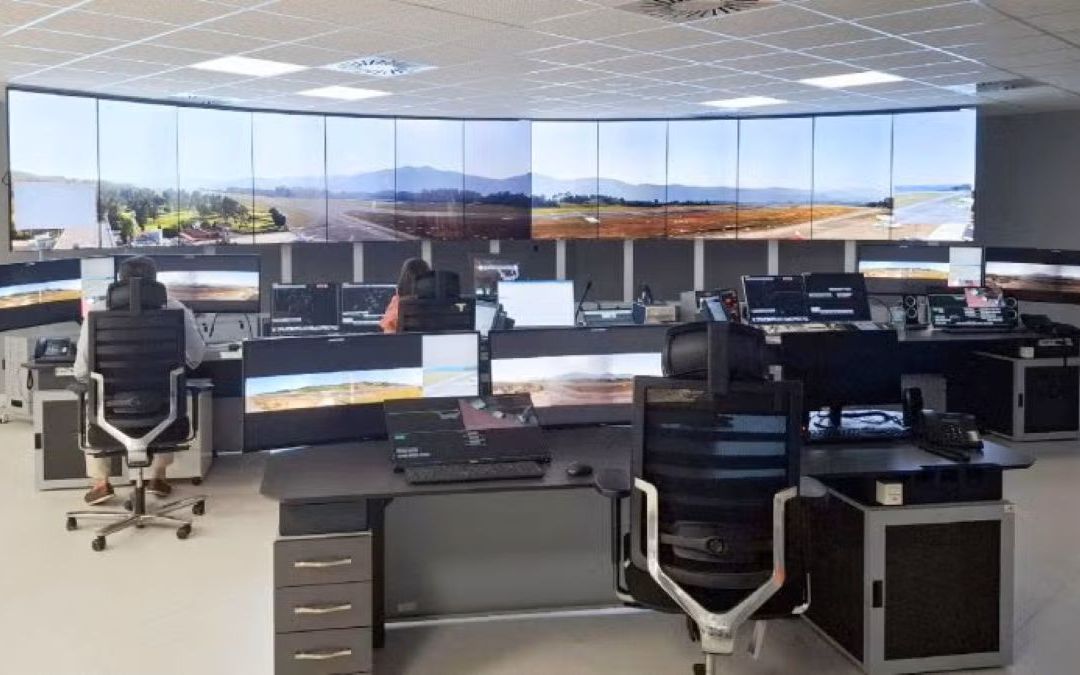
Searidge Technologies has successfully implemented a digital control tower at Vigo Airport, Spain.
The first of its kind in the country, the tower features a high-resolution, 360-degree real-time visual display of traffic at the airport. Developed in partnership with Skyway, the system has been approved by the aviation authorities and is now in operation.
The display uses a feed of sensors and cameras to enhance traffic controllers’ situational awareness, ultimately improving the safety and efficiency of the airport. Searidge Technologies CEO Moodie Cheikh said:
We’re proud to support Aena [Spain’s airport operator] in achieving this important milestone.
The operational launch at Vigo marks a first for Spain and underscores Europe’s leadership in digital tower innovation. We look forward to continuing our collaboration as Aena advances its strategy to digitise and future-proof airport operations across the country.
A phased introduction will ensure safety standards are upheld during the transition to the digital system. Operations will first take place during times of low air traffic with standard control towers as a backup. The new system puts Vigo in line with modern international airports including Dubai International, London Heathrow, and Singapore Changi. Searidge’s digital tower has also been in operation at Hamad International Airport in Saudi Arabia, the first large-scale system of its kind approved by regulators in the Middle East
The news at Vigo Airport comes after IATA revealed that air traffic control delays in Europe have more than doubled since 2015.
Join us at Aerospace Tech Week 2026 to discuss the future of air traffic control.
For more like this, see:
by Elsie Clark | Dec 9, 2025 | Connectivity
Research from IATA has found that air traffic control (ATC) delays in Europe have doubled over the past decade.
This increase has far outpaced the rate of traffic growth (6.7%), and affected 1.1 billion passengers. IATA estimates the delays have collectively cost the industry €16.1 billion since 2015. Delays due to weather and strikes were not covered in the analysis, which found staff shortages to be overwhelmingly responsible for ATC’s poor performance.
Staff capacity-related disruptions have increased by 179.7% and staffing-related delays by 201.7% since 2015. IATA Director-General Willie Walsh commented:
We’re now seeing the consequences of Europe’s failure to get a grip on air traffic control. A small, expected improvement in 2025 from a very bad 2024 does not change the deterioration that we have seen over the last decade. Airlines and travellers were promised a Single European Sky that would cut delays and reduce fuel burn through more efficient navigation and routes. Instead, passengers have seen delays more than double.
10 of the 39 European Air Navigation Service Providers (ANSP) were responsible for 87% of all delays. France (DSNA) and Germany (DFS) alone were responsible for more than 50% of delays. These statistics demonstrate how a handful of countries are having a disproportionately negative impact on the continent’s ATC performance.
Walsh added:
While Eurocrats debate ways to increase the burden of EU261 passenger compensation, the root cause of much of the delay suffered by travellers—air traffic control—escapes without action or censure. And Europe’s connectivity and competitiveness suffer from schedules that must accommodate ATC inefficiency. It is completely unacceptable.
Join us at Aerospace Tech Week 2026, where we’ll be joined by Heiko Teper, Head of Strategy and Technical Deployment, SESAR Deployment Manager.
For more like this, see:



You must be logged in to post a comment.