
by Elsie Clark | Oct 29, 2025 | Innovation, MRO IT
The aviation industry continues to struggle against high labour costs and skilled workforce shortages. And as the aircraft order backlog only goes up, effective maintenance and repair is more crucial than ever in keeping older aircraft in service for longer.
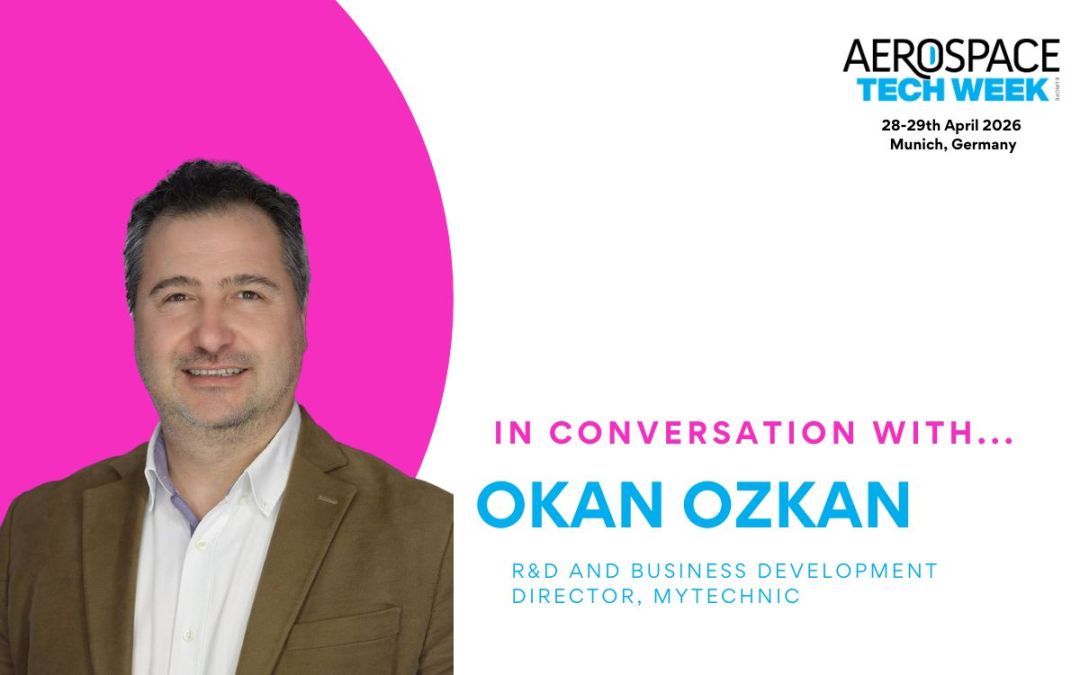
Robotics could play a crucial role in filling these gaps, able to service aircraft to a high standard in collaboration with human overseers. At Aerospace Tech Week 2025, we sat down with Okan Ozkan, R&D and Business Development Director for myTECHNIC, to discuss developments in the industry so far, and where robots could be deployed next.
The challenge facing maintenance workers is considerable. The industry is expected to add 45,900 new aircraft by 2043, but ongoing supply chain challenges have frustrated delivery. Moreover, the influx of new aircraft and keeping old aircraft in service places increasing strain on technicians. Scaling recruitment of these key personnel is a top priority, but with every staff member requiring years of training, other complementary solutions are needed.
Ozkan believes robotics are key to supporting and even improving human output, offering better reliability and accuracy. However, several key adoption challenges remain.
The main difficulty is regulation. If you’re using any robot in the hangar space, you have to ensure that it’s not damaging the aircraft. Safety comes first.
As well as securing regulatory approval, robot capabilities for maintenance remain in the early stages of development. Ozkan explains how deploying robots for autonomous aircraft repair and overhaul remains a long-term goal as the industry explores the full potential of robotic arming technology. In the future, smart robots could service and repair aircraft completely independently.
I like Star Wars, and I remember seeing the robotic technologies on screen for the spacecrafts there. And now I am seeing that time coming in real life because of how robotic technology is growing.
🎥 Watch the interview to hear Okan Ozkan’s full insight on how robotics is developing in aviation MRO.
Questions asked include:
- How are you seeing robotic technology impact aircraft maintenance activity?
- How do you see innovation in robotics having an impact on sustainability?
- How do events like Aerospace Tech Week help drive the industry forward?
Join us at Aerospace Tech Week 2026 to discuss the cutting-edge technologies transforming MRO, including AI and robotics.
For more like this, see:
by Elsie Clark | Oct 22, 2025 | AI & ML, Innovation, MRO IT
Back in April, our Aerospace Tech Review Awards 2025 honoured a range of cutting-edge startups, speakers, and collaborations across the aerospace industry. Most Disruptive Startup went to AIXI, an innovative data and analytics company that is giving aviation MRO data a much-need upgrade.
To learn more, we sat down on video call with AIXI’s CEO, Cameron Byrd. With aviation continuing to depend on legacy systems, AIXI’s data-cleaning AI represents a significant advancement. Information that might previously have been buried in spreadsheets or hidden behind reference numbers can be brought to the fore through AIXI’s industry-specific large-language model (ILM).
It’s impossible to extract reliable information from maintenance data without cleaning it first. That’s where everyone’s failing, and where AIXI focuses.
Byrd believes airlines’ extensive maintenance data backlogs airlines represent an untapped ‘gold mine’ that could be leveraged far more effectively. AIXI’s ILM extracts, cleans, and standardises this data, while additional tools can identify repeat defects by aircraft or by fleet. The startup’s ultimate goal is to provide the aviation industry with strong data foundations, which they can build upon for true prescriptive and predictive maintenance.
With an accuracy rate of over 95%, the AIXI model can review 3,000 records a day and save 15,000 hours of labour. Real-world use cases have demonstrated these high-performance capabilities: AIXI have been working with Southwest Airlines since 2022, and upon installation immediately freed up five full-time employees.
Southwest also tried to have humans verify the results of the autocoder. And what happened was the autocoder would beat the humans.
AIXI is currently tailored to manage Boeing 737s, but in the future Byrd hopes to refine the ILM so it can be applied to more aircraft records. He also hopes to build an industry-specific chatbot tool, where engineers can input questions on maintenance procedures or the number of delays due to certain causes, and receive accurate answers based on the airline’s data.
When it comes to MRO, AI is a transformative tool that will become essential to the running of the aviation industry. Byrd concludes:
AI is the way to unlock the power of data, because if you know the history of your fleet, you can predict the future of your fleet.
🎥 Watch the full interview to get the full lowdown on AIXI’s game-changing technology, and why they won Most Disruptive Startup at the ATR Awards 2025.
Questions asked include:
- Aviation is known for being dependent on legacy tools and methods. What systems have traditionally been used to aggregate MRO data? What are the challenges that come with using these?
- How is AIXI disrupting this field? Tell me more about your AI-powered solutions and how they are a game-changer for MRO.
- What are your plans for the future? How would you like to grow your business/develop the product?
- How do you see use of AI changing aerospace and aviation over the next decade?
Join us at Aerospace Tech Week 2026, where our Startup World Cup will gather the most innovative new businesses from across the industry.
For more like this, see:
by Elsie Clark | Oct 15, 2025 | MRO IT
A new report from IATA and Oliver Wyman, Reviving the Commercial Aircraft Supply Chain, forecasts that supply chain challenges could cost airlines more than US$11 billion in 2025.
This is largely due to the slow pace of aircraft production, which has been exacerbated by ever-increasing demand for air travel. In 2024, passenger demand rose by 10.4%, exceeding the capacity expansion of 8.7%, while the worldwide commercial backlog of aircraft reached historic high of 17,000.
Geopolitical instability, material shortages, and labour availability have compounded these supply chain challenges, forcing airlines to keep older aircraft in service for longer. This results in higher fuel costs, maintenance costs, engine leasing costs, and surplus inventory holding costs. According to IATA, these bottlenecks combined will cost airlines US$11 billion in 2025.
The report offers several suggestions for the aerospace industry to mitigate these problems. Willie Walsh, IATA’s Director General, commented:
Airlines depend on a reliable supply chain to operate and grow their fleets efficiently. Now we have unprecedented waits for aircraft, engines and parts and unpredictable delivery schedules. […]
There is no simple solution to resolving this problem, but there are several actions that could provide some relief. To start, opening the aftermarket would help by giving airlines greater choice and access to parts and services. In parallel, greater transparency on the state of the supply chain would give airlines the data they need to plan around blockages while helping OEMs to ease underlying bottlenecks.
Additionally, the report recommends that the industry improve its use of data, including accelerating predictive maintenance and data sharing to reduce downtime and optimise existing inventory.
Matthew Poitras, Partner in Oliver Wyman’s Transportation and Advanced Industrials practice, added:
Today’s aircraft fleet is larger, more advanced, and more fuel efficient than ever before. However, supply chain challenges are impacting airlines and OEMs alike. We see an opportunity to catalyse an improvement in supply chain performance that will benefit everyone, but this will require collective steps to reshape the structure of the aerospace industry and work together on transparency and talent.
Join us at Aerospace Tech Week 2026, where our dedicated supply chain track will discuss how the industry can build resilience and mitigate disruption.
For more like this, see:
by Elsie Clark | Oct 1, 2025 | Innovation, MRO IT
Predictive maintenance using artificial intelligence (AI) and big data is a hot topic in aerospace, as airlines, airports, and engineers all strive to reduce downtime and optimise infrastructure efficiency.
For many, however, implementing predictive maintenance technology remains stuck in the development stages. In an exclusive interview, Kaire Kalve, Head of Supply Chain at Magnetic Group, told Aerospace Tech Review what needs to change for successful predictive MRO adoption.
Different parties and operators all have their own data, so the key challenge here is actually trust.
Kalve discusses why mutual incentives are critical to breaking down barriers across the industry and eliminating data silos. If this isn’t done, predictive maintenance is slow to implement and less effective: the more data you can feed a model, the more accurate it will be.
The key here is operators. They should take the initiative as they have the most valuable data.
Industrywide collaboration will be essential to realising the benefits of predictive maintenance, and events such as Aerospace Tech Week play an important role in developing new partnerships.
The future of maintenance is truly collaborative and based on transparent agreements for data sharing.
🎥Watch the video below to hear Kaire’s full insights on collaboration in predictive maintenance.
Questions asked include:
- Predictive maintenance is widely discussed, but we’re yet to see its widespread implementation. What’s holding the industry back?
- Predictive maintenance relies heavily on data. Who in the industry has the most important data, so to speak?
- Why are events such as Aerospace Tech Week so important?
For more like this, see:
by Elsie Clark | Sep 19, 2025 | Avionics, MRO IT
Avionics on IndiGo’s fleet of 430 A320 Airbus aircraft will now be maintained by Thales.
The new agreement lasts for 11 years, and includes IndiGo’s growth plans to increase its fleet to 800 craft. Thales’s Repair By The Hour (RBTH) and Avionics By The Hour (ABTH) solutions will be deployed to reduce downtime and ensure critical components are available.
The repairs will take place at IndiGo’s new avionics MRO facility near Delhi Airport in India. An additional 5-year contract has been signed with AvioBook Flight, a Thales company. AvioBook is the only Electronic Flight Bag (EFB) solution authorised by the Directorate General of Civil Aviation (DGCA) for paperless EFB, and provides pilots with essential digital tools to manage their crews.
Parichay Datta, Senior Vice-president, Engineering, IndiGo, said:
We are pleased to partner with Thales, a leading aerospace company trusted worldwide for its expertise in avionics support, to augment IndiGo’s maintenance and repairs capabilities.
With IndiGo’s growing scale and fleet, this association aligns with our commitment to offer a hassle-free and safe flying experience to our customers, while ensuring operational excellence and reliability
India has surpassed Brazil and Indonesia to become the world’s third-largest domestic aviation market. Earlier this week, IndiGo announced plans for a route to Athens from January 2026, as it expands its European strategy.
Since its founding in 2005, the airline has become the largest airline in India by passengers carried and fleet size. The partnership with Thales represents a significant step forward in the company’s efforts to guarantee its growing number of pilots and passengers with safety and efficiency.
Join us at Aerospace Tech Week 2026 to discuss the future of avionics.
For more like this, see:
by Elsie Clark | Sep 12, 2025 | AI & ML, Innovation, MRO IT
Copenhagen Airport (CPH) has introduced a new solution for real-time monitoring emissions from auxiliary power units (APUs).
The Danish airport has rolled out Assaia’s EmissionsControl technology across its stands. Airports often struggle to reduce APU emissions due to a lack of data on how runtime is influenced by locations and weather conditions. Through this new development, CPH claims to have become the world’s first airport to utilise the innovative monitoring solution.
Powered by artificial intelligence (AI), Assaia’s system deploys cameras to track APU usage during aircraft turnarounds. This provides CPH with comprehensive data on APU usage patterns that can then inform effective carbon reduction strategies.
CPH’s chief operating officer Kristoffer Plenge-Brandt said:
The use of APU contributes to noise and emissions of CO₂ and air pollution, including ultrafine particles, which are a concern for both our employees and our neighbouring communities.
That’s why we aim to reduce APU usage as much as possible. With this new tool, we can identify when our operational guidelines are not being met and understand the reasons behind it
Weather conditions are key to understanding APU runtime. Extreme cold temperatures require longer warmup times, while hot weather necessitates internal cooling systems. CPH’s data-centric approach means they can optimise APU usage without relying on assumptions, as has previously been practice.
Alongside improving ground operations, the initiative contributes to CPH’s 2030 net-zero emissions target. Airlines flying into the airport will also benefit from decreased fuel consumption and lower operational costs.
Join us at Aerospace Tech Week 2026 to discuss the future of operational sustainability in aviation.
For more like this, see:




You must be logged in to post a comment.