
by Elsie Clark | Feb 5, 2026 | MRO IT
Airbus’s latest Global Services Forecast (GSF) for the Asia-Pacific region predicts that services demand in the region will reach US$138.7 billion by 2044.
With a compound annual growth rate (CAGR) of 5.2%, APAC is set to be the most dynamic aviation services market in the world. 19,560 new passenger aircraft will be required to meet travel demand, Airbus believe, as passenger traffic looks set to grow at 4.4% annually.
The GSF divides the services market in APAC into seven key sectors:
- Off-wing maintenance, worth US$100 billion in 2044, driven by expanding (and ageing) fleets. Supply chain challenges and labour shortages pose significant challenges to this segment.
- On-wing maintenance, worth US$14 billion in 2044 as key MRO infrastructure develops and expands in fast-growing markets like India, Indonesia, and Malaysia.
- Modifications and upgrades, worth US$6.2 billion in 20444. Airbus say cabin modernisation is being undertaken more regularly as airlines try and offer more premium products and the latest inflight connectivity (IFC) solutions in line with changing customer demand.
- Digital and connectivity, worth US$11.2 billion in 2044, driven by widespread adoption of AI and data analytics for predictive maintenance, improved flight ops, and labour shortage mitigation.
- Training, worth US$7.7 billion in 2044. Airbus predict that 1.06 million new aviation professionals will be required by 2044, including 282,000 pilots, 302,000 technicians and 473,000 cabin crew.
- Maintenance operations support, worth US$46.4 billion by 2044, and a key enabler for operators and MROS.
- Ground operations, worth US$31 billion by 2044 and undergoing complex restructuring as the sector incorporates automation and digital tools for improved performance.
Airbus conclude their notes on APAC by explaining:
As the aviation ecosystem continues to evolve, growth in services demand is increasingly concentrated in Asia-Pacific. Although mature markets will continue to provide scale, Asia-Pacific, driven by South Asia and China, will define the next phase of global aviation services growth, reshaping capacity, capabilities and investment priorities worldwide.
Join us at Aerospace Tech Week 2026.
For more like this, see:
by Elsie Clark | Jan 26, 2026 | MRO IT
Thai Airways are awaiting approval from the board of directors to construct a US$418 million MRO hub at Utapao in Southeast Thailand.
Work on the so-called ‘smart hangar’ would begin in 2027, with 2030 set as a targeted opening date. The proposed site lies beside U-Tapao Rayong–Pattaya International Airport’s second runway, which is currently under construction. Thai Airways will pay the government, who owe the site, through a revenue-sharing model set out over decades.
The new hangar would fill a critical gap in the Thai MRO market. At present, carriers in the country send most of their aircraft abroad for repairs and maintenance, driving up costs and increasing turnaround time. Thai Airways are currently undertaking a growth transformation strategy that will see their fleet expand to 150 aircraft as it targets US$12 billion in revenue by 2033.
As the aviation industry has taken off across Southeast Asia, MRO has become an increasingly pressing issue. Recent years have seen new facilities emerge in Bali, Indonesia, as well as in Kuala Lumpur and Singapore.
Join us at Aerospace Tech Week 2026 to discuss the future of MRO.
For more like this, see:
by Elsie Clark | Jan 16, 2026 | Connectivity, MRO IT
In a new report, Airbus predict that the centre of aviation’s afterservices market is shifting eastwards. The manufacturing and technology firm’s latest Global Services Forecast (GSF) asserts that the sector in China will more than double in value over the next 20 years, rising from US$24.8 billion in 2025 to US$63.8 billion in 2044.
The country hosts the single largest Airbus fleet in the world, with airlines such as China Southern, China Eastern, and Xiamen Air operating hundreds of Airbus aircraft between them. And the growth shows no signs of slowing: domestic passenger volumes grew by 17% in 2025 compared to the pre-pandemic year 2019, and the Global Services Forecast expects China to receive over 9,500 new aircraft in the next two decades.
Airbus add that superior connectivity services will result in huge savings across the Chinese aviation world. The report predicts that the industry will reduce expenses by US$2.2 billion with digital tech ops and a further US$5.7 billion through fuel cost reduction. The digital and connectivity space is the fastest-growing afterservices market in the country: currently worth US$1.8 billion, Airbus predict its value will rise to US$5.1 billion by 2041.
Other important segments in China include off-wing maintenance, which will be increasingly in-demand due to ageing fleets. At the same time, on-wing maintenance will become a US$6.8 billion market to care for the expected 9,500 new aircraft.
Airbus note that training and upskilling will be key to achieving growth: China’s aviation industry will need to be supported by an additional 485,000 personnel by 2044, including pilots and technicians.
Join us at Aerospace Tech Week 2026 to discuss the future of MRO.
For more like this, see:
by Elsie Clark | Jan 14, 2026 | AI & ML, Avionics, Connectivity, Flight Ops IT, Innovation, MRO IT, Sustainability
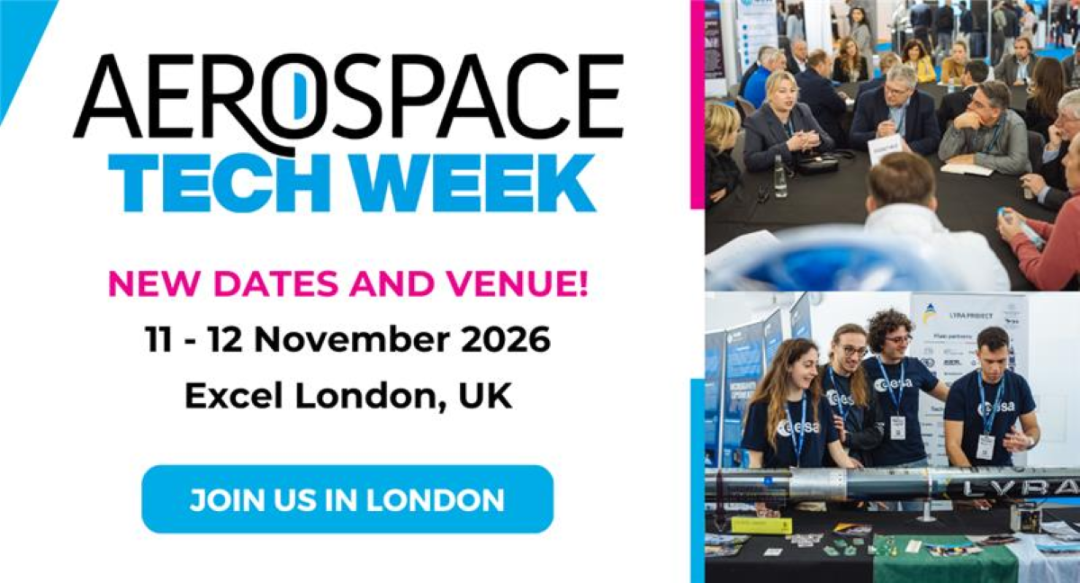
We are excited to announce a significant strategic update to Aerospace Tech Week 2026: the event will now take place in London, UK!
Moving from Munich, Germany to the world-leading Excel exhibition centre means the event can better serve the evolving needs of the aerospace industry. Additionally, new confirmed dates of 11 – 12 November 2026 give us more time to craft our dynamic exhibitor hall and informative agenda.
Lucy Matthews, Senior Conference Producer for Aerospace Tech Week, said:
Moving Aerospace Tech Week to London represents a major step forward for the event. It gives us the opportunity to grow our audience, expand the technical depth of the programme, and deliver our biggest and best edition yet.
Why join us in London?
- A global gateway: Unrivalled international connectivity to attract a truly global visitor base.
- The hub of innovation: Direct access to the UK’s leading aerospace, tech, and investment sectors.
- Enhanced programme: The new dates provide an extended runway to build our most ambitious conference and exhibition to date.
As we prepare for our biggest edition yet, we are now inviting industry leaders to secure their place in the 2026 programme.
Want to be part of the London launch? Whether you are looking to showcase your latest technology on the exhibition floor, lead the conversation as a speaker, or elevate your brand through sponsorship, we want to hear from you.
Click here to speak, sponsor, or exhibit.
Confirmed speakers already including representatives from the UK Ministry of Defence, Oman Air, Airbus, the Civil Aviation Authority, and TAP Maintenance & Engineering.
We look forward to welcoming you and the rest of the global aerospace community to London in November 2026.
About Aerospace Tech Week
Aerospace Tech Week is an event focused on driving innovation and technology advancements in the aerospace sector. Bringing together senior executives and technical leaders, ATW connects the whole value chain of aerospace to discuss, connect, and collaborate on emerging trends, challenges, and opportunities.
In 2026 we are excited to reunite our community of 1,500 industry experts for two inspiring days featuring over 120 speakers. Key topics covered include AI, avionics, flight ops, and sustainability, while our exhibitor and networking programmes spark connections that drive transformations across the industry.
Subscribe to our newsletter to get the latest aerospace news and exclusive interviews straight to your inbox.
by Elsie Clark | Dec 1, 2025 | Innovation, MRO IT
Airbus has reported that the majority of A320 and A320neo aircraft have returned to operation after being grounded suddenly on 28 November.
A safety alert was issued after a JetBlue A320 experienced an uncontrolled descent lasting for several seconds during a flight from Newark to Cancun on 30 October. Airbus’s subsequent investigation found that intense solar radiation was corrupting critical flight control data, forcing thousands of A320s across the world to be recalled for updates.
The manufacturer said on 1 December that fewer than 100 of the 6,000-strong fleet were still undergoing upgrades. For most aircraft, a simple software update was all that was required, but some older models require a more time-consuming hardware installation.
Around 60% of the world’s 9,900 active A320s and sister models were affected by the grounding. 2025 is a peak year in the solar weather cycle, which caused the unusually intense solar radiation that affected JetBlue’s flight.
In the wake of the disruption, Airbus CEO Guillaume Faury issued an apology on LinkedIn, stating:
I want to sincerely apologise to our airline customers and passengers who are impacted now. But we consider that nothing is more important than safety when people fly on one of our Airbus Aircraft – like millions do every day.
Our teams are working around the clock to support our operators and ensure these updates are deployed as swiftly as possible to get planes back in the sky and resume normal operations, with the safety assurance you expect from Airbus.
Join us at Aerospace Tech Week 2026, where Airbus Chief Technology Officer Dr Sabine Klauke will be speaking.
For more like this, see:
by Elsie Clark | Nov 11, 2025 | Innovation, MRO IT
British Airways (BA) have chosen MRO-PRO to digitise and manage the airline’s entire line maintenance network.
The partnership represents a significant advance in BA’s modernisation strategy. Thanks to MRO-PRO’s cloud-based software, the carrier can now tap real-time visibility and forecasting maintenance management. Integrating inbound flight data with engineer availability, the platform also helps optimise staff allocation to address MRO issues more efficiently.
MRO-PRO will be rolled out across BA’s international hubs, including London Gatwick, Manchester, New York, Delhi, and Sydney. Gavin Shearer, Head of Operations – Line Maintenance at British Airways, explained the benefits the airline has already realised:
The system has enabled simplified aircraft workflows with enhanced performance visibility for managers, through improved data insights, and delivered smarter work allocation using flight radar feeds to track any aircraft delays and reprioritise tasks.
He also noted that all of BA’s engineers were now using the system after a full onboarding and training process.
Scott Wells, founder and managing director of MRO-PRO, said that his company was advancing ‘[a] new standard in digital MRO management’. He commented:
MRO-PRO is proud to announce that British Airways, one of the world’s most recognised and prestigious airlines, has chosen our platform to manage the MRO requirements for all its customer line maintenance network. This new partnership represents a significant milestone for MRO-PRO in our growth ambition to deliver digital and AI-enhanced solutions to leading airlines and maintenance providers across the world.
Join us at Aerospace Tech Week 2026 to discuss the latest developments in MRO IT.
For more like this, see:




You must be logged in to post a comment.