
by Elsie Clark | Mar 4, 2026 | AI & ML, Avionics, Connectivity, Flight Ops IT, Innovation, MRO IT, Sustainability
Aerospace Tech Week, the premier international exhibition and conference for the aerospace technology community, is proud to announce a new partnership with ADS Group as the event prepares to launch its inaugural UK edition in London.
The move to the UK marks an exciting new chapter for Aerospace Tech Week, which has established itself as the event for senior executives and technical leaders across the aviation and aerospace sectors. The United Kingdom provides a natural home for the show’s next evolution. World-class engineering, global-leading MRO capability, pioneering sustainability research, and an unmatched supply chain make this industry a cornerstone of British economic and industrial strength. It deserves an event that reflects that ambition.
To mark this milestone, Aerospace Tech Week is delighted to partner with ADS Group, the UK’s leading trade association representing the aerospace, defence, security and space sectors. ADS supports over 1,800 member companies across the UK, championing their interests, enabling business growth, and advocating for the policies and investment that keep British industry globally competitive. The partnership will help ensure that Aerospace Tech Week’s London edition is deeply connected to the UK industry community from day one.
Daniel Boyle, General Manager at Aerospace Tech Week said:
Aerospace Tech Week brings together the leaders shaping the future of aviation technology, so partnering with ADS is a natural fit. As the UK’s leading trade association for aerospace, defence, security and space, ADS represents a powerful network of innovators and industry stakeholders. We are delighted to be working together to strengthen engagement across the ecosystem and ensure Aerospace Tech Week continues to provide real value, meaningful connections and forward-looking insight for the industry.
Balaji Srimoolanathan, Aerospace Director at ADS Group said:
We are pleased to partner with Aerospace Tech Week as it launches its first UK edition, and to have another opportunity to showcase the innovation, ambition and global competitiveness of the UK’s aerospace, defence, security and space industries. Aerospace Tech Week provides an important platform for industrial collaboration across the entire ecosystem. With more than 1,800 member companies spanning the full breadth of the supply chain, we are committed to forming partnerships that connect industry with new opportunities, new technologies and new international relationships. We look forward to supporting a successful inaugural event and ensuring the UK’s world leading expertise is front and centre as the sector continues to innovate, export and grow.
Aerospace Tech Week’s inaugural UK edition will bring together airlines, MROs, ANSPs, OEMs and their partners to explore the latest developments across avionics, connected aircraft, MRO IT, flight operations technology, cybersecurity, sustainability and more.
For further information, to register, or to enquire about exhibition and sponsorship opportunities, click here.
About Aerospace Tech Week | 11 – 12 November 2026, Excel London
Aerospace Tech Week is a conference and exhibition focused on driving innovation and technology advancements in the aerospace sector. Bringing together senior executives and technical leaders, ATW connects the whole value chain of aerospace to discuss, connect, and collaborate on emerging trends, challenges, and opportunities.
In 2026, the event will reunite its community of 1,500 industry experts for two inspiring days featuring over 120 speakers. Key topics covered include AI, avionics, MRO, flight ops, and sustainability, while exhibitor and networking programmes spark connections that drive transformations across the industry.
Visit the event website here.
Subscribe to our newsletter to get the latest aerospace news and exclusive interviews straight to your inbox
by Elsie Clark | Jan 14, 2026 | AI & ML, Avionics, Connectivity, Flight Ops IT, Innovation, MRO IT, Sustainability
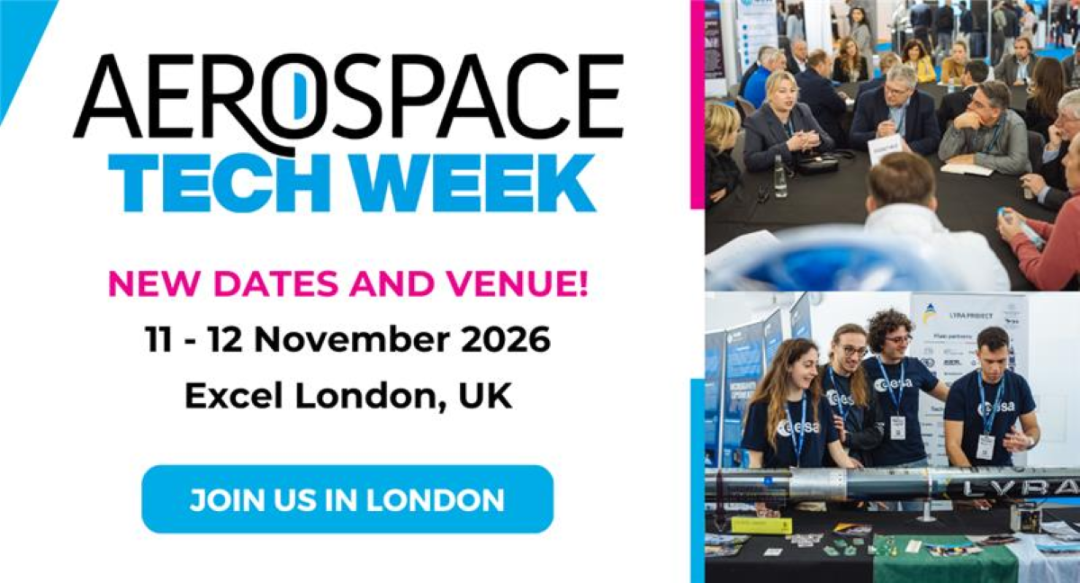
We are excited to announce a significant strategic update to Aerospace Tech Week 2026: the event will now take place in London, UK!
Moving from Munich, Germany to the world-leading Excel exhibition centre means the event can better serve the evolving needs of the aerospace industry. Additionally, new confirmed dates of 11 – 12 November 2026 give us more time to craft our dynamic exhibitor hall and informative agenda.
Lucy Matthews, Senior Conference Producer for Aerospace Tech Week, said:
Moving Aerospace Tech Week to London represents a major step forward for the event. It gives us the opportunity to grow our audience, expand the technical depth of the programme, and deliver our biggest and best edition yet.
Why join us in London?
- A global gateway: Unrivalled international connectivity to attract a truly global visitor base.
- The hub of innovation: Direct access to the UK’s leading aerospace, tech, and investment sectors.
- Enhanced programme: The new dates provide an extended runway to build our most ambitious conference and exhibition to date.
As we prepare for our biggest edition yet, we are now inviting industry leaders to secure their place in the 2026 programme.
Want to be part of the London launch? Whether you are looking to showcase your latest technology on the exhibition floor, lead the conversation as a speaker, or elevate your brand through sponsorship, we want to hear from you.
Click here to speak, sponsor, or exhibit.
Confirmed speakers already including representatives from the UK Ministry of Defence, Oman Air, Airbus, the Civil Aviation Authority, and TAP Maintenance & Engineering.
We look forward to welcoming you and the rest of the global aerospace community to London in November 2026.
About Aerospace Tech Week
Aerospace Tech Week is an event focused on driving innovation and technology advancements in the aerospace sector. Bringing together senior executives and technical leaders, ATW connects the whole value chain of aerospace to discuss, connect, and collaborate on emerging trends, challenges, and opportunities.
In 2026 we are excited to reunite our community of 1,500 industry experts for two inspiring days featuring over 120 speakers. Key topics covered include AI, avionics, flight ops, and sustainability, while our exhibitor and networking programmes spark connections that drive transformations across the industry.
Subscribe to our newsletter to get the latest aerospace news and exclusive interviews straight to your inbox.
by Elsie Clark | Dec 12, 2025 | Flight Ops IT, Innovation
European aerospace giant Airbus, in collaboration with Delta, Air France and Virgin Atlantic, has successfully completed a critical phase of flight testing for its innovative ‘fello’fly’ project. This uses wake energy retrieval (WER) to significantly cut fuel burn on long-haul routes.
The initiative, which draws direct inspiration from the ‘V’ formation adopted by migrating geese, involves a trailing aircraft positioning itself within the optimal updraft created by the lead jet. This highly precise manoeuvre reduces the trailing aircraft’s drag, resulting in a substantial increase in fuel efficiency for long-haul operations. Airbus and their partners worked under the SESAR Joint Undertaking GEESE project.
An Airbus spokesperson noted:
While the actual wake energy retrieval flights have not been tested yet on commercial flights, the successful completion of the rendezvous process is a crucial first step toward future efficiency gains.
Airbus has stated the method could deliver fuel savings of up to 5% on Transatlantic voyages. Specific flight demonstrators showed a resulting reduction in CO2 emissions of six tonnes per paired operation. Other collaborators included AirNav Ireland, DSNA, EUROCONTROL Network Manager, French bee, and NATS. Airbus described EUROCONTROL’s Innovation hub interface as ‘key’ to proving the concept’s safety in real-world conditions.
The project addresses a critical challenge for the future of commercial aviation, particularly for wide-body routes. For such aircraft flying over oceans, batteries do not represent a viable sustainability solution.
While the technical solution is now proven, the project’s next steps will focus on operational integration. This includes securing the necessary regulatory changes and working with Air Navigation Service Providers (ANSPs) to adapt procedures, ensuring that aircraft can safely fly in the close 1.5-nautical-mile proximity required for WER.
Join us at Aerospace Tech Week 2026, where we’ll be joined by leading speakers from EUROCONTROL.
For more like this, see:
by Elsie Clark | Nov 14, 2025 | Flight Ops IT, Innovation
Vietnam Airlines has adopted Lido 4D Flight Planning software for better operational safety and efficiency.
Produced by Lufthansa Systems, the tool enhances real-time situational awareness with updates from weather stations and air traffic control. Sustainability is also a focus, with Lido 4D helping airlines reducing unnecessary emissions and chart optimal flight paths. The solution is a significant step above traditional semi-automated processes, allowing pilots to make decisions more dynamically and adapt to changing circumstances more rapidly.
To Ngoc Giang, Executive Vice President at Vietnam Airlines, commented,
With the support from Lufthansa Systems, we are well-positioned to navigate the challenges and opportunities of the future, reinforcing our status as a premier airline in Asia and beyond.
Other airlines who have adopted Lido 4D include ANA, Emirates, and Malaysia Airlines. Vietnam Airlines currently holds a 4-star rating on Skytrax. Tech investment hopes to put them on equal footing with top airlines in APAC and achieve that coveted 5-star rating. More efficient planning will not only reduce their carbon emissions, but pass on benefits to customers such as smoother flights and improved on-time performance (OTP).
Lufthansa Systems, the in-house innovation team from German airline Lufthansa, supports over 350 customers. Vietnam Airlines adds Lido 4D Flight Planning to its existing suite of Lufthansa Systems solutions,, including mPilot, Lido FMS, and Lido AMDB.
Join us at Aerospace Tech Week 2026 to discuss the future of flight ops IT.
For more like this, see:
by Elsie Clark | Oct 29, 2025 | AI & ML, Flight Ops IT, Innovation
Dubai-based carrier Emirates has reported a measurable decrease in unexpected turbulence incidents over the past year thanks to onboard data and analytics.
Changing atmospheric conditions due to climate change are making inflight turbulence more regular and more severe. Notably, scientists at Reading University in the UK found that severe turbulence has increased by 55% between 1979 and 2020 over the North Atlantic. Professor Paul Williams, one of the scientists leading the project, told the BBC earlier this year that turbulent incidents could soon double or treble in length due to changes in temperature and wind patterns.
Turbulence hit the headlines in 2024 after one died and many more were injured on a Singapore Airlines flight from London Heathrow. Additionally, ICAO reported in 2023 that 40% of all inflight injuries were the result of turbulence.
Emirates takes action to mitigate unexpected turbulence
Over the past year, Emirates has been investing in multiple systems that can provide pilots with real-time analytics and help its aircraft avoid severe turbulence. Captain Hassan Alhammadi, Divisional Senior Vice President Flight Operations at Emirates, said:
While we cannot promise turbulence-free flights, these initiatives have contributed to a significant reduction in unexpected severe turbulence incidents over the past year, helping make journeys safer and more comfortable for our customers.
One technology partner is SkyPath, which uses AI and machine learning (ML) to detect and predict turbulence hotspots that traditional weather forecasting might overlook. Alongside this platform, Emirates has deployed Lufthansa Systems’ Lido mPilot application, which provides pilots with high-resolution weather data and real-time alerts.
Emirates is also participating in IATA’s Turbulence Aware programme, sharing data with airlines to help other aircraft adjust flight paths in advance to minimise the impact of turbulence.
Alhammadi added:
Our multi-layer approach with weather prediction and technology partners and active participation in the IATA Turbulence Aware programme also enables us to contribute valuable data and insights to the broader aviation industry as we collectively work to address this growing meteorological challenge.
Join us at Aerospace Tech Week 2026, where our dedicated track will be discussing data-driven flight ops.
For more like this, see:
by Elsie Clark | Oct 22, 2025 | Flight Ops IT, Innovation, Sustainability
According to the latest patent data, innovation in AI for sustainable aviation and aerospace tech has increased by 20% over the past five years.
The Inside Green Innovation: Progress Report from Appleyard Lees found that global patent filings in the sector went up from 254 in 2019 to 307 in 2023. Increasing control of variables such as aircraft altitude, speed, and pressure, as well as advances in onboard systems and digital data processing, are attributed to the growth.
Adam Tindall, UK and European Patent Attorney for Appleyard Lees, said:
Innovations in areas such as aircraft design, propulsion, operational efficiencies and reductions in waste and energy infrastructure – traditionally aimed at achieving business advantage – are now expected also to reduce carbon emissions and meet environmental targets.
As part of this, AI-driven innovation is showing a tangible surge in aviation and aerospace and redefining how organisations are addressing the industries’ challenges.
The report found that Boeing remains the leader in sustainable aerospace development, filing the most patents over the past ten years. Other leaders include Honeywell, GE Aerospace, Airbus, Thales, and the Chinese company SZ DJI Technology. French company Safran was also highlighted as a key developer in fuel efficiency and hybrid propulsion.
The use cases for AI in sustainable aviation development are only increasing. From flight ops to SAF production, the potential for optimisation is extensive. However, the aviation industry must remember that strong data foundations are required for AI insights to be useful and actionable. And while the patent activity is promising, as net-zero emissions targets loom nearer, successful implementation will be just as important as innovation.
Join us at Aerospace Tech Week 2026 to discuss the future of AI, flight optimisation, and sustainability.
For more like this, see:





You must be logged in to post a comment.