
by Jessica Brownlow | Mar 13, 2025 | Innovation
Today, Archer Aviation announced a new partnership with Palantir Technologies Inc. to improve the software platforms that underpin air traffic control, movement control, and route planning as well as accelerate Archer’s manufacturing capabilities. Palantir’s Co-Founder and CEO described the collaboration as “setting the stage for a transformative leap in efficiency, safety and sustainability.”
The announced partnership has two primary focuses: manufacturing efficiency and smarter aviation systems. Archer will use Palantir’s AI-powered software, Palantir Foundry and AIP, to “accelerate the scaling of Archer’s aircraft manufacturing capabilities.” The pair also plan to drive innovation in next-gen software, elevating ATC, movement control, and route planning. As new aircraft enter the ecosystem, this progress will ensure safer and more efficient operations into the future.
Speaking on the announcement, Archer’s Founder and CEO, Adam Goldstein, said:
“While the aviation industry has an unmatched level of safety, much of the legacy technology supporting the industry has only incrementally advanced. AI and software present an inflection point that will shape the future of aviation. We’re proud to be partnering with Dr. Karp and the entire Palantir team to build the AI backbone for the next generation of aviation.”
While the European eVTOL market appears rocky with Volocopter and Lilium facing insolvency and Airbus pausing its CityAirbus NextGen programme, Archer is going from strength to strength announcing Abu Dhabi Aviation as the first customer planning to deploy Midnight.
For more like this see:
by Jessica Brownlow | Mar 12, 2025 | Innovation, Video
The aerospace industry has reached a ground-breaking era of innovation, catalysed by emerging technologies, investment, and pressing challenges. As a result, the landscape is evolving rapidly. In this conversation, Sophie Lane, Chief Relationships Officer, Aerospace Technology Institute discussed the recent disruptive technologies shaking the industry and highlighted key start ups to watch.
In her role, Lane is responsible for all relationships, partnerships, outreach, international engagement, and also media and comms. She works alongside both the UK and overseas governments, talking about upcoming partnerships and innovation in the sector. At Aerospace Tech Week Europe Lane will be moderating key sessions on the Innovation in Aerospace track, engaging with Airbus and TUM Venture Labs.
During the discussion, Lane explored landmarks for emerging disruptive technologies in the last year or so. Looking specifically at propulsion innovation, she highlighted the testing of Rolls-Royce’s UltraFan, certification of Safran’s electric motor, and Vertical Aerospace’s battery technology tests. Lane also touched on ZeroAvia’s hydrogen-electric propulsion, as well as the challenges within the eVTOL market.
Speaking on the potential of cross-sector innovation, Lane explained:
“There are lots of crossovers into different sectors. That could be a way we can help to sustain and make sure that we’re ready for that next aircraft program when it comes […] Companies bringing technologies from healthcare, such as Adaptix with x-ray technology for non-destructive testing, are really exciting examples of how cross-sector innovation can drive progress in aerospace.”
Watch the full interview below to hear which lesser-known innovators are changing the game, how to balance investment against innovation risks, and learn more about Lane’s sessions onsite at the event.
To join us at ATW Europe book your ticket now!
Questions asked include:
- What would you pick out as the most disruptive technologies from the last year or so?
- Given the rapid pace of technological evolution, how can decision makers strike the right balance between investing in new technology today and waiting until it is more fully developed?
- What are some companies to watch when it comes to industry leading innovation?
- Are there any sessions you’re particularly looking forward to at this year’s event (these could be yours or any others!)
For more on Aerospace Tech Week 2025 see:
by Jessica Brownlow | Mar 10, 2025 | Innovation
RTX-owned Collins Aerospace has opened a new, $25m Engineering Development and Test Centre (EDTC) in Bengaluru, India. By conducting testing closer to where engineering and manufacturing are taking place, the facility plans to accelerate innovation and bring new technologies to market more efficiently.
Emphasising the transformative potential of this facility, Clay Lindwall, Senior Vice President of Engineering & Technology at Collins Aerospace said:
“The aerospace industry is evolving at an incredible pace, and this new centre gives us the capability to support that evolution by making the testing and certification process faster and more efficient. The EDTC strengthens our ability to deliver high-quality, mission-critical systems that meet the needs of customers in India and around the world.”
The “state-of-the-art” facility will simulate extreme temperatures, high altitudes, vibration, and electromagnetic interference to confirm systems are aligned with the highest global safety and performance standards.
Speaking on the significance of this to the Indian market, Savyasachi Srinivas, Vice President of Global Engineering & Technology Centres highlighted:
“This EDTC is a major milestone – not just for Collins Aerospace but for India’s aerospace industry, creating highly-skilled jobs and supporting the ‘Make in India’ initiative. This investment brings advanced testing capabilities closer to where engineering and manufacturing happen and recognises the country’s strategic importance in the global supply chain.”
Not only will the EDTC catalyse the journey from concept to certification, but it will also reinforce India’s role in the supply chain in the process.
For more like this see:
by Jessica Brownlow | Mar 6, 2025 | Innovation, Sustainability
Originally published on World Aviation Festival
Delta Air Lines has announced a “game-changing” new partnership with start up JetZero to catalyse the production of a blended-wing-body (BWB) aircraft. The aircraft design is expected to be up to 50 per cent more fuel-efficient than today’s models.
The official partnership, announced yesterday, follows JetZero’s existing collaboration with the US Air Force, which awarded the start up a grant in 2023.
JetZero plans to launch its first aircraft in 2030 with 100 per cent SAF compatibility, bolstered by support from the US Air Force, NASA, and the FAA.
Delta will “provide the operational expertise to help make this technology viable,” committing its extensive knowledge of maintenance and operational insights to develop the aircraft.
Speaking on the announcement, Amelia DeLuca, Delta’s Chief Sustainability Officer said:
“Working with JetZero to realise an entirely new airframe and experience for customers and employees is bold and important work to advance the airline industry’s fuel saving initiatives and innovation goals. While Delta is focused on doing what we can today to address our carbon footprint, it’s critical we also work with a variety of partners to advance revolutionary technologies, like JetZero’s blended-wing-body aircraft, to solve for a significant portion of future aviation emissions.”
JetZero is the fourth “revolutionary fleet” partnership the carrier has signed as it assumes a leading role in shaping the future of sustainable aviation.
For more like this see:
by Jessica Brownlow | Mar 5, 2025 | Innovation
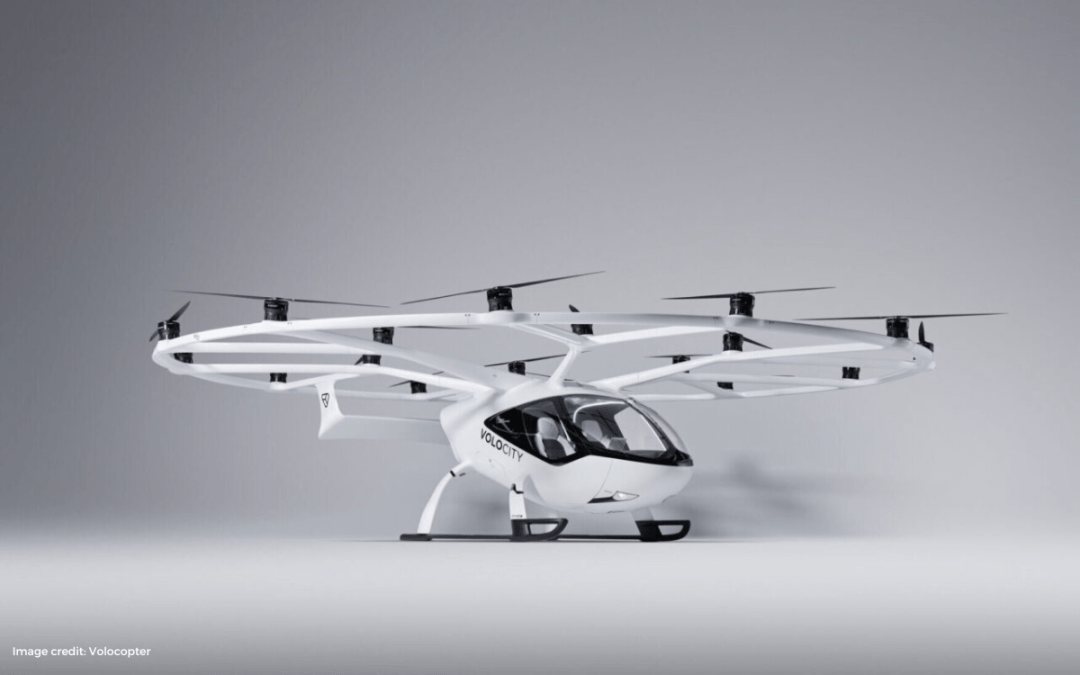
Volocopter’s 500 employees received a notice of termination this week after the German eVTOL (electric vertical takeoff and landing) aircraft developer’s hopes of finding investors by the end of February failed to materialise. When filing for insolvency at the end of the year, Volocopter said:
“The company needs financing to take the final steps towards market entry. We will endeavour to develop a restructuring concept by the end of February and implement it with investors.”
Although this is not promising, German business publication WirtschaftsWoche shared that a solution is still being discussed with “various existing shareholders and new investors.”
Fellow German eVTOL developer Lilium filed for insolvency a second time towards the end of February after the collapse of a €200 million rescue deal. Forbes shared a statement sent to journalists which explained:
“As the funding options to secure Lilium’s future have not materialised in time, Lilium Aerospace has filed for insolvency today. While talks about alternative solutions are still ongoing, the chance for restructuring right now is highly unlikely and therefore operations will be stopped.”
Despite it once looking like the European eVTOL market would lead the industry, major players are struggling to bring the product to market. Back in January, Airbus Helicopters CEO, Bruno Even, shared concerns over the maturity of battery technology and announced the company will be pausing the development of its CityAirbus NextGen electric vertical-takeoff-and-landing (eVTOL) advanced air mobility (AAM) aircraft at the end of the year.
Who do you think will be the first eVTOL company to launch commercial operations?
For more like this see:





You must be logged in to post a comment.