
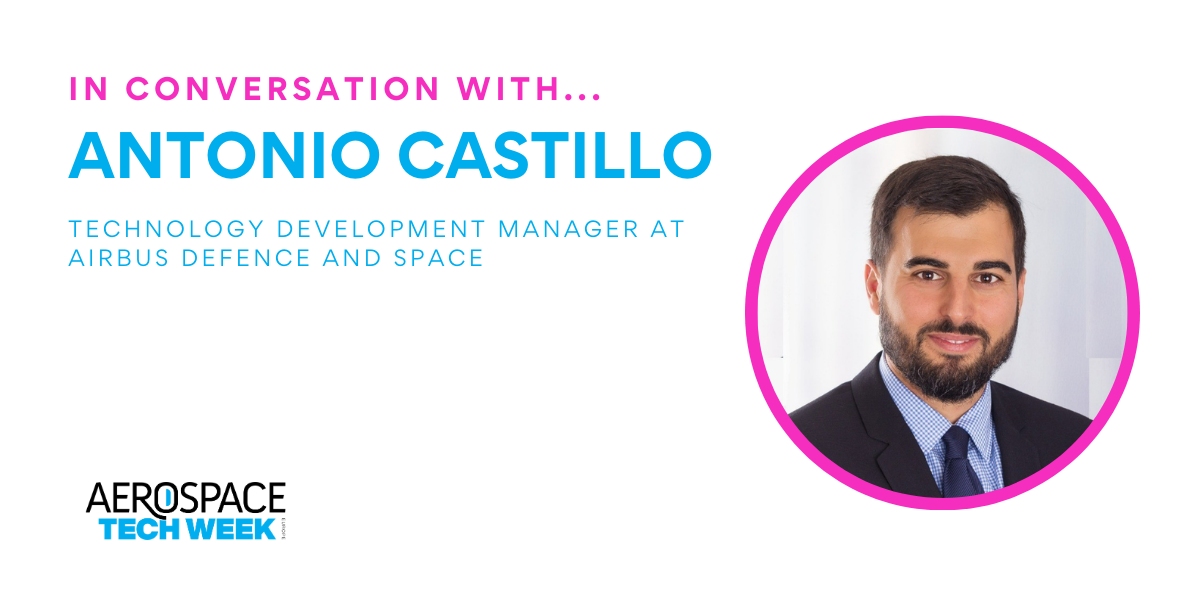
At Aerospace Tech Week, Antonio Castillo, Technology Development Manager at Airbus Defence and Space joined to share his insights on hyperconnected airspace.
During the five minute conversation, Castillo mapped out Airbus’s current connectivity focus and its technological approach, while highlighting key challenges the industry needs to overcome.
Looking to the future, Castillo discussed the development of next-gen satellites, application of artificial intelligent (AI) to automate processes, 4D trajectory prediction, and more. Speaking on the push to implement 4D trajectories by 2028, Castillo said:
“It will bring a lot of benefit to the industry in terms of cost savings, efficiency in operations, higher security or safety for operations, and that’s great. Where we believe we can bring a big improvement is to do that you need continuous connectivity and you need seamless connectivity so that you can get the data you can analyse it and optimise it in real time. I know everybody likes a lot to speak about AI, but maybe in the future you can also do it in an automated way through AI but of course it would take time.”
For more detail, watch the short five-minute interview now.
Questions asked include:
- What is Airbus’ contribution to the vision of hyperconnected airspace and what are the main challenges here?
- When it comes to ensuring efficiency of airborne operations, how much still needs to be done in terms of streamlining and what are the major benefits of this to the wider ecosystem?
- Can you tell me a bit about the trajectory for your next generation of satellites and the importance of flexibility when planning for the future?
For more from onsite at Aerospace Tech Week see:
- Asteris Apostolidis, KLM: Revolutionising aerospace with “trustworthy AI”
- What is holding back progress in the connected ecosystem? Rene de Vogel shares his insight
- Harnessing data to drive the connected aviation ecosystem