
by Elsie Clark | Jan 8, 2026 | Innovation, Sustainability, Video
Boasting more than 600 aircraft that fly to over 250 destinations, the International Airlines Group (IAG) manages some of Europe’s best-known airlines, including British Airways, Iberia, and Vueling. But how can the group manage an effective sustainability strategy across these unique brands?
In an exclusive interview at World Aviation Festival 2025, Jonathon Counsell, Group Director of Sustainability at IAG shared his insight on setting the direction. While aviation’s overall enthusiasm for ESG might have waned from its peak in the mid-2010s, IAG remain committed to their 2050 net-zero emissions target.
We recognise that this is a long-term challenge for us. We have to address our carbon emissions, and we have as an industry a clear roadmap to do that. Fundamentally, climate change is driven by the science, not just politics. So it’s something we have to do.
IAG is currently on track to achieve its 10% sustainable aviation fuel (SAF) target by 2030. US$3.5 billion has been invested so far through partnerships with cutting edge companies such as Infinium, a low-carbon eFuels developer. Counsell sees ‘real value’ in bringing the five member airlines together to share progress and success stories.
It’s quite a close group. We meet every month, and every quarter we have a two-day workshop where we all get together. It’s fantastic to see the sharing of best practice among all the different participants.
IAG’s other investments include ZeroAvia, developers of hydrogen-propelled aircraft. However, Counsell believes in the short term SAF production needs to accelerate to reduce the impact of this hard-to-decarbonise industry, especially while demand continues to outstrip supply.
I truly believe there is a first-mover advantage when it comes to decarbonisation. Our view is that some of the advanced fuels in the second and third generations will be in short supply post-2030. So we think it’s really important that companies get into the market early to secure the regular supply of these SAFs.
🎥 Watch the interview to hear the full conversation on sustainability with Jonathon Counsell.
Questions asked include:
- Do you think that geopolitical change has slowed momentum on sustainability in aviation?
- IAG has committed to net-zero emissions by 2050. What progress have you made on that goal so far? What are the Group’s biggest success stories?
- As an airline group, you have to oversee the sustainability targets of five separate airlines. Is it a challenge bringing all these parties together, or do you see it as an opportunity for greater collaboration?
Jonathon Counsell will be speaking at Aerospace Tech Week 2026. Join us.
For more like this, see:
by Elsie Clark | Dec 10, 2025 | Sustainability
IATA has published its latest sustainable aviation fuel (SAF) production figures and issued a stark warning as the industry looks set to miss key targets.
SAF production has doubled from 2024, reaching 1.9 million tonnes (Mt) by the end of 2025, according to IATA. However, these numbers full short of earlier forecasts, and in 2026 the production rate is projected to slow and reach only 2.4Mt.
IATA lists policies in Europe, including the EU’s ReFuelEU Aviation and UK SAF mandates, as key hindrances. They say these schemes have pushed high SAF costs onto airlines and fail to nurture a stable supply chain. In a strongly-worded statement, Director General Willie Walsh emphasised the urgency of change:
SAF production growth fell short of expectations as poorly designed mandates stalled momentum in the fledgling SAF industry. If the goal of SAF mandates was to slow progress and increase prices, policymakers knocked it out of the park. But if the objective is to increase SAF production to further the decarbonisation of aviation, then they need to learn from failure and work with the airline industry to design incentives that will work.
Marie Owens Thomsen, IATA’s Senior Vice President for Sustainability and Chief Economist, said it would be ‘outrageous’ if regulators were to take the same approach with forthcoming e-SAF mandates. e-SAF already suffers from a much-higher cost base than conventional SAF due to the costs of renewable energy supplies.
Regardless, IATA say the failures of SAF so far have already complicated sustainability targets. Walsh adds:
Regrettably, many airlines that have committed to use 10% SAF by 2030 will be forced to reevaluate these commitments. SAF is not being produced in sufficient amounts to enable these airlines to achieve their ambition. These commitments were made in good faith but simply cannot be delivered.
Join us at Aerospace Tech Week 2026 to discuss the future of sustainable aviation.
For more like this, see:
by Elsie Clark | Nov 24, 2025 | Innovation, Sustainability
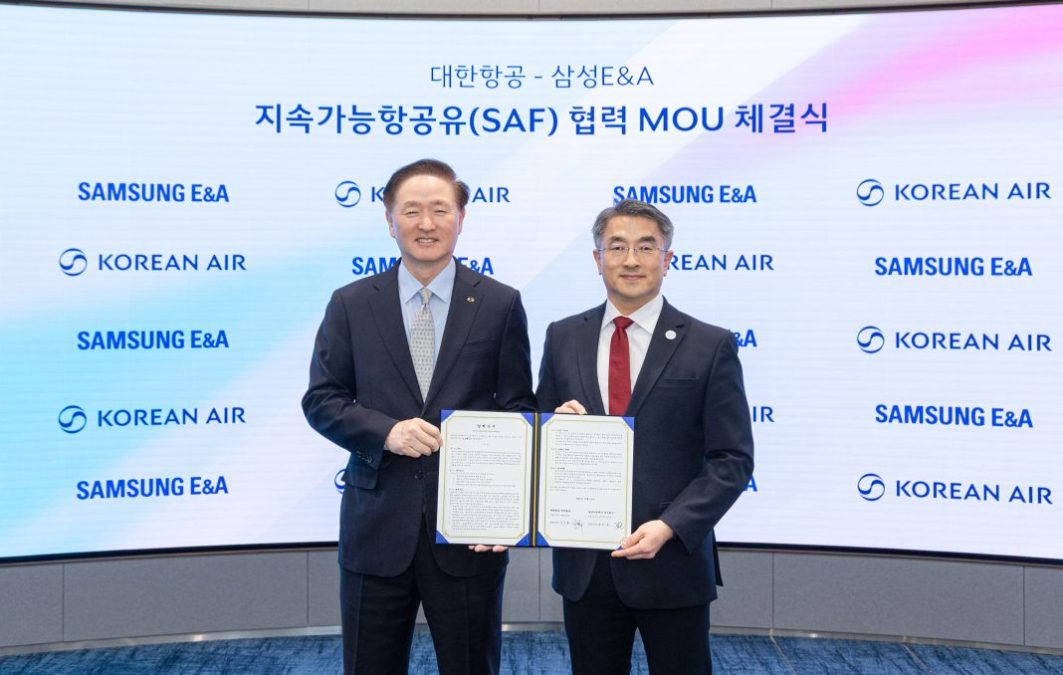
Korean Air and Samsung E&A have signed a Memorandum of Understanding (MoU) to develop a sustainable aviation fuel (SAF) supply chain in the US.
The airline and the engineering firm’s announcement forms part of their commitment to accelerate sustainable energy solutions in aviation. Samsung E&A will build on existing feedstock capacity and infrastructure in the US with its engineering expertise. Meanwhile, Korean Air has signed to become a SAF buyer, ensuring critical long-term demand. Other airlines including Delta and Air France have struck similar agreements to nurture the SAF industry as it takes flight.
Samsung E&A is considering participating in a SAF project that uses gasification–Fischer-Tropsch (FT) technology. This second-generation SAF fuels converts abundant woody waste into synthetic liquid fuel, a significant advance on first-generation processes that use limited supplies of waste cooking oil.
On the partnership with Samsung E&A, a spokesperson for Korean Air commented:
This partnership will further contribute to the aviation industry’s Net Zero 2050 goal and enhance our ability to effectively navigate evolving global environmental regulations, including SAF mandates. Through proactive project participation and continuous cooperation, we aim to accelerate global SAF adoption and advance our commitment to sustainable aviation and ESG management.
A report from IATA earlier this year found that SAF production is currently on track to fall 100 million tonnes short of net-zero emissions targets. The air transport association emphasise that investing in technology, not feedstock, was critical to ramping up sustainability efforts. If successful, Korean Air and Samsung’s new partnership will contribute directly to addressing this issue.
Join us at Aerospace Tech Week 2026 to discuss the future of sustainable aviation fuel (SAF).
For more like this, see:
by Elsie Clark | Oct 30, 2025 | Innovation, Sustainability
Honeywell have pioneered a new production process that turns agricultural and forestry waste into sustainable aviation fuel (SAF).
Under the UOP (Universal Oil Products) Biocrude Upgrading process, inexpensive biomass feedstocks such as wood chips and sawmill dust are converted into a renewable biocrude. This can then be refined at existing petroleum refineries, with no need for further specialist facilities.
The new fuel process complements Honeywell’s existing portfolio of renewable fuels. These including Ecofining, developed in partnership with Eni S.p.A., which converts fats and oils into renewable deisel and SAF. Honeywell’s Ethanol-to-Jet (ETJ) tech turns ethanol into synethetic paraffinic kerosene, while the Fishcer-Tropsch Unicracking refines synthetic gas into liquid fuels.
Ken West, President & CEO of Honeywell Energy & Sustainability Solutions, said:
As demand for SAF continues to grow, the aviation industry is challenged by limited supplies of traditional SAF feedstocks such as vegetable oils, animal fats and waste oils.
When combined with the existing Fischer-Tropsch process, our new technology will expand the feedstock options available in the industry to sources that are more plentiful, ultimately helping improve our customers’ ability to produce SAF.
The new biomass-derived fuel puts the US company in competition with other SAF pioneers, including the Finnish brand Neste, the current leader in SAF production. The race to scale SAF is well and truly on, as demand for sustainable fuels far outpaces current supply, and cost pressures inhibit competitivity with the jet fuel market.
Join us at Aerospace Tech Week to discuss the future of sustainability in aviation operations.
For more like this, see:
by Elsie Clark | Oct 28, 2025 | Sustainability
The European Union Aviation Safety Agency (EASA) says that the industry is on track to achieve its target of 6% sustainable aviation fuel (SAF) by 2030.
The ReFuelEU Aviation Annual Technical Report found that 0.6% of Europe’s supplied aviation fuel for 2024 was SAF. This percentage needs to increase rapidly, but nevertheless saved 714 kilotonnes of carbon emissions, the equivalent of around 10,000 flights between Madrid and Paris.
Overall, EASA believes the EU is on track to achieve its 6% blending target in the next five years. Whether the bloc hits its interim target of 2% SAF in 2025 will be assessed at the close of this calendar year.
China is Europe’s biggest supplier of biofuel
EASA’s findings also highlight the ongoing cost obstacles to SAF adoption. Currently, the average price of SAF sits at €2,085/tonne, compared to €734/tonne for conventional jet fuel. Until the cost becomes more competitive, it is difficult to see how SAF use can scale successfully. Earlier this year, Airlines for Europe (A4E) criticised the EU for imposing SAF mandates without taking action to create a viable SAF market. Nevertheless, EASA’s report affirms progress on the 6% target.
Europe’s biggest producer of SAF is currently Finland, responsible for 10% of supply. However, 69% of feedstock originates outside of the EU, with China the biggest supplier.
Maria Rueda, EASA’s safety management, sustainability and global outreach director, said:
This first annual technical report marks an important milestone and makes clear that the EU has taken important first steps.
A functioning reporting system is now in place, initial reporting compliance levels are solid, and SAF delivery is happening across multiple member states. This report sets an important benchmark for our sustainability efforts in the future.
Join us at Aerospace Tech Week 2026 to discuss the future of sustainable aviation.
For more like this, see:





You must be logged in to post a comment.