
by Elsie Clark | Dec 3, 2025 | Innovation, Sustainability
The aviation industry produces 868 megatonnes (Mt) of carbon dioxide every year, making it one of the highest-polluting industries on the planet. And while enthusiasm for sustainability is high, making air travel zero-carbon is a complex challenge, especially as passenger demand only continues to increase.
While sustainable aviation fuel (SAF) production scales, aviation must find other ways of limiting emissions as much as possible. Data is key to this endeavour, as it is only through reliably identifying emission sources that strategies can be developed to tackle them.
This is the mission of Estuaire, a Paris-based startup co-founded by CEO Maxime Meijers. For his innovative work in the field, Meijers was honoured as our Top Innovator at the Aerospace Tech Review Awards 2025. His passion for aviation emerged in his hometown in Toulouse, France’s aviation hub. But after spells at leading aerospace companies, including Airbus, Meijers decided he wanted to build his own business that could more proactively address aviation’s sustainability challenge.
He explains:
Estuaire has two product lines. The first is a data platform where we measure flight-by-flight their climate impact. So we ingest everything, trajectory, weather, aircraft type. Bsically, if you’ve flown a flight we can tell you precisely what this aircraft released in carbon and the associated impact on the environment.
The other side of the business looks at solutions for mitigating climate impact. Meijers’ special passion is reducing contrails: Estuaire estimate that contrails are responsible for over 150Mt of industry emissions.
Meijers and his team have developed a comprehensive index for measuring contrails in real-time, a product they are currently trialling with several airlines. According to their analysis, 2.9% of world flights generated 80% of the total radiative forcing effect of contrails. Rerouting a very small number of flights could therefore have a substantial impact on the climate.
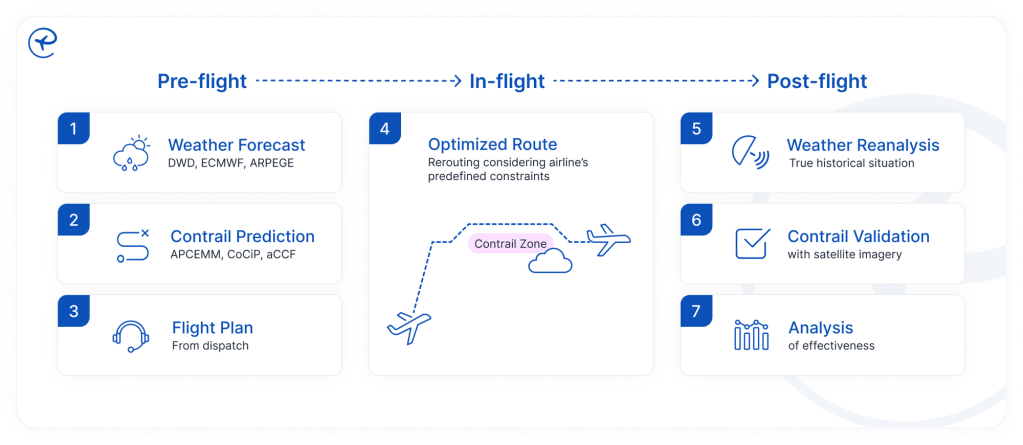
End-to-end contrail management methodology by Estuaire.
Meijers wants to see greater regulation in this area to force further change:
The challenge is that there’s no financial incentives or penalties that push airlines to work on contrails. That’s really something we want to set in place.
Aside from encouraging the EU to act on contrails, Meijers’ ambition is to grow his team and expand their work on emissions monitoring and reduction. On being honoured as Top Innovator, Meijers said:
It’s an award I pass to the team, notably our tech team, because they’re doing the ground work and the quality of our data should speak for itself. So it goes to them first, and having these industry recognitions just encourages us to go further.
🎥 Watch the full interview to hear more about Maxime Meijers’ vision for Estuaire and emissions monitoring in aviation.
Questions asked include:
- Where did your passion for sustainable aviation come from? What was the inspiration behind Estuaire?
- What industry challenges does Estuaire seek to address through its business?
- Which initiatives that you or the company have led that you are most proud of?
- How are you looking to grow in the future? What would you like to do next?
- What is the biggest challenge aviation faces in becoming a sustainable, zero-carbon industry? What advice would you give to help tackle it?
If your business would like to be considered for an Aerospace Tech Review Award, join us at Aerospace Tech Week 2026.
To hear from our other ATR Award winners, see:
by Elsie Clark | Oct 1, 2025 | Innovation, MRO IT
Predictive maintenance using artificial intelligence (AI) and big data is a hot topic in aerospace, as airlines, airports, and engineers all strive to reduce downtime and optimise infrastructure efficiency.
For many, however, implementing predictive maintenance technology remains stuck in the development stages. In an exclusive interview, Kaire Kalve, Head of Supply Chain at Magnetic Group, told Aerospace Tech Review what needs to change for successful predictive MRO adoption.
Different parties and operators all have their own data, so the key challenge here is actually trust.
Kalve discusses why mutual incentives are critical to breaking down barriers across the industry and eliminating data silos. If this isn’t done, predictive maintenance is slow to implement and less effective: the more data you can feed a model, the more accurate it will be.
The key here is operators. They should take the initiative as they have the most valuable data.
Industrywide collaboration will be essential to realising the benefits of predictive maintenance, and events such as Aerospace Tech Week play an important role in developing new partnerships.
The future of maintenance is truly collaborative and based on transparent agreements for data sharing.
🎥Watch the video below to hear Kaire’s full insights on collaboration in predictive maintenance.
Questions asked include:
- Predictive maintenance is widely discussed, but we’re yet to see its widespread implementation. What’s holding the industry back?
- Predictive maintenance relies heavily on data. Who in the industry has the most important data, so to speak?
- Why are events such as Aerospace Tech Week so important?
For more like this, see:
by Elsie Clark | Sep 24, 2025 | Flight Ops IT, Innovation
Optimising flight operations is an increasingly popular topic as the aviation industry tries to reduce emissions and make processes as efficient as possible. But how can data be used to effect meaningful change?
With disruption costing the industry as much as 8% of its revenue, effective flight planning is key to remaining competitive. At Aerospace Tech Week 2025, we sat down with Murray Skelton, Vice President of Business Development at FLYHT Aerospace Solutions, an FTG company, to discuss the future of flight ops.
Most aircraft receive weather updates that are 15 minutes out of date, which can result in delays when flying in unexpected conditions. Skelton discusses how real-time weather updates onboard are essential for ensuring flights operate in the best possible conditions at all times.
We should have, as a community, almost a mandate that says all aircraft that are flying should effectively be flying weather stations.
Weather stations such as the UK Met Office are investing in powerful supercomputers to make forecasts as accurate as possible. But Skelton argues that these computers are only as powerful as the data they provide.
They need more data, and the best place and actually the cheapest place to get the data is to turn aircraft into weather stations.
The conversation also covers the urgent need for aviation to modernise its connectivity infrastructure. With volumes of aircraft expected to double by 2042, leveraging data will be key reducing operational strain.
Right now, ACARS is still the number one communications tool of an airplane. It’s something from 1958, equivalent to very early texting with cellular phones. IP systems are out there, but uptake is quite slow.
Skelton nevertheless remains optimistic about the future, anticipating different ways in which superior data and transmission will enhance flight ops.
The data is getting cheaper. The transmission of data is getting cheaper. And that’s all going to help – but we’re not there yet.
🎥 Watch the full interview to hear Murray Skelton’s full interview on data in aerospace.
Questions asked include:
- How can effective flight planning minimise disruption?
- The number of aircraft in operation is set to double by 2042. How important is it for airlines to leverage data to navigate this transition successfully?
- How do you maintain data quality and ensure all information is reliable and accurate?
For more like this, see:
by Elsie Clark | Sep 8, 2025 | AI & ML, Innovation, Video
From predictive analytics to enhanced scheduling, the aerospace industry now collect more data then ever. But how can Chief Information Officers (CIOs) across the industry leverage that data effectively?
At Aerospace Tech Week 2025, we tapped the expertise of Lauren Edwards, Head of Aerospace and Airlines Practise, from consulting firm Point B. She highlights several priorities for CIOs, including ensuring compatibility between legacy systems and new artificial intelligence (AI) software.
A lot of conversations we’re having are how do we continue to move towards the future while managing and maintaining the information that we have today.
Getting different data systems to ‘talk’ to each other, all while ensuring data cleanliness, presents a challenge for the industry. But when done effectively, the outcomes can be game-changing for customer experience. At the same time, as the workforce ages and workflows incorporate more technology, employees can see significant value too.
We really focus on understanding, and we see the most ROI when your customer experience and your employee experience come together.
🎥 Watch the full interview below to hear more from Lauren on the data landscape for aerospace in the years ahead.
Questions asked include:
- What are the priorities for CIOs in data and privacy in 2025?
- How are data improvements boosting the bottom line for companies?
- What are the major challenges in the landscape?
- What are the untapped benefits of effectively leveraging data and analytics?
Join us at Aerospace Tech Week 2026 to discuss further how data is changing aviation, engineering, and MRO.
To learn 1more, see:





You must be logged in to post a comment.