
by ATR Contributor | Aug 1, 2025 | Sustainability
As the aviation industry faces mounting pressure to decarbonize, OEMs are stepping up with bold innovation, practical design shifts, and deeper collaboration than ever before.
In this interview, Rebina Pozole, Head of Sustainability at Deutsche Aircraft, shares how the company is tackling sustainability challenges through smarter aircraft design, fuel experimentation, and strategic partnerships-with the D328eco aircraft leading the charge.
“We’ve always reduced fuel for economic reasons-now we’re doing it for environmental ones.”
Pozole explains that while long-term innovation is crucial, OEMs have a responsibility to pursue near-term, feasible solutions. For Deutsche Aircraft, this includes improving aerodynamics, weight, and engine efficiency while also testing alternative fuel types like hydrogen, batteries, and more sustainable hydrocarbon use.
“There aren’t that many energy carriers we can use in aviation. We need to explore realistic alternatives-and SAF is one of them.”
She highlights two tracks of experimentation:
- Applied tech testing, like flights using zero-aromatics synthetic fuels
- Research-based experimentation, exploring what may be possible in the future
One major milestone? The upcoming D328eco, scheduled for entry into service in late 2027:
“We’re on track. Seeing the aircraft take shape in the hangar-it’s really exciting.”
Pozole also dives into the critical need for deep, technical collaboration between OEMs, fuel producers, and other ecosystem players:
“It’s not just cooperation for the sake of it. We need to understand each other’s technical and business constraints-something we never had to do before.”
Looking ahead, Deutsche Aircraft is actively forming strategic partnerships with SAF producers to ensure their aircraft can fly with 100% PTL zero-aromatics fuel once it’s commercially available.
Questions asked include:
- What role do OEMs play in the aviation industry’s sustainability journey?
- How is aircraft design being optimized to reduce climate impact?
- What are the key challenges in experimenting with new technologies and fuels?
- Can you tell us about the progress of the D328eco?
- How vital is collaboration in meeting sustainability goals?
- Are there any exciting partnerships on the horizon?
Join us at Aerospace Tech Week Europe 2026!
Subscribe to our free monthly newsletter here.
For more like this see:
by Jessica Brownlow | Jul 14, 2025 | AI & ML, Innovation, Video
As the industry accelerates its digital evolution, Lufthansa Systems is positioning artificial intelligence (AI) and cloud technology at the core of it’s strategy. At Aerospace Tech Week, Stefanie Neumann, CEO of Lufthansa Systems outlined the company’s tech outlook stating:
“Our strategy is about transforming of the industry, not more, not less. And with that I mean we want to really increase the optimisation capabilities that AI can offer to all of us and make sure that this supports the growing scale that we are all observing.”
The conversation looked in more detail at Lufthansa Systems’ strategic investment in technologies with a view to driving optimisation. Given air traffic is due to double by 2045 and the industry must navigate scarce resources, efficiency and optimisation are essential drivers of progress. Lufthansa Systems is already applying AI in operations and maintenance and is calling on more players across the industry to unlock shared value.
Supporting this, Neumann also emphasised the importance of collaboration across the ecosystem through global partnerships. The goal is to tap into diverse talent pools and foster cross-border innovation.
To learn more watch the full interview below. To hear live from industry experts join us at Aerospace Tech Week 2026 in April!
Questions asked include:
- Where are we seeing the highest levels of investment in aerospace’s digital landscape?
- You recently announced a number of large partnerships. How are these pioneering change in the industry?
- How would you describe Lufthansa Systems’ strategy for the coming 12 months?
Subscribe to our free monthly newsletter here.
For more like this see:
by Jessica Brownlow | Jul 10, 2025 | Innovation
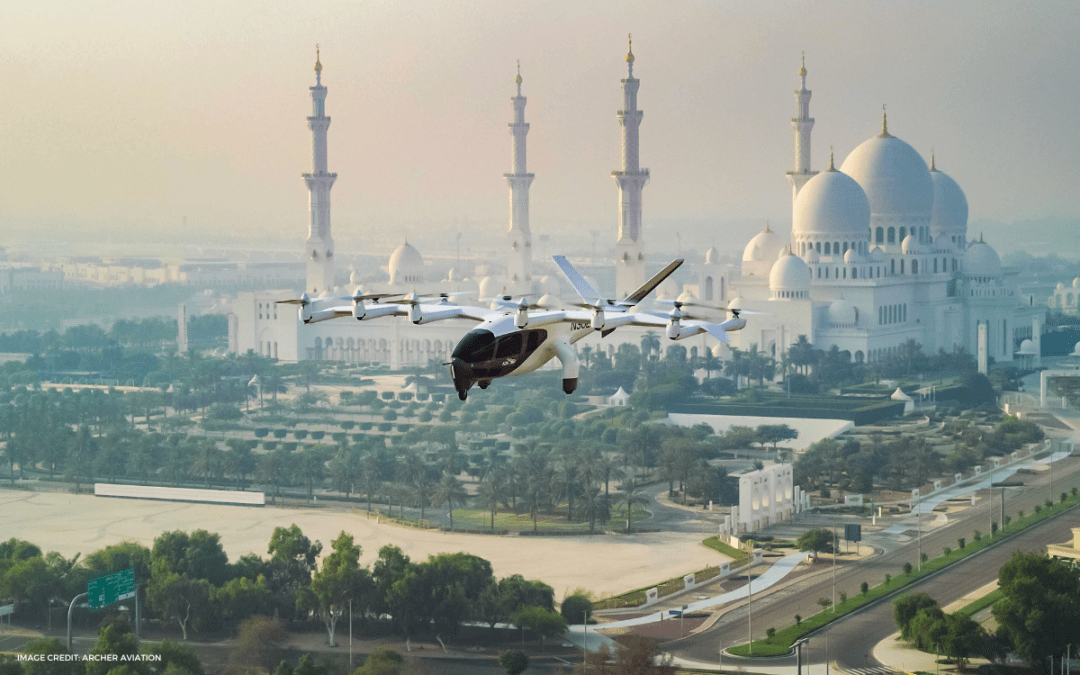
Electric vertical take-off and landing (eVTOL) aircraft company Archer Aviation is attempting to establish air taxi services in Abu Dhabi.
Last week, the company ticked off a new milestone in the expansion of its operations in the Middle East. Archer successfully completed an initial flight of its Midnight aircraft at Al Bateen Executive Airport in Abu Dhabi.
The test helped assess readiness for commercial deployment with a specific focus on the the aircraft’s performance in the UAE. This looked closely at the impact of temperature, humidity, and dust exposure. It also supports the Launch Edition commercialisation programme which aims to establish a pragmatic and repeatable commercialisation playbook to deploy Midnight to dozens of early adopter markets.
In light of this successful test, Archer plans to expand its flight-testing programme for Midnight in the region. Speaking on the news, Adam Goldstein, CEO and Founder of Archer Aviation:
“Our initial test flight operations in the UAE represent a critical milestone as we prepare for our commercial deployment in Abu Dhabi. Testing our aircraft in actual operating conditions in the middle of summer provides us with the data we need to progress our commercial and certification efforts both in the UAE and in the US.”
Highlighting the importance of collaboration in driving the sector’s progress, H.E. Badr Al-Olama, Director General of the Abu Dhabi Investment Office added:
“This flight marks a significant step towards realising Abu Dhabi’s ambition to lead the world in advanced urban air mobility. Through the Smart and Autonomous Vehicles Industry (SAVI) Cluster, we are enabling companies like Archer to test, certify and scale next-generation air mobility solutions, reinforcing our position as a global launchpad for innovation and a hub for transformative technologies.”
The UAE is positioning itself as an early hub for eVTOL deployment. This is a reflection of the growing momentum behind advanced air mobility in the region.
For more like this see:
by Jessica Brownlow | May 22, 2025 | Innovation
Originally published MOVEMNT
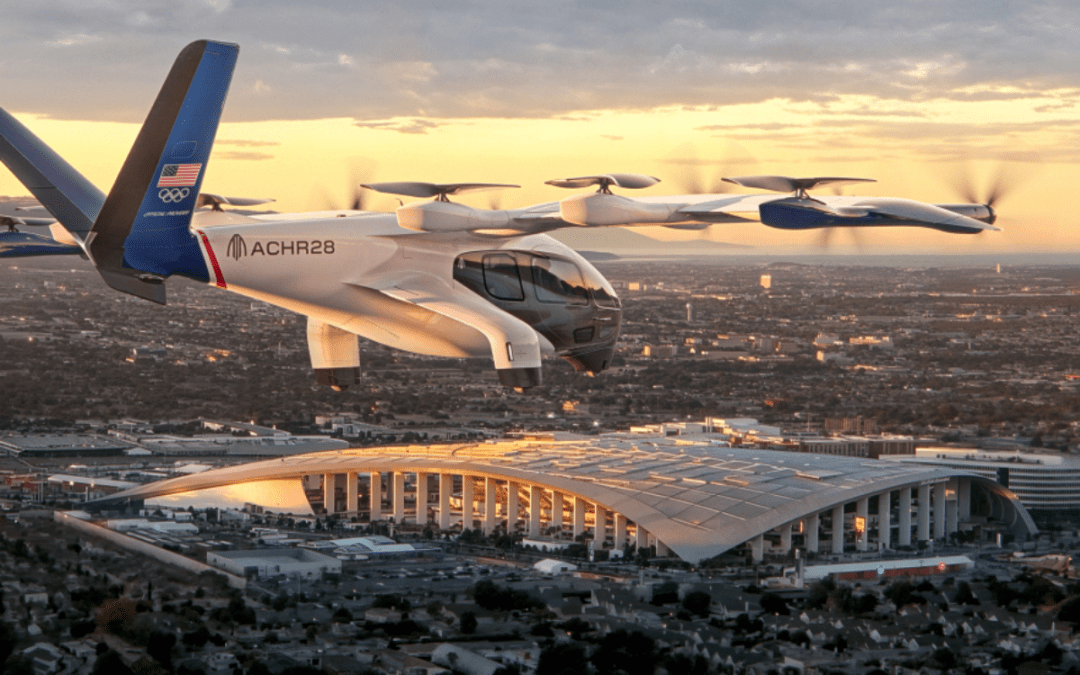
Electric vertical take-off and landing (eVTOL) aircraft company Archer has been selected as the official air taxi provider for the Los Angeles 2028 (LA28) Olympic and Paralympic Games and Team USA.
The California-based company will integrate its Midnight eVTOL aircraft across the LA28 Games for a variety of services including transporting VIPs, fans, stakeholders and providing support for emergency services and security.
Adam Goldstein, CEO and founder of Archer Aviation, said:
“We want to transform the way people get around Los Angeles and leave a legacy that shapes the future of transportation in America. There’s no better time to do that than during the LA28 Games.”
Midnight is Archer’s piloted electric air taxi designed to carry up to four passengers, which produces less noise and emissions than a traditional helicopter.
The LA28 Olympic Games are expected to host over 15 million visitors and broadcast to billions of viewers globally over the course of the Games.
LA28 Chairperson and President Casey Wasserman, said:
“Our vision is to fundamentally reimagine the Olympic and Paralympic Games experience.”
The LA28 Games will mark Los Angeles’ third time to host the Olympic Games, previously hosted in 1984 and 1932, and first time to host the Paralympic Games.
For more like this see:
by Jessica Brownlow | May 7, 2025 | Innovation
Industry 4.0 merges the digital and physical worlds, leveraging technologies like AI, automation, machine learning, data analytics, real-time decision making and more to transform how industries function. Digital Twin technology embodies this transformation driving new levels of productivity and optimisation across industries.
The UK Digital Twin Centre has been constructed to drive nationwide industrial innovation and officially opened at the start of the month. The Belfast-based innovation centre was the product of Digital Catapult, Belfast Region City Deal, and Innovate UK’s collaboration and has been positioned to catalyse the adoption of digital twin technology across critical sectors.
The Centre “offers a practical route to adoption” supporting programmes to unlock the value of digital twin technology where limited test environments and underdeveloped technology has made significant progress difficult to achieve.
At the opening, co-investing industry partners – Artemis Technologies, Spirit AeroSystems, and Thales UK showcased a few early stage applications of the digital twin tech, highlighting the value of cross-sector collaboration. For the first six-month Accelerator Programme, aerospace projects, as well as maritime and defence will be fast-tracked.
Speaking on the launch, Susan BowenCEO, Digital Catapult said:
“The UK Digital Twin Centre brings together our technical expertise, facilities, and networks to unlock the power of deep technologies. By connecting industries with cutting-edge technology through our programmes, we are enabling businesses to harness the full potential of digital twins–driving operational efficiencies, advancing sustainability, and sharpening the competitive edge of UK businesses.”
Find out more here.
For more like this see:



You must be logged in to post a comment.