
by Elsie Clark | Nov 20, 2025 | Innovation
Airbus will open a Tech Hub in Daejeon, South Korea for collaborative research and development.
Three Memoranda of Understanding have been signed to advance the project, which will focus on future energy technologies, advanced lightweight composites, and next-generation space and defence tech. The Hub will be Airbus’s fourth globally, joining others in Japan, the Netherlands, and Singapore. All four aim to leverage local intersections between the private sector, academia, and the government to drive innovation.
Airbus has a long history with its partners in South Korea, dating back to 1974. It is estimated that the company currently employs around 6,000 jobs and contributes US$600 million to the country’s economy.
Mark Bentall, Head of R&T Programme at Airbus, commented:
After five decades of successful industrial partnership with Korea, this step to launch the Airbus Tech Hub in Daejeon is a clear signal of our deepening commitment. The Tech Hub allows Airbus to tap into advanced technologies in Korea, which will help fast-track future aircraft technologies and continue to develop Korea as our trusted, long-term partner.
Exciting projects Airbus hope to advance in Daejeon include space chip antennae with LIG Nex1, as well as electromagnetic interference suppression with EMCoretech. The Tech Hub is also complemented by the Composite Technology Centre (CTC) in Busan, which will work with the Daejeon office to produce composite materials and new processes.
Join us at Aerospace Tech Week 2026, where Dr Sabine Klauke, Airbus’s Chief Technology Officer, will be speaking.
For more like this, see:
by Elsie Clark | Nov 19, 2025 | Connectivity, Innovation
Airbus and Telefónica won Collaboration of the Year at our Aerospace Tech Review Awards in April 2025 for their innovations in 5G connectivity. Working with the Spanish Air and Space Force, the project connected aircraft with servers on the ground to transmit medical data more effectively.
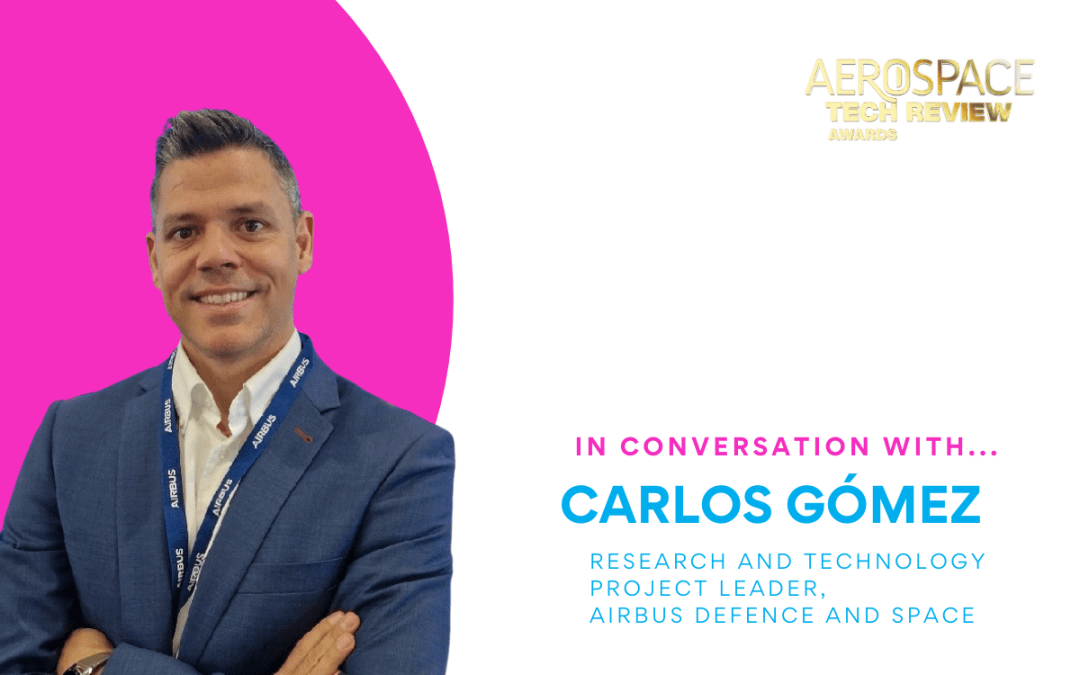
To get the lowdown on the collaboration, Aerospace Tech Review caught up with Carlos Gómez, Research and Technology Project Leader for Airbus Defence and Space. He explained how improving 5G connectivity was essential for the Spanish Air and Space Force to provide more effective communications.
5G brings three major advantages: ultra-low latency, high bandwidth, and the ability to connect thousands of devices simultaneously. This allows information to be exchanged across different domains — land, sea, air, and space — and enables more co-ordinated and informed decision-making.
Airbus and Telefónica each brough different strengths to the project: Airbus’s contributed engineering expertise for the installation of comms equipment, while Telefónica provided the necessary 5G infrastructure. In tests, the system worked successfully to transmit medical data, offering potential lifelines of support in an emergency scenario.
Using medical sensors on the aircraft, we could send information from the patient to a hospital, where the doctor could see the rate of the patient in real time. We also performed a video conference test between the aircraft and a military base.
The future of connectivity
With further investment taking place to make the solution even more advanced, the project is set to evolve and explore 5G use in applications beyond telemedicine. Gómez sees 6G as the next big transformation that Airbus has its eye on for future connectivity.
6G will bring new dimensions like integrated sensing, communication, AI, even integration with terrestrial aerospace systems. This will allow near real-time situational awareness, autonomous decision-making, and resilient communication even in the most challenging environments.
The collaboration stands as testament to what can be achieved when the aerospace industry combines its strengths to deliver effective solutions. Gómez concludes:
For us, this Aerospace Tech Review Award is more than just recognition. It’s a reminder of what is possible when passionate and professional people come together. It gives us more motivation to keep innovating.
🎥 Watch the full interview to hear the full story behind Airbus and Telefónica’s award-winning collaboration.
Questions asked include:
- How did you go about developing your 5G solution? How did Telefonica and Airbus combine their strengths?
- What lessons did both Telefonica and Airbus learn from working together?
- What results did you achieve? What successes did you see in testing and application?
- Will your 5G solution be expanded for use in other applications/used by other countries? How would you like to improve it in the future?
For more like this, see:
by Elsie Clark | Oct 23, 2025 | Connectivity, Innovation
Airbus, Leonardo, and Thales have agreed to a much-anticipated business deal that will see them pool their space businesses together.
Such a project has been under discussion for months now, as the European defence giants seek to establish a rival to SpaceX, Elon Musk’s US-based satellite and space exploration businesses.
Now, the three companies have signed a memorandum of understanding to build a new entity that combines their space businesses. It is hoped that the deal will improve operational agility and consolidate Europe’s position in the aerospace industry by establishing an autonomous alternative to SpaceX’s Starlink, the low-earth orbit (LEO) satellite connectivity project.
In a joint statement, Guillaume Faury, CEO Airbus, Roberto Cingolani, CEO Leonardo, and Patrice Caine, CEO Thales, said:
This proposed new company marks a pivotal milestone for Europe’s space industry. It embodies our shared vision to build a stronger and more competitive European presence in an increasingly dynamic global space market.
By pooling our talent, resources, expertise and R&D capabilities, we aim to generate growth, accelerate innovation and deliver greater value to our customers and stakeholders. This partnership aligns with the ambitions of European governments to strengthen their industrial and technological assets, ensuring Europe’s autonomy across the strategic space domain and its many applications
The new entity will have an annual turnover of €6.5 billion and employ 25,000 people. Regulators are expected to approve the deal, meaning the new business could be operational by 2027. Ownership will be shared between the three companies, with Airbus, Leonardo, and Thales holding 35%, 32.5%, and 32.5% respectively
Each company will contribute to the new entity as follows:
- Airbus: Space Systems and Space Digital businesses
- Leonardo: Space Division, including shares in Telespazio and Thales Alenia Space.
- Thales: Shares in Thales Alenia Space, Telespazio, and Thales SESO.
Full governance structures will be established in due course. The announcement will strengthen and centralise the European aerospace industry, while also offering new opportunities for innovation.
Join us at Aerospace Tech Week 2026 to discuss the future of connectivity and satellites.
For more like this, see:


You must be logged in to post a comment.