
by Elsie Clark | Oct 20, 2025 | Connectivity
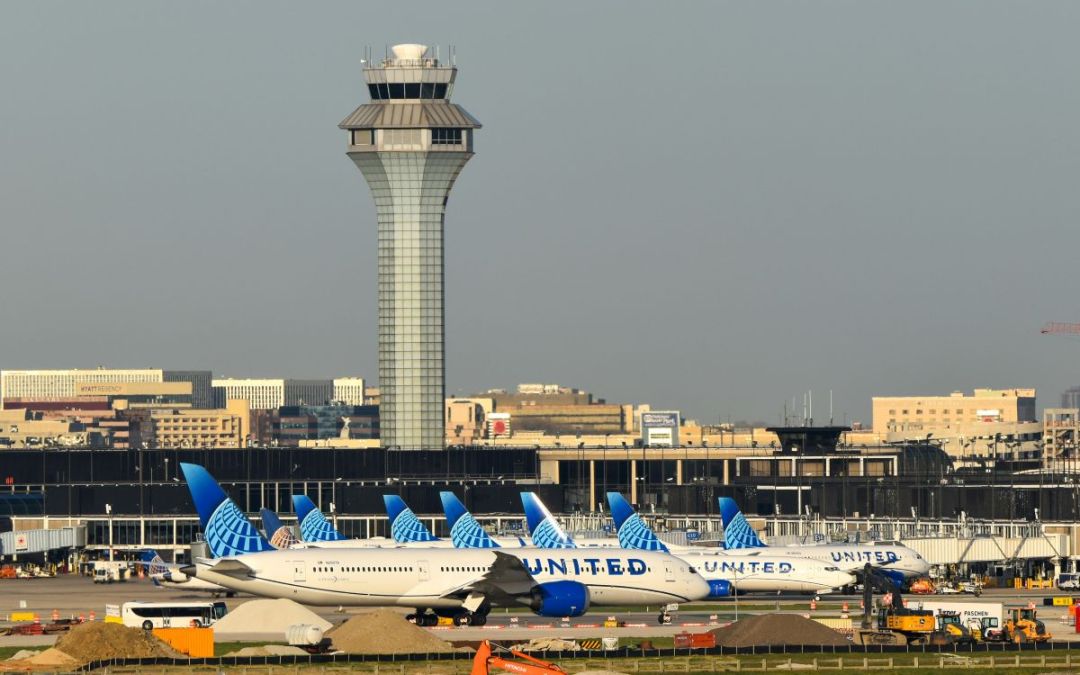
A taxiing Boeing 737 clipped a parked Boeing 767 at Chicago O’Hare International Airport on Friday 16 October.
Both planes belonged to United Airlines. As the 737, carrying 113 passengers and five crew members, passed the 767, which held no passengers, its wing clipped the other plane’s horizontal stabiliser. No one was injured, and a full inspection found no significant damage to either aircraft.
The light impact was reportedly not felt by the 737’s passengers, who were held on the aircraft for just under an hour before deplaning as usual.
The incident is yet another in a series that have affected US airport management as it struggles with a shortage of air traffic control (ATC) staff. On 1 October, at LaGuardia airport two regional Delta jets collided at a taxiway intersection. The crash, which resulted from one plane’s wing hitting the nose and cockpit of the other, injured one flight attendant.
Moreover, September saw another minor collision between United aircraft, this time at San Francisco airport. The incident mirrored another close call for United from May, where one aircraft clipped the tail of another standing stationary.
As of early 2025, the Federal Aviation Administration (FAA) was reporting ATC staff shortages of around 5,000. This year’s rapid recruitment drive has raised concerns about overwork of ATC instructors. Additionally, the US government shutdown, entering its 19th day at the time of writing, has exacerbated these problems.
The recent collision of the United planes thankfully resulted in neither casualties nor serious damages. However, that such accidents are happening at all emphasises that positioning, awareness, and communication require continual investment and improvement.
Join us at Aerospace Tech Week 2026 to discuss the future of ATC, flight ops, and safety.
For more like this, see:
by Elsie Clark | Oct 1, 2025 | Innovation
The Saudi Arabian General Authority of Civil Aviation has approve the kingdom’s first virtual air traffic control (ATC) tower at AlUla airport.
Traffic at the airport will now be monitored remotely by a centre at Jeddah’s King Abdulaziz International Airport, more than 600 kilometres away. The virtual tower was developed by the Saudi Air Navigation Service (SANS) in partnership with Spanish ATC specialist Indra.
Not only is the tower the first of its kind in Saudi Arabia, it is also the only one in operation across the Middle East. Equipped with 360-degree cameras, specialist sensors, and artificial intelligence (AI), the new system offers improved efficiency while reducing burden on airport staff.
An ancient oasis city in the heart of the desert, the Saudi Arabian government has launched plans to boost AlUla’s tourism credentials. A new strategy hopes to attract 2 million tourists to the town by 2030, contributing SAR120 billion to the national economy. The virtual ATC tower improves safety and traffic flow to optimise management of visitors arriving by air. AlUla Airport currently handles around 400,000 passengers a year, with plans to increase that number to 6 million.
The approval of the virtual ATC tower also aligns with Saudi Arabia’s aviation modernisation strategy. The Vision 2030 plan targets 300 million air passengers by 2030, numbers that analysts at OAG have warned will be difficult to achieve due to the limited availability of qualified staff. The virtual ATC tower allows for operations at AlUla to expand without requiring further recruitment.
Initially designed with small- to medium-sized airports in mind, virtual ATC towers have been introduced at several key airports in recent years, notably London City Airport in 2021. The SESAR Joint Undertaking is also considering remote and virtual tower (RVT) concepts as part of its plans to consolidate European aerospace operations.
Join us at Aerospace Tech Week 2026 to discuss the future of ATC and SESAR.
For more like this, see:
by Elsie Clark | Sep 10, 2025 | AI & ML, Innovation
A new strategic partnership between Adacel Technologies and Smart Eye will enhance the MaxSim air traffic control (ATC) simulation platform. MaxSim currently provides the Federal Aviation Authority (FAA), Air Force, and U.S. Army with controller training across a variety of scenarios.
Through integration with Smart Eye’s artificial intelligence (AI) programme, MaxSim will monitor trainee controllers’ eye movements and attention patterns during simulation exercises. This will allow instructors to analyse objective, quantifiable data on the trainees’ development, ultimately improving learning and preparedness.
Adacel vice president Michael Saunders commented:
Partnering with Smart Eye now brings advanced eye-tracking analytics into MaxSim, giving instructors unprecedented insight into attention, decision-making, and situational awareness—further enhancing safety and training effectiveness.
As well as ATC training, the sophisticated human performance analytics system has the potential to roll out across other aviation training in due course.
Improved training critical to planned ATC upgrades
The Adacel/Smart Eye partnership comes as the US begins a major overhaul of its ATC system. Department of Transportation Secretary Sean Duffy announced the plans in May 2025, and recently stated that the upgrade could cost US$31.5 billion.
Training new air traffic controllers is essential to these development plans. The FAA ended 2024 with around 3,900 controllers short of targets, but the ensuing recruitment drive has left instructors overworked. Adacel and Smart Eye’s new partnership will provide data that not only enhances ATC training programmes, but reduces the burden on instructors to evaluate performance.
Join us at Aerospace Tech Week 2026 to discuss the future of air traffic control, technology, and connectivity.
To read more, see:



You must be logged in to post a comment.