
by Elsie Clark | Jan 6, 2026 | Connectivity, Innovation
The Federal Aviation Administration (FAA) has awarded a US$438 million contract to Collins Aerospace for the renovation of radar infrastructure.
Under the Radar System Replacement programme, the FAA is investing in radar to improve the operational readiness of air traffic control. Next-generation tech will support the upgrade, including Collins’s co-operative and non-co-operative radar systems. A single architecture will be used instead of the current fragmented legacy structure.
Nate Boelkins, president of Avionics at Collins Aerospace, said:
As a trusted supplier to the FAA for more than 70 years, Collins is ready to rapidly deploy next-generation radar systems that replace outdated technology with a single, modern and interoperable solution. These systems integrate seamlessly with existing infrastructure, enhance safety and efficiency for air traffic controllers, reduce long-term costs, and ensure the system is prepared for the future of the National Airspace.
Condor Mk3 and ASR XM radar systems are among those included as part of the contract. Together, they will facilitate more precise aircraft tracking, especially at lower altitudes. Collins Aerospace is a subsidiary of RTX, which already has over 550 radar systems operating across the US.
Modernisation of American air traffic control has become an increasing priority in recent years. In 2025, Congress approved a US$12.5 billion modernisation plan for upgrading infrastructure across the country. Meanwhile, the government has also attempted to expedite the training of air traffic controllers, with a shortage of trained personnel also affecting the FAA’s efficiency in flight management.
Join us at Aerospace Tech Week 2026 to discuss the future of air traffic control.
For more like this, see:
by Elsie Clark | Dec 16, 2025 | Connectivity, Innovation
Searidge Technologies has successfully implemented a digital control tower at Vigo Airport, Spain.
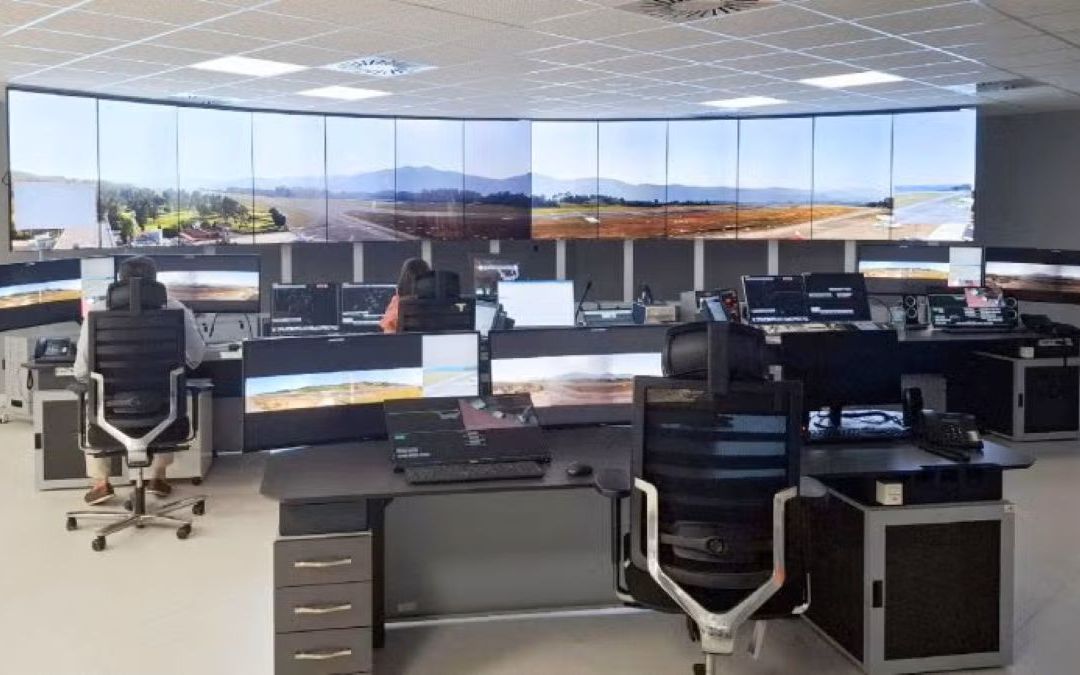
The first of its kind in the country, the tower features a high-resolution, 360-degree real-time visual display of traffic at the airport. Developed in partnership with Skyway, the system has been approved by the aviation authorities and is now in operation.
The display uses a feed of sensors and cameras to enhance traffic controllers’ situational awareness, ultimately improving the safety and efficiency of the airport. Searidge Technologies CEO Moodie Cheikh said:
We’re proud to support Aena [Spain’s airport operator] in achieving this important milestone.
The operational launch at Vigo marks a first for Spain and underscores Europe’s leadership in digital tower innovation. We look forward to continuing our collaboration as Aena advances its strategy to digitise and future-proof airport operations across the country.
A phased introduction will ensure safety standards are upheld during the transition to the digital system. Operations will first take place during times of low air traffic with standard control towers as a backup. The new system puts Vigo in line with modern international airports including Dubai International, London Heathrow, and Singapore Changi. Searidge’s digital tower has also been in operation at Hamad International Airport in Saudi Arabia, the first large-scale system of its kind approved by regulators in the Middle East
The news at Vigo Airport comes after IATA revealed that air traffic control delays in Europe have more than doubled since 2015.
Join us at Aerospace Tech Week 2026 to discuss the future of air traffic control.
For more like this, see:
by Elsie Clark | Dec 9, 2025 | Connectivity
Research from IATA has found that air traffic control (ATC) delays in Europe have doubled over the past decade.
This increase has far outpaced the rate of traffic growth (6.7%), and affected 1.1 billion passengers. IATA estimates the delays have collectively cost the industry €16.1 billion since 2015. Delays due to weather and strikes were not covered in the analysis, which found staff shortages to be overwhelmingly responsible for ATC’s poor performance.
Staff capacity-related disruptions have increased by 179.7% and staffing-related delays by 201.7% since 2015. IATA Director-General Willie Walsh commented:
We’re now seeing the consequences of Europe’s failure to get a grip on air traffic control. A small, expected improvement in 2025 from a very bad 2024 does not change the deterioration that we have seen over the last decade. Airlines and travellers were promised a Single European Sky that would cut delays and reduce fuel burn through more efficient navigation and routes. Instead, passengers have seen delays more than double.
10 of the 39 European Air Navigation Service Providers (ANSP) were responsible for 87% of all delays. France (DSNA) and Germany (DFS) alone were responsible for more than 50% of delays. These statistics demonstrate how a handful of countries are having a disproportionately negative impact on the continent’s ATC performance.
Walsh added:
While Eurocrats debate ways to increase the burden of EU261 passenger compensation, the root cause of much of the delay suffered by travellers—air traffic control—escapes without action or censure. And Europe’s connectivity and competitiveness suffer from schedules that must accommodate ATC inefficiency. It is completely unacceptable.
Join us at Aerospace Tech Week 2026, where we’ll be joined by Heiko Teper, Head of Strategy and Technical Deployment, SESAR Deployment Manager.
For more like this, see:
by Elsie Clark | Dec 2, 2025 | Connectivity
Austro Control, Austria’s air navigation service provider, has selected ADB Safegate to undertake a comprehensive overhaul of the air traffic control (ATC) systems at Vienna Airport (VIE).
Following a competitive international tendering process, the company chose ADB Safegate’s sophisticated OneControl integrated platform, a cutting-edge tower suite designed to modernise all controller working positions in the Vienna Airport ATC Tower. The advanced system, already in use at major international hubs like Hamburg, is set for commissioning by the end of 2028.
OneControl’s key feature is its ability to unify disparate systems. Traditionally, air traffic controllers work across numerous independent displays for functions like surveillance and flight planning. The new platform integrates all safety-critical information into a single, intuitive interface, providing controllers with immediate and complete situational awareness of aircraft and vehicle movements on the apron, aerodrome, and in the air. This consolidation facilitates faster, more accurate decision-making and is expected to enhance overall safety, streamline operations, and support more efficient, sustainable air traffic management.
Philipp Piber, Managing Director of Austro Control, highlighted the strategic importance of the upgrade, stating:
With OneControl, we are relying on state-of-the-art technology and maximum operational reliability. The system will provide our air traffic controllers with optimal support in the safe and efficient handling of air traffic.
The system also includes features such as advanced conflict detection and automated workflows aimed at reducing controller workload and helping the airport to optimise its airside efficiency.
Vienna Airport handled over 31 million passengers in 2024, its highest numbers since 2019. ATC investment will help make air traffic management at Austria’s aviation hub more streamlined and effective.
Join us at Aerospace Tech Week 2026 to discuss the future of air traffic control.
For more like this, see:
by Elsie Clark | Nov 18, 2025 | Connectivity, Innovation
DSNA, the French air navigation services provider, have executed a successful pilot of SITA’s weather intelligence technology.
During a proof-of-concept at the Reims Area Control Centre, DSNA tested SITA’s Enhanced Weather Awareness System (eWAS) and Mission Watch over 21 days from July to October 2025. Originally developed for airlines, these SITA products provide continuous real-time updates on global weather.
During the pilot, DSNA were able to use that information to plan traffic flow significantly more effectively. The authority reported that they were able to reduce delays by up to 65% and handle 2,700 more flights, resulting in an extra €2 million in revenue.
Gael Barbezier, Head of Operations at Reims ACC, commented:
Weather is one of the biggest challenges for air navigation service providers. Working with SITA allowed us to maintain full safety, avoid any weather-related uncontrolled situations, and adjust capacity precisely to the weather avoiding unnecessary reductions in traffic. It feels like we’ve found the key to bringing stability to something that has always been unpredictable.
Unexpected disruption due to weather events can seriously derail airport operations. Earlier this year, stormy weather and poor visibility led to the closure of Nice Airport after two aircraft nearly collided on the runway. With the number of severe weather events only set to increase due to climate change, it is imperative to find better solutions for managing air traffic whatever the climate conditions.
Yann Cabaret, the CEO of SITA for Aircraft, added:
When controllers, pilots and dispatchers all see accurate, real-time weather information, they can plan and adapt together. That means fewer delays, smoother operations and safer flights for passengers.
Join us at Aerospace Tech Week 2026 to learn more about innovative tech in flight planning and airport management.
For more like this, see:



You must be logged in to post a comment.