
by Elsie Clark | Mar 2, 2026 | Innovation
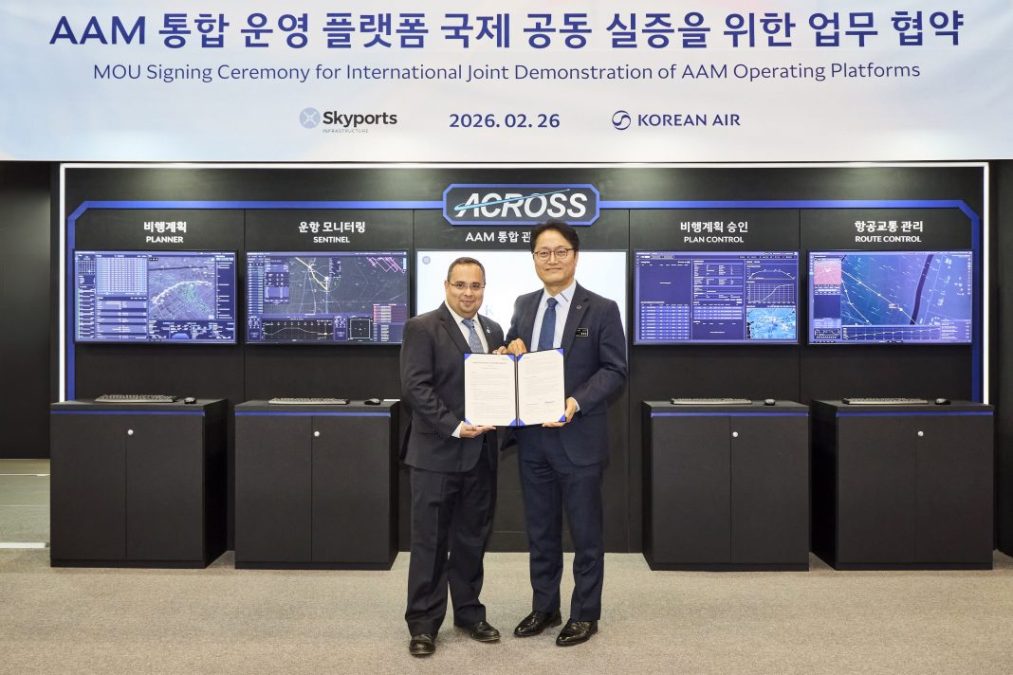
Korean Air and Skyports have announced a new partnership for developing eVTOL operations. Announced at the Drone Show Korea, the collaboration builds on the expertise of both partners to build scalable solutions for advanced air mobility (AAM) integration.
Under the Memorandum of Understanding (MoU), the Air Control & Routing Orchestrated Skyway System (ACROSS), Korean Air’s proprietary flight ops and air traffic management system, will be linked to Skyports’ Vertiport Automation System (VAS) for vertiport infrastructure control. Together, these two platforms can provide infrastructure for commercial eVTOL development, including check-in, security, boarding, and arrivals.
A Korean Air representative comments:
ACROSS delivers integrated flight control and air traffic management for the low-altitude aviation environment. As vertiports serve as the essential interface for these operations, our partnership with Skyports, a global leader in infrastructure, is a critical milestone in building a safe and efficient AAM ecosystem.
Joint demonstrations and piloting programmes will help the partnership strengthen development of AAM as a public transportation arm. The ACROSS system has already been validated by the Korean Ministry of Land, Infrastructure and Transport (MOLIT) through Phases 1 and 2 of the K-UAM Grand Challenge.
Skyports have emerged as the industry leaders in vertiports. Sites in Dubai are expected to host commercial operations later this year, while the company is also developing infrastructure in South Korea’s Jeju Island alongside Abu Dhabi and New York.
Ankit Dass, Chief Technology Officer, Skyports, commented:
Whilst eVTOL aircraft development is progressing at a good pace, there are still various unknowns around how they would operate and navigate effectively in the real world environment. This partnership with Korean Air reflects our shared vision to create the technologies and operational frameworks needed to bring Advanced Air Mobility to life.
Join us at Aerospace Tech Week 2026.
For more like this, see:
by Elsie Clark | Feb 25, 2026 | Innovation
Archer Aviation have sued British rivals Vertical Aerospace, claiming the company’s latest Valo eVTOL design infringes the patent for their Midnight air taxi.
The California-based company has been ramping up testing of Midnight as it plans for certification from the Federal Aviation Authority (AAM). A spokesperson for Archer argued:
After years of developing its VX4 aircraft, Vertical has abandoned that design and unveiled a new aircraft, Valo, which is a visual mimic of Archer’s Midnight aircraft’s award-winning industrial design.
They added that Vertical had ‘knowingly, willfully’ copied Archer’s designs, including flight control systems and methods for managing battery power and flight propulsion. Vertical have dismissed Archer’s lawsuit as ‘without merit’, asserting that the company are attempting to distract the media from wider problems associated with its eVTOL development programme.
In a statement, Vertical said:
Archer’s claims are merely an attempt to distract from Archer’s challenges competing in the marketplace. Vertical has developed a robust aircraft design with a clear path to certification, underpinned by Vertical’s proprietary and market-leading technology and international IP portfolio.
Archer and Vertical’s rivalry has grown more intense in recent years as both companies struggle to gain leverage in an increasingly competitive AAM market. In February this year, Archer announced they were establishing a new base in Bristol, UK, the city where Vertical are headquartered. Meanwhile, Vertical challenged Archer and Joby, another competitor in the space, by announcing plans for a New York air taxi network. Neither company is certified in the US, UK, or abroad as both try to prove eVTOL networks can be safe and efficient modes of transport.
Join us at Aerospace Tech Week 2026 to discuss the future of advanced air mobility (AAM).
For more like this, see:
by Elsie Clark | Feb 6, 2026 | Innovation
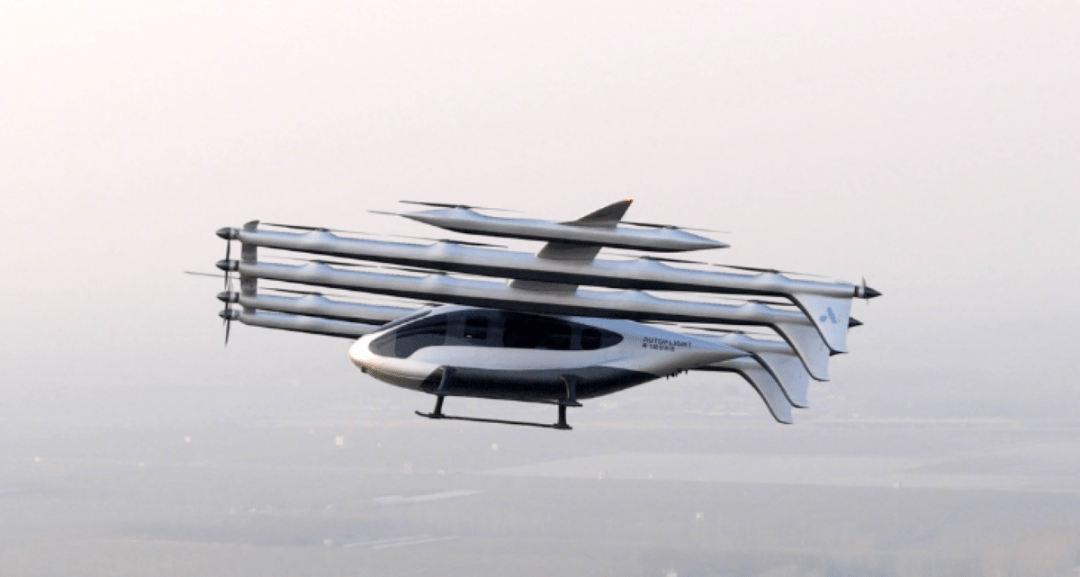
Chinese developers AutoFlight have debuted Matrix, what they claim is the world’s first 10-passenger eVTOL. Weighing five tons, the air taxi took to the skies for the first time in a public demonstration on 5 February.
AutoFlight say the design even includes washbasins and lavatories in the cabin. Most eVTOLs in development are configured for four to six passengers, meaning Matrix could represent a significant advancement.
AutoFlight’s CEO and Founder, Tian Yu, said:
Matrix is not only a rising star in the aviation industry but also an ambitious industry disruptor. It will break the industry perception that eVTOL = short-haul, low-load, and will reshape the rules of eVTOL routes.
With a 20-metre wingspan, the aircraft uses up to 20 fifth-generation lift motors, providing reliability in the event of engine failure. At the demonstration, Matrix successfully completed the full transition sequence, from vertical take-off to cruise flight and vertical landing. AutoFlight’s CarryAll cargo eVTOL also participated in the demonstration.
The pure-electric Matrix variant can travel up to 200km in one journey, while the hybrid variant has a range up to 1,500km.
Yu added:
Through economies of scale, it significantly reduces transportation costs per seat-kilometre and ton-kilometre, revolutionizing costs and embracing profitability. It covers all scenarios from urban commuting to intercity feeder routes, driving the expansion of the entire low-altitude ecosystem.
Join us at Aerospace Tech Week 2026 to discuss the future of advanced air mobility (AAM).
For more like this, see:
by Elsie Clark | Jan 29, 2026 | Innovation
This interview is taken from our sister site, World Aviation Festival.
Handling 87 million passengers every year, Dallas Fort Worth International (DFW) is the third-busiest airport in the world. At the same time, for three consecutive years, Airports Council International (ACI) has recognised DFW as one of the best large airports in North America. So how does the Texan airport achieve its high customer service scores while processing such huge traveller numbers?
Paul Puopolo, DFW’s Chief Technology and Innovation Officer, believes tech investment has been instrumental to improving airport processes and enhancing the traveller experience.
We began our innovation journey about six years ago, and one of the things that we did was we looked at customer needs. On the innovation side, our team really tries to take a human-centric approach.
Among the security measures Puopolo has overseen are streamlined security, a private 5G network, biometrics, and artificial intelligence (AI) systems. DFW’s new Terminal F, currently in construction, also represents an opportunity to rethink airport design. When complete, the US$1.6 billion project will boast self-service bag drops, e-gates, and sensors for managing passenger flow.
When we build new infrastructure, we want to make sure it’s a little bit more flexible. So as customer needs change, we can change. We don’t want to end up being like a mall that nobody goes to anymore.
Advanced air mobility (AAM) is one such consideration. A ‘when, not if’ evolution for the industry, Puopolo is watching sandbox initiatives in the Middle East to see how eVTOLs and air taxis could be incorporated at DFW once they receive FAA certification. He currently forecasts that AAM services could go live in 2028, but for this to be possible DFW needs to prepare now.
We believe air taxis are coming to the airport, and being a feeder route is important to us. But for that to happen, we have to make our infrastructure investments two to three years ahead.
🎥 Watch the interview to hear Paul Puopolo’s full thoughts on AAM integration, tech, and innovation.
Questions asked include:
- What role do you think innovation has played in boosting your customer service rating?
- What are your plans for Terminal F from a tech perspective?
- How can airports implement designs that are tech-forward but also sustainable and long-lasting?
- How do you see air taxis being integrated at DFW in the future?
Join us at Aerospace Tech Week 2026 to discuss the future of advanced air mobility (AAM).
For more like this, see:
by Elsie Clark | Jan 22, 2026 | Innovation
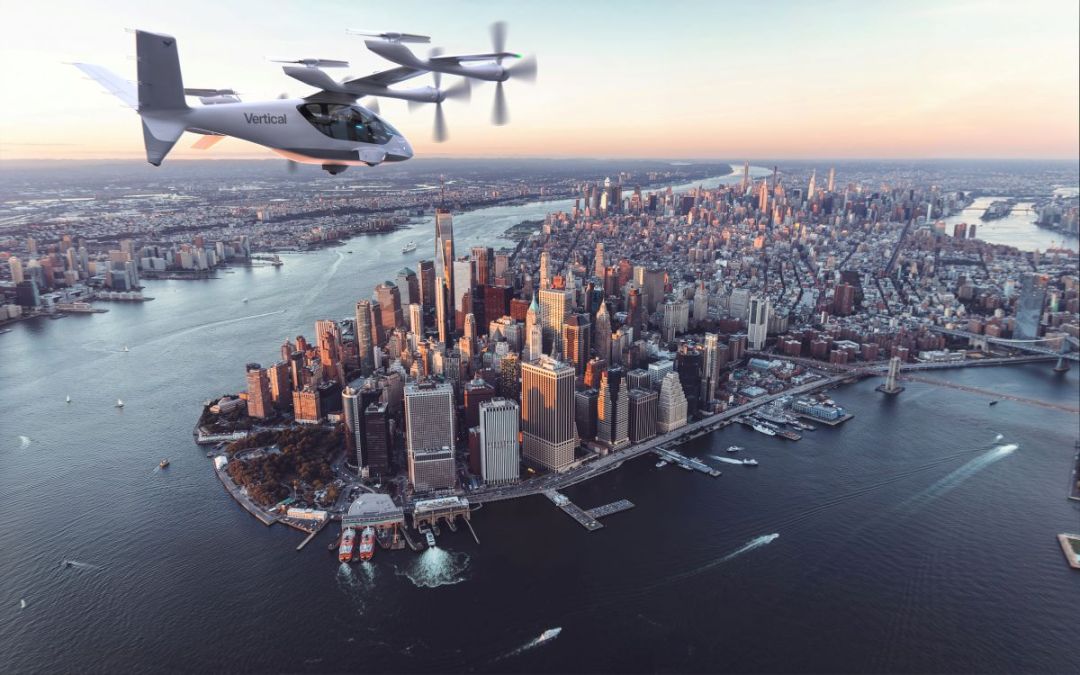
Vertical Aerospace, a UK eVTOL company, is directly taking on its competitors with plans to launch a New York air taxi network as early as 2028.
The company’s Valo aircraft will debut before American investors on January 23 in Manhattan. To align with this meeting, Vertical have announced a potential route map for commercial service across the biggest metropolis in the US. In collaboration with Bristow Group and Skyports Infrastructure, Vertical would open a hub in Downtown Manhattan to connect with the airports around the city: JFK, Newark, East Hampton, and Teterboro. Potential links could also be added to the MetLife Stadium, other heliports, and medical sites such as Westchester County Medical Center.
Stuart Simpson, CEO of Vertical Aerospace, said:
New York is a natural next step to explore how electric aviation could support urban and regional travel in the US, working with partners like Bristow and Skyports to keep safety, certification and real-world operations at the core.
The company has already unveiled prospective plans for a UK air taxi network that would see Valo connect Canary Wharf in London to Heathrow and Gatwick Airports, as well as the important academic research centres of Oxford and Cambridge.
Rivals Archer and Joby have both released their own plans for vertiport networks across New York. Both companies have also signed development agreements with countries in the Middle East, with Joby expected to launch a commercial eVTOL service in Dubai later this year. Archer meanwhile have continued US testing in a bid for certification from the Federal Aviation Administration (FAA). Their Midnight aircraft is expected to launch in time to provide connections at the 2028 Olympic Games in Los Angeles.
Join us at Aerospace Tech Week 2026 to discuss the future of advanced air mobility (AAM).
For more like this, see:



You must be logged in to post a comment.