
by Elsie Clark | Jan 14, 2026 | Innovation
Advanced Air Mobility (AAM) firm Joby Aviation has received the first of two CAE simulators to train its pilots.
Specifically designed for eVTOL operations, the simulators will enable Joby to train as many as 250 pilots a year. Featuring a 300-by-130-degree field of view, state of the art 3D visuals and audio cues recreate a real-world environment as closely as possible.
Alexandre Prévost, President of Civil Aviation at CAE, said:
By leveraging decades of expertise in high-fidelity simulation, we are helping Joby prepare pilots for safe, efficient operations and supporting the industry’s transition to sustainable air transportation.
Joby has worked with CAE on on the simulators since 2022. The culmination of for years of research and development, the systems will be key to advancing Joby’s certification plans in the US. Among other agreements, the company has also made significant progress in the United Arab Emirates (UAE), where it plans to launch a commercial eVTOL service later this year.
Bonny Simi, President of Operations at Joby, added:
These simulators are central to the FAA certification process and are being delivered on time to support pilot training ahead of Joby’s first commercial flights planned for this year. Developing flight fully qualified simulators takes years of work and access to aircraft data, and it is required for Part 135 operations of eVTOL aircraft in the United States.
Join us at Aerospace Tech Week 2026 to discuss the future of Advanced Air Mobility (AAM).
For more like this, see:
by Elsie Clark | Jan 9, 2026 | AI & ML, Innovation
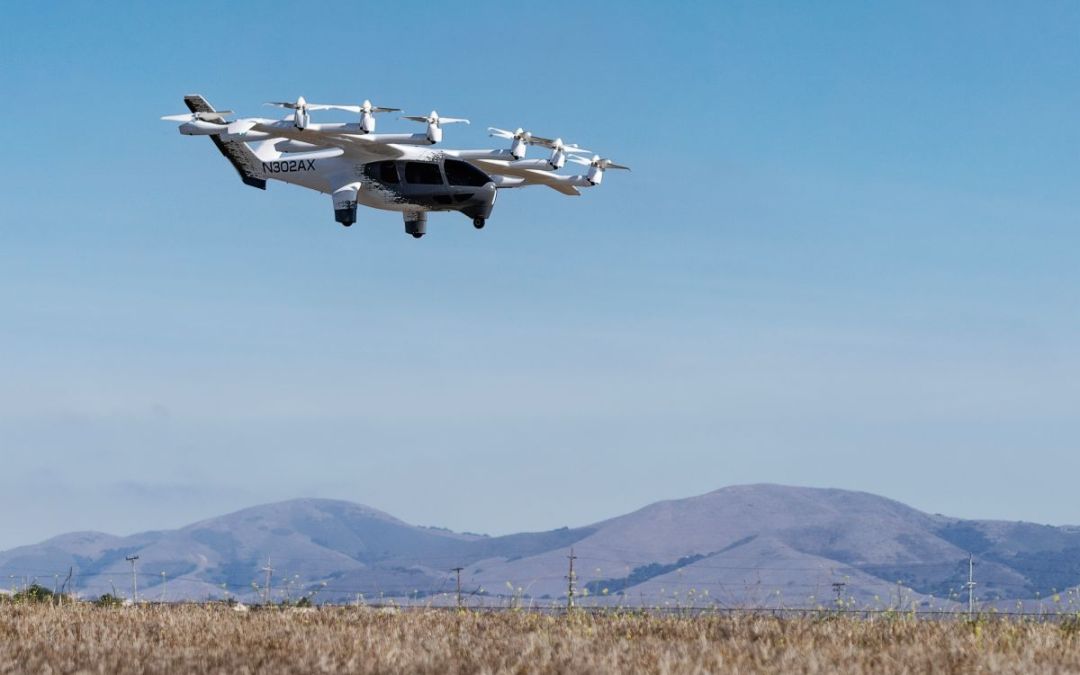
US-based advanced air mobility (AAM) company Archer has announced that it will develop new AI tech for aviation with NVIDIA’s IGX Thor platform. Improving pilot safety, advancing autonomous operation, and ensuring airspace integration will be the key priorities during development.
Archer recently acquired Hawthorne Airport in Los Angeles, California, for the purpose of testing its aircraft and new systems. The company will make use of this base as it advances its collaboration with NVIDIA.
Adam Goldstein, Archer’s Founder and CEO, said:
NVIDIA’s AI compute capabilities and software stack give us the foundation to accelerate toward safer, smarter aircraft systems and modernise how aviation interfaces with the world’s airspace.
The IGX Thor platform has been designed to enhance the safety and situational awareness of onboard computers, ensuring high performance at all times. Archer will build on this foundation and explore advanced uses of:
- Real-time flight path data for improved pilot awareness
- Improved routing and traffic planning
- Autonomous and semi-autonomous flight controls
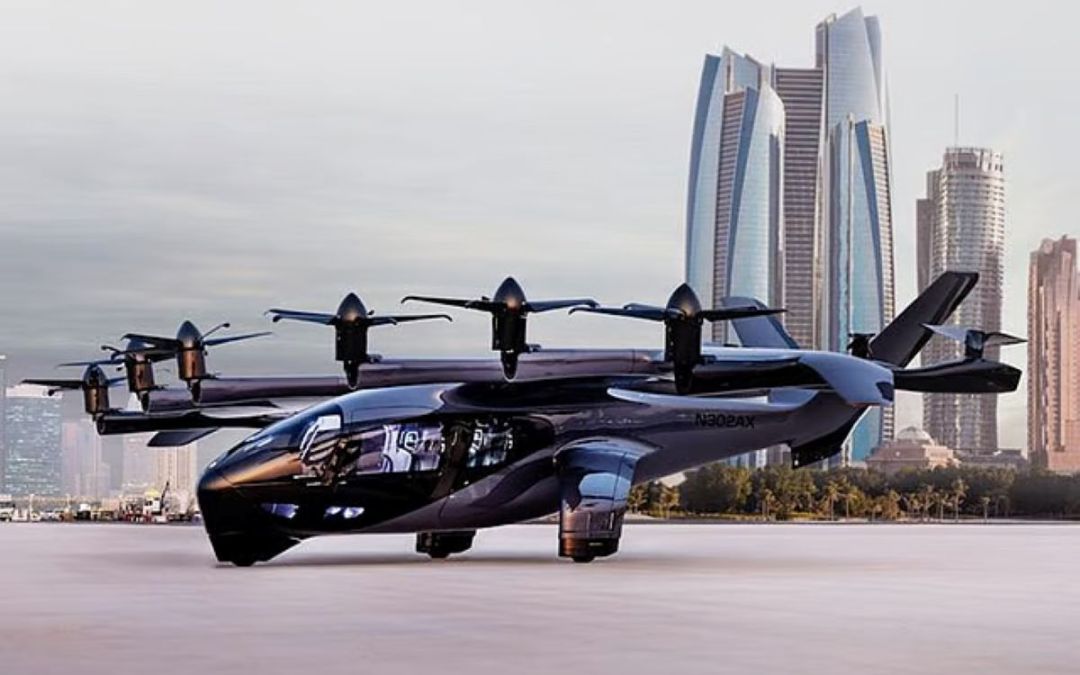
One of the world’s leading AAM companies, Archer’s Midnight eVTOL is rapidly approaching commercialisation. Air taxi trials in the US and Saudi Arabia, announced at the end of 2025, will bring the aircraft closer to regulatory approval. The company has also signed development agreements with authorities in Japan and South Korea.
While the partnership with NVIDIA will contribute significantly to Archer’s product, the results will be of significant interest to the aviation industry as commercial automation begins to take flight.
Join us at Aerospace Tech Week 2026 to discuss the future of AI in aerospace.
For more like this, see:
by Elsie Clark | Jan 5, 2026 | Innovation
The Chinese city of Shanghai has set out a new strategy for aerospace development that aims to make it the world’s eVTOL capital by 2028.
According to policy documents, Shanghai’s ‘low-altitude economy’ could reach a value of CNY80 billion (US$11.4 billion) within two years. 10 leading firms will form a cluster for development, including eVTOl, drone, and other advanced air mobility (AAM) companies. Through investment across the supply chain, the city is targeting the production of 500 low-flying aircraft a year by 2028.
Shanghai is already established as China’s hub for eVTOL development. More than half of the country’s industry is concentrated there, including leading developers such as Vertaxi and TCab. EHang, based further West in Guangzhou, is another advanced eVTOL developer whose autonomous air taxis were recently trialled in a real-world test in Bangkok, Thailand.
Chinese businesses face stiff competition in the eVTOL adoption race. Middle Eastern countries including Bahrain, Saudi Arabia, and the United Arab Emirates (UAE) have all signed partnerships with rival Western AAM companies, including Eve Mobility and Joby. Dubai in the UAE plans to launch its first commercial air taxi services later this year, while through Archer Aviation the city of Miami in the US also hopes to see eVTOLs take flight in 2026.
Join us at Aerospace Tech Week 2026 to discuss the future of advanced air mobility.
For more like this, see:
by Elsie Clark | Dec 4, 2025 | Innovation
Archer Aviation has revealed plans for its vertiport network across Miami, as the eVTOL company hopes to launch its Midnight air taxis across the Floridian city in 2026.
The plans call for the redevelopment of existing heliports alongside the construction of new purpose-built vertiports. Designed to carry four passengers, Archer says that the Midnight aircraft is ideal for 10- to 20-minute journeys across Miami. The integration of a fully-fledged air taxi network will relieve congestion on the ground safely and efficiently, the company adds.
Miami’s three airports — Miami International, Fort Lauderdale-Hollywood International, and Palm Beach International — will be redeveloped to host air taxi landing and take-off points. In the city itself, investment firm Dragon Global and real estate developer Related Ross will partner with Archer to build new vertiports serving the Magic City Innovation District and the West Palm Beach development respectively.
Bob Zangrillo, founder of Dragon Global and a partner in the Magic City Innovation District, said;
The Magic City Innovation District was designed as a next-generation hub for technology, culture, and mobility.
By partnering with Archer to integrate an entirely new layer of transportation, [we are embracing] an air mobility network that connects our district with the broader region and advances a multimodal, future-ready transportation ecosystem for South Florida.
Hard Rock Stadium has asserted its readiness to adapt existing helipads for eVTOLs. Home to the Miami Dolphins NFL team, a Formula 1 Grand Prix, and the Miami Open, the stadium is one of the world’s leading sports venues and welcomes millions of visitors each year. Apogee Golf Club, another internationally-renowned sporting venue, also said they were willing to redesign a heliport to accommodate eVTOLs.
The Miami plans represent another stage in Archer’s global commercialisation effort. The company signed a deal with Korean Air earlier this year, and recent partnerships at Dubai Airshow will see eVTOLs flying in Abu Dhabi and Saudi Arabia.
Francis Suarez, the Mayor of Miami, added:
Miami has never been afraid to bet on the future. We’re a city that attracts visionaries, embraces breakthrough technology, and turns bold ideas into real impact.
For years, I have worked with Archer as they have advanced a vision for an air-taxi network that will elevate Miami’s position as a global capital for innovation and mobility. What they are building is not just transformational transportation; it embodies the Miami mindset: we lead, we innovate, and we redefine what is possible.
Join us at Aerospace Tech Week 2026 to discuss the future of advanced air mobility (AAM).
For more like this, see:
by Elsie Clark | Nov 26, 2025 | Innovation
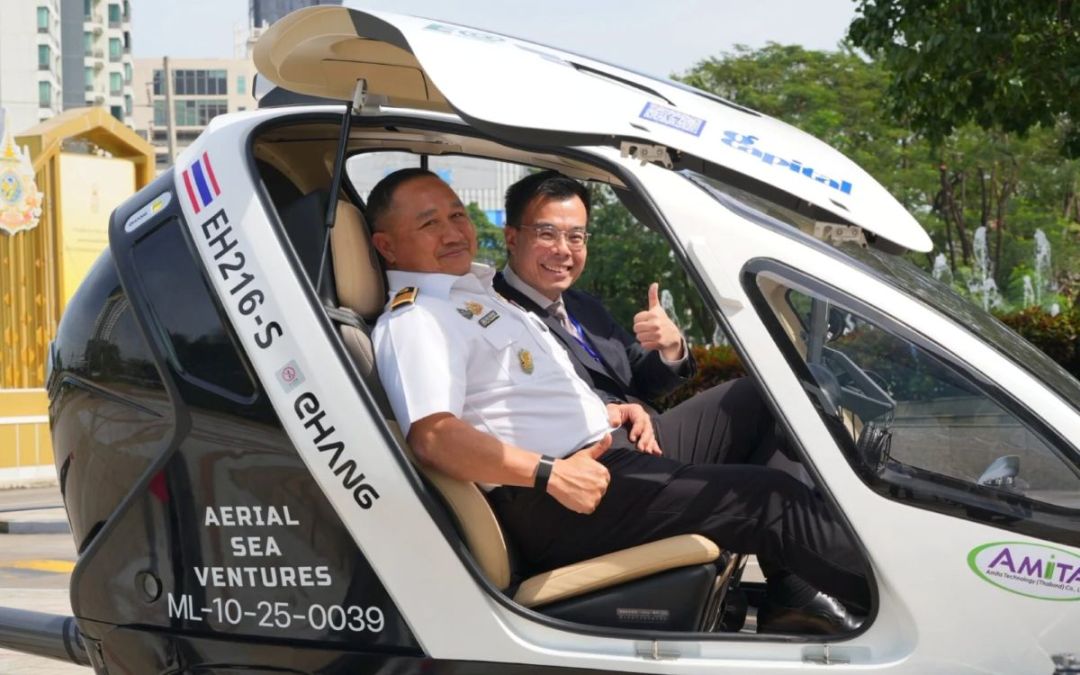
Chinese company EHang has carried out the first-ever urban autonomous passenger eVTOL flight in Bangkok, Thailand.
The pilotless two-seat EHang 216-S executed multiple take-offs and landings in Bangkok’s business district as part of an advanced air mobility (AAM) sandbox initiative. In partnership with the Civil Aviation Authority of Thailand (CAAT), the event represents a significant milestone for autonomous air taxis.
Among the passengers to fly in the aircraft was Air Chief Marshal Manat Chavanaprayoon, the Director General of CAAT, who became the first head of a civil aviation authority to ride the EHang aircraft. Conor Yang, Chief Financial Officer of EHang, said:
With the support of the CAAT, Thailand is highly likely to achieve the world’s first commercial eVTOL operations using an innovative regulatory approach of “sandbox”, creating a demonstration model for Southeast Asia and the world.
This week’s display in Bangkok hopes to prove the commercial potential of the tech in Thailand, a country EHang has identified as a significant potential market. Plans anticipate the company to collaborate with local partners in establishing air taxi services across the capital, as well as at Pattaya, Phuket, and Koh Samui.
Earlier in November, competitors Joby Aviation completed the world’s first crewed eVTOL flight in a demonstration at the Dubai Airshow, as commercialisation of AAM tech becomes imminent.
Join us at Aerospace Tech Week 2026 to discuss the regulation and innovation needed to power AAM.
For more like this, see:



You must be logged in to post a comment.