
by Elsie Clark | May 12, 2026 | Innovation
A new vertiport consortium led by eVOL developers SkyDrive hopes to make commercial air taxi services a reality in Japan. With partners including Osaka Metro Company, Soracle, and Marubeni Corporation, SkyDrive plan to launch their aircraft in the Kansai prefecture plan in 2028.
The ambition aligns with the Kansai government’s existing target of deploying 100 eVTOL craft by 2035. 146 existing heliports are being considered for redevelopment, alongside the consortium’s proposed vertiport project. Osaka Metro are long-term partners of SkyDrive, supporting the first public flight demonstration of its SD-05 prototype in 2024.
The eVTOL race is heating up across APAC. China has set ambitious targets in air taxi integration, with the city of Shanghai launching a strategy to become the world’s eVTOL capital by launching 500 aircraft by 2028. Chinese startup EHang are also leaders in autonomous transport, executing their first urban pilotless flights in Bangkok.
Meanwhile, South Korea are looking to deploy eVTOLs in the near future. An agreement between Korean Air and Californian advanced air mobility (AAM) firm Archer gives the airline the option to buy up to 100 of the company’s flagship Midnight aircraft. March 2026 also saw them sign an additional agreement with vertiport developers Skyports to establish robust infrastructure for eVTOLs alongside Korean Air’s existing operations.
Join us at Aerospace Tech Week 2026.
by Elsie Clark | Apr 28, 2026 | Innovation
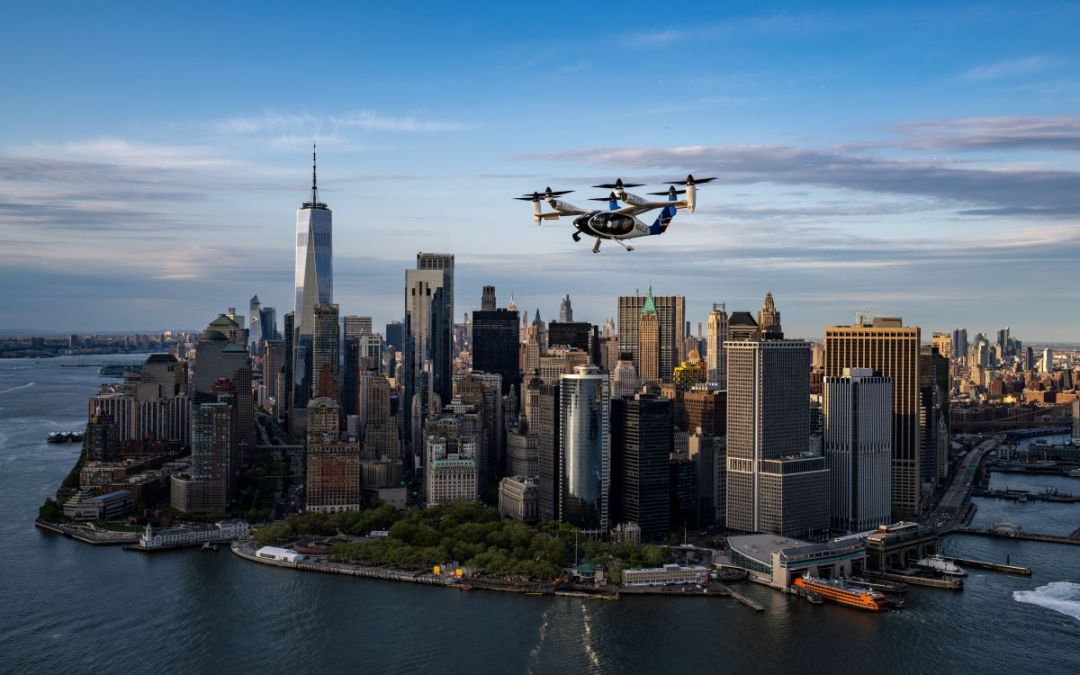
Joby Aviation have conducted the first ever point-to-point eVTOL flight across the New York City skyline in a demonstration of how an air taxi network could operate across the US’s most populous urban area.
During the test flight, Joby’s N545JX aircraft took off from JFK airport and travelled up Manhattan island, touching down at existing Downtown and Midtown helipads along the journey. The demo took place under the federal eVTOL Integration Pilot Program (eIPP), which selected New York as one of the testing hubs for air taxi technology. Joby will collaborate on five eIPP projects overall. JoeBen Bevirt, founder and CEO of Joby, commented:
New York has always been a city that defines the future by demanding better. We first flew here in 2023, and now we’re showing what the next chapter looks like: a quiet, zero operating emissions air taxi service designed to better serve New Yorkers. This week, flying between JFK and Manhattan, we showed what the White House-backed eIPP initiative makes possible and offered New York a look at what’s coming.
Joby face stiff competition in the race to receive certification from the Federal Aviation Authority (FAA). Other providers jostling to launch commercial service in NYC include British developers Vertical Aerospace and Californian startup Archer Aviation. All three air taxi providers claim their aircraft could cut travel times between key New York City locations down to as little as ten minutes.
NYC’s helipads will be electrified to prepare for the mass deployment of air taxis, while key partners at the city’s Economic Development Corporation and the Port Authority are facilitating integration with existing transport links.
Port Authority Chairman Kevin O’Toole said:
The bridges, tunnels, airports, and rail lines that the Port Authority operates move hundreds of millions of people through this region every year, and our job is to make sure that network keeps pace with the future. This cutting-edge aircraft is exactly the kind of innovation we have a responsibility to test, understand, and help shape for the good of the region and the public. These flights advance our work to determine how next-generation aviation technology can serve the people of New York and New Jersey.
Join us at Aerospace Tech Week 2026 to discuss the future of advanced air mobility (AAM).
For more like this, see:
by Elsie Clark | Apr 10, 2026 | AI & ML, Innovation
eVTOL developers Joby Aviation and software company Air Space Intelligence (ASI) are teaming up to explore the real-world integration of advanced air mobility (AAM).
Using ASI’s Flyaways AI Platform, Joby will deploy high-fidelity 4D modelling to understand how eVTOL operations can be scaled alongside existing air traffic procedures. With the Federal Aviation Administration (FAA) set to launch the Brand New Air Traffic Control System (BNATCS), the companies say the time is right to think seriously about AAM integration in the US.
Bernard Asare, President, Civil Aviation at Air Space Intelligence, said:
Scaling advanced air mobility requires more than new aircraft — it requires a new operating system for the airspace. Our Flyways AI platform gives operators and controllers the predictive awareness to coordinate high-density operations proactively, not reactively. This partnership brings that same capability to eVTOL operations from day one.
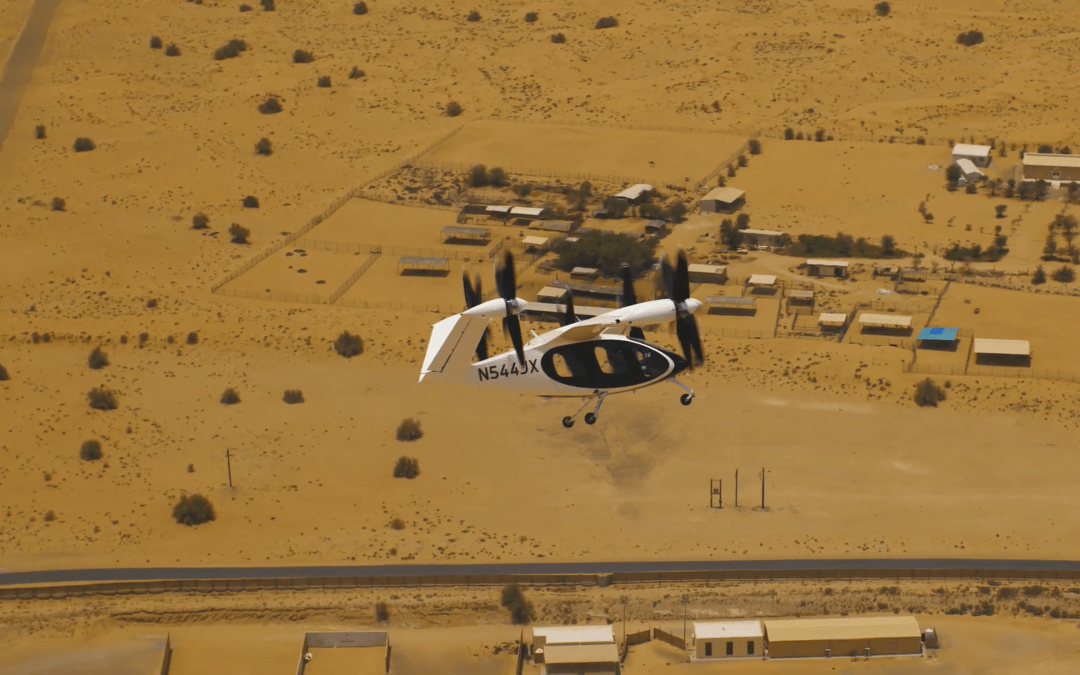
The commercial readiness of eVTOLs is accelerating at pace. While Joby have made significant gains and are expected to launch operations in Dubai later this year, competition in the US market is fierce, with rivals Archer and Vertical also keen to make their mark. In seeking FAA approval, demonstrating how the tech will perform in real-world scenarios is essential.
Greg Bowles, Joby Aviation’s Chief Policy Officer commented:
America has long set the global standard for aviation, and modernizing our airspace is key to maintaining that leadership, By combining Joby’s operational capabilities with ASI’s advanced AI-driven Flyways platform, we’re helping build the intelligent infrastructure needed to integrate electric air taxis seamlessly into the NAS — one of America’s most important national assets.
Join us at Aerospace Tech Week 2026 to discuss the future of advanced air mobility (AAM).
For more like this, see:
by Elsie Clark | Apr 7, 2026 | Innovation
UK advanced air mobility (AAM) developer Vertical Aerospace have completed the first piloted transition test flight of their Valo eVTOL.
Taking place on April 2 in Gloucestershire, UK, the test saw the aircraft take off and land in a simulation of a runway environment. Vertical will next target the second half of a two-way transition system, where Valo takes off and lands vertically.
David King, chief engineer at Vertical Aerospace, said,
Completing this piloted transition milestone is a profound achievement and the result of years of engineering innovation and disciplined test execution.
The aircraft performed exactly as designed, transitioning smoothly and under full control – proving the core elements of Vertical’s distributed electric propulsion and tiltrotor technology at full scale, in real flight conditions. This is not yet final mission accomplished, but it is a pivotal technical proof point on our path to two-way transition.
The test flight took place under the Permit to Fly programme, run by the UK’s Civil Aviation Authority (CAA) in partnership with the European Aviation Safety Agency (EASA). Based in Southwest England, Vertical report 1,500 pre-orders for Valo and recently announced a funding package worth US$850 million to continue aircraft development.
In February, the company courted controversy when rival American eVTOL developers Archer announced they were suing Vertical for patent infringement. Both firms have pitched potential New York air taxi networks, while Archer has threatened Vertical on home turf by establishing a base in Bristol, UK. Vertical dismissed the claims, stating Archer made them to distract from challenges in the competitive air taxi market.
Join us at Aerospace Tech Week 2026 to discuss the future of advanced air mobility (AAM).
For more like this, see:
by Elsie Clark | Mar 10, 2026 | Innovation
Eve Air Mobility are partnering with Sydney-based startup Alt Air and Skyports to bring a commercial eVTOL network to Australia.
The three companies will collaborate to develop sustainable infrastructure that will make air taxis viable transport in Queensland and New South Wales. With Brisbane set to host the Olympic Games in 2032, Eve believe Australia provides the ideal environment to build vertiports and develop systems for ground operations, route planning, and airspace integration. Johann Bordais, Chief Executive Officer at Eve Air Mobility, said:
Through this collaboration, we are laying the foundation for a world-class eVTOL ecosystem in Australia. New South Wales and Queensland present an incredible opportunity to deliver sustainable, quiet, and efficient urban air mobility solutions that will benefit residents, businesses, and international visitors, especially as we look toward the opening of Western Sydney International Airport and the global stage of the Brisbane 2032 Games.
The consortium is prioritising development on potential high-demand routes, including Western Sydney Airport to central Sydney. Aaron Shaw, Managing Director at Alt Air, added:
Our work with Eve Air Mobility and Skyports underscores our shared commitment to building meaningful aviation innovation in Australia. Together, we are designing an eVTOL network that will significantly improve connectivity and set a benchmark for advanced air mobility worldwide.
Eve have previously signed agreements with the government of Bahrain for developing commercial eVTOL service across the Middle Eastern country. Rivals in the space, including Archer, Joby, and Vertical, are in the process of designing potential air taxi networks in metropolises including Dubai, Miami, and New York.
Join us at Aerospace Tech Week 2026.
For more like this, see:




You must be logged in to post a comment.