
by Elsie Clark | Jan 29, 2026 | Innovation
This interview is taken from our sister site, World Aviation Festival.
Handling 87 million passengers every year, Dallas Fort Worth International (DFW) is the third-busiest airport in the world. At the same time, for three consecutive years, Airports Council International (ACI) has recognised DFW as one of the best large airports in North America. So how does the Texan airport achieve its high customer service scores while processing such huge traveller numbers?
Paul Puopolo, DFW’s Chief Technology and Innovation Officer, believes tech investment has been instrumental to improving airport processes and enhancing the traveller experience.
We began our innovation journey about six years ago, and one of the things that we did was we looked at customer needs. On the innovation side, our team really tries to take a human-centric approach.
Among the security measures Puopolo has overseen are streamlined security, a private 5G network, biometrics, and artificial intelligence (AI) systems. DFW’s new Terminal F, currently in construction, also represents an opportunity to rethink airport design. When complete, the US$1.6 billion project will boast self-service bag drops, e-gates, and sensors for managing passenger flow.
When we build new infrastructure, we want to make sure it’s a little bit more flexible. So as customer needs change, we can change. We don’t want to end up being like a mall that nobody goes to anymore.
Advanced air mobility (AAM) is one such consideration. A ‘when, not if’ evolution for the industry, Puopolo is watching sandbox initiatives in the Middle East to see how eVTOLs and air taxis could be incorporated at DFW once they receive FAA certification. He currently forecasts that AAM services could go live in 2028, but for this to be possible DFW needs to prepare now.
We believe air taxis are coming to the airport, and being a feeder route is important to us. But for that to happen, we have to make our infrastructure investments two to three years ahead.
🎥 Watch the interview to hear Paul Puopolo’s full thoughts on AAM integration, tech, and innovation.
Questions asked include:
- What role do you think innovation has played in boosting your customer service rating?
- What are your plans for Terminal F from a tech perspective?
- How can airports implement designs that are tech-forward but also sustainable and long-lasting?
- How do you see air taxis being integrated at DFW in the future?
Join us at Aerospace Tech Week 2026 to discuss the future of advanced air mobility (AAM).
For more like this, see:
by Elsie Clark | Jan 22, 2026 | Innovation
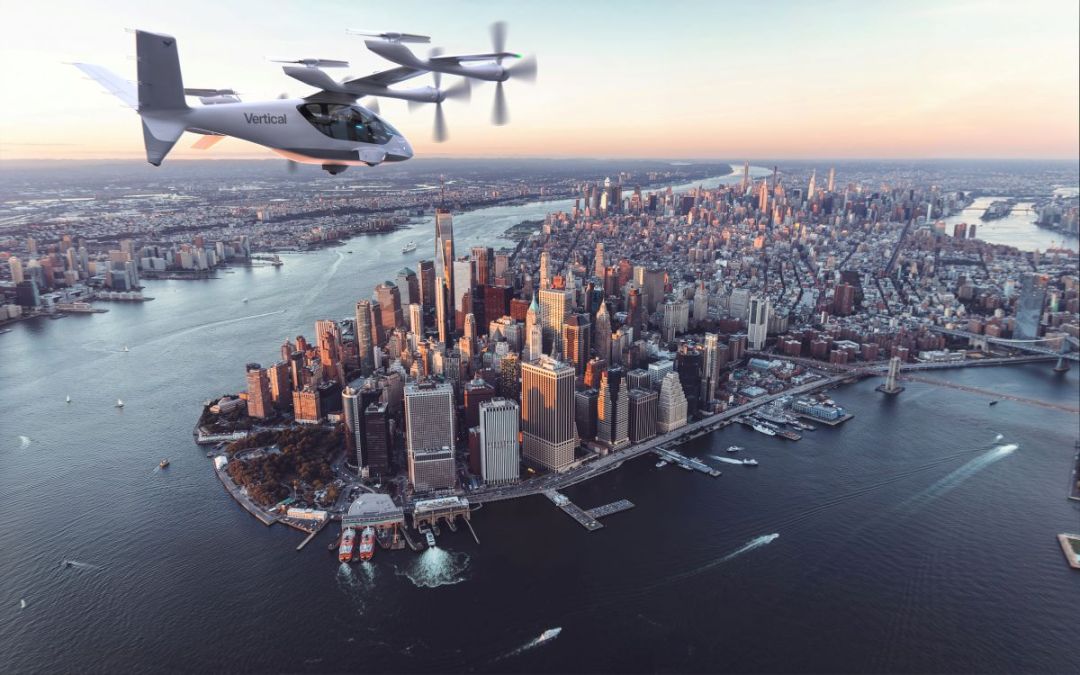
Vertical Aerospace, a UK eVTOL company, is directly taking on its competitors with plans to launch a New York air taxi network as early as 2028.
The company’s Valo aircraft will debut before American investors on January 23 in Manhattan. To align with this meeting, Vertical have announced a potential route map for commercial service across the biggest metropolis in the US. In collaboration with Bristow Group and Skyports Infrastructure, Vertical would open a hub in Downtown Manhattan to connect with the airports around the city: JFK, Newark, East Hampton, and Teterboro. Potential links could also be added to the MetLife Stadium, other heliports, and medical sites such as Westchester County Medical Center.
Stuart Simpson, CEO of Vertical Aerospace, said:
New York is a natural next step to explore how electric aviation could support urban and regional travel in the US, working with partners like Bristow and Skyports to keep safety, certification and real-world operations at the core.
The company has already unveiled prospective plans for a UK air taxi network that would see Valo connect Canary Wharf in London to Heathrow and Gatwick Airports, as well as the important academic research centres of Oxford and Cambridge.
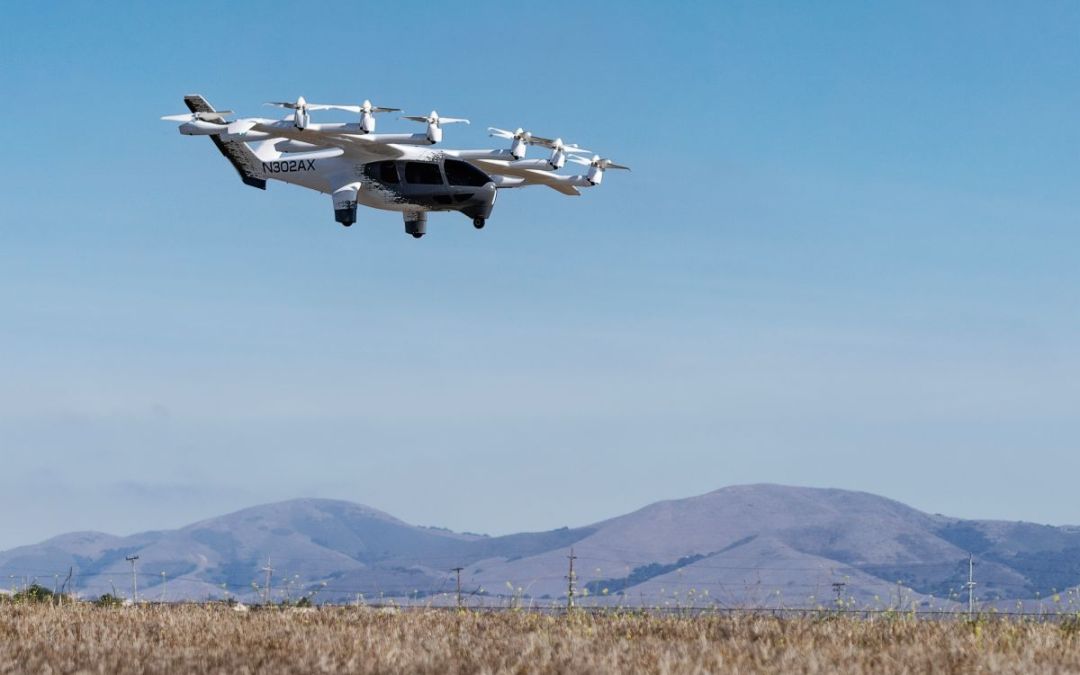
Rivals Archer and Joby have both released their own plans for vertiport networks across New York. Both companies have also signed development agreements with countries in the Middle East, with Joby expected to launch a commercial eVTOL service in Dubai later this year. Archer meanwhile have continued US testing in a bid for certification from the Federal Aviation Administration (FAA). Their Midnight aircraft is expected to launch in time to provide connections at the 2028 Olympic Games in Los Angeles.
Join us at Aerospace Tech Week 2026 to discuss the future of advanced air mobility (AAM).
For more like this, see:
by Elsie Clark | Jan 14, 2026 | Innovation
Advanced Air Mobility (AAM) firm Joby Aviation has received the first of two CAE simulators to train its pilots.
Specifically designed for eVTOL operations, the simulators will enable Joby to train as many as 250 pilots a year. Featuring a 300-by-130-degree field of view, state of the art 3D visuals and audio cues recreate a real-world environment as closely as possible.
Alexandre Prévost, President of Civil Aviation at CAE, said:
By leveraging decades of expertise in high-fidelity simulation, we are helping Joby prepare pilots for safe, efficient operations and supporting the industry’s transition to sustainable air transportation.
Joby has worked with CAE on on the simulators since 2022. The culmination of for years of research and development, the systems will be key to advancing Joby’s certification plans in the US. Among other agreements, the company has also made significant progress in the United Arab Emirates (UAE), where it plans to launch a commercial eVTOL service later this year.
Bonny Simi, President of Operations at Joby, added:
These simulators are central to the FAA certification process and are being delivered on time to support pilot training ahead of Joby’s first commercial flights planned for this year. Developing flight fully qualified simulators takes years of work and access to aircraft data, and it is required for Part 135 operations of eVTOL aircraft in the United States.
Join us at Aerospace Tech Week 2026 to discuss the future of Advanced Air Mobility (AAM).
For more like this, see:
by Elsie Clark | Jan 9, 2026 | AI & ML, Innovation
US-based advanced air mobility (AAM) company Archer has announced that it will develop new AI tech for aviation with NVIDIA’s IGX Thor platform. Improving pilot safety, advancing autonomous operation, and ensuring airspace integration will be the key priorities during development.
Archer recently acquired Hawthorne Airport in Los Angeles, California, for the purpose of testing its aircraft and new systems. The company will make use of this base as it advances its collaboration with NVIDIA.
Adam Goldstein, Archer’s Founder and CEO, said:
NVIDIA’s AI compute capabilities and software stack give us the foundation to accelerate toward safer, smarter aircraft systems and modernise how aviation interfaces with the world’s airspace.
The IGX Thor platform has been designed to enhance the safety and situational awareness of onboard computers, ensuring high performance at all times. Archer will build on this foundation and explore advanced uses of:
- Real-time flight path data for improved pilot awareness
- Improved routing and traffic planning
- Autonomous and semi-autonomous flight controls
One of the world’s leading AAM companies, Archer’s Midnight eVTOL is rapidly approaching commercialisation. Air taxi trials in the US and Saudi Arabia, announced at the end of 2025, will bring the aircraft closer to regulatory approval. The company has also signed development agreements with authorities in Japan and South Korea.
While the partnership with NVIDIA will contribute significantly to Archer’s product, the results will be of significant interest to the aviation industry as commercial automation begins to take flight.
Join us at Aerospace Tech Week 2026 to discuss the future of AI in aerospace.
For more like this, see:
by Elsie Clark | Jan 5, 2026 | Innovation
The Chinese city of Shanghai has set out a new strategy for aerospace development that aims to make it the world’s eVTOL capital by 2028.
According to policy documents, Shanghai’s ‘low-altitude economy’ could reach a value of CNY80 billion (US$11.4 billion) within two years. 10 leading firms will form a cluster for development, including eVTOl, drone, and other advanced air mobility (AAM) companies. Through investment across the supply chain, the city is targeting the production of 500 low-flying aircraft a year by 2028.
Shanghai is already established as China’s hub for eVTOL development. More than half of the country’s industry is concentrated there, including leading developers such as Vertaxi and TCab. EHang, based further West in Guangzhou, is another advanced eVTOL developer whose autonomous air taxis were recently trialled in a real-world test in Bangkok, Thailand.
Chinese businesses face stiff competition in the eVTOL adoption race. Middle Eastern countries including Bahrain, Saudi Arabia, and the United Arab Emirates (UAE) have all signed partnerships with rival Western AAM companies, including Eve Mobility and Joby. Dubai in the UAE plans to launch its first commercial air taxi services later this year, while through Archer Aviation the city of Miami in the US also hopes to see eVTOLs take flight in 2026.
Join us at Aerospace Tech Week 2026 to discuss the future of advanced air mobility.
For more like this, see:




You must be logged in to post a comment.