
by Elsie Clark | Jan 12, 2026 | AI & ML, Innovation, Sustainability
Industry body IATA has named the five risks that most threaten the aviation industry in 2026. With profit margins expected to remain tight at 3.9%, good decision planning and situational awareness will be critical in determining which airlines make it through the year unscathed.
1. Policy fragmentation
Last year saw the aviation industry thrown into chaos by tariffs, and Marie Owens Thomsen, Senior Vice President, Sustainability & Chief Economist, at IATA, reckons trade disruption will continue in the year ahead. However, this time policy fragmentation around the globe will have more impact.
From protectionism to divergence on sustainability and taxation, nations are more inclined than ever to sidestep industry bodies. Owens Thomsen notes:
Such policies raise little money for governments, have little or no impact on emissions, and make air transport more expensive.
2. Supply chain disruptions
This has been an ongoing theme for years now, but unfortunately pressure on supply chains remains high. IATA does not expect delays on aircraft orders to abate until the 2030s, and also highlights that this negatively impacts the pace on sustainable development.
3. Climate change-related disruptions
Rising temperatures are resulting in more extreme weather events. From violent snowstorms to heatwaves, the impact on all industries’ trade and infrastructure cannot be understated. In the years ahead, increased migration from ‘climate refugees’ will place further strain on air transport and immigration authorities.
4. Cyber threats and Artificial Intelligence (AI)
Airlines and airports are increasingly turning to technology to improve efficiency and manage greater passenger numbers. Yet the deployment of third-party tech providers also multiplies the frontiers for cyberattack. As a critical industry that hosts a wealth of sensitive data, the aviation world is especially vulnerable.
As for AI, the benefits could take years to realise, and the software is not infallible. Misinformation and loss of privacy could all damage relationships with passengers.
5. Macro-economic outlook
The weakening of the US dollar will have a significant impact on aviation, where over half of its cost base is invoiced in USD. While lower oil prices will benefit airlines, the world economy in general is not inclined to growth, threatening the aviation industry’s already narrow margins.
Nevertheless, IATA see reasons to be optimistic, with 4% of global GDP still linked to air travel. Additionally, they emphasise that a move towards sustainable aviation could generate far greater change than any economic policy.
Join us at Aerospace Tech Week 2026.
For more like this, see:
by Elsie Clark | Jan 8, 2026 | Innovation, Sustainability, Video
Boasting more than 600 aircraft that fly to over 250 destinations, the International Airlines Group (IAG) manages some of Europe’s best-known airlines, including British Airways, Iberia, and Vueling. But how can the group manage an effective sustainability strategy across these unique brands?
In an exclusive interview at World Aviation Festival 2025, Jonathon Counsell, Group Director of Sustainability at IAG shared his insight on setting the direction. While aviation’s overall enthusiasm for ESG might have waned from its peak in the mid-2010s, IAG remain committed to their 2050 net-zero emissions target.
We recognise that this is a long-term challenge for us. We have to address our carbon emissions, and we have as an industry a clear roadmap to do that. Fundamentally, climate change is driven by the science, not just politics. So it’s something we have to do.
IAG is currently on track to achieve its 10% sustainable aviation fuel (SAF) target by 2030. US$3.5 billion has been invested so far through partnerships with cutting edge companies such as Infinium, a low-carbon eFuels developer. Counsell sees ‘real value’ in bringing the five member airlines together to share progress and success stories.
It’s quite a close group. We meet every month, and every quarter we have a two-day workshop where we all get together. It’s fantastic to see the sharing of best practice among all the different participants.
IAG’s other investments include ZeroAvia, developers of hydrogen-propelled aircraft. However, Counsell believes in the short term SAF production needs to accelerate to reduce the impact of this hard-to-decarbonise industry, especially while demand continues to outstrip supply.
I truly believe there is a first-mover advantage when it comes to decarbonisation. Our view is that some of the advanced fuels in the second and third generations will be in short supply post-2030. So we think it’s really important that companies get into the market early to secure the regular supply of these SAFs.
🎥 Watch the interview to hear the full conversation on sustainability with Jonathon Counsell.
Questions asked include:
- Do you think that geopolitical change has slowed momentum on sustainability in aviation?
- IAG has committed to net-zero emissions by 2050. What progress have you made on that goal so far? What are the Group’s biggest success stories?
- As an airline group, you have to oversee the sustainability targets of five separate airlines. Is it a challenge bringing all these parties together, or do you see it as an opportunity for greater collaboration?
Jonathon Counsell will be speaking at Aerospace Tech Week 2026. Join us.
For more like this, see:
by Elsie Clark | Jan 7, 2026 | Sustainability
A study has revealed how aviation could halve its emissions without cutting flights.
As demand for air travel continues to rise, the industry needs to find solutions that can mitigate its climate impact. The global aviation sector’s carbon footprint could as much as triple by 2050 if more is not done to implement sustainable practice. New research led by Prof Stefan Gössling at Linnaeus University in Sweden finds that overall emissions could be halved by getting rid of premium seating, filling flights to the maximum, and flying only the most fuel- and energy-efficient aircraft.
Gössling told The Guardian:
I always thought air transport was already very efficient, and that is also what airlines like to tell people. But, in reality, it’s very inefficient because of the three factors: using old aircraft, transporting people [in premium seats] with lots of space, and often having aircraft that are not really fully loaded.
Analysing 27 million flights from 2023, the researchers endeavoured to highlight notable inefficiencies in sustainability. In 2023, the average load factor for aircraft was 80%. The study recommends increasing this average to 95%. Analysis by region also found that regions such as India and South America were running greater numbers of efficient flights. while North America and Africa journeys were far more carbon inefficient.
Gössling added that the carbon footprint of passengers in first and business class was almost three times that of those in economy, and could be up to thirteen times greater in the most spacious cabins. The research team concluded that improving load factors while running efficient aircraft without premium seating could slash industry emissions by 50-75%, all without cutting any journeys.
The study’s recommendation to fly only economy seating on all flights goes against the industry trend towards premiumisation. In recent years, airlines including American have been going all-out on luxury interior redesigns to win over higher-spend passengers. The industry has been banking on CORSIA and sustainable aviation fuel (SAF) to decarbonise. Linnaeus University’s research identifies much more effective measures, but these are incompatible with customer preferences and airline identities. Sustainability thus remains the elephant in the room in the aviation conversation.
Join us at Aerospace Tech Week 2026 to discuss progress on sustainability and flight efficiency.
For more like this, see:
by Elsie Clark | Dec 10, 2025 | Sustainability
IATA has published its latest sustainable aviation fuel (SAF) production figures and issued a stark warning as the industry looks set to miss key targets.
SAF production has doubled from 2024, reaching 1.9 million tonnes (Mt) by the end of 2025, according to IATA. However, these numbers full short of earlier forecasts, and in 2026 the production rate is projected to slow and reach only 2.4Mt.
IATA lists policies in Europe, including the EU’s ReFuelEU Aviation and UK SAF mandates, as key hindrances. They say these schemes have pushed high SAF costs onto airlines and fail to nurture a stable supply chain. In a strongly-worded statement, Director General Willie Walsh emphasised the urgency of change:
SAF production growth fell short of expectations as poorly designed mandates stalled momentum in the fledgling SAF industry. If the goal of SAF mandates was to slow progress and increase prices, policymakers knocked it out of the park. But if the objective is to increase SAF production to further the decarbonisation of aviation, then they need to learn from failure and work with the airline industry to design incentives that will work.
Marie Owens Thomsen, IATA’s Senior Vice President for Sustainability and Chief Economist, said it would be ‘outrageous’ if regulators were to take the same approach with forthcoming e-SAF mandates. e-SAF already suffers from a much-higher cost base than conventional SAF due to the costs of renewable energy supplies.
Regardless, IATA say the failures of SAF so far have already complicated sustainability targets. Walsh adds:
Regrettably, many airlines that have committed to use 10% SAF by 2030 will be forced to reevaluate these commitments. SAF is not being produced in sufficient amounts to enable these airlines to achieve their ambition. These commitments were made in good faith but simply cannot be delivered.
Join us at Aerospace Tech Week 2026 to discuss the future of sustainable aviation.
For more like this, see:
by Elsie Clark | Dec 3, 2025 | Innovation, Sustainability
The aviation industry produces 868 megatonnes (Mt) of carbon dioxide every year, making it one of the highest-polluting industries on the planet. And while enthusiasm for sustainability is high, making air travel zero-carbon is a complex challenge, especially as passenger demand only continues to increase.
While sustainable aviation fuel (SAF) production scales, aviation must find other ways of limiting emissions as much as possible. Data is key to this endeavour, as it is only through reliably identifying emission sources that strategies can be developed to tackle them.
This is the mission of Estuaire, a Paris-based startup co-founded by CEO Maxime Meijers. For his innovative work in the field, Meijers was honoured as our Top Innovator at the Aerospace Tech Review Awards 2025. His passion for aviation emerged in his hometown in Toulouse, France’s aviation hub. But after spells at leading aerospace companies, including Airbus, Meijers decided he wanted to build his own business that could more proactively address aviation’s sustainability challenge.
He explains:
Estuaire has two product lines. The first is a data platform where we measure flight-by-flight their climate impact. So we ingest everything, trajectory, weather, aircraft type. Bsically, if you’ve flown a flight we can tell you precisely what this aircraft released in carbon and the associated impact on the environment.
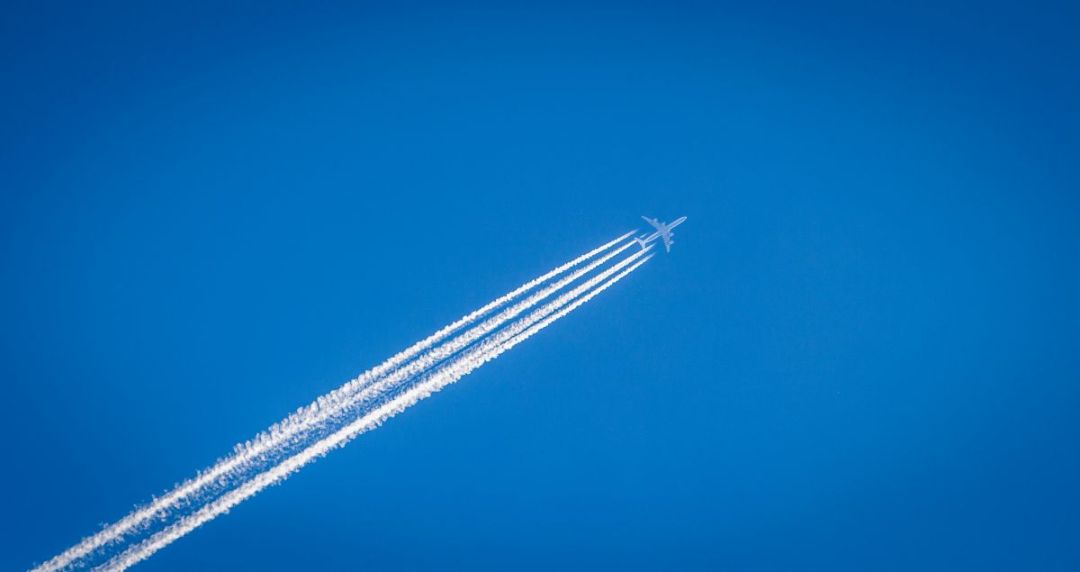
The other side of the business looks at solutions for mitigating climate impact. Meijers’ special passion is reducing contrails: Estuaire estimate that contrails are responsible for over 150Mt of industry emissions.
Meijers and his team have developed a comprehensive index for measuring contrails in real-time, a product they are currently trialling with several airlines. According to their analysis, 2.9% of world flights generated 80% of the total radiative forcing effect of contrails. Rerouting a very small number of flights could therefore have a substantial impact on the climate.
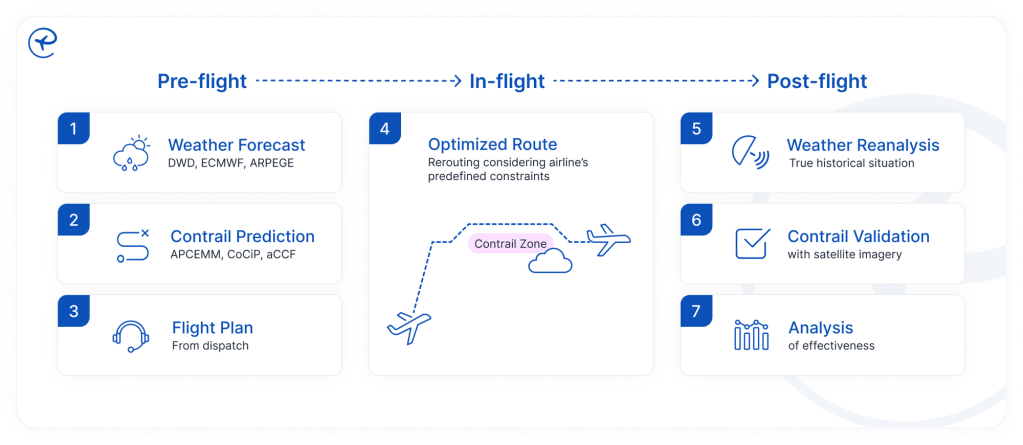
End-to-end contrail management methodology by Estuaire.
Meijers wants to see greater regulation in this area to force further change:
The challenge is that there’s no financial incentives or penalties that push airlines to work on contrails. That’s really something we want to set in place.
Aside from encouraging the EU to act on contrails, Meijers’ ambition is to grow his team and expand their work on emissions monitoring and reduction. On being honoured as Top Innovator, Meijers said:
It’s an award I pass to the team, notably our tech team, because they’re doing the ground work and the quality of our data should speak for itself. So it goes to them first, and having these industry recognitions just encourages us to go further.
🎥 Watch the full interview to hear more about Maxime Meijers’ vision for Estuaire and emissions monitoring in aviation.
Questions asked include:
- Where did your passion for sustainable aviation come from? What was the inspiration behind Estuaire?
- What industry challenges does Estuaire seek to address through its business?
- Which initiatives that you or the company have led that you are most proud of?
- How are you looking to grow in the future? What would you like to do next?
- What is the biggest challenge aviation faces in becoming a sustainable, zero-carbon industry? What advice would you give to help tackle it?
If your business would like to be considered for an Aerospace Tech Review Award, join us at Aerospace Tech Week 2026.
To hear from our other ATR Award winners, see:
by Elsie Clark | Nov 24, 2025 | Innovation, Sustainability
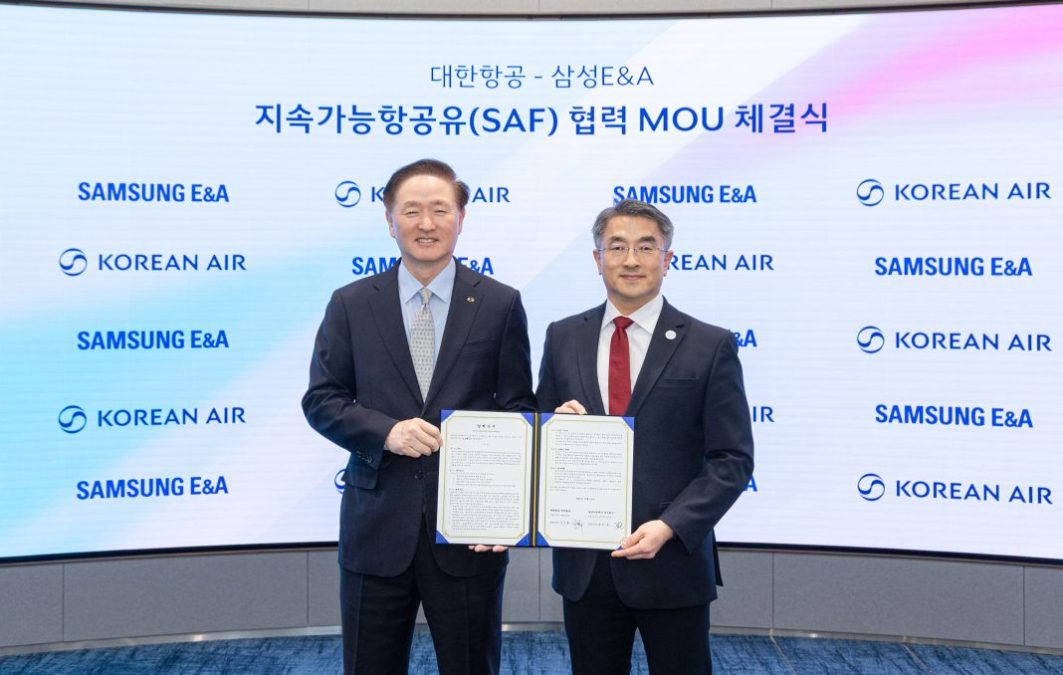
Korean Air and Samsung E&A have signed a Memorandum of Understanding (MoU) to develop a sustainable aviation fuel (SAF) supply chain in the US.
The airline and the engineering firm’s announcement forms part of their commitment to accelerate sustainable energy solutions in aviation. Samsung E&A will build on existing feedstock capacity and infrastructure in the US with its engineering expertise. Meanwhile, Korean Air has signed to become a SAF buyer, ensuring critical long-term demand. Other airlines including Delta and Air France have struck similar agreements to nurture the SAF industry as it takes flight.
Samsung E&A is considering participating in a SAF project that uses gasification–Fischer-Tropsch (FT) technology. This second-generation SAF fuels converts abundant woody waste into synthetic liquid fuel, a significant advance on first-generation processes that use limited supplies of waste cooking oil.
On the partnership with Samsung E&A, a spokesperson for Korean Air commented:
This partnership will further contribute to the aviation industry’s Net Zero 2050 goal and enhance our ability to effectively navigate evolving global environmental regulations, including SAF mandates. Through proactive project participation and continuous cooperation, we aim to accelerate global SAF adoption and advance our commitment to sustainable aviation and ESG management.
A report from IATA earlier this year found that SAF production is currently on track to fall 100 million tonnes short of net-zero emissions targets. The air transport association emphasise that investing in technology, not feedstock, was critical to ramping up sustainability efforts. If successful, Korean Air and Samsung’s new partnership will contribute directly to addressing this issue.
Join us at Aerospace Tech Week 2026 to discuss the future of sustainable aviation fuel (SAF).
For more like this, see:



You must be logged in to post a comment.