
by Elsie Clark | Mar 18, 2026 | Sustainability
The UK’s ‘Jet Zero’ taskforce have published their first annual report after the government introduced sustainable aviation fuel (SAF) targets at the beginning of 2025.
The mandate sets guidelines for achieving 10% SAF blending by 2030. Supported by a Revenue Certainty Mechanism and a £63 million Advanced Fuels Fund, aviation minister Keir Mather said at the Sustainable Skies World Summit that the progress made so far was ‘encouraging’. He added:
We must be clear eyed that there is still a long way to go on this journey and there are real challenges ahead but there are enormous opportunities too.
The green transition is not only about protecting our planet but also about strengthening our economy and our resilience. In an uncertain world, energy security has never been more important and that is why we must keep building momentum, boosting the production and deployment of SAF, backing technological renovation, improving efficiency and building robust carbon markets.
Alongside scaling SAF, the UK government is expanding the Hydrogen Challenge programme and launching a £240 million fund for next-generation aerospace technologies. Sustainable Aviation also announced a £2 million greenhouse gas removals (GGR) initative alongside the report, with estimates suggesting that the UK’s aviation industry will need 20 to 30 million tonnes of carbon removed each year by 2050.
Duncan McCourt, Chief Executive of Sustainable Aviation, said:
The UK aviation industry is working hard to address its climate impact. Scaling Greenhouse Gas Removals is essential for hard-to-abate sectors, and this Advanced Market Signal is the aviation industry acting now to help stimulate the growth of the GGR sector.
We have also made clear today that the aviation industry supports action to address the non-CO₂ impact of aviation. By accelerating research, trials and collaboration, we can deliver practical solutions that reduce aviation’s full climate impact.
Join us at Aerospace Tech Week 2026 to discuss sustainable aviation.
by Elsie Clark | Mar 9, 2026 | Innovation, Sustainability
Equilibrion and Rolls Royce have signed a memorandum of understanding (MoU) to develop British sustainable aviation fuel (SAF) production through nuclear power.
The Rolls Royce small modular reactor (SMR) can support the deployment of cost-effective, sustainable energy. Equilibrion’s proprietary Eq.flight SAF production system, meanwhile, is designed to minimise energy use during the SAF production process. Each Rolls Royce SMR has the potential to produce 160 million litres of SAF a year, representing a significant contribution to the UK’s SAF target, set at 22% of aviation fuel by 2040.
Caroline Longman, Director at Equilibrion, said:
Aviation will only meet its climate commitments if SAF becomes available in large, dependable volumes. Nuclear‑derived fuel production offers the reliability, scalability and low carbon intensity needed to deliver that future. Delivering nuclear‑enabled SAF also creates long‑term, high‑quality employment—each Eq.flight facility has the potential to generate around 10,000 skilled local jobs over its lifetime.
IATA has previously warned that SAF production systems are lagging far behind what is necessary to meet net-zero targets, with supply meeting only 1% of global demand. Nuclear-powered production would not only accelerate the supply chain but lower the carbon footprint of the entire SAF process. Alan Woods, Director of Strategy and Business Development for Rolls-Royce SMR, addded:
Our SMR technology is designed to provide clean, affordable and dependable low‑carbon energy, exactly the qualities required to unlock large‑scale Sustainable Aviation Fuel production. The technical and economic assessment completed with Equilibrion will enable them to demonstrate how nuclear can power one of the most ambitious decarbonisation challenges in aviation.
Join us at Aerospace Tech Week 2026 to discuss sustainable aviation.
by Elsie Clark | Mar 4, 2026 | AI & ML, Avionics, Connectivity, Flight Ops IT, Innovation, MRO IT, Sustainability
Aerospace Tech Week, the premier international exhibition and conference for the aerospace technology community, is proud to announce a new partnership with ADS Group as the event prepares to launch its inaugural UK edition in London.
The move to the UK marks an exciting new chapter for Aerospace Tech Week, which has established itself as the event for senior executives and technical leaders across the aviation and aerospace sectors. The United Kingdom provides a natural home for the show’s next evolution. World-class engineering, global-leading MRO capability, pioneering sustainability research, and an unmatched supply chain make this industry a cornerstone of British economic and industrial strength. It deserves an event that reflects that ambition.
To mark this milestone, Aerospace Tech Week is delighted to partner with ADS Group, the UK’s leading trade association representing the aerospace, defence, security and space sectors. ADS supports over 1,800 member companies across the UK, championing their interests, enabling business growth, and advocating for the policies and investment that keep British industry globally competitive. The partnership will help ensure that Aerospace Tech Week’s London edition is deeply connected to the UK industry community from day one.
Daniel Boyle, General Manager at Aerospace Tech Week said:
Aerospace Tech Week brings together the leaders shaping the future of aviation technology, so partnering with ADS is a natural fit. As the UK’s leading trade association for aerospace, defence, security and space, ADS represents a powerful network of innovators and industry stakeholders. We are delighted to be working together to strengthen engagement across the ecosystem and ensure Aerospace Tech Week continues to provide real value, meaningful connections and forward-looking insight for the industry.
Balaji Srimoolanathan, Aerospace Director at ADS Group said:
We are pleased to partner with Aerospace Tech Week as it launches its first UK edition, and to have another opportunity to showcase the innovation, ambition and global competitiveness of the UK’s aerospace, defence, security and space industries. Aerospace Tech Week provides an important platform for industrial collaboration across the entire ecosystem. With more than 1,800 member companies spanning the full breadth of the supply chain, we are committed to forming partnerships that connect industry with new opportunities, new technologies and new international relationships. We look forward to supporting a successful inaugural event and ensuring the UK’s world leading expertise is front and centre as the sector continues to innovate, export and grow.
Aerospace Tech Week’s inaugural UK edition will bring together airlines, MROs, ANSPs, OEMs and their partners to explore the latest developments across avionics, connected aircraft, MRO IT, flight operations technology, cybersecurity, sustainability and more.
For further information, to register, or to enquire about exhibition and sponsorship opportunities, click here.
About Aerospace Tech Week | 11 – 12 November 2026, Excel London
Aerospace Tech Week is a conference and exhibition focused on driving innovation and technology advancements in the aerospace sector. Bringing together senior executives and technical leaders, ATW connects the whole value chain of aerospace to discuss, connect, and collaborate on emerging trends, challenges, and opportunities.
In 2026, the event will reunite its community of 1,500 industry experts for two inspiring days featuring over 120 speakers. Key topics covered include AI, avionics, MRO, flight ops, and sustainability, while exhibitor and networking programmes spark connections that drive transformations across the industry.
Visit the event website here.
Subscribe to our newsletter to get the latest aerospace news and exclusive interviews straight to your inbox
by Elsie Clark | Feb 24, 2026 | Innovation, Sustainability
Zero-emissions taxiing is the focus of a new project backed by the UK’s Aerospace Technology Institute and Innovate UK. Led by Airbus, a consortium of partners including Drive System Design (DSD), Evolito, and the University of Southampton will work together to advance an electric wheel taxi system.
Such a solution could reduce taxi emissions by 47%, as aircraft could take off without deploying their main engines. Called Project SONATA, the consortium will develop a low speed, high torque electric motor and other infrastructure to support development.
Commenting on DSD’s involvement, Chris McDonald, the UK Government Minister for Industry, said:
Aviation needs to be sustainable on both land and air to reach Jet Zero, and that’s why this government is backing this innovative project by DSD to electrify aircraft ground operations. The UK’s world class aerospace sector has a key role to play in this race, and that’s why we’re doubling down on support for the sector through our Modern Industrial Strategy, delivering innovation and good jobs.
IATA named climate change-related disruption as one of the aviation industry’s top risks for 2026. The increasing frequency of extreme weather events will make running flights more difficult and less predictable, making improved sustainability an operational necessity. If successful, projects such as SONATA could go some way to mitigating these risks while reducing aviation’s overall environmental impact.
Join us at Aerospace Tech Week 2026, where we’ll be hosting key partners from the UK aerospace industry to discuss key sustainability questions.
For more like this, see:
by Elsie Clark | Feb 17, 2026 | Innovation, Sustainability
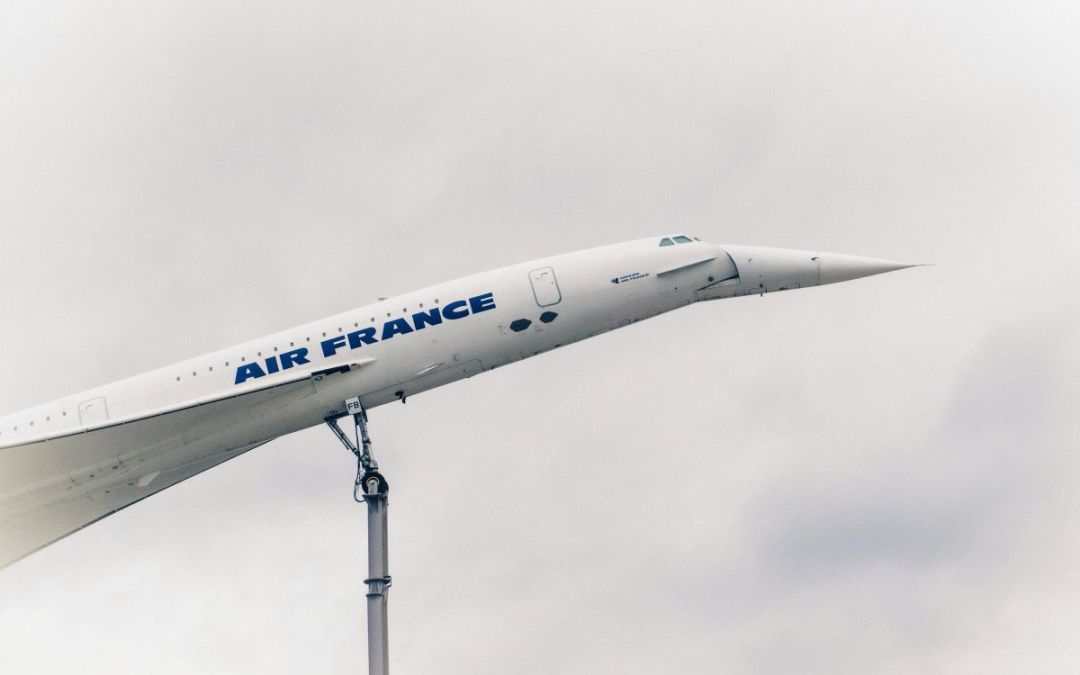
An icon of British and French engineering, the first commercial Concorde flight took off 50 years ago on 21 January 1976. But more than two decades after the famous jet touched down for the last time, are supersonic aircraft making a return above the Atlantic?
Capable of flying between New York and London in three-and-a-half hours, Concorde could travel at 1,354 miles (2,179 km) per hour — more than twice the speed of sound. The jet has come to epitomise both technological prowess and luxury, with tickets for a one-way flight in 1976 costing an eye-watering US$2,800 in today’s money.
An executive order from President Donald Trump has lifted the ban on commercial supersonic planes flying over US land, potentially opening a door for a greater number of routes. Meanwhile, companies are developing new premium supersonic commercial jets with modern technology to make them more energy-efficient. Could these twin developments pave the way for supersonic flight taking off again in the next five years?
The heirs to Concorde
Based in Colorado, Boom Supersonic are one developer hoping to revive the age of Concorde. Its Overture jet features an all-premium cabin that could host 60-80 passengers in a swish business-style experience. Compatible with sustainable aviation fuel (SAF), Boom claim the aircraft can reach speeds of Mach 1.7 and serve more than 600 global routes. A number of airlines have already placed pre-orders for Overture, including American Airlines, Japan Airlines, and United Airlines.
Overland civil supersonic flights had been banned in the US since 1973 due to concerns over the noise from sonic booms, as well as potential damage to property and people. However, Trump lifted this ban in June 2025, with the White House claiming in a press release:
Advances in aerospace engineering, materials science, and noise reduction now make supersonic flight not just possible, but safe, sustainable, and commercially viable. This order begins a historic national effort to reestablish the United States as the undisputed leader in high-speed aviation.
This executive order opens up the West Coast of the US to supersonic travel. But despite the White House’s claims, is the world ready to embrace Concorde-style travel once more?
Why was Concorde discontinued in the first place?
For all its technological achievements, Concorde faced a number of problems that ultimately contributed to it being retired from service in 2003. To reach its incredibly high speeds, the aircraft needed to consume 6,771 gallons of expensive jet fuel in a single transatlantic flight, making it difficult to run at a profit. Restrictions on overland travel further inhibit revenue, ultimately limiting Concorde deployment to routes between New York, Washington DC, London, and Paris.
Concorde’s environmental impact made it unpopular with the public. Sonic booms resulted in noise complaints, and residents reported windows being broken when the planes flew overhead. Additionally, Concorde was extremely carbon-intensive, producing three times more CO2 than subsonic planes and leaving visible air pollution in its wake.
Concorde’s decline was further accelerated by the Air France Concorde crash in 2000 that killed over 100 people, and the drop in air travel following the 9/11 terrorist attacks. But the aircraft’s ultimate failure lay with its unprofitability and environmentally-unfriendly technology.
Would a modern Concorde face the same problems?
Sustainability remains a huge question for the new supersonic jets. Boom Supersonic claim Overture is ‘SAF-compatible’. However, the sustainable fuels market is nowhere near ready to supply subsonic aircraft, let alone the supersonic, on the scale required. As it stands, there can be no justification for launching a jet that could have triple the carbon impact of a regular plane in an industry already struggling to meet net-zero targets.
Furthermore, experts have questioned whether there is sufficient demand for a modern Concorde. Business jets are more popular than ever, and wealthier customers may prefer to avoid commercial aircraft, no matter how fast they fly, when they could travel privately on their own schedule.
In its heyday, one of Concorde’s key benefits was to help business travellers get across continents in as little time as possible. Many meetings are now hosted online through Zoom or Teams, reducing the need for travel. And at the same time, more airlines are investing in high-speed inflight WiFi through Starlink, meaning work can continue even at 30,000 feet in the sky. Is the length of the flight so important now that the customer experience has improved significantly through better connectivity, entertainment, and comfort?
Blake Scholl, CEO of Boom Supersonic, remains confident. He told The Independent in 2025:
We believe in a world where more people can go to more places more often. Sustainable supersonic travel unlocks new possibilities for business relationships, prospects for vacation and opportunities for human connection.
Join us at Aerospace Tech Week 2026.
For more like this, see:
by Elsie Clark | Feb 16, 2026 | Innovation, Sustainability
London Heathrow Airport has set the ambitious target of exceeding the UK government’s sustainable aviation fuel (SAF) target by 2% in 2026. This year, regulations stipulate that 3.6% of all aviation fuel used in the UK should be sustainable. However, Heathrow is going further with a 5.6% target, backed by an £80 million fund.
Matt Gorman, Heathrow’s Director of Sustainability, said:
Sustainable Aviation Fuel is not a hypothetical concept for the future, it’s already producing real impact in 2026. Heathrow is leading the way globally, with 17% of the world’s SAF supply in 2024 used at the airport. SAF is a key lever on aviation’s journey to net zero by 2050, and a key element of Heathrow’s Net Zero Plan. Our incentive delivers real progress today, as well as a future promise for tomorrow.
The initiative forms part of Heathrow’s wider sustainability plans, which will also see it exceed UK government mandates. By 2030, 10% of fuel used in the country must be SAF, but Heathrow plans to scale their targets to achieve 11% SAF use that same year. The £80 million will help make SAF more competitive with traditional kerosene fuels while reducing the cost impact on airlines — a common criticism of existing SAF mandates.
Overall, the plans will see 350,000 tonnes of SAF used at Heathrow in 2026. This results in a carbon saving of approximately 600,000 tonnes, the equivalent of 950,000 economy passengers flying a round-trip between Heathrow and JFK.
Join us at Aerospace Tech Week 2026 to discuss sustainable aviation.
For more like this, see:




You must be logged in to post a comment.