
by Elsie Clark | Feb 24, 2026 | Innovation, Sustainability
Zero-emissions taxiing is the focus of a new project backed by the UK’s Aerospace Technology Institute and Innovate UK. Led by Airbus, a consortium of partners including Drive System Design (DSD), Evolito, and the University of Southampton will work together to advance an electric wheel taxi system.
Such a solution could reduce taxi emissions by 47%, as aircraft could take off without deploying their main engines. Called Project SONATA, the consortium will develop a low speed, high torque electric motor and other infrastructure to support development.
Commenting on DSD’s involvement, Chris McDonald, the UK Government Minister for Industry, said:
Aviation needs to be sustainable on both land and air to reach Jet Zero, and that’s why this government is backing this innovative project by DSD to electrify aircraft ground operations. The UK’s world class aerospace sector has a key role to play in this race, and that’s why we’re doubling down on support for the sector through our Modern Industrial Strategy, delivering innovation and good jobs.
IATA named climate change-related disruption as one of the aviation industry’s top risks for 2026. The increasing frequency of extreme weather events will make running flights more difficult and less predictable, making improved sustainability an operational necessity. If successful, projects such as SONATA could go some way to mitigating these risks while reducing aviation’s overall environmental impact.
Join us at Aerospace Tech Week 2026, where we’ll be hosting key partners from the UK aerospace industry to discuss key sustainability questions.
For more like this, see:
by Elsie Clark | Feb 23, 2026 | Innovation
Research from Lufthansa Innovation Hub (LIH) finds that airline investment in startups has hit a five-year low.
Airlines completed 31 innovation deals in 2025, down from 39 in 2024 and well below the 2018 peak of 49 deals. Furthermore, only 7 airlines were responsible for 2025’s start-up activity, compared to 11 in 2025. LIH analysis confirms that only 7% of IATA-registered airlines have ever invested in start-ups, prompting them to comment:
For the vast majority of airlines, start-up investing is not a strategic tool. It’s something other industries do.
Data shows 2025 was the year corporate venturing hit an all-time high. Over 3,000 companies worldwide are now investing in start-ups, making airlines’ limited activity in this area especially notable.
United Airlines led the pack in 2025, signing 10 start-up investment deals. International Airlines Group (IAG) and All Nippon Airways (ANA) also invested in 7 start-ups each. LIH note that the share of investment in APAC is growing year-on-year, propelled by the ANA Frontier Fund, launched in 2024, and IndiGo Ventures, the first airline innovation arm based in India that closed a US$52 million fund last year.
Aviation’s cautious nature is not only highlighted by the limited number of airlines investing: of those investments, the majority are increasingly heading to later-stage companies as airlines try to mitigate risk. LIH found that in 2025 mature start-ups received 65% of airline investment, a significant rise from the 41% recorded in 2023.
JetBlue, one of the earliest airlines to fund start-ups, sold its venturing arm, JetBlue Ventures, to SKY Leasing in May 2025 to focus on core airline operations. This demonstrates how even successful funds are at risk when airlines remain focused on near-term profitability.
LIH suggests this mindset could be detrimental to aviation’s performance in the long run. They conclude:
A few selected airlines are still investing, but they’re doing so cautiously, selectively, and increasingly late. That approach may reduce risk in the short term. But it also raises an important question: are airlines still positioning themselves close enough to the next wave of disruption?
Join us at Aerospace Tech Week 2026 to explore our cutting-edge Start-Up Zone.
For more like this, see:
by Elsie Clark | Feb 19, 2026 | Innovation
European aircraft and aerospace manufacturer Airbus have published their full-year 2025 financial performance, recording revenue of €73.4 billion and a record backlog of 8,754 commercial aircraft.
Revenue was up on 2024’s €69.2 billion, and Airbus also managed to deliver more aircraft (783 in 2025 against 766 in 2024). Airbus Defence and Space performed especially well, with revenue increasing 11% year-on-year to €13.4 billion.
For 2026, assuming no further geopolitical disruption, the company is targeting 870 commercial deliveries. Production on the A220s is still accelerating, with Airbus now hoping to deliver 13 models a month by 2028. They blame Pratt & Whitney as engine suppliers for the current stalling on the programme, and assert that they will achieve a rate of 70 to 75 overall aircraft a month before the end of 2027.
Rivals Boeing posted a profit in 2025 for the first time since 2018, but also reported a backlog worth US$682 billion.
Guillaume Faury, Airbus Chief Executive Officer, said:
2025 was a landmark year, characterised by very strong demand for our products and services across all businesses, a record financial performance, and strategic milestones. We successfully navigated a complex and dynamic operating environment to deliver on our updated guidance.
Global demand for commercial aircraft underpins our ongoing production ramp-up, which we are managing while facing significant Pratt & Whitney engine shortages. The broad and competitive portfolios of Defence and Space as well as Helicopters allow us to capture the momentum in defence. We are also making progress to establish a new global industrial space player, together with our partners. These 2025 results and the confidence in our future financial performance support the proposed higher dividend payment.
Faury alludes to the merger with Leonardo and Thales that will see Airbus contribute its Space Systems and Space Digital businesses to a new aerospace entity that could rival SpaceX. Worth €10 billion, the European super-company represents an exciting development for Airbus as the manufacturing arm continues to struggle with supply chain issues and an extensive backlog.
Join us at Aerospace Tech Week 2026.
For more like this, see:
by Elsie Clark | Feb 17, 2026 | Innovation, Sustainability
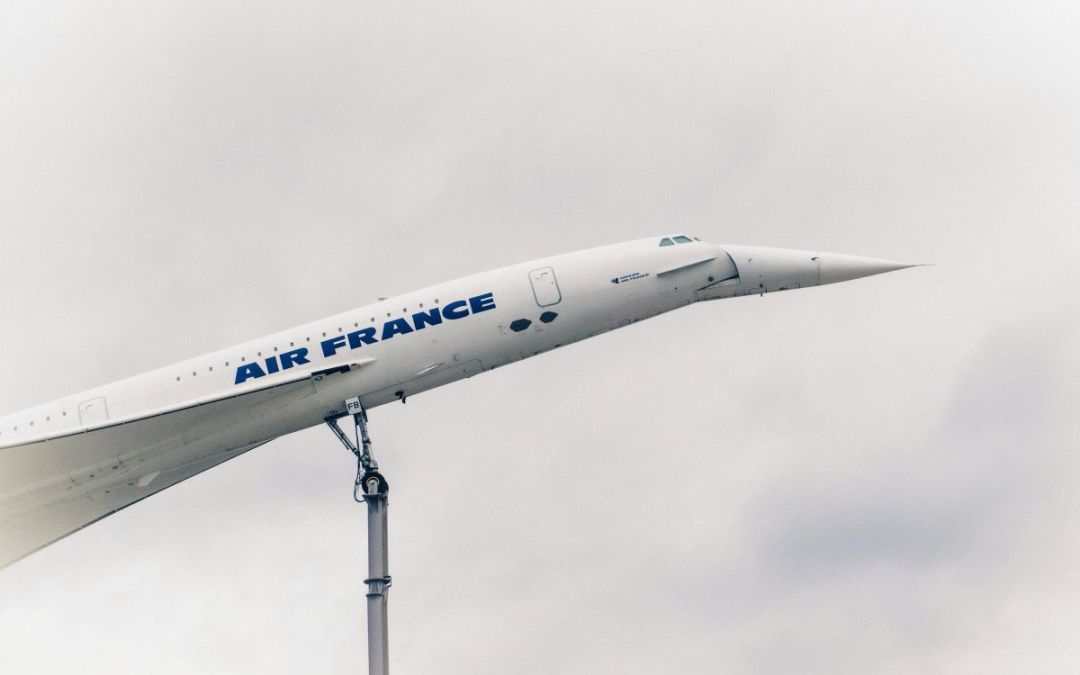
An icon of British and French engineering, the first commercial Concorde flight took off 50 years ago on 21 January 1976. But more than two decades after the famous jet touched down for the last time, are supersonic aircraft making a return above the Atlantic?
Capable of flying between New York and London in three-and-a-half hours, Concorde could travel at 1,354 miles (2,179 km) per hour — more than twice the speed of sound. The jet has come to epitomise both technological prowess and luxury, with tickets for a one-way flight in 1976 costing an eye-watering US$2,800 in today’s money.
An executive order from President Donald Trump has lifted the ban on commercial supersonic planes flying over US land, potentially opening a door for a greater number of routes. Meanwhile, companies are developing new premium supersonic commercial jets with modern technology to make them more energy-efficient. Could these twin developments pave the way for supersonic flight taking off again in the next five years?
The heirs to Concorde
Based in Colorado, Boom Supersonic are one developer hoping to revive the age of Concorde. Its Overture jet features an all-premium cabin that could host 60-80 passengers in a swish business-style experience. Compatible with sustainable aviation fuel (SAF), Boom claim the aircraft can reach speeds of Mach 1.7 and serve more than 600 global routes. A number of airlines have already placed pre-orders for Overture, including American Airlines, Japan Airlines, and United Airlines.
Overland civil supersonic flights had been banned in the US since 1973 due to concerns over the noise from sonic booms, as well as potential damage to property and people. However, Trump lifted this ban in June 2025, with the White House claiming in a press release:
Advances in aerospace engineering, materials science, and noise reduction now make supersonic flight not just possible, but safe, sustainable, and commercially viable. This order begins a historic national effort to reestablish the United States as the undisputed leader in high-speed aviation.
This executive order opens up the West Coast of the US to supersonic travel. But despite the White House’s claims, is the world ready to embrace Concorde-style travel once more?
Why was Concorde discontinued in the first place?
For all its technological achievements, Concorde faced a number of problems that ultimately contributed to it being retired from service in 2003. To reach its incredibly high speeds, the aircraft needed to consume 6,771 gallons of expensive jet fuel in a single transatlantic flight, making it difficult to run at a profit. Restrictions on overland travel further inhibit revenue, ultimately limiting Concorde deployment to routes between New York, Washington DC, London, and Paris.
Concorde’s environmental impact made it unpopular with the public. Sonic booms resulted in noise complaints, and residents reported windows being broken when the planes flew overhead. Additionally, Concorde was extremely carbon-intensive, producing three times more CO2 than subsonic planes and leaving visible air pollution in its wake.
Concorde’s decline was further accelerated by the Air France Concorde crash in 2000 that killed over 100 people, and the drop in air travel following the 9/11 terrorist attacks. But the aircraft’s ultimate failure lay with its unprofitability and environmentally-unfriendly technology.
Would a modern Concorde face the same problems?
Sustainability remains a huge question for the new supersonic jets. Boom Supersonic claim Overture is ‘SAF-compatible’. However, the sustainable fuels market is nowhere near ready to supply subsonic aircraft, let alone the supersonic, on the scale required. As it stands, there can be no justification for launching a jet that could have triple the carbon impact of a regular plane in an industry already struggling to meet net-zero targets.
Furthermore, experts have questioned whether there is sufficient demand for a modern Concorde. Business jets are more popular than ever, and wealthier customers may prefer to avoid commercial aircraft, no matter how fast they fly, when they could travel privately on their own schedule.
In its heyday, one of Concorde’s key benefits was to help business travellers get across continents in as little time as possible. Many meetings are now hosted online through Zoom or Teams, reducing the need for travel. And at the same time, more airlines are investing in high-speed inflight WiFi through Starlink, meaning work can continue even at 30,000 feet in the sky. Is the length of the flight so important now that the customer experience has improved significantly through better connectivity, entertainment, and comfort?
Blake Scholl, CEO of Boom Supersonic, remains confident. He told The Independent in 2025:
We believe in a world where more people can go to more places more often. Sustainable supersonic travel unlocks new possibilities for business relationships, prospects for vacation and opportunities for human connection.
Join us at Aerospace Tech Week 2026.
For more like this, see:
by Elsie Clark | Feb 16, 2026 | Innovation, Sustainability
London Heathrow Airport has set the ambitious target of exceeding the UK government’s sustainable aviation fuel (SAF) target by 2% in 2026. This year, regulations stipulate that 3.6% of all aviation fuel used in the UK should be sustainable. However, Heathrow is going further with a 5.6% target, backed by an £80 million fund.
Matt Gorman, Heathrow’s Director of Sustainability, said:
Sustainable Aviation Fuel is not a hypothetical concept for the future, it’s already producing real impact in 2026. Heathrow is leading the way globally, with 17% of the world’s SAF supply in 2024 used at the airport. SAF is a key lever on aviation’s journey to net zero by 2050, and a key element of Heathrow’s Net Zero Plan. Our incentive delivers real progress today, as well as a future promise for tomorrow.
The initiative forms part of Heathrow’s wider sustainability plans, which will also see it exceed UK government mandates. By 2030, 10% of fuel used in the country must be SAF, but Heathrow plans to scale their targets to achieve 11% SAF use that same year. The £80 million will help make SAF more competitive with traditional kerosene fuels while reducing the cost impact on airlines — a common criticism of existing SAF mandates.
Overall, the plans will see 350,000 tonnes of SAF used at Heathrow in 2026. This results in a carbon saving of approximately 600,000 tonnes, the equivalent of 950,000 economy passengers flying a round-trip between Heathrow and JFK.
Join us at Aerospace Tech Week 2026 to discuss sustainable aviation.
For more like this, see:
by Elsie Clark | Feb 12, 2026 | AI & ML, Innovation
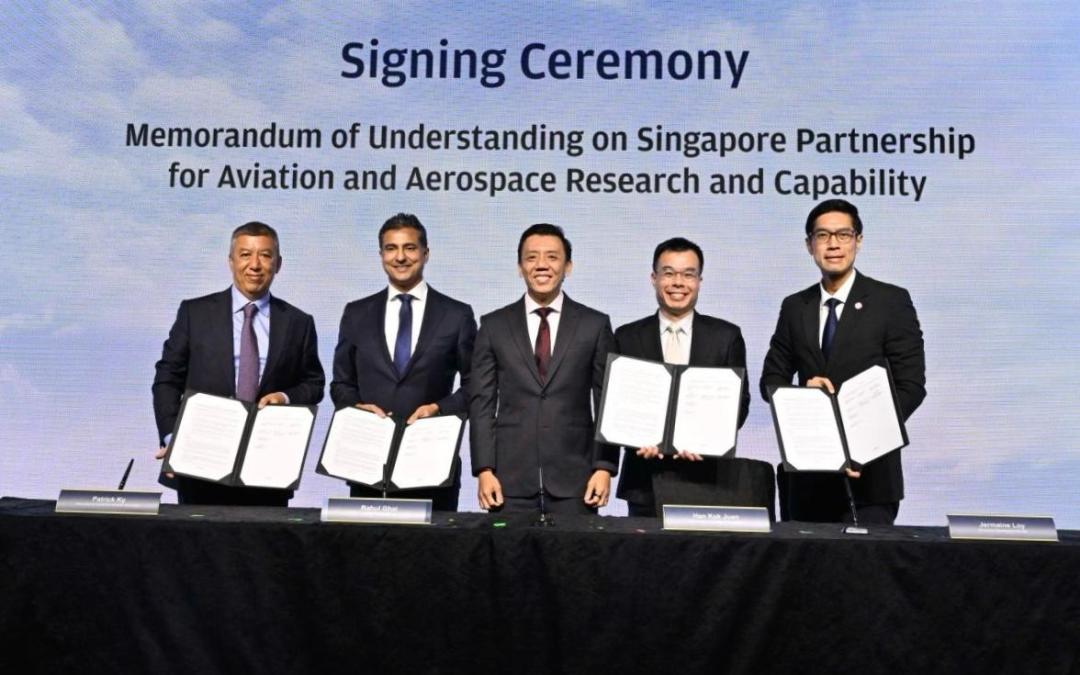
The Civil Aviation Authority of Singapore (CAAS), the Singapore Economic Development Board (EDB), GE Aerospace, and the International Centre for Aviation Innovation (ICAI) have signed a Memorandum of Understanding (MoU) to establish an innovation centre.
The Singapore Partnership for Aviation & Aerospace Research and Capability (SPAARC) will develop next-generation aviation and aerospace solutions. Covering AI, digital platforms, and aerodynamics, the centre will enhance operational efficiency and safety.
Mr. Han Kok Juan, Director-General of CAAS, said:
We have seen rapid advancement in technologies across many fields which, if applied to aviation, has the potential to fundamentally transform it. But because aviation is global and safety-critical, development and deployment at scale involves multiple stakeholders and is often long-drawn and costly. Through public-private-research partnerships such as this, we hope to establish and offer new innovation pathways that are more efficient and effective than what are available currently. These will help accelerate the development and deployment of breakthrough capabilities.
The establishment of a collaborative framework will structure the research and development (R&D) efforts while emphasising governance frameworks for new tech that meets critical safety standards. Mr. Jermaine Loy, Managing Director of EDB, said:
The establishment of SPAARC reflects Singapore’s commitment and ambition to spearhead aviation and aerospace innovation. This partnership will add new capabilities to Singapore in areas such as AI, air traffic management and aerodynamics. Our local workforce will also have opportunities to develop advanced technologies that will drive Singapore’s continued growth as a global aviation and aerospace hub.
Join us at Aerospace Tech Week 2026 to discuss the next innovations in the industry.
For more like this, see:





You must be logged in to post a comment.