
by Elsie Clark | Mar 4, 2026 | AI & ML, Avionics, Connectivity, Flight Ops IT, Innovation, MRO IT, Sustainability
Aerospace Tech Week, the premier international exhibition and conference for the aerospace technology community, is proud to announce a new partnership with ADS Group as the event prepares to launch its inaugural UK edition in London.
The move to the UK marks an exciting new chapter for Aerospace Tech Week, which has established itself as the event for senior executives and technical leaders across the aviation and aerospace sectors. The United Kingdom provides a natural home for the show’s next evolution. World-class engineering, global-leading MRO capability, pioneering sustainability research, and an unmatched supply chain make this industry a cornerstone of British economic and industrial strength. It deserves an event that reflects that ambition.
To mark this milestone, Aerospace Tech Week is delighted to partner with ADS Group, the UK’s leading trade association representing the aerospace, defence, security and space sectors. ADS supports over 1,800 member companies across the UK, championing their interests, enabling business growth, and advocating for the policies and investment that keep British industry globally competitive. The partnership will help ensure that Aerospace Tech Week’s London edition is deeply connected to the UK industry community from day one.
Daniel Boyle, General Manager at Aerospace Tech Week said:
Aerospace Tech Week brings together the leaders shaping the future of aviation technology, so partnering with ADS is a natural fit. As the UK’s leading trade association for aerospace, defence, security and space, ADS represents a powerful network of innovators and industry stakeholders. We are delighted to be working together to strengthen engagement across the ecosystem and ensure Aerospace Tech Week continues to provide real value, meaningful connections and forward-looking insight for the industry.
Balaji Srimoolanathan, Aerospace Director at ADS Group said:
We are pleased to partner with Aerospace Tech Week as it launches its first UK edition, and to have another opportunity to showcase the innovation, ambition and global competitiveness of the UK’s aerospace, defence, security and space industries. Aerospace Tech Week provides an important platform for industrial collaboration across the entire ecosystem. With more than 1,800 member companies spanning the full breadth of the supply chain, we are committed to forming partnerships that connect industry with new opportunities, new technologies and new international relationships. We look forward to supporting a successful inaugural event and ensuring the UK’s world leading expertise is front and centre as the sector continues to innovate, export and grow.
Aerospace Tech Week’s inaugural UK edition will bring together airlines, MROs, ANSPs, OEMs and their partners to explore the latest developments across avionics, connected aircraft, MRO IT, flight operations technology, cybersecurity, sustainability and more.
For further information, to register, or to enquire about exhibition and sponsorship opportunities, click here.
About Aerospace Tech Week | 11 – 12 November 2026, Excel London
Aerospace Tech Week is a conference and exhibition focused on driving innovation and technology advancements in the aerospace sector. Bringing together senior executives and technical leaders, ATW connects the whole value chain of aerospace to discuss, connect, and collaborate on emerging trends, challenges, and opportunities.
In 2026, the event will reunite its community of 1,500 industry experts for two inspiring days featuring over 120 speakers. Key topics covered include AI, avionics, MRO, flight ops, and sustainability, while exhibitor and networking programmes spark connections that drive transformations across the industry.
Visit the event website here.
Subscribe to our newsletter to get the latest aerospace news and exclusive interviews straight to your inbox
by Elsie Clark | Mar 2, 2026 | Innovation
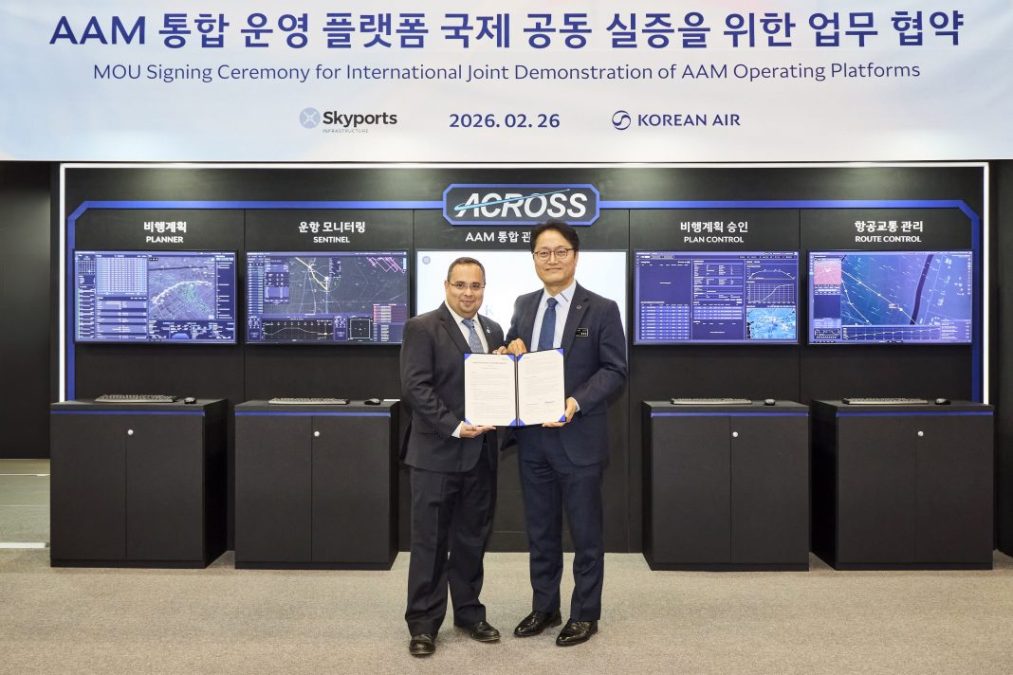
Korean Air and Skyports have announced a new partnership for developing eVTOL operations. Announced at the Drone Show Korea, the collaboration builds on the expertise of both partners to build scalable solutions for advanced air mobility (AAM) integration.
Under the Memorandum of Understanding (MoU), the Air Control & Routing Orchestrated Skyway System (ACROSS), Korean Air’s proprietary flight ops and air traffic management system, will be linked to Skyports’ Vertiport Automation System (VAS) for vertiport infrastructure control. Together, these two platforms can provide infrastructure for commercial eVTOL development, including check-in, security, boarding, and arrivals.
A Korean Air representative comments:
ACROSS delivers integrated flight control and air traffic management for the low-altitude aviation environment. As vertiports serve as the essential interface for these operations, our partnership with Skyports, a global leader in infrastructure, is a critical milestone in building a safe and efficient AAM ecosystem.
Joint demonstrations and piloting programmes will help the partnership strengthen development of AAM as a public transportation arm. The ACROSS system has already been validated by the Korean Ministry of Land, Infrastructure and Transport (MOLIT) through Phases 1 and 2 of the K-UAM Grand Challenge.
Skyports have emerged as the industry leaders in vertiports. Sites in Dubai are expected to host commercial operations later this year, while the company is also developing infrastructure in South Korea’s Jeju Island alongside Abu Dhabi and New York.
Ankit Dass, Chief Technology Officer, Skyports, commented:
Whilst eVTOL aircraft development is progressing at a good pace, there are still various unknowns around how they would operate and navigate effectively in the real world environment. This partnership with Korean Air reflects our shared vision to create the technologies and operational frameworks needed to bring Advanced Air Mobility to life.
Join us at Aerospace Tech Week 2026.
For more like this, see:
by Elsie Clark | Feb 26, 2026 | Avionics, Innovation
Avionyx and Rapita Systems have announced they are partnering to accelerate avionics development. With software compliance issues constraining eVTOL and aircraft supply chains, the companies say their collaboration will help the aerospace industry hit regulatory targets faster.
Avionyx are owned by Joby Aviation, the electric air taxi developers. Focused on engineering, their capabilities complement Rapita’s expertise in software verification tools. Getting software to adhere to rigorous industry standards can take years and millions in investment, but by partnering the two businesses say they can create a ‘one-stop shop’ for safety and compliance.
Tom Ferrell, General Manager at Avionyx said:
This collaboration enables Avionyx to offer our customers a faster, more efficient path to certification, even for the most demanding DAL A and multi-core projects. Rapita’s tools, combined with our decades of aerospace experience, create a powerful solution for programs across the Americas.
Rapita say the partnership will help companies find and fix software bugs ‘in hours instead of weeks’. It will also support investment in the most powerful computer chips while remaining compliant with aviation regulation. If successful, the collaboration will reduce supply chain delays and associated costs. Jamie Ayre, Chief Commercial Officer at Rapita Systems, commented:
Rapita and Avionyx joining forces is a logical union given our shared focus on supporting high-criticality aerospace projects and commitment to solving the industry’s hardest challenges.
Join us at Aerospace Tech Week 2026 to discuss the future of avionics.
For more like this, see:
by Elsie Clark | Feb 25, 2026 | Innovation
Archer Aviation have sued British rivals Vertical Aerospace, claiming the company’s latest Valo eVTOL design infringes the patent for their Midnight air taxi.
The California-based company has been ramping up testing of Midnight as it plans for certification from the Federal Aviation Authority (AAM). A spokesperson for Archer argued:
After years of developing its VX4 aircraft, Vertical has abandoned that design and unveiled a new aircraft, Valo, which is a visual mimic of Archer’s Midnight aircraft’s award-winning industrial design.
They added that Vertical had ‘knowingly, willfully’ copied Archer’s designs, including flight control systems and methods for managing battery power and flight propulsion. Vertical have dismissed Archer’s lawsuit as ‘without merit’, asserting that the company are attempting to distract the media from wider problems associated with its eVTOL development programme.
In a statement, Vertical said:
Archer’s claims are merely an attempt to distract from Archer’s challenges competing in the marketplace. Vertical has developed a robust aircraft design with a clear path to certification, underpinned by Vertical’s proprietary and market-leading technology and international IP portfolio.
Archer and Vertical’s rivalry has grown more intense in recent years as both companies struggle to gain leverage in an increasingly competitive AAM market. In February this year, Archer announced they were establishing a new base in Bristol, UK, the city where Vertical are headquartered. Meanwhile, Vertical challenged Archer and Joby, another competitor in the space, by announcing plans for a New York air taxi network. Neither company is certified in the US, UK, or abroad as both try to prove eVTOL networks can be safe and efficient modes of transport.
Join us at Aerospace Tech Week 2026 to discuss the future of advanced air mobility (AAM).
For more like this, see:
by Elsie Clark | Feb 24, 2026 | Innovation, Sustainability
Zero-emissions taxiing is the focus of a new project backed by the UK’s Aerospace Technology Institute and Innovate UK. Led by Airbus, a consortium of partners including Drive System Design (DSD), Evolito, and the University of Southampton will work together to advance an electric wheel taxi system.
Such a solution could reduce taxi emissions by 47%, as aircraft could take off without deploying their main engines. Called Project SONATA, the consortium will develop a low speed, high torque electric motor and other infrastructure to support development.
Commenting on DSD’s involvement, Chris McDonald, the UK Government Minister for Industry, said:
Aviation needs to be sustainable on both land and air to reach Jet Zero, and that’s why this government is backing this innovative project by DSD to electrify aircraft ground operations. The UK’s world class aerospace sector has a key role to play in this race, and that’s why we’re doubling down on support for the sector through our Modern Industrial Strategy, delivering innovation and good jobs.
IATA named climate change-related disruption as one of the aviation industry’s top risks for 2026. The increasing frequency of extreme weather events will make running flights more difficult and less predictable, making improved sustainability an operational necessity. If successful, projects such as SONATA could go some way to mitigating these risks while reducing aviation’s overall environmental impact.
Join us at Aerospace Tech Week 2026, where we’ll be hosting key partners from the UK aerospace industry to discuss key sustainability questions.
For more like this, see:




You must be logged in to post a comment.