
by Elsie Clark | Nov 12, 2025 | Innovation, Sustainability
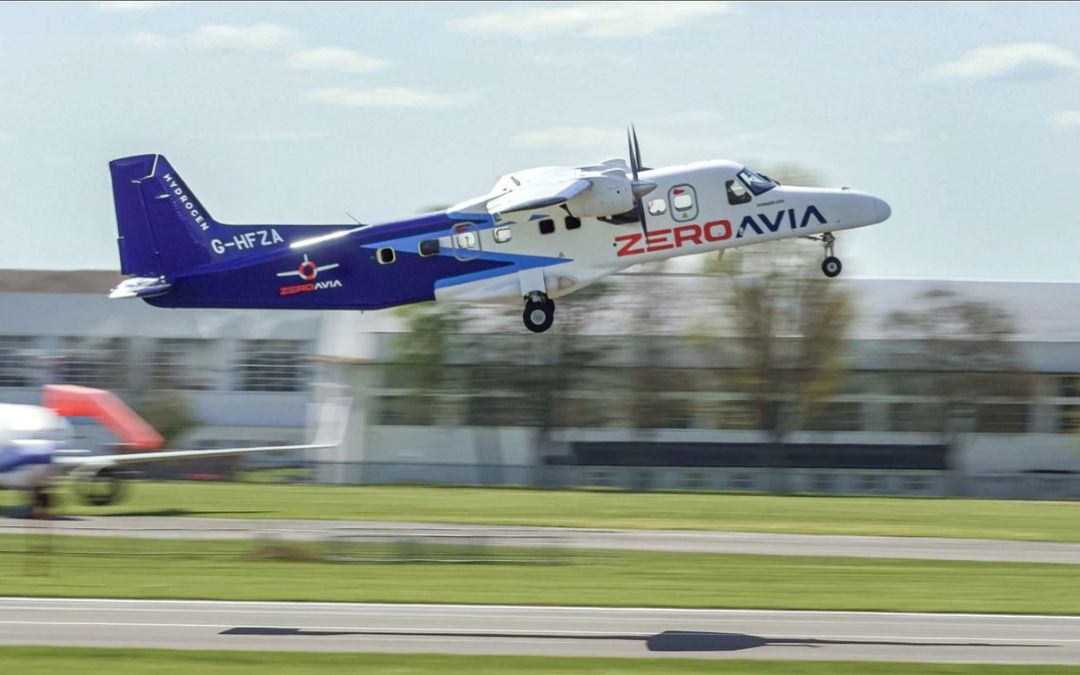
The EU’s Innovation Fund has approved ZeroAvia’s application for €21.4 million (US$24.5 million) in funding to advance their hydrogen-electric engines.
The money will go towards a new project in Norway that will see 15 Cessna Caravan planes with ZeroAvia’s ZA600 hydrogen-electric engine. The funding will also go towards hydrogen infrastructure development across the Scandinavian state, including storage and refuelling capabilities.
ZeroAvia founder and CEO Val Miftakhov said:
The EU Innovation Fund is notoriously competitive with applications needing to pass through rigorous assessment and demonstrate compelling evidence for near-term greenhouse gas reductions.
This project will set a phenomenal example by introducing a scaled network of hydrogen-electric aircraft operations, efficiently delivering vital goods to people and businesses across Norway without the typical associated environmental damage.
The Norwegian project will create the largest-established zero-carbon commercial flight network ever. If successful, the deployment of ZeroAvia engines could reduce carbon emissions on kerosene-powered cargo routes by 95%.
The project’s goal is to test the viability of hydrogen propulsion tech in Norway, findings which will in turn inform development across the EU. Regulatory approval for ZeroAvia’s ZA600 powertrain is currently ongoing with both the UK Civil Aviation Authority, and the Federal Aviation Administration (FAA).
ZeroAvia also seeks to expand their hydrogen tech beyond planes. Earlier this year, the company announced it plans to build a facility for hydrogen-electric train manufacture in Scotland.
Join us at Aerospace Tech Week 2026 to advance the future of hydrogen propulsion in aviation.
For more like this, see:
by Elsie Clark | Nov 10, 2025 | Sustainability
21 airlines will change their environmental claims after the EU found them to be misleading or exaggerated.
An investigation by the EU Commission and the Network of Consumer Protection Cooperation (CPC) Authorities decided that airlines’ descriptions of carbon offsets and sustainable aviation fuel (SAF) gave passengers a false impression that flying was sustainable. Flight emissions ‘calculators’ and vague net-zero emissions targets were also raised as greenwashing practices.
Lufthansa, KLM, and Ryanair are among the airlines who will now revise their claims after reaching an agreement with the EU. The bloc warned that if they did not fall in line with the investigation, sanctions could follow. The 21 airlines must now use the term ‘sustainable aviation fuel’ with appropriate clarifications, and be much clearer with their carbon offsetting claims.
Agustín Reyna, Director General of BEUC, said:
It is excellent news airlines have agreed to stop luring consumers with green promises following our complaint to the European Commission. It was high time airlines stopped painting flying as a sustainable option. Paying ‘green fares’ to plant trees can never guarantee to suck aircraft emissions out of the air.
The EU’s recommendations made clear that sustainability claims and ‘green’ terminology can only be used if backed up by comprehensive targets, strategies, and timelines. Announced on the eve of COP30, the agreement sends a strong message to all airlines, and highlights how much more needs to be done for aviation to make realistic steps towards decarbonisation and overall sustainability.
Join us at Aerospace Tech Week 2026 to discuss how to make the skies sustainable.
For more like this, see:
by Elsie Clark | Oct 30, 2025 | Innovation, Sustainability
Honeywell have pioneered a new production process that turns agricultural and forestry waste into sustainable aviation fuel (SAF).
Under the UOP (Universal Oil Products) Biocrude Upgrading process, inexpensive biomass feedstocks such as wood chips and sawmill dust are converted into a renewable biocrude. This can then be refined at existing petroleum refineries, with no need for further specialist facilities.
The new fuel process complements Honeywell’s existing portfolio of renewable fuels. These including Ecofining, developed in partnership with Eni S.p.A., which converts fats and oils into renewable deisel and SAF. Honeywell’s Ethanol-to-Jet (ETJ) tech turns ethanol into synethetic paraffinic kerosene, while the Fishcer-Tropsch Unicracking refines synthetic gas into liquid fuels.
Ken West, President & CEO of Honeywell Energy & Sustainability Solutions, said:
As demand for SAF continues to grow, the aviation industry is challenged by limited supplies of traditional SAF feedstocks such as vegetable oils, animal fats and waste oils.
When combined with the existing Fischer-Tropsch process, our new technology will expand the feedstock options available in the industry to sources that are more plentiful, ultimately helping improve our customers’ ability to produce SAF.
The new biomass-derived fuel puts the US company in competition with other SAF pioneers, including the Finnish brand Neste, the current leader in SAF production. The race to scale SAF is well and truly on, as demand for sustainable fuels far outpaces current supply, and cost pressures inhibit competitivity with the jet fuel market.
Join us at Aerospace Tech Week to discuss the future of sustainability in aviation operations.
For more like this, see:
by Elsie Clark | Oct 28, 2025 | Sustainability
The European Union Aviation Safety Agency (EASA) says that the industry is on track to achieve its target of 6% sustainable aviation fuel (SAF) by 2030.
The ReFuelEU Aviation Annual Technical Report found that 0.6% of Europe’s supplied aviation fuel for 2024 was SAF. This percentage needs to increase rapidly, but nevertheless saved 714 kilotonnes of carbon emissions, the equivalent of around 10,000 flights between Madrid and Paris.
Overall, EASA believes the EU is on track to achieve its 6% blending target in the next five years. Whether the bloc hits its interim target of 2% SAF in 2025 will be assessed at the close of this calendar year.
China is Europe’s biggest supplier of biofuel
EASA’s findings also highlight the ongoing cost obstacles to SAF adoption. Currently, the average price of SAF sits at €2,085/tonne, compared to €734/tonne for conventional jet fuel. Until the cost becomes more competitive, it is difficult to see how SAF use can scale successfully. Earlier this year, Airlines for Europe (A4E) criticised the EU for imposing SAF mandates without taking action to create a viable SAF market. Nevertheless, EASA’s report affirms progress on the 6% target.
Europe’s biggest producer of SAF is currently Finland, responsible for 10% of supply. However, 69% of feedstock originates outside of the EU, with China the biggest supplier.
Maria Rueda, EASA’s safety management, sustainability and global outreach director, said:
This first annual technical report marks an important milestone and makes clear that the EU has taken important first steps.
A functioning reporting system is now in place, initial reporting compliance levels are solid, and SAF delivery is happening across multiple member states. This report sets an important benchmark for our sustainability efforts in the future.
Join us at Aerospace Tech Week 2026 to discuss the future of sustainable aviation.
For more like this, see:
by Elsie Clark | Oct 27, 2025 | Innovation, Sustainability
Swedavia are the first in Europe to introduce a curved air traffic approaches concept at Stockholm Arlanda Airport.
The Established on RNP (EoR) concept makes it easier for aircraft to approach on a curve, thereby increasing capacity, sustainability, and efficiency. More aircraft can land per hour as the runway queue is reduced, while fewer aircraft on the arrival runway helps limit unnecessary fuel burn.
Susanne Norman, Director of Operations at Swedavia, said:
For us, it is of course gratifying that Swedavia will be the first in Europe to apply the new concept for managing arrivals. Enabling more curved approaches is also the most effective way to support airlines in their transition work, in addition to facilitating increased use of sustainable aviation fuel (SAF).
Launched in partnership with Luftfartsverket, the initiative encourages airlines to invest in tech compatible with curved approaches, which also minimises noise.
Anna Granberg, Director of Operations at Luftfartsverket, commented:
The modernisation of the airspace by Luftfartsverket shows how air traffic control can help reduce the environmental impact of aviation. The traffic flow into Stockholm Arlanda Airport becomes more efficient during peak hours, and arriving aircraft have shorter flight paths with reduced emissions.
To adopt the EoR concept, airports and aircraft need to have bespoke equipment, specially-trained staff, and a permit from the local aerospace authority. Nevertheless, airlines including SAS and Norwegian have celebrated the development. Alexandra Lindgren Kaoukji, Head of External Communication and PR at SAS, said:
SAS welcomes all initiatives that help reduce fuel consumption, noise, and emissions. The introduction of the new approach concept is a step in the right direction towards a more efficient and more sustainable airspace around Arlanda.
Join us at Aerospace Tech Week 2026 to discuss the future of efficient, sustainable air traffic operations.
For more like this, see:





You must be logged in to post a comment.