
by Elsie Clark | Feb 18, 2026 | MRO IT
Turkish low-cost carrier Pegasus Airlines have significantly boosted their in-house MRO capabilities with a new US$40 million facility. Situated at Istanbul Sabiha Gökçen Airport, the facility consists of three new hangars, two for maintenance and one for paint. These provide space for simultaneous line and base maintenance for up to five narrowbodies.
By the end of 2026, another hangar will be constructed, enabling base maintenance for a further five aircraft. Güliz Öztürk, chief executive of Pegasus Airlines, said:
Every investment we make in technical infrastructure takes our operational strength one step further. Our aircraft maintenance centre investment at Istanbul Sabiha Gökçen Airport is a strategic milestone in Pegasus’ sustainable growth journey. Our new hangars will not only enable us to manage the maintenance needs of our growing fleet more effectively, but also accelerate our transformation focused on digitalisation and efficiency. By managing our aircraft maintenance processes more quickly and in a more optimised way, we aim to provide our guests with an ever more seamless travel experience.
The facility will support a range of technical processes, from avionics modification to aircraft painting and engine changing. Digitisation has been a key consideration in the construction, with the facility boasting a digital warehouse and tool management system, as well as AI-enhanced occupational health solutions.
Together, the hangars will create 200 jobs. While currently only caring for Pegasus aircraft, in future the airline said they would be open to third-party work as well.
Join us at Aerospace Tech Week 2026!
For more like this, see:
by Elsie Clark | Sep 3, 2025 | AI & ML, Innovation, Video
Artificial intelligence (AI) for aviation is forecast to be a $4.96 billion by 2030 — and infrastructure is set to be the largest solution segment.
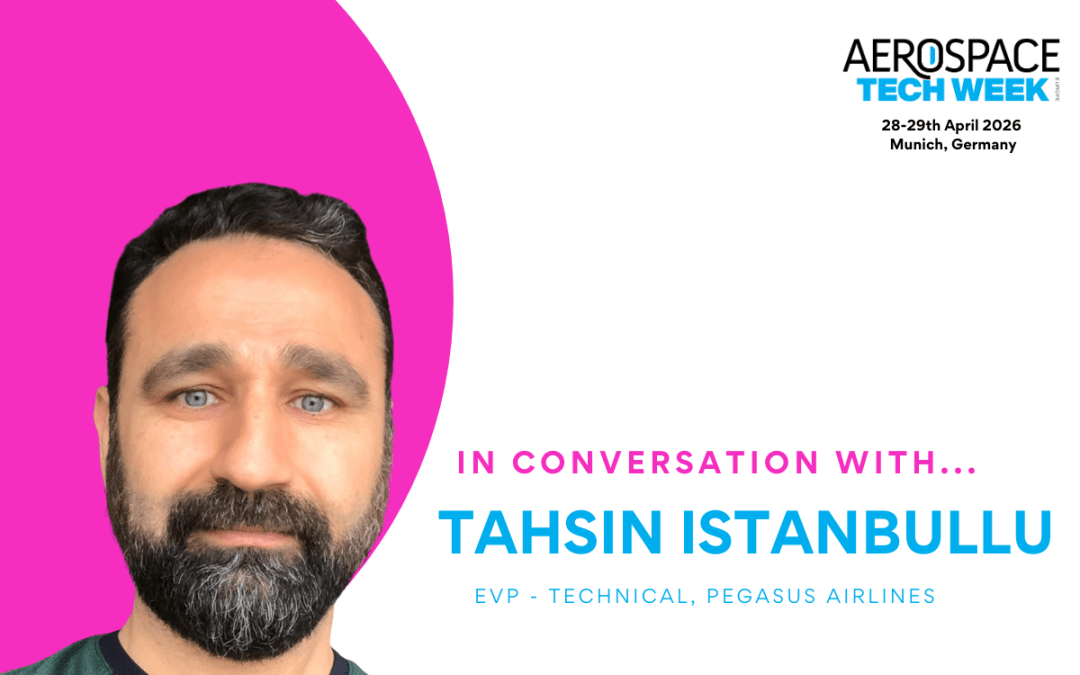
At Aerospace Tech Week 2025, we sat down with Tahsin Istanbullu, Executive Vice President – Technical at Pegasus Airlines, to tap his insights on aviation’s ongoing tech transformation.
Pegasus, a low-cost carrier (LCC) based in Türkiye, operates 37 domestic and 109 international routes. Aiming to become Türkiye’s most on-time airline, adopting tech is key to optimising its operational and maintenance processes.
Everyone is talking about AI, which maybe two years ago people weren’t hearing about. Now everyone is trying to find the right way to use it.
Amid this innovation boom, the range of solutions on offer can be overwhelming. In our exclusive interview, Istanbullu emphasises the importance of planning when integrating new tech.
I think the first challenge is to decide where to start, because the potential [of technology] is huge and promises so much, but you have limited resources.
As well as discussing how AI is reducing downtime and unscheduled maintenance, Istanbullu makes predictions on how he thinks the industry will transform over the next decade. With supply chains continuing to fracture, predictive analytics and maintenance could become essential tools in the aviation industry’s arsenal.
I think in ten years’ time, everybody will be using AI.
🎥 Watch the full interview to hear more about Istanbullu’s predictions for the future of aviation.
Questions asked include:
- How do you see emerging technology reducing aircraft downtime, particularly as the industry struggles with supply chain challenges?
- Are there any specific technologies that you think have the greatest potential?
- What would you identify as the main challenges of innovative tech adoption in the industry?
- Ten years in the future, how will airlines approach fleet maintenance and technical operations differently?
Join us at Aerospace Tech Week 2026!
Subscribe to our free newsletter here.
For more like this, see:


You must be logged in to post a comment.