
by Elsie Clark | Feb 12, 2026 | AI & ML, Innovation
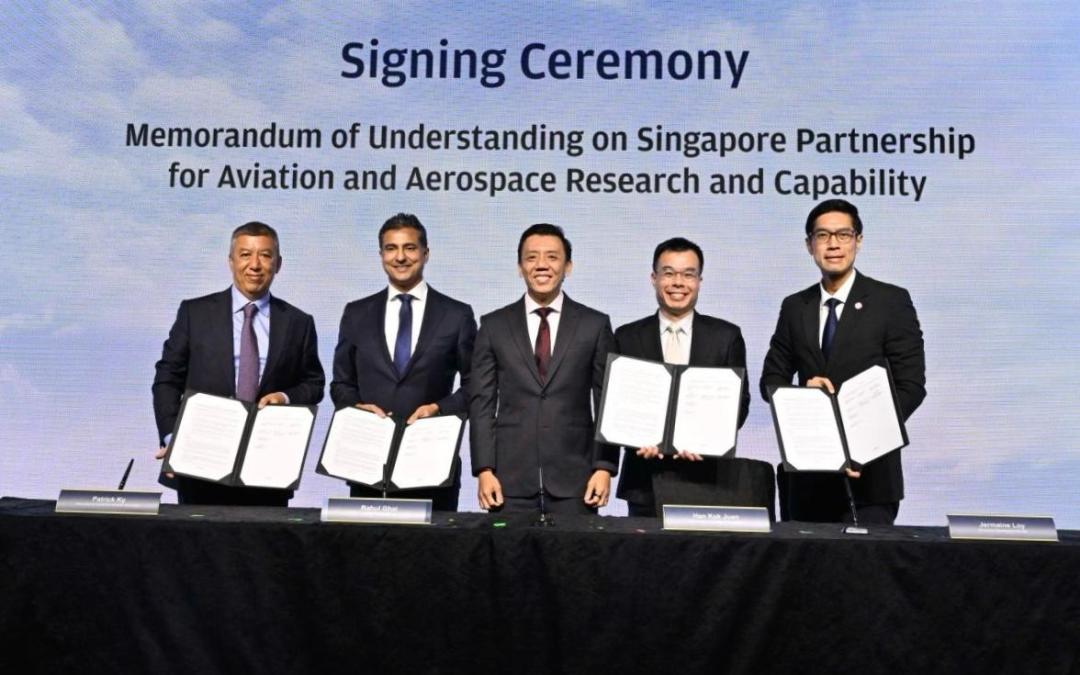
The Civil Aviation Authority of Singapore (CAAS), the Singapore Economic Development Board (EDB), GE Aerospace, and the International Centre for Aviation Innovation (ICAI) have signed a Memorandum of Understanding (MoU) to establish an innovation centre.
The Singapore Partnership for Aviation & Aerospace Research and Capability (SPAARC) will develop next-generation aviation and aerospace solutions. Covering AI, digital platforms, and aerodynamics, the centre will enhance operational efficiency and safety.
Mr. Han Kok Juan, Director-General of CAAS, said:
We have seen rapid advancement in technologies across many fields which, if applied to aviation, has the potential to fundamentally transform it. But because aviation is global and safety-critical, development and deployment at scale involves multiple stakeholders and is often long-drawn and costly. Through public-private-research partnerships such as this, we hope to establish and offer new innovation pathways that are more efficient and effective than what are available currently. These will help accelerate the development and deployment of breakthrough capabilities.
The establishment of a collaborative framework will structure the research and development (R&D) efforts while emphasising governance frameworks for new tech that meets critical safety standards. Mr. Jermaine Loy, Managing Director of EDB, said:
The establishment of SPAARC reflects Singapore’s commitment and ambition to spearhead aviation and aerospace innovation. This partnership will add new capabilities to Singapore in areas such as AI, air traffic management and aerodynamics. Our local workforce will also have opportunities to develop advanced technologies that will drive Singapore’s continued growth as a global aviation and aerospace hub.
Join us at Aerospace Tech Week 2026 to discuss the next innovations in the industry.
For more like this, see:
by Elsie Clark | Nov 25, 2025 | Innovation
GE Aerospace are investing nearly US$53 million in their manufacturing facility in West Jefferson, North Carolina. The facility is responsible for critical components in the CFM LEAP engine, which powers commercial narrow-body aircraft.
Under the new project, a 35,000 square foot extension will be added to the manufacturing site, and more equipment purchased to boost production. Funding from local government is supporting the initiative, while GE Aerospace has committed to training North Carolinians to fill 40 new job roles.
Parts made at the West Jefferson facility include rotating parts, turbines, and spools, The planned upgrades will take place over three years as GE Aerospace seeks to address directly the supply chain issues plaguing the aerospace sector.
A report from IATA and Oliver Wyman found that supply chain challenges could cost airlines as much as US$11 billion in 2025. Geopolitical instability, material shortages, and labour availability have compounded existing bottlenecks, all while increasing costs.
However, aviation’s growth plans continue to rise, with airlines ordering greater volumes of aircraft than ever. Airbus and Boeing are both struggling to meet the demand for narrow-body aircraft, with delivery slots for the A320neo and 737 MAX sold out for the next decade. The rapid growth of low-cost carriers such as flydubai and Ryanair, alongside legacy carrier’s focus on premium narrow-body experiences, has placed more pressure on manufacturers.
GE Aerospace’s investment hopes to ease some of these supply chain constraints. However, with the facility not set to open for a further three years, the industry must still address a range of production challenges to tackle the supply chain conundrum.
Join us at Aerospace Tech Week 2026, where our dedicated supply chain track will discuss how the industry can build resilience and mitigate disruption.
For more like this, see:
by Elsie Clark | Nov 6, 2025 | AI & ML, Innovation
GE Aerospace will support propulsion and testing for Shield AI’s X-BAT.
Under a new Memorandum of Understanding (MoU), GE Aerospace will supply their 110-GE-129 engine to power Shield’s AI-piloted eVTOL fighter jet. Launched last month in Washington DC, the X-BAT operates autonomously using Shield’s Hivemind software. The company says it can perform even in environments with limited communications, whether working in a team or on independently.
Shield AI aircraft engineering senior vice president Armor Harris said:
GE Aerospace’s F110 engine is one of the most successful and reliable fighter engines in history and has the operability characteristics that X-BAT’s VTOL design demands. GE Aerospace has been a great partner, and we are excited by the potential of our combined team.
With over 11 million flight hours, the F110 engine has been tested and developed over four decades. GE Aerospace’s expertise in the fields complements Shield AI’s innovation. The eVTOL business has already been valued at more than US$5 billion as the defence and aerospace industries seek to advance AI-powered solutions.
Earlier this year, Shield announced a partnership with Korea Aerospace Industries to develop AI pilots. GE Aerospace defence and systems president and CEO Amy Gowder said:
We’re excited to pair GE Aerospace’s proven experience in developing and scaling propulsion systems with Shield AI’s vehicle development to move faster from concept to capability.
Join us at Aerospace Tech Week 2026 to discuss the future of AI-powered flight.
For more like this, see:
by Elsie Clark | Sep 5, 2025 | Innovation, Sustainability
World-leading engine provider GE Aerospace and cutting-edge manufacturers BETA Technologies are partnering to advance hybrid electric aircraft engines.
The US$300 million equity investment from GE Aerospace will help advance lower-carbon aircraft propulsion. As the leading engine provide for commercial aircraft, powering around three-quarters of the world’ planes, finding more sustainable aerospace solutions is key to the company’s growth.
Through the partnership, GE Aerospace and BETA plan to co-develop a hybrid electric turbogenerator for Advanced Air Mobility (AAM) applications. One of the leading players in the electric vertical takeoff and landing (eVTOL) space, BETA’s expertise complements GE Aerospace’s large-scale manufacturing capabilities.
Kyle Clark, BETA Technologies’ Founder and CEO, commented:
This partnership brings together two teams deeply committed to and guided by aerospace engineering excellence and building the future of flight. We believe the industry is on the precipice of a real step change, and we’re humbled that GE Aerospace has the confidence in our team, technology, and iterative approach to innovation to partner with us.
We look forward to partnering to co-develop products that will unlock the potential of hybrid electric flight, and to do it with the rigour, reliability, and safety that aviation demands.
BETA’s aircraft have been tested in a range of weather conditions, and the company leads the AAM industry in miles and hours flown. Meanwhile, GE Aerospace’s 2022 test of the world’s first megawatt-class, multi-kilovolt (kV) hybrid electric propulsion system demonstrated how the tech could be applied to commercial flight.
The new partnership aims to maximise hybrid electric engine capabilities, from improving range to lowering operating costs. GE Aerospace Chairman and CEO H. Lawrence Culp, Jr., said:
Partnering with BETA will expand and accelerate hybrid electric technology development, meeting our customers’ needs for differentiated capabilities that provide more range, payload, and optimised engine and aircraft performance.
Join us at Aerospace Tech Week 2026 to advance the flight technologies of the future.
To read more, see:



You must be logged in to post a comment.