In late August, The New York Times published an exposé called “Airline Close Calls Happen Far More Often Than Previously Known” by Sydney Ember and Emily Steel. The story purports that near-catastrophic events in commercial aviation are increasing. The article says the Aviation Safety Reporting System (ASRS) (also known to many in the aviation industry as the NASA reporting system because for many years that program has been overseen and monitored by NASA) has reports that indicate these events have more than doubled over the past decade.
Does the NYT article get it right? Or are they fearmongering? Perhaps we are just privy to more information than in years past, creating a sense that these events are increasing? The Federal Aviation Administration (FAA) was quick to respond, saying in a statement, “The U.S. aviation system is the safest in the world, but one close call is one too many. The FAA and the aviation community are pursuing a goal of zero serious close calls, a commitment from the Safety Summit in March. The same approach virtually eliminated the risk of fatalities aboard U.S. commercial airlines. Since 2009, U.S. carriers have transported more than the world’s population with no fatal crashes.”
Additionally, the FAA noted that data shows runway incursions are steadily decreasing and released a statement saying the FAA will hold runway safety meetings at approximately 90 airports between now and the end of September. “Sharing information is critical to improving safety,” said Tim Arel, chief operating officer of the FAA’s Air Traffic Organization. “These meetings, along with other efforts, will help us achieve our goal of zero close calls.”
Whether or not the NYT or the FAA is more correct, one thing is certain. The flying public puts their trust in the air transportation system and deserves the safest possible system within the constraints of human frailty.
To gain more clarity on this report and our commercial aviation safety record, I spoke to aviation safety expert Jeff Guzzetti. Guzzetti is a 40-year aviation safety industry veteran having held leadership positions within the FAA, the NTSB, the Office of The Inspector General – Aviation and now as head of GuARD (Guzzetti Aviation Risk Discovery) and analyst for multiple news outlets.
I asked Guzzetti if these near-catastrophic events are truly increasing. “No,” Guzzetti said emphatically. “The article even says so, by quoting FAA statistics that, after a rise in 2013, the number has gone down since 2018 to now. … Also, runway incursions are classified as A, B, C, and D, with A being the ‘near-catastrophic’ ones, B being concerning and C and D being very minor. Most Class A events involve single-engine Cessnas and Pipers, not airliners. Class A events involving airliners have not increased.”
I asked him if the NYT article get some things right and he agreed that “their facts are correct, but their cherry-picked NASA ASRS narratives and quotes from disgruntled ATC controllers do not provide a balanced or nuanced description of the current situation.” In many cases, we are privy to more information than years past, creating a sense that these events are increasing.
The article’s authors say the ATM system is “a safety net under mounting stress.” But Guzzetti stated that he thinks the aviation safety net is constantly under varying levels and types of stress and that this is nothing new. “For example, using satellite-based navigation and glass cockpits has significantly lessened the stress on the safety net over the years (compared to ADF approaches with steam gauges), but new challenges like increasing air travel, a temporary shortage of controllers and a pilot shortage have replaced that stress to some degree.”
Next, I asked Guzzetti about staffing levels in the air traffic control system. He pointed to a Department of Transportation Office of the Inspector General report, “FAA Faces Controller Staffing Challenges as Air Traffic Operations Return to Pre-Pandemic Levels at Critical Facilities” that says, “The FAA has made limited efforts to ensure adequate controller staffing at critical air traffic control facilities. The agency also has yet to implement a standardized scheduling tool to optimize controller scheduling practices at these facilities, and FAA officials disagree on how to account for trainees when determining staffing numbers. As a result, the FAA continues to face staffing challenges and lacks a plan to address them, which in turn poses a risk to the continuity of air traffic operations.”
The NYT article says current and former ATC controllers said, “close calls were happening so frequently that they feared it was only a matter of time until a deadly crash occurred.” But this is purely anecdotal and Guzzetti points to the lack of hard evidence in the statement. “I don’t believe it. This statement is truly fearmongering! Did every controller they talked to say this? I doubt it,” Guzzetti said.
The article also says ASRS reports have more than doubled. But Guzzetti questions what facts the authors based this statement on. “Are they referring to all NASA reports? Or just ones from airline pilots who report near misses? Pilots notoriously over-exaggerate these types of occurrences because it is hard to accurately perceive distances and flight dynamics. The rule of thumb at the NTSB for comparing DFDR data with pilot comments was a three-to-one ratio (i.e., “we were in a 90-degree bank!” when the DFDR indicated 35 degrees),” he said.
When asked what else needs visibility in aviation safety, Guzzetti pointed to several areas including the lack of a permanent, strong, qualified FAA administrator, causing a decrease in morale, support and stability of the FAA workforce; FAA employee brain-drain due to retirements and a lack of adequate respect and incentives to recruit the next generation of inspectors and engineers; lack of an adequate budget to fund new technology; and the significant mechanic shortage.
Guzzetti had more to say, and his full comments will be included in the online content on our website and you can see them here. He will also be presenting at our Aerospace Tech Week Americas event in Atlanta on November 14-15.
Power, reliability and real-time computing capabilities are just some of the advantages of using multicore processors. But, careful consideration of safety and certification standards is needed since rigorous testing and validation for critical systems is required by regulation. Our two-part story on the multicore evolution looks at the challenges and benefits of using multicore processors in avionics.
Multicore processors afford some advantages versus single core processors in avionics systems and multicore processors are becoming more common in avionics equipment. In this first of a two-part story on multicore processors in avionics we reached out to industry experts to establish a comparison of multicore versus single core processors, the state of things as to the use of multicore processors in avionics, the difficulties in certification and some solutions available to date.
Multicore vs. Single Core Processors
During the early history of microprocessors, performance improvements and efficiency gains were achieved by continuously increasing the clock speeds of central processing units (CPU), affirms Mike Pyne, senior director of strategic accounts and solutions architect at CoreAVI. “Early processors ran at clock speeds of 10 megahertz compared to today’s processors that run at speeds up to 3 gigahertz. At some point, in the late 1990s it became clear that there were transistor technology limitations associated with ever increasing clock speeds,” he said.
Mike Pyne, CoreAVI
To continue to provide increased performance, multicore processor (MCP) architectures were developed, Pyne observes. “Today, multicore processors can be found in just about every avionics system including mission computers, flight control systems, smart displays, air data processors, navigation gear and of course entertainment hubs,” he affirmed.
Gregory Sikkens, Curtiss-Wright Defence Solutions
Gregory Sikkens, safety critical senior product manager at Curtiss-Wright Defence Solutions, affirms that MCPs are a convenient way to improve performance where an efficient core can be replicated in a System on Chip (SoC). “Not only is this approach convenient, but MCPs can also save space, power, cost and provide an effective solution for integrated modular avionics (IMA) architectures. Today, it is rare to see a true single core processor in new systems as the majority of commercial-off-the-shelf (COTS) devices that avionics equipment depend on typically include more than one processor core,” he said. “For many years, it was the case that all but one core would be disabled on avionics equipment to avoid having to deal with the complications that multicore processors introduced when demonstrating compliance with applicable airworthiness regulations.”
Yemaya Bordain, Daedalean
According to Yemaya Bordain, Daedalean’s president of Americas, the advantages of using multicore processors (MCP) in avionics are the same as for non-avionics applications: higher performance, lower power consumption and improved efficiency. “Some secondary benefits also include their scalability and their ability to execute multiple workloads concurrently. The difference with avionics is our focus on size, weight and power consumption (SWaP), as well as heat dissipation, which is a direct consequence of power consumption and, crucially, certification,” she said.
Roberto Valla, EMEA
According to Roberto Valla, EMEA aerospace and defense head of sales at Wind River, their greater performance allows MCPs to execute multiple tasks simultaneously, which can enable parallel processing of data leading to improved overall performance. “This is particularly important in avionics, where real-time data processing is critical. Another advantage is the increased flexibility and future growth provisioning. MCPs can be configured to support a variety of applications and can provide spare capacity for future growth, making them more flexible than single-core processors and avoiding costly hardware upgrades,” she said. “The increased performance of MCPs can enable multiple applications which previously ran on individual avionics line replaceable units (LRU) to be consolidated onto a common processing LRU using an MCP, reducing requirements for space, weight, power and cabling.”
Andrea Beer, Rapita Systems
Use in Avionics
The use of MCPs in avionics equipment is trending positive, but it is not yet widespread. For safety-critical applications, MCPs were not until recently available as certifiable components and, for higher safety-criticality, such as design assurance level A (DAL-A) flight control systems, few multicore-based systems are yet available, observed Bordain. “For machine-learned systems running neural networks such as those we use, there are no processors currently certifiable that will satisfy our requirements,” she said. “In a white paper we recently co-authored with Intel, we propose a reference design based on the 11th Gen Intel Core i7 and Intel Agilex F-Series FPGA for machine learning applications. This architecture satisfies all requirements for future certifiable machine-learned avionics systems requiring high-performance computing at low SWaP.”
Multicore processors (MCPs) are increasingly being used within avionics systems, they offer increased performance compared to single core processors and allow more functionality to be included within hardware, points out Andrea Beer, marketing manager at Rapita Systems. “They can also contain other embedded functions such as memory management and embedded security, reducing the chip count for a system,” she said. “However, there are numerous implementation and certification issues that are not present in single-core processor implementations and, in addition, the use of single-core processors in so few other industries also raises concerns amongst avionics suppliers over their future supply.”
Over the last couple of years, there have been some successful multicore certifications, with more in development, Sikkens highlights. “In the defence space, most avionics equipment is turning to multicore processing-based solutions as avionics increasingly requires the performance level provided by multicore COTS SoC devices. Overall, multicore architectures are becoming more and more common as understanding increases,” he affirmed. “Also, the availability of tools for multicore processors is also increasing, providing a mechanism to demonstrate that multicore interface channels can account for worst case execution time (WCET) analysis as well as other objectives. I believe that the move to multicore processing in avionics is inevitable.”
The adoption of MCPs is increasing, partly due to the diminishing availability of single core processors, but also because of the increased performance requirements of some modern applications, including those involving artificial intelligence (AI) and machine learning (ML), according to Valla. “MCPs also provide greater processing power and enable consolidation of applications. MCPs are being increasingly used in avionics applications such as primary flight displays (PFD), mission systems, communication systems, and sensor suites, among others,” he said. “Of course, it is important to note that the use of MCPs in safety-related avionics applications is subject to strict safety certification requirements, and their use must undergo rigorous verification to ensure that they meet the required safety and reliability standards.”
Certification Difficulties
The architecture for single core processors is relatively straightforward and the process rigor and certification requirements for qualifying these systems for use in aircraft is very mature, according to Pyne. “MCPs on the other hand introduce a much greater potential for resource conflict which complicates the goal of determinism which is key to endorsing a system for safe flight operations. The European Union Aviation Safety Agency (EASA) and the US Federal Aviation Administration (FAA) have released separate guidelines for the use of MCPs in safety critical applications (i.e., EASA Certification Review and CAST-32A),” he said. “These agencies are now working in concert to finalize these requirements in more formal use of MCPs in avionics applications and address component roles (processor architecture, operating system, drivers, etc.) along with approaches to modelling and testing such systems.”
The main obstacle in certifying avionics equipment with MCPs is ensuring that the system still operates in a deterministic way considering that processes running on each core will be accessing common resources, according to Bordain. “Sharing is always more difficult than keeping things strictly separated. Interference between processors competing for the same resources such as cache, memory, and through shared interconnects, can make it difficult to prove determinism of the system under all circumstances. Some avionics designs utilizing MCPs go so far as to disable all but one core to prevent interference,” she said.
According to Sikkens, at a high level, the obstacle for certification of multicore-based avionics is the need for a deeper understanding of multiple interconnected device details, as well as how software makes use of the hardware. “These requirements add development activities and lifecycle data to the avionics equipment development project,” he said. “MCPs can complicate application implementation and require, for example, an understanding and planning for data-sharing between threads, and the use of shared resources, such as interconnect fabrics and the synchronizing of concurrent operations, just to list a few of the associated challenges.”
Whilst MCPs offer a great deal of advantages, their behavior is harder to verify due to the presence of interference channels, explains Beer. “Interference channels can be caused by a variety of factors, including contention over shared hardware resources. This interference can have a significant effect on timing behaviour, raising critical safety concerns,” she said. “Validating the timing requirements of multicore systems offers new challenges. As traditional worst-case execution time analysis methods do not take interference effects into account, new methods, such as Rapita’s Multicore Timing Analysis Solution have been developed.”
Solutions
While program execution running within a multiple cores enclave is similar to a single core, complications arise when going to an external cores enclave where transfers across the shared internal fabric to shared memory interfaces and interference can occur from each of the cores, observes Sikkens.
“These interference channels can impact performance and can complicate the determination and demonstration of WCET. Also, it can be a challenge to obtain details of the internal fabric to model a WCET determination,” he affirmed. “To help address this challenge, collaboration was formed between avionics equipment suppliers and COTS SoC suppliers, called MultiCore For Avionics (MCFA), which is an ad hoc group that establishes a unified voice of avionics equipment vendors for COTS SoC suppliers that provides guidance for the COTS SoC supplier in preparing common design data artifacts for multicore processor SoCs and assists suppliers in demonstrating compliance with airworthiness regulations.”
There are inherently more possible pathways for interference in MCPs in comparison to single core processors, according to Bordain. “This feature makes it difficult for the software, such as a Real-Time Operating System (RTOS), to control the behavior of the MCP and bound the worst-case execution time (WCET) of tasks being executed,” she said. “These pathways must all be understood, controlled, tested, and validated; therefore, the system design itself should include considerations of interference as well as which features of the MCP are needed for the application. Many MCPs have features embedded to manage resources, such as Intel’s Cache Allocation Technology as part of its Resource Director Technology Framework. We expect this year to see the first product with Daedalean technology certified. Developed out of a partnership between Daedalean and Avidyne Corporation, the Avidyne PilotEye Visual System uses the Intel Core i7 processor, which has four cores.”
Intel’s 11th gen Core i7 processor offers an advantage for aerospace suppliers since Intel has introduced the Airworthiness Evidence Package (Intel AEP), said Bordain. “It provides aircraft-embedded manufacturers with processor artifacts and the tools to analyze and mitigate non-deterministic and unintended behavior to support DO-254 certification up to DAL-A,” she added. “Initially, information was provided in 2016 by the Certification Authorities Software Team in its CAST-32A paper and later that was officially adopted by EASA as an Acceptable Means of Compliance in AMC 20-193. Both regulators recognize the advantages of MCPs and the need to steward their introduction into avionics systems.”
Since their first deployment several decades ago, flight management systems have been constantly updated and they have increased capabilities. In the era of connectivity, flight management systems (FMS) are being upgraded to satisfy this ever greater need. In this feature, we provide an update on how FMS have developed in recent years, the drivers of changes in FMS technology, and what future FMS will feature.
New Features
The flight management system (FMS) portfolio of GE Aerospace is designed for accuracy, connectivity and to optimize flight paths. Continuous improvements to reduce time, fuel consumption and emissions are a constant factor in ongoing development, according to Gary Goz, director of navigation and guidance at GE Aerospace. “Our latest generation FMS, TrueCourse, has a modular design using common components across multiple aircraft platforms while having the ability to tailor modules for a specific aircraft. This creates a development environment that can deliver new and upgraded capabilities to our customers faster than our previous generations,” he says. “Another advancement is in the computing domain.
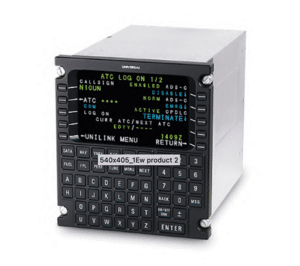
The Universal Avionics UNS-1Ew FMS. Universal Avionics image.
Our legacy platforms support standard keyboard-based ARINC 739 multi-function control and display units (MCDU) driven by the flight management software that runs on a flight management computer (FMC).”
Universal Avionics’ FMS platforms reflect several decades of innovation in FMS technologies and features up to its current UNS-1Ew and UNS-1Fw SBAS/WAAS FMS capabilities, affirmed Dror Yahav, chief executive officer (CEO) of Universal Avionics. “Certified on over 50 aircraft types, we specialize in flight deck upgrades, providing flexible options for aircraft types ranging from the Pilatus PC-12 to the Boeing 747. These products reflect the steady evolutions of FMSs in addressing the navigation and flight management needs of modern aircraft,” he said. “Based on our integrated 12 channel GPS capability, our SBAS-FMSs meet stringent internal monitoring requirements to provide guidance to any of the minimum descent altitude (MDA) levels for area navigation (RNAV) (GPS) approach guidance. They also illustrate the continued integration of FMS with data link enabled features such as push to load supporting a more streamlined working environment; performance, safety, and efficiency, improving the overall pilot experience in the context of FANS 1/A+, CPDLC operations.”
GE Aerospace is currently prototyping a touchscreen control display unit (TCDU) that combines the functionality of the FMC and MCDU into a single, powerful unit with a partitioned operating system, explained Goz. “This is essentially a smart display that also provides an open system architecture that can meet the needs for both civil and military aircraft. Connectivity is also one of the major new features that we have been focused on, and there are two areas of connectivity that are of importance,” he said. “The first is referred to as Connected FMS. This technology essentially creates a secure connection between the FMS and the electronic flight bag (EFB) application of choice allowing data to be exchanged between the two. This requires an update to the FMS, a configuration file that identifies the data to be exchanged, and a software development kit that is used by the EFB application provider to make the secure connection and enable the data exchange. While Connected FMS is particularly suited for the TrueCourse architecture, it has also been demonstrated with GE Aerospace’s legacy 737 FMS and it is an option for all civil and military legacy platforms. Connected FMS can be implemented either through a wired connection or through a wireless connection using an aircraft interface device, such as our SmartDMS.”
GE Aerospace is currently prototyping a new system with a touchscreen control display unit (TCDU) that combines the functionality of the FMC and MCDU into a single unit. GE Aerospace image.
As part of its Connectivity Ecosystem initiatives, Universal Avionics is embedding Connected FMS capabilities in its products, pointed out Yahav. “The Connected FMS delivers pilot workflow improvements based on two-way flight plan sharing, continuous weather and flight performance data exchanges in all phases of flight supported by Universal’s FlightPartner Tablet application. The App ease of use, intuitive interface, helps minimise crew workload, fatigue, and human error working in tandem with FMS capabilities,” he said.
Another feature that is in the early stages of research and development at GE Aerospace is called Cloud FMS, affirmed Goz. “The Cloud FMS prototype has been developed on a NASA project in partnership with SmartSky Networks and Mosaic ATM using the TrueCourse FMS. This is still in the R&D stage but has the potential to bring more connectivity between the FMS and ground-based systems used by air traffic control (ATC) and airline operation centres (AOC),” he said. “The differentiator that Cloud FMS provides gives the ability for the FMS to share data with the receiver, such as modified flight plans, remaining fuel, and weight as examples. This kind of information paired with a digital twin of the FMS, can allow ATC or AOC to perform various ‘what-if’ scenarios to accommodate other traffic, fleet needs, and emergencies with much better results than can be achieved today.”
Drivers of Change
According to Goz, the industry goal of reduced crew workload is a key driver as the FMS is a high workload system requiring a lot of data entry by the pilot. “Automating tasks such that it reduces this workload but keeps the pilot in the loop by allowing them to accept the data provided will be a key first step towards reducing that workload. Connected FMS is a major enabler for this capability, eliminating error-prone manual entry,” he said.
With the advent of the EFB, numerous applications now give the pilot the ability to plan ‘optimal’ routes on their handheld device, Goz pointed out. “However, there is a difference in the calculations that are performed by the EFB applications and those performed by the FMS, this results in differences in what the pilot sees when entering the data to the FMS. The same goes for the calculations that are done by the dispatcher at the AOC. There is no system today that duplicates the FMS outside of the avionics platform,” he said. “Connected FMS and Cloud FMS can help solve this issue by providing actual FMS calculations to ensure the accuracy of the results that other systems compute. These drivers require greater connectivity and/or having a digital twin that can replicate the FMS. This will enable overall greater optimization of the airspace. These types of applications can give a pilot more situational awareness and reduce their workload, especially in high workload situations and thus reduce the time to make decisions in those critical instances.”
The key drivers of changes in FMS technology include interest in increased portability and user interface evolutions, according to Yahav. “This is illustrated by Universal’s i-FMS, a portable FMS with its modular architecture for ready deployment to any ARINC 653 compliant platform and a separate ARINC661 compliant user application and human-machine interface (HMI). The i-FMS is designed as a more opened FMS supporting third-party HMI, customizing of menus and operational logic, as well as integration of proprietary functions by interfacing to the core operating systems,” he said. “Another domain is augmented reality, which couples the FMS with enhanced vision systems capabilities to deliver increased pilot situational awareness in all phases of flight and all weather conditions. As an example, this can include capabilities allowing the pilot to project waypoints and information from the FMS onto the real world, superimposed on our SkyLens head-wearable display (HWD) or a head up display powered by our ClearVision platform.”
The aerospace industry and infrastructure tend to drive and dictate the timeline for major systems like FMS, affirmed Goz. “Depending on if it is for the commercial or military market and the level of technology advancement, it can take anywhere from 8 to 10 years. In the commercial space, there is a lot of collaboration required to make this happen including OEMs, airlines, air traffic control, and regulators,” he said. “There is also the aspect of cost, not just the cost to create the technology, but also the cost of replacing antiquated systems and implementation and integration with other existing systems. Non-embedded avionics technologies such as a Cloud FMS and applications that can run on an EFB that can take advantage of connectivity such as Connected FMS can be developed and introduced at a much quicker pace.”
Future Focus Areas
Looking to the future, a first area of focus, which is considered in the context of Universal Avionics’ Connectivity Ecosystem, is the support for FMS 4D trajectory management along with digital twin technology to cope with ever escalating growth in air traffic and environmental constraint, affirmed Yahav. “Also, support of low RNP (<0.3), A-RNP, and RNP-AR operations is at the focus including enhanced FMS navigation support in particular in degraded/GPS denied navigation environments. In this context, one initiative of ours is currently focused on the DME-DME based navigation,” he said. According to Goz, artificial intelligence (AI) and machine learning (ML) will play an increasing role in avionics and FMS. “Although current FMS implementation does not include any AI/ML, this will play an increasing role in years to come. Early first steps will include non-embedded tools such as decision aids. This will help by bringing together the information needed to make decisions quickly without the need for constant back and forth communication with a dispatcher,” he said. GE Aerospace is developing such an aid that is close to the demonstration stage, stated Goz. “This is a form of situational awareness that will likely be the place where AI will have the most impact in the shortest amount of time and that is because it can help where it is most important in this industry; safety. The more situationally aware a pilot is and the more complete the information is to make decisions from, the more likely that the action taken will conclude in the safest result. We are investing in more AI/ML technologies in the situational awareness space for this reason,” he concluded.
There is no doubt that Maintenance & Engineering (M&E)/MRO software platforms are improving the quality, speed, and compliance of airline maintenance programs worldwide. The evidence can be found in the five following MRO IT (information technology) case studies below. All provide indisputable proof that the integration, monitoring, and management of an airline’s MRO functions using end-to-end software solutions is the right move for any carrier to make, no matter how large or small they may be.
Aerogility Making Life Easier for easyJet
When easyJet wanted to update its MRO IT platform, the company turned to Aerogility (www.aerogility.com). In fact, easyJet was the first airline to implement the Aerogility platform. “It employs a model-based artificial intelligence (AI) to create a digital twin of an airline’s fleet and sustainment operations,” said Phil Cole, Aerogility’s airline business manager. “Over the past five years, easyJet has been utilizing Aerogility daily across its entire maintenance operation. Feedback from this extensive use has enabled us to create new and improved interactive planning tools and capabilities.”
For the record, model-based AI “is a predictive tool that enables the user to interrogate the data and the output conclusions,” said www.aerogility.com. “It operates according to a behavioral model, where each key element in a business or organizational system — such as an asset, a facility or a decision-maker — can be represented as an agent and configured to act in a particular way. The model is the result of these individual agents operating and interacting with each other to create accurate simulations.”
When it comes to MRO IT support, “Aerogility uses model-based AI to create a digital twin of an airline’s fleet and sustainment operations,” Cole said. A ‘digital twin’ is a real-time virtual replica of the airline’s aircraft and other physical assets, constantly modified by collected onboard performance and diagnostic to keep it in line with its ‘physical twin’.
The real power of a digital twin for aircraft maintenance is its ability to be used by an AI-enabled platform to project maintenance trends and possible responses into the future. “With its agent-based nature, Aerogility allows users to quickly alter planning parameters and create what-if scenarios for instant side-by-side comparison,” said Cole. “You can use this virtual representation to conduct forecast planning while considering constraints such as peak period shutdowns and limited MRO capacity/capabilities. This allows our customers to make more informed decisions and optimize operations, to improve efficiency and reduce costs.”
Back to easyJet. According to Phil Cole, the airline layered Aerogility on top of its existing MRO management and transactional systems, using these connections and its model-based AI engine to help them interpret their MRO data to make better and more useful maintenance decisions, in a faster and more timely manner.
“Implementing Aerogility involves seeding the model with a simple CSV export from any management information system (MIS) into the Aerogility model, replacing the current plan with Aerogility’s solution,” he explained. “A key aspect of Aerogility is its ease of integration with surrounding systems. For example, if modifications are required to an airline’s MIS, this will have no impact on Aerogility’s implementation.”
With Aerogility in place, easyJet has been able to make better, more informed MRO decisions for its fleet. This is true for day-to-day operations, as well as for scheduled heavy base, mid-term, landing gear and powerplant maintenance procedures. “Using Aerogility in our engine shop visit program has significantly helped to simplify the process of producing our engine shop visit plan,” said Alejandro Lopez Ruesca, easyJet’s head of powerplant. “It is a great piece of software; very user-friendly, incredibly fast, with support provided by an always helpful group of people.”
“easyJet’s improved visibility into its maintenance operations is common to Aerogility users,” Cole noted. The reason: “Most of our customers convert to Aerogility from manual and labor-intensive solutions, such as spreadsheets or project management tools, which prove limiting when scaling their fleet,” he said. “These solutions often result in a lack of understanding and collaborative planning among groups, teams and departments, with a heavy reliance on individual employees.”
This airline is certainly happy with its decision to implement Aerogility to manage its fleet.
“Aerogility has provided us with an essential tool to help deliver our business strategy — to drive down costs and maximize the number of aircraft available to our customers,” said Swaran Sidhu, easyJet’s head of fleet technical management. “We are really excited by the enhanced maintenance forecasting and planning capabilities this gives our team.”
EmpowerMX Empowers EAMS and Others
When Embraer Aircraft Maintenance Services (EAMS) of Nashville, Tenn., wanted to upgrade their MRO IT system, they selected EmpowerMX (empowermx.com). “EAMS was looking for a solution to improve technician efficiencies and reduce late deliveries,” said Levi Schmidt, EmpowerMX’s managing director of customer excellence. “EmpowerMX specializes in planning and execution of aircraft maintenance during line visits and heavy checks. To optimize these processes, we also offer full material solutions, integrations, and 100% paperless options.”
Moving EAMS to this MRO software required some investigative work on the part of EmpowerMX. To make it happen, “we needed to understand their current processes and application needs,” Schmidt said. “Part of the migration process included data mapping so things like skill codes, task types, crew structures, and department workflows were all familiar to the teams working the projects.”
“Where EAMS was instrumental was in realizing that all tools require proper use,” he added. “Their implementation specialist, who would ultimately become EAMS’ internal subject matter expert (SME), had a background in aviation maintenance from several perspectives, including project management, lead technician, and technician. As well, they were a part of that company’s Continuous Improvement team. This elevated their ability to implement EmpowerMX at EAMS and deliver the desired results.
Like EAMS, many customers have seen positive outcomes after successfully implementing EmpowerMX solutions. To learn more about these successes, case studies are available on the EmpowerMX website (www.empowermx.com/resources). These case studies illustrate how the four pillars of business success—safety, quality, delivery, and cost — have been improved in each.
EmpowerMX has been proven to be effective in improving safety and quality, with one group demonstrating a 50% reduction in injuries, two groups showing a 42% and 55% reduction in paperwork and dock errors, and the last group showing a 25% reduction in quality escapes.
In all case studies, delivery was an important metric as customers expect to receive their aircraft or component back in a timely manner. The first case study saw a dramatic decrease in delayed deliveries, from 67% to just 10%. The second case study also saw a significant decrease in delayed deliveries, from 62% to less than 5%. One case study even reported 100% of aircraft delivered on time for six out of seven months, demonstrating the effectiveness of the strategies implemented.
Within the first two years of implementation, customers reported at least 10% efficiency gains, contributing to a reduction in delayed aircraft. This allowed one case study to add an additional heavy check line without hiring additional resources, while another case study used their efficiency gains of 16% to increase throughput and generate additional revenue without adding any resources.
EXSYN Aviation Solutions and Malaysia Airlines Collaborate for Enhanced Success
Embracing the philosophy of perseverance, Malaysia Airlines recognized the need for a more effective Maintenance & Engineering (M&E) software solution after initial implementation fell short of their expectations. Determined to achieve optimal results, the airline sought the expertise of EXSYN Aviation Solutions (www.exsyn.com) for their comprehensive support in ensuring the seamless operation of Malaysia Airlines’ M&E/AMOS (Aircraft Maintenance & Engineering System) platform. Together, these two entities joined forces to propel the airline towards greater success.
EXSYN has to find and fix a number of problems to get to this point. “For instance, the airline’s component configurations and statuses were being tracked over multiple programs, making it challenging to provide a holistic overview of these components’ airworthiness status,” said Rob Vermeij, head of operations at EXSYN Aviation Solutions. “This situation resulted in potential human errors and discrepancies in airworthiness data despite their best efforts, which is not uncommon in the industry.” As well, Malaysia Airlines faced difficulties with inter-departmental communications, which led to ineffective project decisions, outputs and results.
To address these and other problems, EXSYN began by assessing the current state of data migration onto the new M&E/AMOS platform at Malaysia Airlines. “The data was analyzed through an automated validation process to flag any major potential gaps and issues that would need to be solved during the project,” Vermeij said. “The final result paved a concrete way forward to achieve the project’s ambitious timelines. Malaysia Airlines appreciated this analysis and contracted EXSYN to implement this new data migration approach to accelerate the project while guaranteeing the quality of airworthiness data.”
To make this happen, EXSYN joined up with a local team of Malaysian Airlines employees and trained them on its data migration methodologies and NEXUS tooling (which manages data related to aircraft airworthiness critical processes). “We established direct connections to all source systems (databases) and/or created standardized inputs based on reports, which fed into the library of pre-built components that EXSYN made based on our long experience with different M&E systems,” said Vermeij. “This approach enabled Malaysian Airlines to catch up quickly with NEXUS and empowered them to tackle different heavy engineering topics, such as modifications data, autonomously. EXSYN also coordinated the data migration process, providing expert support on both project management and deep technical levels while taking on some of the data migration tasks directly to ensure timely completion.”
EXSYN used a phased approach to ensure that the Malaysia Airlines’ M&E/AMOS project went smoothly as possible. For example, “we first created an early baseline data load to make the initial plan and expectations from data mapping tangible and provide a reference point for progression,” Vermeij said. “After that, we focused on getting all the static data in good shape, which defined all maintenance and airworthiness requirements of the fleet and supporting services. This phase typically required a few iterations. Then, we shifted focus to the dynamic data of the fleet, such as last done/next due date, aircraft configurations, and stock levels. From there onwards, the aim in terms of data validation moved towards getting an accurate maintenance forecast and fleet status.”
Eight months after EXSYN had signed onto the project, Malaysia Airlines achieved the M&E/AMOS goals that they were seeking. Better yet, “we were able to accelerate the project while ensuring the quality of airworthiness data, enabling the airline to achieve significant efficiency gains in their engineering and maintenance operations,” said Vermeij.
“To get a project like this through the gate successfully, full commitment on all levels in the organization is required,” he added. “Then you must staff the project with motivated people who are also empowered to make individual decisions for their expertise. Only with such a team and mindset are meeting timelines like these remotely possible.”
Ramco Brings Iraqi Airways into the Digital Age
Iraqi Airways is the national carrier of Iraq, headquartered on the grounds of Baghdad International Airport. It is the second oldest airline in the Middle East, having commenced service on January 29, 1946, using five De Havilland Dragon Rapides 6-8 passenger biplanes. “Currently Iraqi Airways holds 31 aircraft with 11 different fleet types,” said Peer Mohideen, associate director of Ramco Aviation Software (www.ramco.com).
Mohideen knows the specifics of Iraqi Airways’ fleet because of the role Ramco has played in deploying its MRO ERP system at this airline. Before Ramco came in to help, Iraqi Airways was using printed paper reports and Excel spreadsheets to manage their asset tracking, component and compliance, maintenance, and planning programs. As well, “all regulatory reports were prepared manually,” he said.
The operational and safety problems associated with this antiquated approach were so serious, that the European Aviation Safety Agency (EASA) banned Iraqi Airways from operating in European airspace in 2015. This is why this airline turned to Ramco for an M&E ERP solution to help reverse the ban. “The key reason for Iraqi Airways to adopt a maintenance application like ours was to eliminate the hazard of releasing an unairworthy aircraft into service, due to inaccurate data and to get regulatory approvals,” said Mohideen. “Along with the customer, we did micro-level planning, identifying the risks in its existing approach to the maintenance program and developing a mitigation plan. This really helped prepare the way for a smooth and successful implementation.”
Peer Mohideen, Ramco Aviation Software
Now that Ramco’s MRO ERP solution is in place, Iraqi Airways’ productivity has been increased in their Stores and Procurement Department, where all parts movements are now being tracked and maintained in the system. The airline’s maintenance planners can also plan ahead for scheduled tasks and stock/assign these tasks accordingly.
In fact, Iraqi Airways’s end-to-end aircraft maintenance process has been completely digitized, Mohideen said, improving its accuracy and levels of compliance while reducing workloads and task completion times. The Ramco solution also provides the airline’s management with the accurate data they need to make better and more timely decisions.
Although Iraqi Airways has yet to win EASA approval to resume flights over Europe, its implementation of Ramco’s MRO ERP solution is a major step towards this goal. And the airline is happy with the results.
“Ramco is one of the respectable and approved companies of many international airlines, and it has brought about a great and good change in the Iraqi Airways company,” said a quote from Iraqi Airways provided by Ramco for this article. “As for their system, it is a good, understandable and very useful system, especially for maintenance activities in our company. As for the work team, they are qualified, experienced and very cooperative people. They are a very good team.”
Swiss Aviation Software Integrating Air Algérie’s MRO Data
Air Algérie is another national flag carrier; as its name suggests, for the north African nation of Algeria. While this article was being written, the airline’s MRO database was being migrated from a legacy IT management system and associated software programs, to the single AMOS platform made by Swiss Aviation Software (Swiss-AS).
“AMOS offers a wide variety of data import solutions to make the replacement of legacy software safe and easy,” said Remo Suter, who leads Swiss-AS’ data integration solutions team. He performed this interview together with Alexander Belykh, who is responsible for the hands-on data migration into AMOS. “These options integrate seamlessly with state-of-the-art ETL (extract transform load) software, which allows smooth data processing.”
According to Suter, Air Algérie has four main reasons for moving to AMOS. First, “their previous product does not have a very large customer base anymore and development seems to have come to a standstill,” he said. “A second reason is the higher level of integration offered by AMOS: it covers more business processes than the legacy solution did. This means that AMOS can replace the legacy MRO system plus many additional solutions. Third, the legacy solution was mainly dependent on a complex mainframe IT architecture that was difficult to maintain. Finally, integration options with third party solutions and ERP systems were not as easy to execute as they are with AMOS.”
Iraqi Airways
In migrating Air Algérie’s MRO data to AMOS, Swiss-AS were careful to spot and remedy erroneous, redundant, and obsolete information from the airline’s database. “Very often data quality in legacy systems is affected by a high amount of pollution, which has accumulated over the years,” he said. “Therefore, every data migration project is also a good opportunity for data cleansing!”
Swiss-AS also made an effort to coordinate the migration with the airline throughout the process. “Mapping the data properly requires input from the business’ end users, in order to prepare the target system to function as they expected,” said Suter. “It is important to involve all departments in the data mapping workshops,” he added. “Sometimes gaps in legacy systems are filled with additional stand-alone solutions. If customers don’t mention them in the beginning, it can cause some extra work during the project.”
Today, Swiss-AS is in the final stage of the Air Algérie switchover to AMOS. It’s going well: “Data quality in AMOS was high in the last migration iteration we performed and we are confident that the rehearsal and cut-over will be smooth,” Suter said. “However, the last two months in every project are always quite hectic; everyone is preparing for changed processes and a different view on the company’s data.”
Remo Suter closes this article with useful advice for any airline planning to move to a new MRO IT solution. “The higher the data quality is at source, the easier it is to migrate into a new system,” he said. “Make sure you use the opportunity to clean data during the migration process; the user experience on the new system will be a lot better!”
Aviation apps are making flying safer, simpler, more cost-efficient and convenient for pilots.
Tailored, mobile applications (apps) paired with smartphones and lightweight tablets such as Apple’s iPad hosted on electronic flight bags (EFB) allow flight crews to perform many functions that were traditionally accomplished by using paper products and tools. Hundreds of aviation apps are available today to make pilots’ jobs easier in many ways, all of which enhance their flight performance. Apps provide easy access to flight paths, airports and available support services, which helps pilots fly smarter, more safely and efficiently and potentially save on fuel costs.
“Some of the most widely used EFB apps today include flight planning capabilities, weather data, airport information, navigation charts, document library, performance data, weight and balance reporting and briefings,” said Julia Larsson, director of operations EMEA at Web Manuals, Malmö, Sweden. “Needs and preferences have a stake in which EFB apps are used.”
Above is Air Navigation Pro’s 3D View which offers an EFIS-like realtime navigation view with attitude from internal device gyroscopes and accelerometers as well as a 3D terrain model with satellite photos. Air Navigation Pro image.
One way apps have taken a key role in aircraft operations is by replacing paper charts, flight documents and manuals. “Pilots now have real-time information thanks to constant access to the internet and other sources,” said Oliver Maiwald, project manager of Air Navigation Pro, Lausanne, Switzerland. “The possibility to display information to the pilot in a graphical manner, rather than in plain text form, greatly improves navigation and situational awareness. Being able to synchronize information across devices, either company-wide or within the members of a flight crew performing a flight, supports the communication greatly. Since everyone is on ‘the same page’ regarding the status of the flight or operational procedures in force, communication errors or misunderstandings are less likely to happen.”
Web Manuals says their product gives access to operationally critical documents anytime, anywhere. Manuals are instantly updated, which ensures all devices are up to date. Photos courtesy of Web Manuals.
Connecting to apps at altitude means pilots are never out of touch and always have access to their favorite services. EFB apps improve communication between pilots and ground staff by providing a digital platform for exchanging information.
“This helps reduce miscommunications and improve overall efficiency,” said Stefan Baudoin Bundgaard, director of products at Web Manuals. “Also, a digital platform used for storing and accessing critical information reduces the upkeep of paper books and lightens the extra load of bringing a flight bag of physical manuals onto the aircraft for each flight. With this, the cost savings over time can be quite substantial if you count the administration staff’s time and fuel savings through the onboard weight reductions.”
What are the main apps for use on commercial operators’ aircraft today? Daniel Cook, head of marketing, Bytron Aviation Systems, Kirmington, Lincolnshire, United Kingdom, said, “That’s a tricky question to answer as there are quite a few EFB options and they can massively vary in quality, price and product features; it’s especially difficult without being biased to our own EFB.In no particular order the main ones we tend to come across that focus on a pilot’s digital briefing and journey log process are: Aviator by Boeing, Mission+, Aviobook, EFBOne by IFS and our own solution, skybook by Bytron Aviation Systems.”
Apps Aiding Pilots
Newer avionics systems are being built with connectivity in mind, allowing EFB apps to not only interchange routes or waypoints, but Maiwald predicts they’ll be able to receive critical flight parameters from on-board systems. “Besides using this data for displaying improved calculations to the pilot, EFBs will soon monitor other parameters such as current fuel onboard and alert the pilot in case of discrepancies with the expected parameters, thus helping in the decision-making processes.”
EFB apps are becoming more advanced at automating more processesEFBs are integrating with a wide range of aviation software and hardware platforms, in an effort to make life easier on the flight deck, reducing a pilot’s need to keep switching between multiple applications and reducing manual input; data can simply be added to the EFB with the tap of a button. “A current example of this is Aircraft Interface Devices which provides a link between the aircraft’s avionic system and an EFB; so data such as waypoint information or OOOI times can be grabbed automatically from the airplane, removing the requirement for manual input by the pilot,” Cook said.
Many believe EFB apps are most valuable — especially compared to paper — in the major increase in safety following document digitization. Bundgaard explains new flight procedures can be received onboard the aircraft and sent to all crew in seconds with a clear indication if they have been seen. With night-mode or dark-mode options in the EFB apps pilots can access their information without having to use a light source or risk night’s-eye adaptation in a dark cockpit.
Cook explains, “Notice to Air Missions (NOTAM) data is also becoming easier to digest on EFB apps with clever filtering to provide pilots with the most relevant and crucial briefing information; improving their safety awareness. With an end-to-end EFB solution, dispatchers can easily send instant messages to make pilots aware of any vital changes to the flight plan and briefing packages.”
More Sustainable
EFB apps can provide pilots with real-time access to more accurate and recent weather information, which allows them to better plan and execute flights. Digital flight briefings on EFB apps are more interactive than when they were originally hosted in a PDF briefing pack. For example, pilot charts now include more detailed turbulence, wind and temperature data on vertical profile charts. Weather and environment awareness is improving with near real-time interactive maps that show the route information, planned position and weather period data, ensuring pilots have the most accurate information read for their flight. Avoiding areas of unfavorable weather leads to faster and more economical routes, decreases emissions and fuel consumption, and reduces the risk of flight disruptions.
Air Navigation Pro has a weather function that displays rain radar, wind, cloud, gusts, visibility and pressure modules. Air Navigation Pro image.
Also, EFB apps can provide pilots with information about turbulence, which allows them to plan alternative routes. This not only makes the flight smoother for passengers, but it can also save fuel by reducing the need for the aircraft to fly at lower altitudes.
“Fuel consumption monitoring at the fingertips of the pilots allows them to optimize fuel efficiency,” Larsson said. “With this information, you can adjust the aircraft’s speed, altitude and route, which reduces emissions and lowers the operating costs. Updated navigation charts help pilots to navigate more efficiently. This can support in reducing flight times and fuel consumption, as well as improve safety by reducing the risk of navigation errors.”
Certain EFBs have the capability to extract the accurate data and use it within a reporting and analytics system, to gain useful insights on not only fuel analysis, but also delays and on-time performance analysis. Using the flight data to find trends will lead to more efficiencies and observing which aircraft are performing more sustainably. Cook explains highly configurable EFBs allow fields such as fuel data to be as in-depth as the airlines require.
At Cranberry Twp., Pa.-based Automated Systems in Aircraft Performance Inc., EFB consultant and marketing manager Torie S. Tezik said her company can “preserve an aircraft’s engine life through reduced power takeoffs. ASAP STAR displays icons — such as check marks — that change color to notify users of errors and warning signs to further reduce errors. ASAP STAR provides a one-engine inoperative turn process and is the first in the industry to render and showcase them in a wide variety of formats such as YouTube videos, PDF documents, Google Earth, and text. ASAP STAR engineers help ensure that the pilot fully comprehends the turn procedure and the terrain they are flying out of.”
App Learning
As helpful as apps are, they are useless unless pilots know how to correctly use and set them up. Cook believes an important aspect of EFB training is ensuring that the airline has a designated EFB manager or trainer in place that can make sure all the pilots are on the same versions of the app, arrange regular training sessions and provide pilots with the most up-to-date training material.
“In commercial operations, pilots usually don’t have much of a choice and need to go with the solution provided by their company,” Maiwald said. “Companies need to appoint an EFB administrator, who, depending on the size of the company, is also responsible for training. EFB administrators are usually in contact with EFB software developers and provide valuable feedback for future improvements to the system.”
Companies who are in the process of adopting an EFB solution should consult with the pilots about available solutions. Important questions to be answered:
– Does the EFB application provide the data and information that is important for my type of operation?
– What functions are available? Are all my operational needs covered?
– Does the system provide central management capabilities allowing for the synchronization of flight-critical information?
EFBs are here to stay. Industry experts predict in the coming years these systems will become more and more integrated in the cockpit as more advanced features are being developed.




You must be logged in to post a comment.