
by Elsie Clark | May 29, 2026 | AI & ML
French aircraft manufacturer Airbus have announced a new partnership with Mistral AI. Spanning the company’s entire operational chain, the agreement will expand the use of AI across Airbus’s activities.
Four key opportunities for integration have been noted, with some projects already underway. These cover:
- Automating technical documents production and making workflows more intuitive.
- Using AI-powered simulations and optimisations to accelerate design innovation, as well as development and test phases.
- AI models to make aircraft and spacecraft more intelligent, for example automatic object recognition and improved operational safety.
- Specific defence applications, including cyber investigation and coding assistants.
Airbus stress that AI deployment will meet stringent security standards to maintain the confidentiality of critical defence and aerospace data.
Catherine Jestin, Executive Vice President Digital at Airbus, said:
This partnership paves the way for the deployment of high-impact, high-value use cases of trusted and responsible AI in aerospace. Thanks to the high-performance models and made-to-measure support of Mistral AI experts, we are building the foundations necessary to power our current and future products and services, enabling us to serve our customers better.
Founded in 2023, Mistral AI are a French company whose customers include Cisco and HSBC. Timothée Lacroix, co-founder and Chief Technology Officer at Mistral AI, commented:
We are proud to partner with Airbus and contribute to its critical industrial operations. Together, we will deploy Mistral’s fully integrated AI stack to accelerate innovation, contribute to improve flight safety, and deliver greater value for customers.
Join us at Aerospace Tech Week 2026.
For more like this, see:
by Elsie Clark | May 28, 2026 | MRO IT
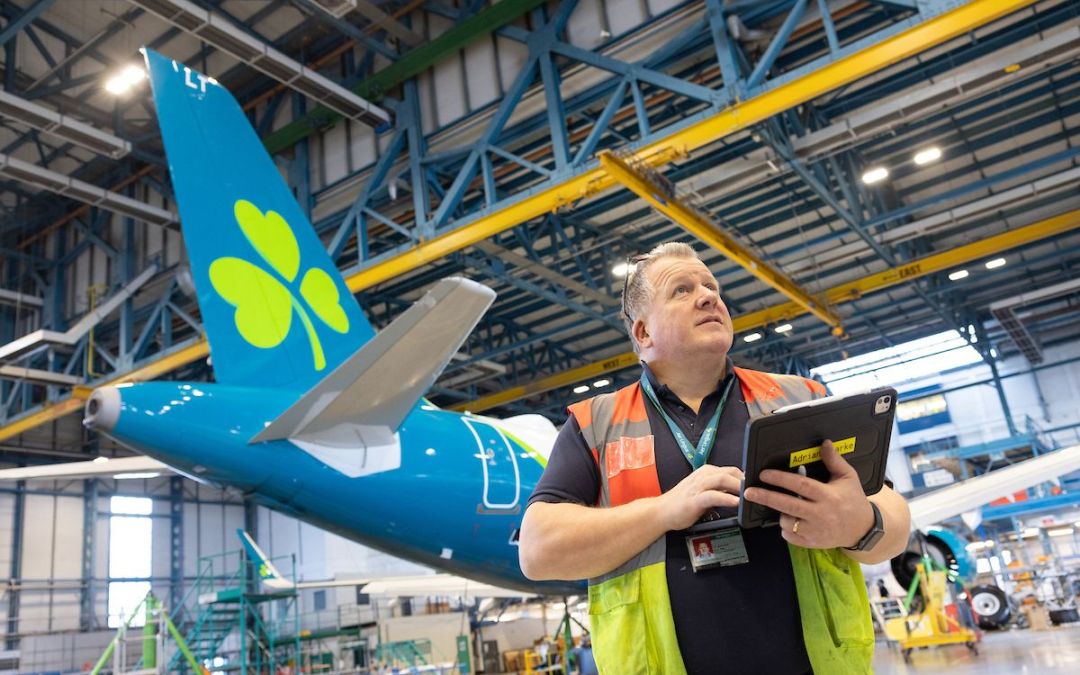
International Airlines Group (IAG) member Aer Lingus have announced a new commercial partnership with AISmartPlan.
The startup joined the IAGi Accelerator in 2025, a dedicated programme helping IAG’s airlines connect with emerging companies. AISmartPlan’s innovative system has reduced manual processes and helps engineers better visualise their work with its automatic engineer/aircraft pairing software and drag-and-drop tools.
Lucas De Almeida Ramos Faria, Maintenance Production Planning Manager at Aer Lingus, said:
The way maintenance tasks were allocated to our engineers was previously highly manual and time consuming, which limited how far ahead we could plan. The IAGi Accelerator programme provided us with a valuable opportunity to work with AISmartPlan and test an AI optimised approach using real operational constraints. This partnership marks a fundamental change in how we plan and optimise maintenance. What used to take hours each day can now be done in minutes, and with far greater confidence in the outcome.
In just three months the startup advanced their solution from a proof-of-concept to an operational system supporting everyday MRO at Aer Lingus. With the signing of a multi-year agreement, AISmartPlan are also considering scaling their work to other IAG airlines.
Since its establishment ten years ago, the IAGi Accelerator has partnered with more than 120 companies. Nicolas Grondin, Founder of AISmartPlan, commented:
Our goal has always been to fully automate maintenance planning and make complex plans instantly visible and actionable. The IAGi Accelerator gave us an incredible opportunity that early-stage companies rarely get – deep operational engagement with an airline that was willing to test, challenge and cocreate the solution with us. Aer Lingus’ feedback directly shaped the product and proved its market fit in aviation.
Join us at Aerospace Tech Week 2026.
by Elsie Clark | May 28, 2026 | Innovation
Airbus have blamed supply chain difficulties as it delays delivery of Qantas’s first ultra-long-haul A350-1000.
Nicknamed ‘Project Sunrise’, Qantas plans to use the aircraft to run direct flights from Sydney Kingsford Smith to London Heathrow and New York JFK. The Australia-US flight will last 22 hours, and is possible thanks to a 20,000-litre fuel tank.
Airbus had been scheduled to deliver the first of 12 A350-1000s to Qantas at the end of this year. However, the Toulouse-based manufacturer has pushed the date back to April 2027.
A Qantas spokesperson said:
We continue to work closely with Airbus on the delivery and certification process that will enable us to begin operating these history-making ultra long-haul flights.
Supply chain issues have blighted the aviation industry for several years now. In its 2025 end-of-year report, Airbus reported a record backlog of 8,754 commercial aircraft. Engine suppliers Prattt & Whitney were blamed as the principal cause of delays. An increasingly fragmented geopolitical environment has been complicated further by the ongoing closure of the Strait of Hormuz, exacerbating supply chain complications.
Qantas assert that test flights of the A350-1000 will begin within weeks, and that pilot training in the simulator is underway. The inaugural route and schedule for Project Sunrise is also set to release in the coming months.
Join us at Aerospace Tech Week 2026.
For more like this, see:
by Elsie Clark | May 27, 2026 | Innovation, Sustainability
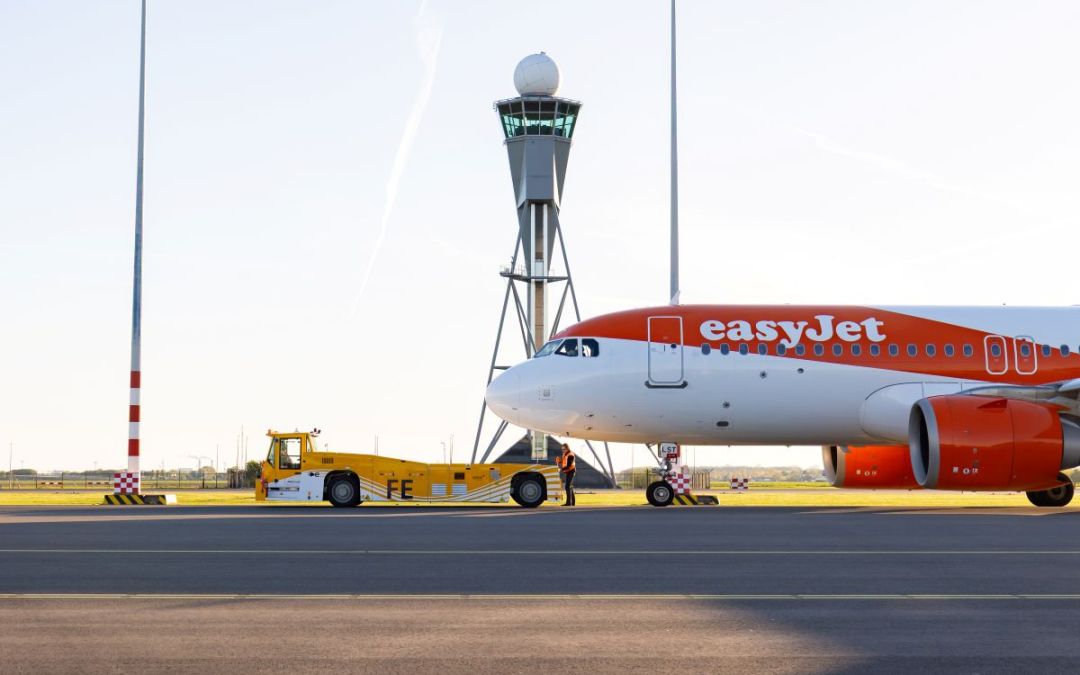
easyJet and Amstedam Schiphol have rolled out an automated TaxiBot system for quieter and more sustainable ground operations.
TaxiBot is a semi-robotic tractor that moves aircraft between gates and the runway. During the process, the aircraft only operates with its Auxiliary Power Unit (APU) rather than the engine, significantly reducing fuel consumption, noise levels, and overall carbon emissions.
Following a successful trial, four easyJet aircraft are being equipped for TaxiBot compatabiity. The airline say the system will save an average of 95 kilograms of fuel and 299 kilograms of CO2 per flight.
David Morgan, Chief Operating Officer at easyJet:
As we continue to modernise our operations, initiatives like this demonstrate how innovation and collaboration across the industry can help reduce aviation’s environmental impact both in the air and on the ground.
TaxiBot is part of the carrier’s programme to reach net-zero carbon emissions by 2050. Amsterdam Schiphol, meanwhile, wants to reach sustainable taxiing operations by 2035. The airport say that widespread deployment of TaxiBot could reduce fuel consumption during taxiing by as much as 65%.
Esmé Valk, Chief People and Transformation Officer at Amsterdam Airport Schiphol, added:
This is how we’re creating a healthier and cleaner workplace, and an ever more sustainable and modern airport that is ready for the future.
Join us at Aerospace Tech Week 2026 to discuss sustainable aviation.
by Elsie Clark | May 20, 2026 | AI & ML
United Ventures and Pegasus Innovation Lab are among the investors contributing to a US$1.5 million fundraising round for startup Overwatch AI.
Baobab Ventures and Masia also backed the company, which was founded by former pilot Leo Kotil alongside Nikita Kaeshko. The startup aims to make it easier for airline crew and operations staff to access critical information. Currently fragmented across different systems, Overwatch are building a platform that allows staff to search find what they need using natural language.
Kotil explained:
After nearly a decade as a pilot, I know how painfully disjointed many of the pre- and in-flight processes are. You are trawling through various apps and systems based on outdated software, trying to piece together the information you need to take action. You spend more time on this than flying the plane.
The AI does the hard work of trawling through the reams of documentation and dozens of operational data sources, making sense of it and connecting the dots, surfacing the answers and insights airline teams are looking for.
Overwatch has already experienced early successes, deploying the tech across 30,000 flights. The results are encouraging: a 4.6-times increase in compliant decision-making and a 6.6% increase in crew productivity. The company estimate full deployment could save airlines up to US$4 million.
Pegasus Airlines Innovation Lab managing director Kurtulus Ozturk commented:
Through this partnership, Pegasus contributes real-world operational context, extensive documentation, and direct crew feedback to tailor and scale Overwatch AI within a live airline environment. As a result, our pilots and cabin crew can instantly access critical information through natural language, improving decision-making, operational efficiency, and on-time performance, ultimately enhancing passenger satisfaction.
The US$1.5 million funding round comes following Overwatch AI’s success at Aviation Festival Asia 2026, where they won our Startup Pitch Competition.
Join us at Aerospace Tech Week to discuss the future of flight ops.
For more like this, see:



You must be logged in to post a comment.