
by Elsie Clark | May 19, 2026 | Innovation, MRO IT
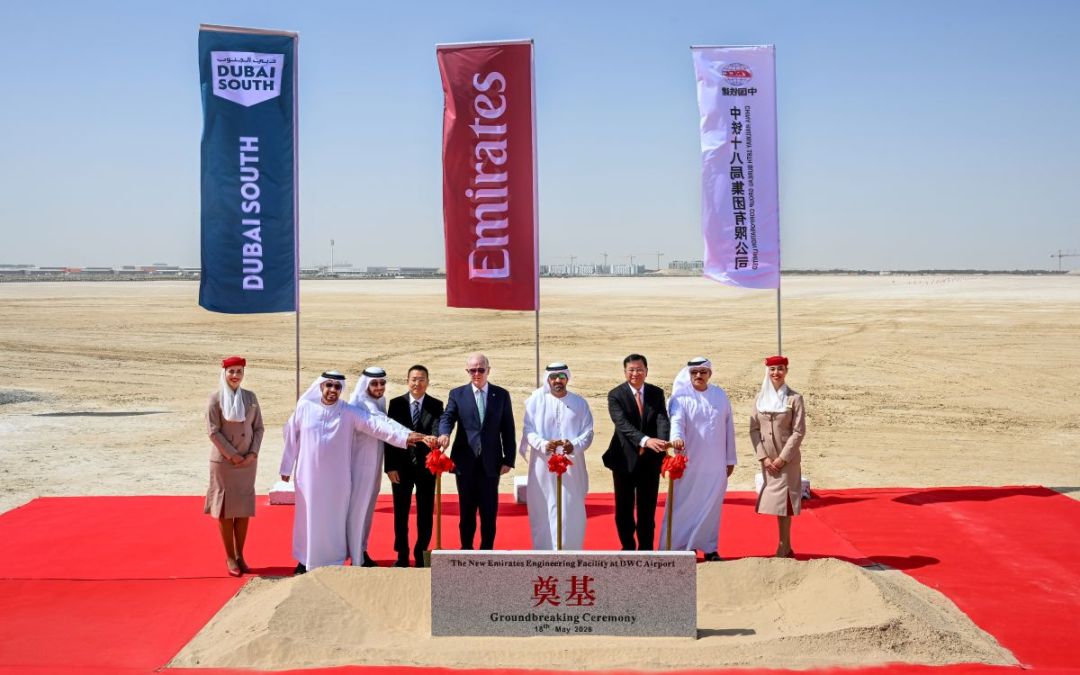
Emirates have begun construction on a high-tech US$5.1 billion MRO facility in Dubai South. Totalling 1.1 million square metres, once complete the building will be one of the world’s largest by volume, as well as the largest steel structure in the Gulf.
China Railway Construction Corporation are leading construction, alongside Artella as project consultants. The ambition is to create an advanced hangar that can simultaneously accommodate 28 wide-body aircraft and two painting hangars.
Ahmed bin Saeed Al Maktoum, Chairman and Chief Executive at Emirates Airline and Group, said:
The new facility strengthens Emirates Engineering’s vertical integration strategy by bringing more skills, infrastructure, parts production, and specialist capabilities under one roof, while positioning the airline to serve as a strategic engineering partner for the future requirements of the regional and global aviation industry.
Alongside the latest MRO tech, the facility will also incorporate sustainability with solar panels across the roof. Construction is scheduled to complete in 2030, with the hangars initially serving as overspill for Emirates Engineering work at Dubai International Airport (DXB).
As supply chain delays continue to impede the delivery of new aircraft, effective maintenance and overhaul have become key priorities for airlines who want to make the most of their existing assets. Emirates continues to target an ambitious growth strategy that will not be possible unless they keep their aircraft in top condition. As a carrier that prides itself on its superior customer service, this MRO investment will reduce turnaround times and delays, ultimately producing a better experience for passengers.
Join us at Aerospace Tech Week 2026.
by Elsie Clark | Oct 29, 2025 | AI & ML, Flight Ops IT, Innovation
Dubai-based carrier Emirates has reported a measurable decrease in unexpected turbulence incidents over the past year thanks to onboard data and analytics.
Changing atmospheric conditions due to climate change are making inflight turbulence more regular and more severe. Notably, scientists at Reading University in the UK found that severe turbulence has increased by 55% between 1979 and 2020 over the North Atlantic. Professor Paul Williams, one of the scientists leading the project, told the BBC earlier this year that turbulent incidents could soon double or treble in length due to changes in temperature and wind patterns.
Turbulence hit the headlines in 2024 after one died and many more were injured on a Singapore Airlines flight from London Heathrow. Additionally, ICAO reported in 2023 that 40% of all inflight injuries were the result of turbulence.
Emirates takes action to mitigate unexpected turbulence
Over the past year, Emirates has been investing in multiple systems that can provide pilots with real-time analytics and help its aircraft avoid severe turbulence. Captain Hassan Alhammadi, Divisional Senior Vice President Flight Operations at Emirates, said:
While we cannot promise turbulence-free flights, these initiatives have contributed to a significant reduction in unexpected severe turbulence incidents over the past year, helping make journeys safer and more comfortable for our customers.
One technology partner is SkyPath, which uses AI and machine learning (ML) to detect and predict turbulence hotspots that traditional weather forecasting might overlook. Alongside this platform, Emirates has deployed Lufthansa Systems’ Lido mPilot application, which provides pilots with high-resolution weather data and real-time alerts.
Emirates is also participating in IATA’s Turbulence Aware programme, sharing data with airlines to help other aircraft adjust flight paths in advance to minimise the impact of turbulence.
Alhammadi added:
Our multi-layer approach with weather prediction and technology partners and active participation in the IATA Turbulence Aware programme also enables us to contribute valuable data and insights to the broader aviation industry as we collectively work to address this growing meteorological challenge.
Join us at Aerospace Tech Week 2026, where our dedicated track will be discussing data-driven flight ops.
For more like this, see:


You must be logged in to post a comment.