
by Elsie Clark | May 27, 2026 | Innovation, Sustainability
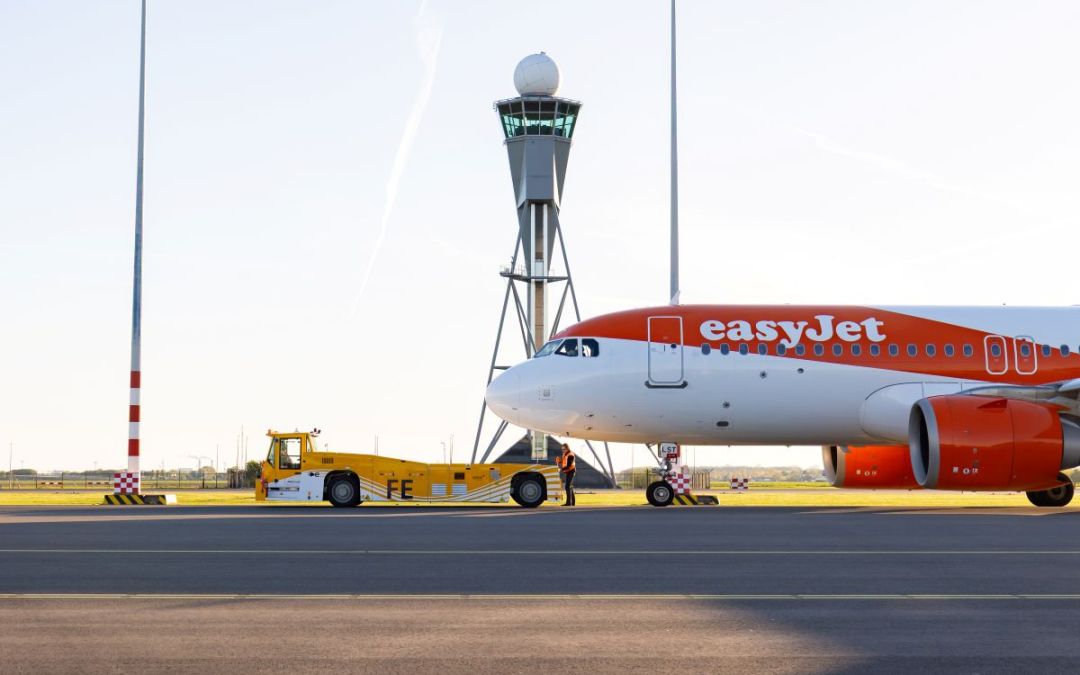
easyJet and Amstedam Schiphol have rolled out an automated TaxiBot system for quieter and more sustainable ground operations.
TaxiBot is a semi-robotic tractor that moves aircraft between gates and the runway. During the process, the aircraft only operates with its Auxiliary Power Unit (APU) rather than the engine, significantly reducing fuel consumption, noise levels, and overall carbon emissions.
Following a successful trial, four easyJet aircraft are being equipped for TaxiBot compatabiity. The airline say the system will save an average of 95 kilograms of fuel and 299 kilograms of CO2 per flight.
David Morgan, Chief Operating Officer at easyJet:
As we continue to modernise our operations, initiatives like this demonstrate how innovation and collaboration across the industry can help reduce aviation’s environmental impact both in the air and on the ground.
TaxiBot is part of the carrier’s programme to reach net-zero carbon emissions by 2050. Amsterdam Schiphol, meanwhile, wants to reach sustainable taxiing operations by 2035. The airport say that widespread deployment of TaxiBot could reduce fuel consumption during taxiing by as much as 65%.
Esmé Valk, Chief People and Transformation Officer at Amsterdam Airport Schiphol, added:
This is how we’re creating a healthier and cleaner workplace, and an ever more sustainable and modern airport that is ready for the future.
Join us at Aerospace Tech Week 2026 to discuss sustainable aviation.
by Elsie Clark | Oct 21, 2025 | Innovation
British low cost carrier (LCC) easyJet has launched a fresh apprenticeship recruitment drive, as research shows that an ageing workforce threatens to create significant staff shortages across aviation and aerospace.
The UK Civil Aviation Authority found that over a quarter (27%) of British aircraft maintenance personnel will retire in the next decade. With over 22 billion air passengers expected by 2053, the industry must fill these gaps if it is to maintain safety standards, manage new aircraft, and unlock the full potential of maintenance tech, including AI.
easyJet’s apprenticeship programme will give students hands-on training and pay them to learn. Applications for 2026 are now open, with the scheme to launch at easyJet’s Gatwick and Luton hubs, and plans in place to expand to Manchester, Liverpool, Bristol, Edinburgh and Glasgow.
Brendan McConnellogue, director of engineering and maintenance at easyJet, said:
Today’s young people are motivated by purpose – they want to solve problems, travel, innovate and play their part in building a more sustainable future.
Our engineering apprenticeships give candidates the chance to gain valuable experience working on our state-of-the-art fleet while helping to deliver on aviation’s commitment to decarbonisation.
easyJet survey reveals depth of aviation recruitment problem
As well as expanding their apprenticeships, easyJet conducted a survey of 2,000 16-24 year olds to understand further the challenges of replacing the ageing aviation workforce.
65% of respondents said that they had never considered a career in engineering, with many holding misconceptions around cost, qualifications, and accessibility. A significant gender gap also emerged: 52% of young men said they had considered engineering as a career, compared with only 36% of women
However, the survey also highlighted how young people’s career preferences align well with the world of aviation engineering. 44% of respondents wanted to help tackle climate change, and 43% of that group saw engineering as a good career for helping develop low-emission technologies.
The UK government’s aviation minister, Keir Mather, commented:
[easyJet’s] engineering apprenticeship scheme marks an important step in continuing to build a highly skilled aviation workforce fit for the future.
Initiatives like easyJet’s unlock exciting, flexible routes into aviation, backing an expanding sector whilst offering young people valuable opportunities and long-term careers.
Join us at Aerospace Tech Week 2026 to discuss the future of aircraft engineering and maintenance.
For more like this, see:
by Elsie Clark | Sep 29, 2025 | Connectivity, Flight Ops IT
An incident at Nice Côte d’Azur Airport is under investigation after two aircraft came within three metres of each other on the runway, narrowly avoiding a crash.
The near-accident occurred on Sunday 21 September at around 21.30 local time during stormy, foggy conditions. A Nouvelair A320 from Tunis Carthage Airport came into land and flew metres above an easyJet flight on the runway, bound for Nantes.
Eyewitnesses said that the easyJet aircraft shook as the Nouvelair plane passed overhead. The flight to Nantes was subsequently cancelled, and the easyJet pilot was reported to have left the craft in distress. The Nouvelair plane was forced to go-around and landed safely shortly after.
The French Minister of Transport, Philippe Tabaro, has opened an investigation into the near-collision through the Bureau d’enquêtes et d’analyses (BEA).
Stormy conditions emphasise limitations of available positioning tech
The situation at Nice Airport was complicated by the poor weather conditions that forced many flights to be delayed, diverted, or cancelled. In an amusing high-profile incident, Formula One drivers Carlos Sainz and Charles Leclerc ended up driving a van back to Monaco from Italy after their plane to Nice was unexpectedly diverted on the evening of 21 September.
Possibly, the incident between the easyJet and Nouvelair planes would have occurred if visibility had been better. Yet the near-accident also highlights the shortcomings of air traffic control and the inability of aircraft to position themselves safely in relation to each other.
Recently, Aerospace Tech Review also reported on Honeywell’s testing new SURF-A technology, which the company claims will improve pilots’ situational awareness and prevent runway incidents. The test recreated two famous near-collisions at American airports and demonstrated how real-time alerts could have been used to prevent them.
Yet technology can be fallible too. The drama that unfolded at Nice last week only highlights once again the importance of ongoing safety improvements and multiple backups to guarantee the safety of passengers and crew.
Join us at Aerospace Tech Week 2026, where we’ll be discussing the latest innovations in avionics and flight ops that are improving safety in aviation.
For more like this, see:


You must be logged in to post a comment.