
by Jessica Brownlow | May 27, 2025 | Connectivity, Innovation, MRO IT
Ultra low-cost carrier Ryanair has posted a full year profit of €1.61 billion after tax, becoming the first European airline to carry more than 200 million passengers in a single year.
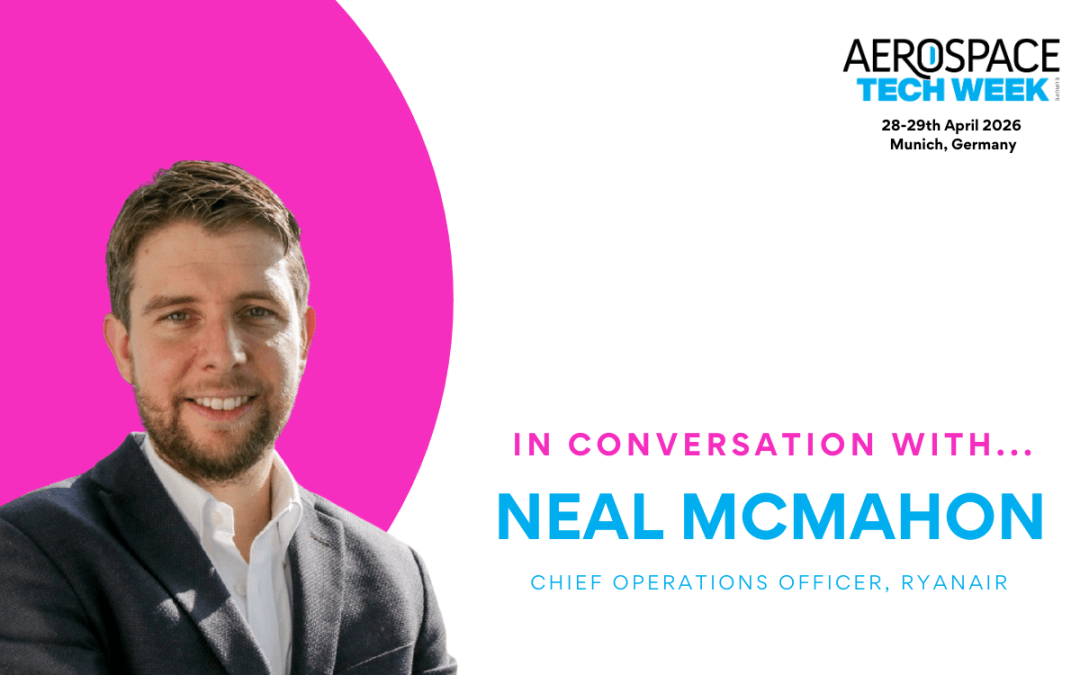
At Aerospace Tech Week in April, Ryanair’s Chief Operations Officer (COO), Neal McMahon, shared insights into the airline’s strategic aircraft investment and ambitious growth plans. McMahon unpacked Ryanair’s $40 billion investment in Boeing’s new aircraft tech, and detailed the airline’s plans to grow traffic to 300 million over the next decade.
Speaking on the current state of air traffic control (ATC), McMahon emphasised the urgent need to modernise outdated structures that operate in siloes, attributing upcoming struggles on staff shortages:
“ATC is going to be a shambles again this year. I’d love to say it’ll be better, and through our best efforts, trying to be helpful, trying to push people, trying to publicise it – we’ve been unsuccessful to get them to hire more. So, you take a few countries: Germany has less air traffic controllers than last year, they’re the worst in Europe; France hasn’t grown air traffic controllers, Spain hasn’t grown them quickly enough, and the UK has less air traffic controllers. So, we have a problem that there’s just not enough people being brought into the system.”
McMahon also discussed flight shaming which he claimed “does not exist,” alongside the airline’s expansion of its MRO facilities and pilot training initiatives. Watch the full interview below for more.
Join us at Aerospace Tech Week 2026.
Questions asked include:
- At the end of the year, Ryanair invested in Boeing’s new aircraft tech with the 737. How does this fit in with your wider strategy?
- You also recently began work on a new state-of-the- art hangar. How does this enhance your MRO capabilities and position you for future success?
- In summer of 2024, you described ATC services in Europe as “at their worst levels ever” with summer 2025 just around the corner, what is your current assessment of the ATC landscape?
Subscribe to our free monthly newsletter.
For more from ATW Europe see:
by Jessica Brownlow | May 22, 2025 | Innovation
Originally published MOVEMNT
Electric vertical take-off and landing (eVTOL) aircraft company Archer has been selected as the official air taxi provider for the Los Angeles 2028 (LA28) Olympic and Paralympic Games and Team USA.
The California-based company will integrate its Midnight eVTOL aircraft across the LA28 Games for a variety of services including transporting VIPs, fans, stakeholders and providing support for emergency services and security.
Adam Goldstein, CEO and founder of Archer Aviation, said:
“We want to transform the way people get around Los Angeles and leave a legacy that shapes the future of transportation in America. There’s no better time to do that than during the LA28 Games.”
Midnight is Archer’s piloted electric air taxi designed to carry up to four passengers, which produces less noise and emissions than a traditional helicopter.
The LA28 Olympic Games are expected to host over 15 million visitors and broadcast to billions of viewers globally over the course of the Games.
LA28 Chairperson and President Casey Wasserman, said:
“Our vision is to fundamentally reimagine the Olympic and Paralympic Games experience.”
The LA28 Games will mark Los Angeles’ third time to host the Olympic Games, previously hosted in 1984 and 1932, and first time to host the Paralympic Games.
For more like this see:
by Jessica Brownlow | May 9, 2025 | Connectivity, Flight Ops IT
Originally published on TotalTele
The three-year plan will see new telecoms equipment deployed at over 4,600 locations
This week, the US Department of Transport (DOT) has announced a new plan to upgrade the nation’s ‘antiquated’ air traffic control infrastructure.
The three-year ‘Brand New Air Traffic Control System Plan’ will includes upgrades throughout the system, from new hardware and software to the construction of six new air traffic control centres.
“Decades of neglect have left us with an outdated system that is showing its age. Building this new system is an economic and national security necessity, and the time to fix it is now,” said Transportation Secretary Sean Duffy in a statement.
The update will also include a major revamp of the system’s telecoms infrastructure, including “new fiber, wireless and satellite technologies at over 4,600 sites, 25,000 new radios and 475 new voice switches”.
The financial requirements for such an upgrade were not formally announced, but Duffy said that “billions” would be required from Congress to complete the project.
For more like this see:
by Jessica Brownlow | May 7, 2025 | Innovation
Industry 4.0 merges the digital and physical worlds, leveraging technologies like AI, automation, machine learning, data analytics, real-time decision making and more to transform how industries function. Digital Twin technology embodies this transformation driving new levels of productivity and optimisation across industries.
The UK Digital Twin Centre has been constructed to drive nationwide industrial innovation and officially opened at the start of the month. The Belfast-based innovation centre was the product of Digital Catapult, Belfast Region City Deal, and Innovate UK’s collaboration and has been positioned to catalyse the adoption of digital twin technology across critical sectors.
The Centre “offers a practical route to adoption” supporting programmes to unlock the value of digital twin technology where limited test environments and underdeveloped technology has made significant progress difficult to achieve.
At the opening, co-investing industry partners – Artemis Technologies, Spirit AeroSystems, and Thales UK showcased a few early stage applications of the digital twin tech, highlighting the value of cross-sector collaboration. For the first six-month Accelerator Programme, aerospace projects, as well as maritime and defence will be fast-tracked.
Speaking on the launch, Susan BowenCEO, Digital Catapult said:
“The UK Digital Twin Centre brings together our technical expertise, facilities, and networks to unlock the power of deep technologies. By connecting industries with cutting-edge technology through our programmes, we are enabling businesses to harness the full potential of digital twins–driving operational efficiencies, advancing sustainability, and sharpening the competitive edge of UK businesses.”
Find out more here.
For more like this see:
by Jessica Brownlow | Apr 30, 2025 | Innovation
Having amassed over 40,000 miles of test flights, Joby has now flown a full transition flight with a pilot onboard.
The California-based Joby Aviation has already successfully tested the electric, vertical take-off and landing (eVTOL) air taxi’s design both remotely-piloted and in hover and low-speed flight. But this month, Joby signalled their confidence in the aircraft with the first pilot-on-board transition flight.
Demonstrating its ability to transition from vertical to cruise flight, and back again, the aircraft showcased its versatility in the performance, harnessing the benefits of both helicopters and airplanes.
Speaking on the achievement, Didier Papadopolous, President of Aircraft OEM at Joby, commented:
“Achieving this milestone is hugely significant for Joby. It not only demonstrates the high level of confidence we have in the performance of the aircraft as we prepare for commercial service in Dubai, it also paves the way to starting TIA flight testing with FAA pilots onboard […] We have taken a very methodical approach to achieving this long-planned milestone, with an immense amount of testing, both in the air and on the ground, helping form a solid foundation that allowed us to move from one historic flight to routine pilot-on-board transitions almost overnight.”
Having successfully completed this test on the 22nd April 2025, Joby has since got multiple transition flights under its belt with three different pilots. The first pilot, Joby Chief Test Pilot James “Buddy” Denham said:
“I’m honoured to have played a role in this historic moment. Designing and flying an aircraft that can seamlessly transition between vertical and cruise flight has long been considered one of the most challenging technological feats in aerospace, but our team has developed and built an aircraft that makes it feel like an everyday task. The aircraft flew exactly as expected, with excellent handling qualities and low pilot workload.”
For more like this see:





You must be logged in to post a comment.