
by Jessica Brownlow | Jul 14, 2025 | AI & ML, Innovation, Video
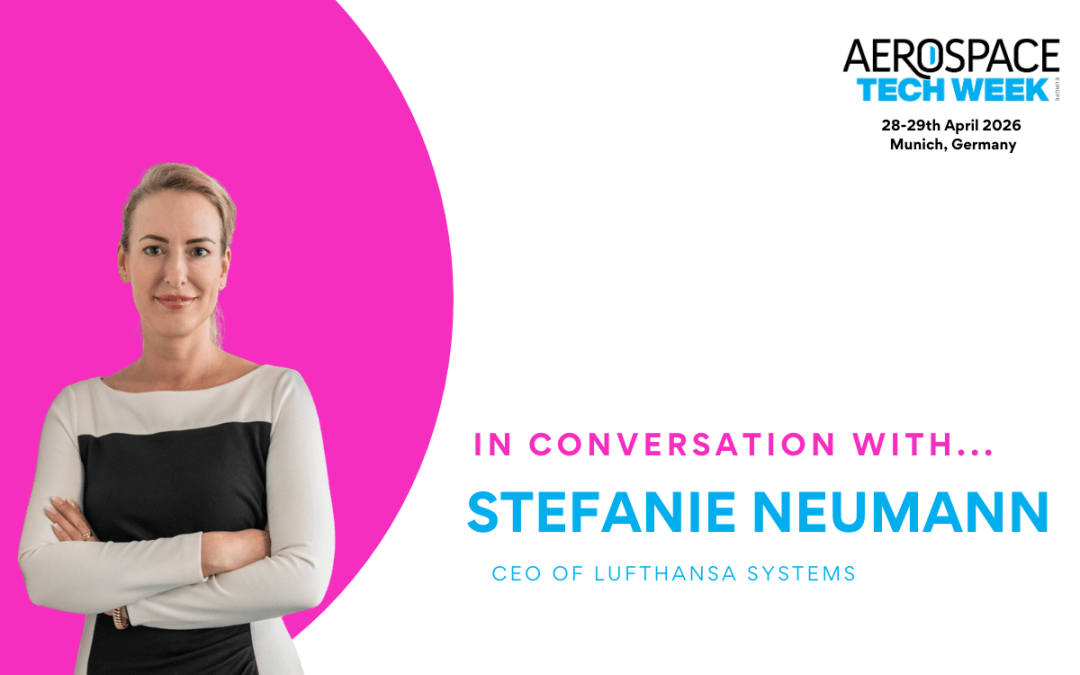
As the industry accelerates its digital evolution, Lufthansa Systems is positioning artificial intelligence (AI) and cloud technology at the core of it’s strategy. At Aerospace Tech Week, Stefanie Neumann, CEO of Lufthansa Systems outlined the company’s tech outlook stating:
“Our strategy is about transforming of the industry, not more, not less. And with that I mean we want to really increase the optimisation capabilities that AI can offer to all of us and make sure that this supports the growing scale that we are all observing.”
The conversation looked in more detail at Lufthansa Systems’ strategic investment in technologies with a view to driving optimisation. Given air traffic is due to double by 2045 and the industry must navigate scarce resources, efficiency and optimisation are essential drivers of progress. Lufthansa Systems is already applying AI in operations and maintenance and is calling on more players across the industry to unlock shared value.
Supporting this, Neumann also emphasised the importance of collaboration across the ecosystem through global partnerships. The goal is to tap into diverse talent pools and foster cross-border innovation.
To learn more watch the full interview below. To hear live from industry experts join us at Aerospace Tech Week 2026 in April!
Questions asked include:
- Where are we seeing the highest levels of investment in aerospace’s digital landscape?
- You recently announced a number of large partnerships. How are these pioneering change in the industry?
- How would you describe Lufthansa Systems’ strategy for the coming 12 months?
Subscribe to our free monthly newsletter here.
For more like this see:
by Jessica Brownlow | Jul 7, 2025 | AI & ML, Flight Ops IT, Video
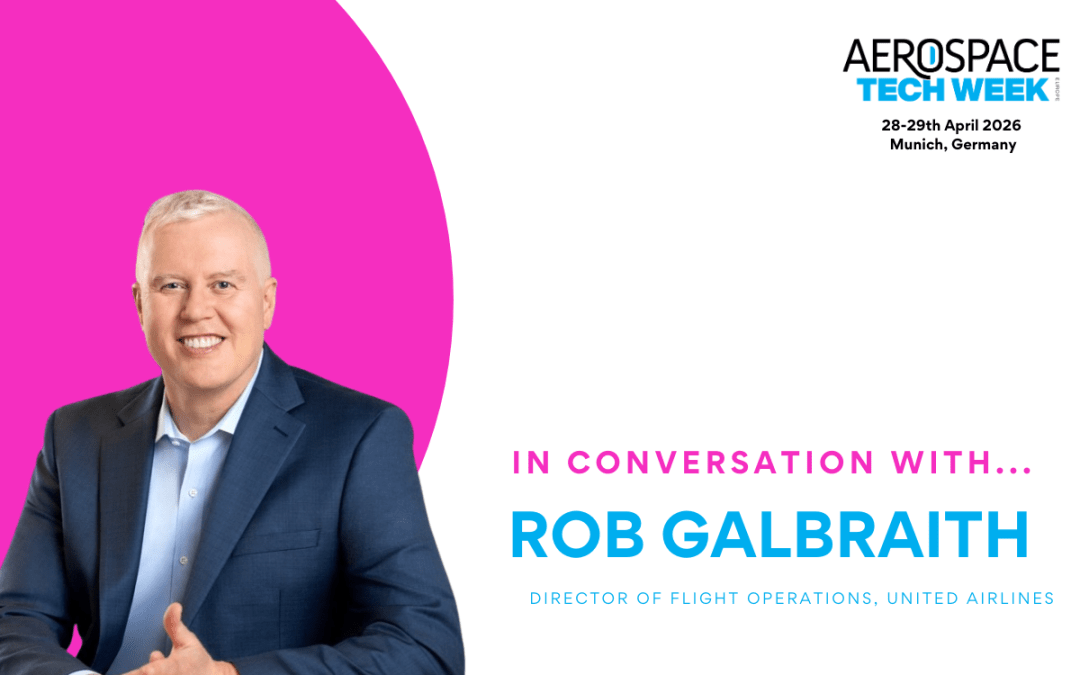
At Aerospace Tech Week, Rob Galbraith, Director of Flight Operations at United Airlines reflected on the airline’s flight operations progress looking at the technology driving change, opportunities for AI/ML integration, and the greatest challenges to seamless real-world operations.
Galbraith picked out the electronic flight bag (EFB) as one of the most impactful areas of progress due to its more flexible regulatory status. This offers flexibility for airlines and developers to innovate and respond to changing demands.
Acknowledging not every aspect of the industry is keeping pace with desired progress, Galbraith described the greatest challenge to achieving seamless flight ops as:
“Working with our training teams to actually train how we expect the pilot to operate. Right now we do a great job with simulators training how we would like to actually fly the airplane, but not operate the airplane. The next step is that we can use it in the simulator and mirror exactly how the crew would use it on the line flying a real flight. And currently that’s not possible in a lot of cases.”
AI and ML also sit at the heart of the industry’s optimisation strategy. Galbraith shared how the technology is being leveraged to help flight crews make better real-time decisions as well as streamline backend processes like updating manuals and ensuring compliance across global regulations.
To learn more watch the full interview below. To hear live from industry experts join us at Aerospace Tech Week 2026 in April!
Questions asked include:
- Which technology do you believe is currently driving the most progress in flight ops?
- Are there any emerging technologies that, although they are still in their infancy, you expect will have a major impact in the future?
- How is United integrating AI & ML into flight ops systems and to what end? Can you share any specific examples?
- What do you understand as the greatest challenge to achieving seamless flight ops, and what’s United’s strategy for overcoming this?
Subscribe to our free monthly newsletter here.
For more like this see:
by Jessica Brownlow | Jun 23, 2025 | AI & ML, MRO IT, Video
Onsite at Aerospace Tech Week Europe, five winners of the Aerospace Tech Review (ATR) Awards were announced for the first time. The awards celebrate individuals and companies for their outstanding contributions to the aerospace industry in 2024. Each category featured three deserving finalists and the winners were selected by an expert panel.
Among the winners were Kquika, whose ground breaking Trakt System won the prize for Most Creative Product Applying AI. Kquika’s Trakt System is an AI-powered predictive maintenance platform designed specifically for the aviation industry. Using a proprietary multi-model AI architecture, it achieves 92-95 per cent accuracy in predicting component failures, significantly outperforming industry standards.
In this interview, Victor Oribamise, CEO, Kquika shared deeper insight into the technology that is helping airlines anticipate issues well before they occur. Explaining the company’s goal, Oribamise said:
“We are an AI powered aviation technology company that my co-founder and I founded in 2021. Our mission is very simple but very, very transformative: we want to make air travel enjoyable, stress-free, without any cause of delays, maintenance problem for airlines, and ultimately their passengers.”
The system applies multiple AI models to analyse aircraft data and predict potential faults before they occur. To find out more about the technology powering Trakt System and how it achieves accuracy scores of between 92 and 95 per cent, watch the full interview below.
Questions asked include:
- Can you tell me about Kquika Inc and what the company does?
- Could you talk me through the Trakt System and how it works?
- I understand the system achieves 92–95% accuracy in predicting component failures, significantly outperforming industry standards. How is this level of accuracy achieved?
- How does the Trakt System transform reactive maintenance into proactive fleet optimization?
- What kind of real-world results have you seen from implementing the Trakt System?
- What’s next for Kquika Inc, and what are your personal goals moving forward?
For more like this see:
by Jessica Brownlow | Jun 20, 2025 | AI & ML, Flight Ops IT, Innovation, Video
The European Organisation for Civil Aviation Equipment (EUROCAE) develops standards ensuring safety, reliability, and innovation in aviation. As the industry landscape evolves rapidly, it is imperative standards keep pace with both the technological advancement and changing operational, environmental, and human factors that come too. At Aerospace Tech Week, Anna von Groote, Director General, EUROCAE explored this and more in this five-minute interview.
The conversation looked at the importance of addressing human factors to support safe, effective AI adoption with von Groote adding, “we in aviation know well how to deal with technical things but now the human factor is a really important topic as well.” Here, she explored the dedicated Working Groups that have been set up with this focus, shifting away from purely technical standards.
Towards the end of the discussion, von Groote unpacked the challenges of an increasingly congested airspace, and explained:
“IATA predicts growth of passenger traffic by 2.7 times in the next couple of years […] So we have to again be very holistic and look at the innovation pipeline – bringing technology to market, ensuring we give industry a framework, a regulatory framework, including technical standards, so the industry can safely deploy and bring these technologies to market.”
For more on this as well as taking a holistic approach to sustainability, watch the full interview below.
Questions asked include:
- AI is a critical part of the sector’s evolution. How should the industry tackle human factors around AI-decision making? Or broader integration?
- The journey to net-zero will involve embracing new technologies, aircraft, such as hydrogen. How can we ensure these are integrated into the ecosystem without safety being compromised?
- As airspace becomes more congested, how can we advance air traffic management to accommodate this growth?
Subscribe to our free monthly newsletter here.
For more from ATW Europe see:
by Jessica Brownlow | Jun 17, 2025 | BUZZ, MRO IT
The International Paris Air Show has been the meeting place for global aerospace for over a century. The event gathers manufacturers, airlines, lessors, and more to showcase the latest tech and sign major commercial deals.
This year, Airbus bagged nearly $10 billion in orders within the first day. The Europe-based plane maker secured commitments for up to 238 new aircraft in day one of the seven day show.
Confirmed orders included (132):
- AviLease, the Saudi-backed leasing company, confirmed purchases of 10 A350F freighters and 30 A320neo jets.
- Riyadh Air announced a significant commitment for 25 Airbus A350-1000 aircraft.
- ANA Holdings (Japan) finalized an agreement for 27 Airbus planes – 14 A321neo for All Nippon Airways (ANA) and 13 narrowbodies (10 A321neo and 3 A321XLR) for its low-cost subsidiary Peach Aviation.
- LOT Polish Airlines (Poland) placed its inaugural Airbus order, securing 40 A220s, split evenly between the A220-100 and A220-300 variants.
Potential orders (106):
- AviLease holds options to scale up its order to 22 A350Fs and 55 A320neos.
- Riyadh Air may double its commitment, with rights to acquire up to 50 A350-1000s.
- LOT Polish Airlines has indicated plans to expand its A220 fleet to as many as 84 aircraft over time.
Speaking specifically on the Riyadh Air partnership, Benoît de Saint-Exupéry, Airbus EVP Sales of the Commercial Aircraft business said:
“We are proud to extend our strategic partnership with Riyadh Air as it continues to build a pioneering carrier for the Kingdom. As the long-range leader, the A350-1000 will provide unrivalled efficiency, range and passenger comfort, making it the ideal choice to support the airline’s ambitious growth plans and Saudi Arabia’s Vision 2030 objectives to enhance global connectivity and economic diversification.”
For more like this see:




You must be logged in to post a comment.