
by Elsie Clark | Oct 15, 2025 | Innovation, Video
A report from CAE predicts that the civil aviation industry will need 1.465 million additional professionals by 2034 to meet passenger demand. Training and upskilling is therefore of the highest priority if airlines and airports want to increase their capacity safely.
Lufthansa Aviation Training, part of the Lufthansa Group, has been training aviation professionals for more than 60 years. Boasting 50 full flight simulators across six dedicated centres, the company remains at the heart of training Europe’s pilots and cabin crews.
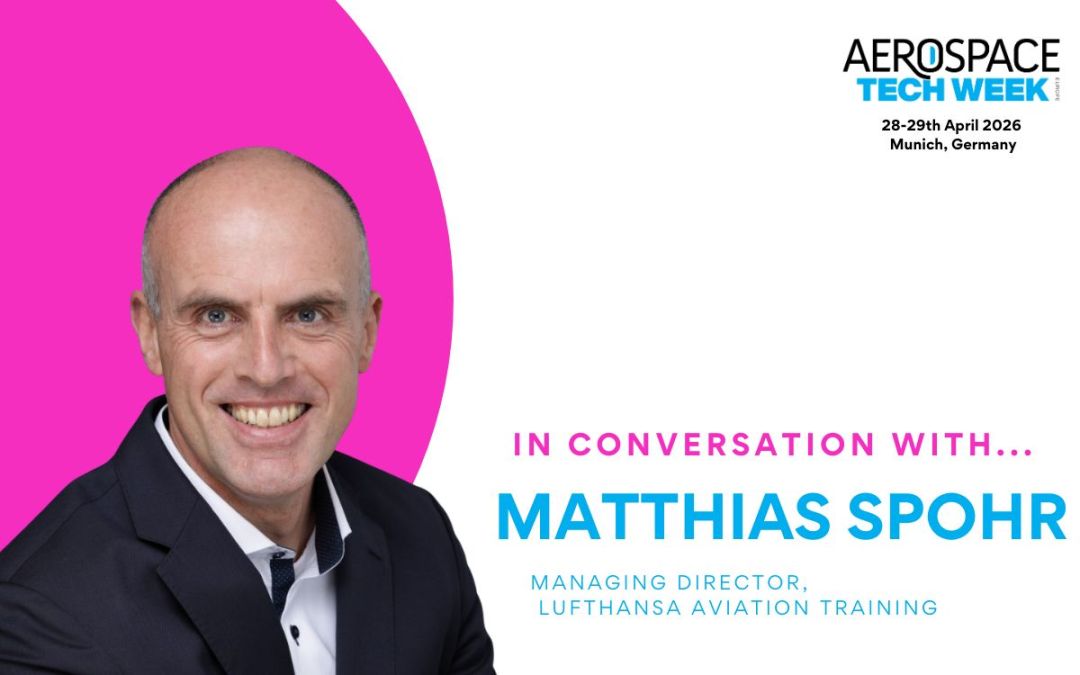
In an exclusive interview at Aerospace Tech Week 2025, we spoke to Managing Director Matthias Spohr about how Lufthansa Aviation Training is adapting for the future, including investments in digital twins.
Responsible for managing over 250 customers, Spohr sees digitisation as a key tool in offering a personalised service to every airline. Despite a strict regulatory environment, Lufthansa Aviation Training has been at the forefront of cutting-edge training technology. Remaining so is key to their strategy moving forward.
The big training devices we have are not 100% personalised to every company or airline we work with. Digital solutions give us the change to have a fully digital twin of how the airline is training, and of course to make training more realistic.
Investments of these kinds, costing in the millions of euros, represent a significant risk. Nevertheless, Spohr believes they are necessary if training is to keep pace with modern expectations. In the future, he believes aviation training will be much more decentralised, perhaps even progressing to a model where studying from home is more common.
Of course we welcome every customer that visits us, but it would be a lot better if we can decentralise and be where the crews are. That will produce savings on the airline side, and on the customer side there will be lower travel costs, more individualised training, and hopefully we can serve more customers.
The use of technology to enhance training and meet students where they are will be essential for aviation to educate and upskill the volume of workers growth forecasts require.
🎥 Watch the full interview to hear Matthias Spohr’s full thoughts on the evolution of aviation training.
Questions asked include:
- How do you see technology shaping training in the industry?
- What can you tell us about how you’re leveraging VR and digital twins?
- How does investment today drive cost savings in the future?
- What’s next in innovation in training?
Join us at Aerospace Tech Week 2026.
For more like this, see:
by Elsie Clark | Oct 15, 2025 | MRO IT
A new report from IATA and Oliver Wyman, Reviving the Commercial Aircraft Supply Chain, forecasts that supply chain challenges could cost airlines more than US$11 billion in 2025.
This is largely due to the slow pace of aircraft production, which has been exacerbated by ever-increasing demand for air travel. In 2024, passenger demand rose by 10.4%, exceeding the capacity expansion of 8.7%, while the worldwide commercial backlog of aircraft reached historic high of 17,000.
Geopolitical instability, material shortages, and labour availability have compounded these supply chain challenges, forcing airlines to keep older aircraft in service for longer. This results in higher fuel costs, maintenance costs, engine leasing costs, and surplus inventory holding costs. According to IATA, these bottlenecks combined will cost airlines US$11 billion in 2025.
The report offers several suggestions for the aerospace industry to mitigate these problems. Willie Walsh, IATA’s Director General, commented:
Airlines depend on a reliable supply chain to operate and grow their fleets efficiently. Now we have unprecedented waits for aircraft, engines and parts and unpredictable delivery schedules. […]
There is no simple solution to resolving this problem, but there are several actions that could provide some relief. To start, opening the aftermarket would help by giving airlines greater choice and access to parts and services. In parallel, greater transparency on the state of the supply chain would give airlines the data they need to plan around blockages while helping OEMs to ease underlying bottlenecks.
Additionally, the report recommends that the industry improve its use of data, including accelerating predictive maintenance and data sharing to reduce downtime and optimise existing inventory.
Matthew Poitras, Partner in Oliver Wyman’s Transportation and Advanced Industrials practice, added:
Today’s aircraft fleet is larger, more advanced, and more fuel efficient than ever before. However, supply chain challenges are impacting airlines and OEMs alike. We see an opportunity to catalyse an improvement in supply chain performance that will benefit everyone, but this will require collective steps to reshape the structure of the aerospace industry and work together on transparency and talent.
Join us at Aerospace Tech Week 2026, where our dedicated supply chain track will discuss how the industry can build resilience and mitigate disruption.
For more like this, see:
by Elsie Clark | Oct 2, 2025 | Innovation
The OxCam Advanced Air Mobility (AAM) Corridor will test electric vertical take-off and landing (eVTOL) tech in the UK for the first time.
The project will last six months and aims to prove the viability of an air taxi service between Oxford and Cambridge. The cities, home to internationally-renowned universities, are significant economic and research hubs. However, travelling between them currently takes two-and-a-half hours by train.
An East-West rail link is currently in development, as UK Chancellor Rachel Reeves aims to strengthen ties between Oxford and Cambridge through initiatives she says will be worth £78bn to the UK economy by 2035.
If successful, an air taxi corridor serving the two cities would boost connectivity even further. Laura Peacock, head of innovation at Oxfordshire County Council said:
This is a chance to demonstrate how innovation can be harnessed not just for economic growth, but for real societal and positive environmental impact.
Announcement of the project came shortly after the UK Civil Aviation Authority (CAA) published its eVTOL development model. This framework is designed to make air taxi travel a reality in the country as early as 2029.
The OxCam AAM Corridor is a joint project between Skyports, Bristow Helicopters, NATS, Vertical Aerospace, and Oxfordshire County Council. A planned ‘A to A’ piloted eVTOL demonstration at Skyports’ Bicester Vertiport next year will see Vertical Aerospace’s VX4 prototype take to the skies. When it takes place, it will be the first piloted passenger flight of its kind in the UK.
Cities such as Dubai and San Francisco, who bill themselves as innovation hubs, have already freed up regulation to facilitate eVTOL testing. The Oxford-Cambridge project represents a significant step in the UK’s position in AAM, as it races to keep pace with international tech developments.
Join us at Aerospace Tech Week 2026 to discuss the future of Advanced Air Mobility.
For more like this, see:
by Elsie Clark | Oct 1, 2025 | Innovation
The Saudi Arabian General Authority of Civil Aviation has approve the kingdom’s first virtual air traffic control (ATC) tower at AlUla airport.
Traffic at the airport will now be monitored remotely by a centre at Jeddah’s King Abdulaziz International Airport, more than 600 kilometres away. The virtual tower was developed by the Saudi Air Navigation Service (SANS) in partnership with Spanish ATC specialist Indra.
Not only is the tower the first of its kind in Saudi Arabia, it is also the only one in operation across the Middle East. Equipped with 360-degree cameras, specialist sensors, and artificial intelligence (AI), the new system offers improved efficiency while reducing burden on airport staff.
An ancient oasis city in the heart of the desert, the Saudi Arabian government has launched plans to boost AlUla’s tourism credentials. A new strategy hopes to attract 2 million tourists to the town by 2030, contributing SAR120 billion to the national economy. The virtual ATC tower improves safety and traffic flow to optimise management of visitors arriving by air. AlUla Airport currently handles around 400,000 passengers a year, with plans to increase that number to 6 million.
The approval of the virtual ATC tower also aligns with Saudi Arabia’s aviation modernisation strategy. The Vision 2030 plan targets 300 million air passengers by 2030, numbers that analysts at OAG have warned will be difficult to achieve due to the limited availability of qualified staff. The virtual ATC tower allows for operations at AlUla to expand without requiring further recruitment.
Initially designed with small- to medium-sized airports in mind, virtual ATC towers have been introduced at several key airports in recent years, notably London City Airport in 2021. The SESAR Joint Undertaking is also considering remote and virtual tower (RVT) concepts as part of its plans to consolidate European aerospace operations.
Join us at Aerospace Tech Week 2026 to discuss the future of ATC and SESAR.
For more like this, see:
by Elsie Clark | Oct 1, 2025 | Innovation, MRO IT
Predictive maintenance using artificial intelligence (AI) and big data is a hot topic in aerospace, as airlines, airports, and engineers all strive to reduce downtime and optimise infrastructure efficiency.
For many, however, implementing predictive maintenance technology remains stuck in the development stages. In an exclusive interview, Kaire Kalve, Head of Supply Chain at Magnetic Group, told Aerospace Tech Review what needs to change for successful predictive MRO adoption.
Different parties and operators all have their own data, so the key challenge here is actually trust.
Kalve discusses why mutual incentives are critical to breaking down barriers across the industry and eliminating data silos. If this isn’t done, predictive maintenance is slow to implement and less effective: the more data you can feed a model, the more accurate it will be.
The key here is operators. They should take the initiative as they have the most valuable data.
Industrywide collaboration will be essential to realising the benefits of predictive maintenance, and events such as Aerospace Tech Week play an important role in developing new partnerships.
The future of maintenance is truly collaborative and based on transparent agreements for data sharing.
🎥Watch the video below to hear Kaire’s full insights on collaboration in predictive maintenance.
Questions asked include:
- Predictive maintenance is widely discussed, but we’re yet to see its widespread implementation. What’s holding the industry back?
- Predictive maintenance relies heavily on data. Who in the industry has the most important data, so to speak?
- Why are events such as Aerospace Tech Week so important?
For more like this, see:





You must be logged in to post a comment.