
by Elsie Clark | Nov 20, 2025 | Avionics, Connectivity
The International Air Transport Association (IATA) are calling for safeguards around the deployment of 5G/6G to protect avionics systems and radio altimeters.
IATA has presented a paper at the International Telecommunication Union (ITU) WP5B Meeting in Geneva, Switzerland that outlines priority areas for protection. Radio altimeters, which need spectrum availability, must be taken into consideration in 5G planning to ensure aircraft and crew operate at optimum situational awareness.
Guiding the ITU’s studies will inform the output of the World Radiocommunications Conference 2027 (WRC-27), which will determine the technical conditions for 5G and 6G deployment.
Nick Careen, IATA Senior Vice President Operations, Safety and Security, said:
The benefits of 5G and 6G can never come at the cost of aviation safety. Spectrum decisions must be based on real-world aircraft operations, not idealized telecommunications industry modelling. That means ensuring ITU studies fully reflect the most demanding conditions pilots face. With input from aviation users, WRC-27 must deliver clear global rules to ensure the safe coexistence of radio altimeters and other safety-critical avionic systems with next-generation telecom networks across all phases of flight
In many countries, telecommunications providers have voluntarily implemented measures to avoid interference with o the Radio Altimeter (RAD ALT) allocation (4.2–4.4 GHz). However, in countries such as Canada, these temporary measures are about to expire, potentially leaving aviation communications vulnerable.
Careen added:
Current 5G mitigations were never designed as a long-term solution and several will expire within months. At the same time, more resilient radio altimeters will not reach airlines until the next decade. That leaves a significant mitigation gap. With new spectrum auctions underway and protections being lifted in key markets, regulators must not assume safety will take care of itself. The industry needs clear, consistent safeguards to bridge the period before new altimeters are available.
Join us at Aerospace Tech Week 2026 to discuss the impact of 5G and 6G on aviation and aersopace.
For more like this, see:
by Elsie Clark | Nov 19, 2025 | Connectivity, Innovation
Airbus and Telefónica won Collaboration of the Year at our Aerospace Tech Review Awards in April 2025 for their innovations in 5G connectivity. Working with the Spanish Air and Space Force, the project connected aircraft with servers on the ground to transmit medical data more effectively.
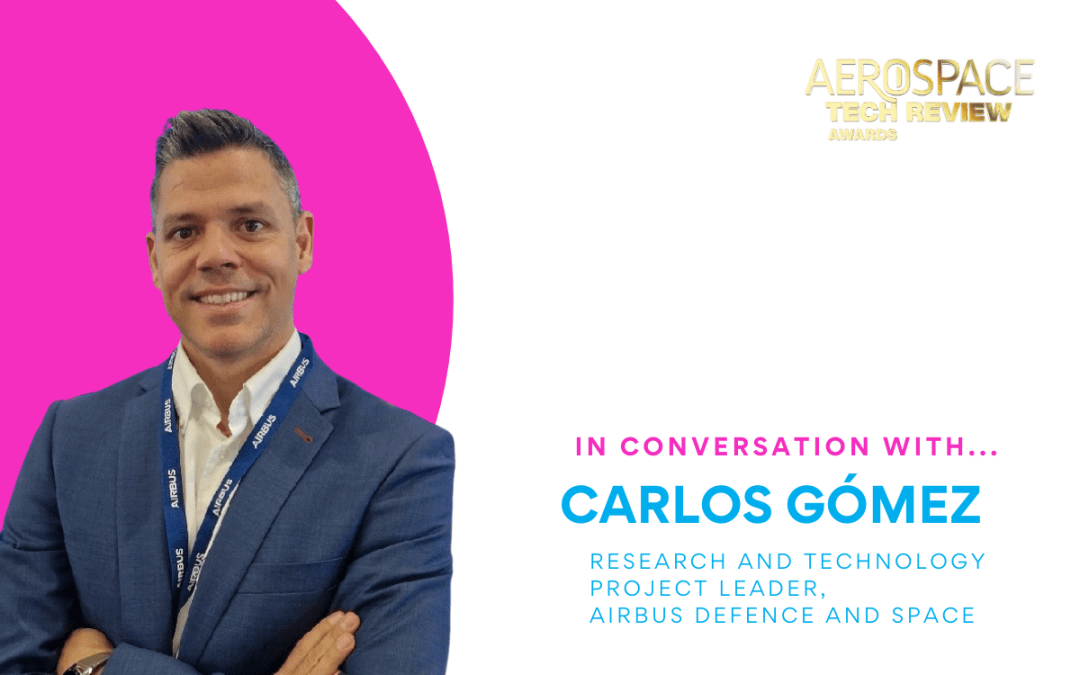
To get the lowdown on the collaboration, Aerospace Tech Review caught up with Carlos Gómez, Research and Technology Project Leader for Airbus Defence and Space. He explained how improving 5G connectivity was essential for the Spanish Air and Space Force to provide more effective communications.
5G brings three major advantages: ultra-low latency, high bandwidth, and the ability to connect thousands of devices simultaneously. This allows information to be exchanged across different domains — land, sea, air, and space — and enables more co-ordinated and informed decision-making.
Airbus and Telefónica each brough different strengths to the project: Airbus’s contributed engineering expertise for the installation of comms equipment, while Telefónica provided the necessary 5G infrastructure. In tests, the system worked successfully to transmit medical data, offering potential lifelines of support in an emergency scenario.
Using medical sensors on the aircraft, we could send information from the patient to a hospital, where the doctor could see the rate of the patient in real time. We also performed a video conference test between the aircraft and a military base.
The future of connectivity
With further investment taking place to make the solution even more advanced, the project is set to evolve and explore 5G use in applications beyond telemedicine. Gómez sees 6G as the next big transformation that Airbus has its eye on for future connectivity.
6G will bring new dimensions like integrated sensing, communication, AI, even integration with terrestrial aerospace systems. This will allow near real-time situational awareness, autonomous decision-making, and resilient communication even in the most challenging environments.
The collaboration stands as testament to what can be achieved when the aerospace industry combines its strengths to deliver effective solutions. Gómez concludes:
For us, this Aerospace Tech Review Award is more than just recognition. It’s a reminder of what is possible when passionate and professional people come together. It gives us more motivation to keep innovating.
🎥 Watch the full interview to hear the full story behind Airbus and Telefónica’s award-winning collaboration.
Questions asked include:
- How did you go about developing your 5G solution? How did Telefonica and Airbus combine their strengths?
- What lessons did both Telefonica and Airbus learn from working together?
- What results did you achieve? What successes did you see in testing and application?
- Will your 5G solution be expanded for use in other applications/used by other countries? How would you like to improve it in the future?
For more like this, see:


You must be logged in to post a comment.