
by Ian Harbison | Oct 18, 2022 | Innovation
Due to their long service life, aircraft engines evolve over the years to take account of such factors as reliability and maintainability, as well as, more recently sustainability. Ian Harbison found out what some of the major OEMs are up to.
Frank Preli, vice president, propulsion and material technologies at Pratt & Whitney says the company is committed to continually advancing the efficiency of aircraft propulsion systems, whether through revolutionary step changes in performance like with the GTF engine family, or through more incremental upgrades.

The Pratt & Whitney GTF Advantage engine lowers fuel consumption and CO2 emissions by up to 1% compared to the current model GTF engine. Capable of a takeoff thrust improvement of 4% at sea level, the engine could enable longer range and higher payload, the company says. Pratt & Whitney image.
In the last 12 months, it has announced two new engine upgrade programs– the GTF Advantage and PW127XT.
Designed for Airbus A320neo Family aircraft, the GTF Advantage engine enables a further 1% improvement in fuel efficiency and reduced CO2 emissions, in addition to the 16% step change originally achieved by the GTF at entry into service in 2016. At the same time, the GTF Advantage provides operators with 1,000lb greater thrust. However, it will actually run cooler than the current 33,000lb thrust models, offering greater durability.
The power increase gives a takeoff thrust improvement of 4% at sea level, providing longer range and higher payload, making it particularly suitable for A321XLR aircraft, while, for hot and high operations, there is an increase of up to 8% takeoff thrust at higher altitudes. GTF Advantage will be intermixable and interchangeable with the current GTF engine to ensure maximum operational flexibility.
Frank Preli
Pratt & Whitney
In early October, Airbus started development flight tests of the GTF Advantage engine on an A320neo aircraft. The program will involve testing in a variety of environments, including hot and cold weather and operation from high-altitude airports. This is an extension of ongoing product development by Pratt & Whitney and Airbus over the last eighteen months. Engine certification will continue through the first half of 2023, including flights currently underway on a Boeing 747SP flying test bed at Pratt & Whitney in Mirabel, Québec, Canada, as well as extensive endurance testing to ensure product maturity at entry into service. The company has also started FAR33 certification testing. The engine has completed more than 2,400 hours and 7,800 cycles of testing, including a successful test on 100% sustainable aviation fuel (SAF).
The latest GTF engines for the A320neo family are demonstrating dispatch reliability rates consistent with mature rates on the V2500 engine for the A320ceo family but, says Preli, the company is still making improvements to extend time on wing, with the upgrades that have been incorporated in the current engine demonstrating positive results. All these upgrades will carry over to GTF Advantage.
The Pratt & Whitney Canada PW127XT turboprop has been developed for ATR 42/72 aircraft and received Transport Canada certification in August. compared to the PW127M, time on wing has been extended by 40% by increasing the period required between engine overhauls and hot section inspections to 20,000 hours, while, with only two scheduled engine events over 10 years (based on typical mission lengths and 2,000 annual flying hours), maintenance costs should be reduced by 20%. It also provides a 3% improvement in fuel efficiency compared to the previous generation engine and will be capable of running on 100% sustainable aviation fuel (SAF).
Preli comments that this will further increase the environmental performance and operating economics of regional turboprop aircraft, which can be up to 40% more efficient than regional jets on equivalent routes.
In June, it was announced that another variant of the engine, the PW127XT-S had been selected by Deutsche Aircraft to power its D328eco regional turboprop. The two companies will also cooperate on enabling the PW127XT-S engine to run on 100% SAF, including hydrogen-based Power-to-Liquid (PtL) fuel.”
GE Update
For GE, it is focused on three aspects:
• Engine hardware upgrades: Improved and validated designs that can be introduced on legacy platforms
• Services technology: Ways to clean, inspect and repair engines to improve efficiency, reduce turnaround time and extend service time
• Analytics and fleet stability: Analytics Based Maintenance used to predict optimal time for preventative maintenance
An example of an engine hardware upgrade is the HPT durability upgrade program for CF34-8 engines that was launched in 2019. Under this program, GE provides customers with upgraded parts that can be incorporated into the engine during its next overhaul. These parts are listed in a series of Service Bulletins that GE issued and include components in the fan, compressor, combustor and HPT modules. The set maintenance offer is providing up to $30 per cycle lower engine life cost of maintenance.
On the GE90-115B, the company has invested in component improvements, from the front composite fan blades to HPT nozzles, blades and shrouds. Today, according to FDM data, the average engine cycles from EIS to first shop visit on a newly-built GE90 engine has increased from around 2,000 in 2007) to more than 4,000 today.
In September, Pratt & Whitney announced it will establish a technology accelerator in Singapore in collaboration with the Singapore Economic Development Board (EDB). Technologies developed in Singapore will be applied across Pratt & Whitney’s global maintenance, repair and overhaul (MRO) footprint. The facility will help to accelerate the development and deployment of technology insertion projects across Pratt & Whitney’s four Singapore-based MRO facilities over the next five years. Projects will focus on automation, advanced inspection, connected factory and digital twin and helping to enhance connectivity and intelligence across the company’s MRO operations. Pratt & Whitney image.
In 2021, the GEnx engine completed more than 3,000 cycles of dust ingestion testing in a simulated severe environment using a specialized dust ingestion rig. The endurance tests validated several hardware improvements, including an improved combustor deflector and redesigned high pressure turbine stage 1 blade. The endurance testing mimicked the dust GEnx engines encounter flying in some of the most severe operating environments in the world. In partnership with GE Research, dust was reversed engineered to replicate specific field conditions.
GE completed similar testing in 2021 on the FAA-certified GE9X engine, which will enter service on the Boeing 777X.
These tests were partly aimed at helping customers in the Middle East, where sand ingestion is a recurring problem, as was development of another services technology: 360 Foam Wash. With more cleaning capability than the water wash method, the 360 Foam Wash cart injects a proprietary foam detergent into target areas within the engine that reduces the build-up of deposits, lowers exhaust gas temperatures and improves engine compressor efficiency, increasing time on wing. It is completely self-contained, so can be used inside hangars.
The system was first introduced in 2017as a development program and tested on engines in the field and in service with customers. but a major step forward came in 2021 with its launch in partnership with Etihad Airways, which has included it in its Boeing 787 Greenliner Programme. After training their staff, airlines can obtain technical licenses from GE for GE90, GEnx and CF34 models, as well as Engine Alliance GP7200 engines.
Etihad obtained licenses for GE90 and GEnx-1B engines on its Boeing 777 and 787 fleets and was quickly followed in the region by. Emirates, Qatar Airways, Royal Jordanian Airlines and Saudi Arabian Airlines.
GE estimates using 360 Foam Wash on a GEnx engine operating in the Middle East can produce fuel savings of 15,900 gallons of fuel, based on 650 cycles a year, with each cycle lasting six hours. For a GE90, the savings are 35,500 gallons of fuel per year, based on 700 cycles a year, with each cycle lasting 6.5 hours. Of course, there an associated reduction in CO2 emissions.
Outside the Middle East, Air India received a technical license for GEnx-1B aircraft engines on its fleet of 27 Boeing 787s and expects to save approximately 230,000 gallons and a reduction of more than 2,200 tonnes of CO2 in 2022.
The latest customer, getting its technical license in January this year, is Japan Airlines, which is the first to use the system on the CF34, in this case the CF34-8E powering Embraer 170 aircraft operated by Japan Airlines and its subsidiary, J-Air. Expected annual savings are up to 82,000 liters of fuel and up to 285 tonnes of CO2 carbon emissions by replacing some water washes.
Returning to hardware upgrades, again with hot and harsh flying environments in mind, the Thermal Barrier Coating (TBC) Shield is a tool that can be used on-wing to re-apply thermal coatings in the GEnx combustor, increasing engine durability and reducing maintenance requirements. The application is carried out by a small robotic arm that enters the igniter port on the combustor.
On the CF6 engine, GE is performing metal additive component repairs. One example is the repair of high-pressure compressor (HPC) blades that run at high speeds with tight clearances, producing regular erosion. Repairing these blade tips used to require a long process of cutting, welding and grinding to create the proper shape but the company has established an automated additive manufacturing process to repair the HPC blade tips, saving time and costs associated with labor and machining. Image-analysis software maps the shape of a used blade and creates customized instructions for a Concept Laser M2 machine to build a new tip with precise alignment and profile. The 3D-printed part is near-net shape and can be finished with minimal additional processing. Beyond much faster turn-around times, the technology reduces the scrap.
For analytics and fleet stability, GE uses data received to monitor on-wing aircraft engines and help diagnose operational disruptions before they happen. For example, GE Aviation employees in both Cincinnati and Shanghai perform 24/7 data analysis, seeking to identify trends such as oil usage, vibrations and gas temperature. Once a trend is spotted, they are capable of alerting the airline customer and identifying potential engine issues with recommended maintenance actions.
The company’s engine health monitoring service includes self-serve access to GE’s customer web portals, where customers can find technical updates, and analysis of key engine performance trends and more. Customer Notification Reports (CNRs) issued to GE Aviation customers identify potential engine issues with recommended maintenance actions. Additionally, customers can receive 24/7 global support for AOG situations.
by Ian Harbison | Jul 21, 2022 | Connectivity
The ever-growing demand for passenger connectivity is also driving developments that can be linked to make the aircraft a flying hub. Ian Harbison looks at some recent developments.
Airbus
By 2027, Airbus expects almost 30,000 aircraft to be equipped for In Flight Connectivity (IFC). It has been working for a number of years to develop a roadmap, with teams defining, developing and demonstrating the connected in-cabin technologies that will be needed. This started in 2018 with a ‘Connected Cabin Experience’ mockup that was exhibited at trade shows, backed up by demonstrations of real technologies on the company’s dedicated A350 Airspace Explorer Flight-Lab test aircraft. It has also produced ‘Vision 2030’, which focuses on the digital future of the cabin experience, and has presented this at various customer workshops to show airlines a glimpse of what they can expect in the future.
The Iris system uses satellites to relay data digitally from the cockpit to the ground, increasing communication capacity and coverage including remote and oceanic areas. Using Iris, flight plans can be continually updated during the flight to maintain an optimal trajectory towards the destination, minimizing the fuel burned and the carbon dioxide emitted. ESA image.
At this year’s Aircraft Interiors Expo, Airbus launched Airspace Link HBCplus, the first elements of a real open connected ecosystem.
The first element is the intelligent Core Management Platform (iCMP), which will be available in 2026 on A320 Family aircraft, replacing the current Head end Server Unit (HeSU) FROM Kid Systeme. This will use fibre-optic technology and provides the infrastructure for a digital smart platform enabling data access and management, content hosting (including IFE) and cabin management controls.
Next are the Internet of Things (IoT) services, which will connect the different elements within the cabin, such as overhead bins, galleys, seats and life vests, collecting data that can be combined with different data sources (such as CRM systems, ground operations and suppliers) as input for big-data analysis for the optimisation of ancillary revenues, passenger experience and operational efficiency.
Several components have been tested on the Airspace Explorer Flight-Lab aircraft since 2019, including OLED welcome panels, a digital galley, connected seats (from Stelia in business class, from Recaro in economy class), as well as elements of a connected cargo system.
The Airspace Link App Store is a marketplace for airline customers, with apps being offered from developing partners, airline internal developers and Airbus Services. The first product is the Airspace Link ‘Wireless IFE’ app. developed in partnership by Bluebox, Inflight Dublin and Display Interactive. The launch customer was Titan Airways in 2019 and will be joined this year by Jetstar Airways for its new A321neos, and Condor for its A330neos.
The final element is connectivity and Airbus is looking at satcom and air-to-ground (ATG) solutions. It has already selected Inmarsat Aviation, with its GX Aviation inflight broadband solution, as the first managed services provider (MSP), with more joining soon, while Safran Passenger Innovations (SPI) is the terminal provider and integrator of the low drag ThinKom antenna. Entry into service of the Ka-band satcom solution is planned for 2024, with Ku-band planned to be introduced at a later stage.
The ATG part will probably take longer, even though it offers efficient broadband connectivity without the latency of satcoms. Although the European Aviation Network has been in operation from some years, take up has been slow, with British Airways, Iberia and Aegean Airlines being the only users. However, China may be the place where it makes an impact, as Airbus has just signed a Memorandum of Understanding (MoU) with China Mobile (Shanghai) Industrial Research Institute, a subsidiary of China Mobile, to cooperate on industrialization and pilot phase flight route trials for the application of 5G ATG connectivity, covering new service solutions in connected cabin, cabin experience and digitalization.
Initiated and driven by the Airbus China Innovation Centre, the work has now been taken over by Airbus Services. One technical challenge is potential interference risks in C-band with the radio altimeter. After certification, the system operation and business value will be evaluated over Chinese flight routes. The companies will jointly explore business models for airline customers. Airbus has also signed an MoU with China Southern, to jointly define evaluate pilot case system embodiment.
Airbus says its Airspace Link HBCplus system provides satcom based, off-board connectivity for the Airspace Link open ecosystem, an end-to-end Airbus offer. It can provide the exchange of data as one seamlessly integrated aircraft system and is positioned to unlock future digital services capacity, the company says. Airbus image.
Airspace Link HBCplus will be offered as a Supplier Furnished Equipment line-fit catalogue option and also for retrofit on all Airbus programs.
Intelsat
Also at AIX, Intelsat announced the launch of a new IFC solution for use by airline customers, which features an Electronically Scanned Array (ESA) antenna. This will allow aircraft to communicate with all types of satellite: Geostationary Earth Orbit (GEO), Medium Earth Orbit (MEO) and Low-Earth Orbit (LEO).
Intelsat’s new Electronically Steered Antenna (ESA), 3-D printed model, shown above, enables flexible access to GEO and LEO satellites, enabling new connected experiences in a lean package, the company says. It interoperates with its established geostationary satellites (GEO), as well as Low-Earth Orbit (LEO) satellites from other providers. Intelsat image.
GEO satellites, such as Intelsat’s constellation of Epic satellites as well as the new generation of Software Defined Satellites (SDS) provide higher capacity, redundancy, and coverage, which is important at crowded airline hubs as well busy oceanic corridors. LEO satellites deliver improved performance with some cloud-based productivity applications, quicker browsing and interactive experiences on a global basis. They also provide coverage in Polar regions, adding hours of additional connectivity to intercontinental polar flights.
The new terminal fits a variety of aircraft and mission profiles ranging from the smallest commercial aircraft to international widebody aircraft. Standing just 3.5in high on the fuselage, it reduces drag, fuel burn and carbon emissions. The antenna combines mature ESA technology from Ball Aerospace, with a modular design from design and integration partner Stellar Blu Solutions, that will offer simplified maintenance, access and improved reliability.
Intelsat anticipates a first installation on a CRJ-700 in late 2022, with production installations to occur roughly a year later.
Confirming the Airbus view that connectivity will grow, Intelsat has had a couple of major successes recently. The latest in June, will see its 2Ku satellite connectivity solution being installed on the Airbus production line in Hamburg, Germany, on 30 Airbus A321XLR aircraft of Air Canada. The airline will retrofit the same solution to 15 A321ceos, beginning in early 2023.
In March, it was selected by Alaska Airlines, to provide 2Ku inflight connectivity on 105 of the company’s new fleet of Boeing 737MAX aircraft. The system is already in operation on 105 other aircraft.
Inmarsat
In another application of connectivity, but with a more serious intent, June saw easyJet become the first airline partner of the Iris program by Inmarsat and the European Space Agency (ESA), which utilizes the latest generation of satellite technology to modernize air traffic management (ATM).
The program enables real-time collaboration between pilots, air traffic controllers and airline operation centers using secure, high-bandwidth data links to minimize delays, save fuel and reduce environmental impact for airlines, while also improving airspace usage to ease congestion and accommodate future growth.
Powered by Inmarsat’s SwiftBroadband-Safety (SB-S) connectivity platform, Iris enables new ATM functionalities such as trajectory-based operations that pinpoint aircraft in four dimensions (latitude, longitude, altitude and time), which will allow the airline to avoid holding patterns, calculate the shortest available routes and optimum altitudes, and benefit from continuous climb and descent pathways. The additional datalink capacity provided by SB-S will also power onboard digital applications such as AI flight profile optimizers and real-time weather applications.
With the support of leading Air Navigation Service Providers (ANSPs), easyJet will evaluate Iris on up to 11 Airbus A320neos, set to begin flying from November 2022. The aircraft have been fitted with a Light Cockpit Satcom (LCS) solution powered by terminal manufacturer Cobham, which is fully integrated with the Flight Operations & Maintenance Exchanger (FOMAX) developed by Collins and Airbus.
Engineers are shown above in 2018 testing Iris equipment designed to exchange messages in real-time with a flight control facility.The program was developed under a public-private partnership between ESA and Inmarsat and was designed to help relieve pressure on the aviation sector’s congested radio frequency communication channels. The goal is to provide a secure, text-based data link between pilots and air traffic control (ATC) networks using satellite technology. It is part of the European Commission’s Single European Sky ATM Research (SESAR) masterplan to modernize Europe’s air traffic management.
ESA Image.
Iris will enter commercial and operational service fully in Europe next year, supporting the Single European Sky’s ATM Research (SESAR) masterplan. It will be the first communication service to benefit from a Pan-European certification from the European Aviation Safety Agency (EASA).
by Ian Harbison | Jul 21, 2022 | MRO IT
UK-based Aerogility uses model-based AI to run simulations of complex programs. Aerogility’s chief scientific adviser is Michael Luck, professor of computer science and director of the UKRI Centre for Doctoral Training on Safe and Trusted Artificial Intelligence. He said people assume that model-based AI is the same as ML, because ML has become so powerful and successful in a wide range of applications.
But while ML can analyze images or translate what people are saying, in many cases it doesn’t actually understand the significance of the content. In contrast, model-based AI links various specialist databases (also called intelligent agents) in such a way that “what if” scenarios can be generated. This also has the advantage that, if conditions change, the model can be run again.
A good example is provided by the company’s longest-standing airline client, low-cost carrier easyJet, which has used the system since 2018 to organize winter base maintenance programs and engine and landing gear overhauls. Aircraft utilization is used to calculate when the next check is due and then correlated with hangar slots at various MRO facilities to find the best match. A hangar visit is a good time to swap landing gear, so this can also be planned.
In 2019, SAS adopted the system to handle powerplant shop visit scheduling. The SAS fleet is much more diverse than easyJet’s, including Airbus A320 family aircraft, A350s and Boeing 737s. As the system was being introduced, it also had to handle the phasing out of some older 737s and introduction of new Airbus A320/321neo aircraft.
Gary Vickers
Aerogility
Gary Vickers, CEO of Aerogility, said that while big data and predictive maintenance are becoming more common, they are based on history, extrapolating trends from collected information. That can throw up new problems that have never been detected before. Using Aerogility, airlines can run realistic simulations to establish the likely effect on their operations and then develop the best solution. The simulations can be run again to see how they matched up to the real world and modified if necessary.
One of the most important aspects of model-based AI, Vickers said, is that it is understandable. There is an element of trust when you’re working with huge amounts of data that are too large for human comprehension. On the other hand, Aerogility is composed of readily understandable modules, even though the setup is a complex process.
Looking forward, he sees a new area where model-based AI can have a big impact. It could be used by airlines to simulate various methods of reducing carbon emissions, to identify the best possible outcomes for both their business and their sustainability targets before implementing them in real life. That could be done across an entire fleet while looking ahead to see how these decisions will affect their operations over the next months, years or even decades.
Aiir Innovations says users of any model of borescope can simply drag and drop the video file of their inspection into their cloud-based platform via a dedicated internet portal. Multiple parties can then view, comment on and share the findings allowing for quick decisions to be made by the group. Aiir Innovations images.
Last year, easyJet continued its commitment to advanced maintenance technology by partnering with Amsterdam-based Aiir Innovations to explore how computer vision and artificial intelligence can speed up borescope inspections and cut out errors by providing automated damage detection.
Aiir Innovations
Aiir Innovations was formed in 2016 by an assistant professor in computer vision and five graduates in artificial intelligence. They had been invited by the AFI KLM E&M engine shop at Amsterdam-Schiphol to see if they could develop a system to automatically analyze borescope video streams to identify faults such as cracks, scratches and dents.
Bart Vredebregt
Aiir Innovations
Bart Vredebregt, CEO and co-founder (and one of the students), said initial results were promising but it took a few years to return to AFI KLM E&M with a viable product.
The Aiir software, which includes automated blade-counting, uses image analysis to very quickly generate a report. Damage is flagged before the camera probe has left the engine, while historical footage can be reviewed online.
This last feature was important for their customer MTU Maintenance Lease Services. A problem engine could be anywhere in the world, at an MRO facility or even an AOG at a remote airport. With travel restrictions during the pandemic, the data could be reviewed by all interested parties on Aiir Innovation’s cloud-based platform via a dedicated internet portal. With no room for doubt, quick decisions could be made on rectification and liability.
The latest development, earlier this year, was a technology partnership with Waygate Technologies, which will incorporate a version of the advanced software into its Everest Mentor Visual iQ VideoProbe. In this case, the software will provide automatic defect detection on still images taken during inspections. This transforms the borescope into a true digital assistant, capable of spotting tiny defects that human eyes can easily miss and helping to improve inspection reliability and efficiency.
Vredebregt said many AI projects fail because they are “innovation for innovation’s sake” and they fail to take enough account of human involvement, especially when there is no associated legislation in place. As a result, while prototypes may be easy to create, they are difficult to get accepted by workshop personnel. He is very proud of the fact that the system at AFI KLM E&M is in daily operation and fully accepted by the technicians and seen as a backup to their experience. Having determined the problem, they check the software report in case something has been missed.
Ramco Systems
For Ramco Systems, ML is being used to develop value-added packages for its enterprise resource planning software, said Saravanan Rajarajan, director of aerospace and defense solution consulting and presales.
Saravanan Rajarajan
Ramco Systems
The company’s innovation lab in Singapore is working on a number of use cases that could eventually be combined as an optional package. For example, if a mechanic encounters a technical problem, they can consult the system, which will use historical data to identify the most likely cause, with a probability of around 95%. It can also provide details of the parts required for rectification. If the advice is accepted, the ERP system can then automatically process the request, including delivery, inventory management and finance. Rajarajan said the human decision is essential and avoids concerns about replacement by a machine. Of course, if there are any changes to the process — replacement part numbers, for example — they can easily be incorporated as an update.
Ramco is considering image analysis, but the use case is based on scanning packaging labels in Goods Inward and using Optical Character Recognition to enter the details automatically in the ERP system. The company is an ERP specialist and this will always take priority, he said.
flydocs says their recently launched Component Management software enables buyers to procure, sell and lease parts faster, backed by a digital trace. The solution is powered by AI, ML and blockchain. flydocs images.
OCR is also being used to analyze teardown reports. Rajarajan said they contain lots of useful information but are rarely studied in detail. High-value components can be identified and the system scans the report and places the details in the ERP system.
It can also be used to analyze invoices. A price range is selected for each component and any outliers (high or low) are flagged up.
flydocs
At flydocs, Mark Bunting, product director of asset management, component management and machine learning, said the company originally started by scanning maintenance records and using OCR to analyze them. Since the company’s takeover by Lufthansa Technik, there has been a shift in emphasis to transfer the technology into other areas. As a result, it has been a busy year.
Yet again, easyJet is involved, with a 10-year deal signed in February that will use the flydocs integration with AMOS MRO software from Swiss AviationSoftware to digitize the records and asset management of its entire fleet of over 300 aircraft. This will include lease transitions. Another AMOS-related deal, an extension for five years, was signed two months later with Wizz Air, to continue to digitize records management and technical services for over 140 aircraft.
In April, flydocs launched its Component Management software, which will enable buyers to procure, sell, and lease parts up to 50% faster, backed by a digital trace. The solution is powered by AI, ML and blockchain. The company has previously partnered with Honeywell on its GoDirect Trade marketplace as well as with the IATA MRO SmartHub.
That was quickly followed by an MoU with Pratt & Whitney’s Commercial Serviceable Assets business, a provider for serviceable material, engines and tailored solutions, to use the software to
provide an optimized solution for inventory and document management as well as a tailored inventory for existing and prospective customers.
The latest development, and another new direction, was an MoU in June with Conduce Group to develop an interface with the latter’s eTechLog8, allowing common clients to keep a central repository for their e-signed tech log pages.
Bunting also highlighted aircraft teardowns as a challenge, especially, he said, the Airbus A380.
by Ian Harbison | Apr 22, 2022 | Innovation
Although affected by the pandemic, the commercial aviation industry will inevitably recover and continue to grow. At the same time, it will have to take serious steps to reduce CO2 emissions.
Sustainable Aviation Fuel (SAF) has been around for about 15 years. It was originally known as biofuel. The very first biofuel flight took place on February 1, 2008, with a three-hour flight by an Airbus A380 prototype from Filton, UK, to Toulouse, France, using a 60/40 blend of jet fuel and synthetic fuel. This was followed by some serious interest in biofuels produced from a variety of raw materials, but the financial crisis of 2009 resulted in many airlines’ giving a lower priority to reducing CO2 emissions, to focus on reducing fuel consumption to save money.
The very first biofuel flight (shown above) took place on February 1, 2008, with a three-hour flight by this
Airbus A380 prototype from Filton, UK, to Toulouse, France, using a 60/40 blend of jet fuel and synthetic fuel. Airbus image.
However, between 2011 and 2015, according to IATA, 22 airlines performed over 2,500 commercial passenger flights using blends of up to 50% biojet fuel from feedstock including used cooking oil, jatropha, camelina, algae and sugar cane. But some of the feedstocks for biofuel could have competed with food production (oilseed and soya beans), while the use of palm oil is criticized for causing deforestation. The result was a dropoff in research.
The world has changed significantly since then. Now, there is no alternative but to look at reducing reliance on fossil fuels and to look for cleaner alternatives. However, for all the talk of radical new propulsion systems for aviation — electric, hybrid, hydrogen — it is clear that they are unlikely to be available in the near term. In fact, IATA estimates that it will not be until 2035 that electric and/or hydrogen aircraft will be available for the regional market (50-100 seats, 30- to 90-minute flights), and an additional five years until there are hydrogen aircraft for the short-haul market (100-150 seats, 45- to 120-minute flights).
That leaves larger narrowbody and widebody aircraft reliant on conventional engine technology, with a continuing demand for jet fuel. Even though continuous development has brought some significant improvements in fuel consumption, with parallel reductions in CO2 emissions, those aircraft are used for the vast majority of current airline networks and will see a substantial increase in numbers in the future. To overcome the associated rise in CO2 emissions, the entire aviation industry, manufacturers and operators, needed to find an alternative solution. This has turned out to be sustainable aviation fuel, which offers a lifecycle carbon reduction of around 80% compared with traditional jet fuel, and is now being produced by more environmentally friendly methods than in the beginning.
The IATA estimates were part of an announcement in October 2021 of the approval of a resolution to achieve net zero carbon emissions by 2050, aligning with the Paris Agreement goal of keeping global warming below 1.5°C. With 10 billion people expected to fly in 2050, at least 1.8 gigatons of carbon must be offset in that year, while the net zero commitment implies that a cumulative total of 21.2 gigatons of carbon will be offset between now and 2050.
IATA predicts that 65% of this will be abated through the use of SAF, with production steadily rising over the years (see Chart 1). The rest will come from new propulsion technology, such as hydrogen (13%), carbon capture and storage (11%), offsets (8%) and efficiency improvements (3%).
Availability
All well and good, but the limiting factor right now is availability.
Take the example of Delta, which signed an agreement in March with Colorado-based Gevo that aims for a goal of using SAF for 10% of its operations by 2030. That involves roughly 75 million gallons of SAF annually for seven years but is only anticipated to start in mid-2026. However, the airline will need to secure 400 million gallons annually by the end of 2030 to meet its 10% SAF procurement commitment, and approximately 4 billion gallons annually if it were to fly solely on SAF. However, in addition to high costs, there is limited supply — only enough SAF is available on the market currently to support one day of Delta’s operations at pre-pandemic levels.
The day before the Delta agreement, Gevo signed up with the oneworld alliance (Alaska Airlines, American Airlines, British Airways, Finnair, Japan Airlines and Qatar Airways) to supply up to 200 million gallons of SAF per year for five years. This will be used only for operations in California, including San Diego, San Francisco, San Jose and Los Angeles international airports, and will start in 2027 as three facilities are still to be built in the U.S. Midwest.
Reflecting Delta’s concerns about availability, this agreement followed another by oneworld in November 2021, with renewable fuels company Aemetis, to purchase more than 350 million gallons of blended SAF for operations at San Francisco International Airport. This is due to start in 2025 for seven years, but it has to meet current certification standards, so it will be a less sustainable blend of 60% conventional jet fuel and 40% SAF. In March, Finnair signed up for 17.5 million gallons, worth approximately $70 million over the seven- year term of the agreement. The airline has its own target to fly carbon neutral by 2045.
Gevo’s SAF, to be produced in the U.S., will use inedible corn products that will be processed to create ethanol that will then be converted into sustainable aviation fuel. The entire supply chain will be certified by the Roundtable for Sustainable Biomaterials standard, which is widely recognized as the most robust certification scheme for bioenergy.
Aemetis is building a facility in Riverbank, Calif., that will use scrap agricultural products from orchards and vineyards, combined with renewable vegetable oil and animal fats. Through gasification, the wood fibers will be distilled to create hydrogen. This is then combined with vegetable oil and animal fat to produce SAF and renewable diesel. The facility, which will be co-located with a carbon capture and storage facility, can adjust to produce either renewable diesel only or a mix of renewable diesel and up to 50% SAF.
Of course, oneworld member British Airways is part of the International Airline Group, which also has a target of 10% SAF by 2030 and is investing $400 million over the next 20 years into the development of SAF. At the end of last year, the airline signed its own multiyear agreement for SAF produced at the Phillips 66 Humber Refinery near Immingham in North Lincolnshire, UK. This has already started to be delivered to the airline via the existing pipeline infrastructure that feeds directly into UK airports.
It is an encouraging sign, but it must be regarded as something of a symbolic move. The total amount to be purchased will only be enough to reduce lifecycle CO2 emissions by about 100,000 metric tons, the equivalent of powering 700 net zero CO2 emissions flights between London and New York by Boeing 787 aircraft. The airline currently operates around 40 flights a week on this single sector, using Boeing 777s.
Another airline committing to SAF is Qantas. Its most recent investment, in March, with Aemetis, was for 35 million gallons of blended SAF to be delivered to San Francisco Airport over the seven-year term of the agreement. The value of the contract including incentives is approximately $250 million. Before that, in December 2021, Qantas signed an agreement with Air bp to purchase 10 million liters of SAF in 2022, with an option to purchase up to another 10 million liters in 2023 and 2024, representing up to 15% of the airline’s annual fuel use out of London. This will be a 50/50 blend.
Establishing Supply Chains
Andreea Moyes, Air bp’s global aviation sustainability director, says the company has supplied SAF to customers at over 20 locations across three continents, and it has been used to fuel many different types of aircraft, from small private jets to large passenger aircraft. It has also established supply chains across the Nordic region and supply into other areas of Europe and the U.S., which are used to meet both mandated and voluntary demand.
Air bp has established supply chains across the Nordic region and supply into other areas of Europe and the U.S. Air bp images.
The company’s refinery in Castellon, Spain, is co-processing waste-based sustainable feedstocks with fossil fuel to produce synthetic low-carbon fuel that can be certified using International Sustainability and Carbon Certification PLUS procedures, which are approved as part of ICAO’s Carbon Offsetting and Reduction Scheme for International Aviation. This calls for at least 10% net reduction in greenhouse gases compared with conventional aviation fuel on a life cycle basis and no land use change to produce feedstock that involves land with high carbon stock (primary forests, wetlands and peatlands). Since July 2021, a major user of this fuel has been NetJets Europe, the fractional ownership operators, and it has been supplied to airports in Munich, Germany, and Biggin Hill, Bristol and Airbus-owned Hawarden in the UK.
Andreea Moyes
Global Aviation Sustainability Director, Air bp
Moyes says Air bp is not standing still. In February 2022, the Lingen refinery in Germany, operated by parent company bp, produced SAF by co-processing used cooking oil with crude oil. It is also aware that much of the feedstock is from HEFA (hydrotreated esters and fatty acids). As supplies are limited, bp announced a 10-year strategic partnership in February with U.S.-based Nuseed to use carinata oil. Carinata (also known as Ethiopian mustard) is a nonfood cover crop that grows when weather limits main crop production, protects the soil between harvest and the next season’s planting, and does not compete with food production or require additional farmland. It also removes carbon from the air while growing, restoring it to the soil. The company will continue to look at new pathways. For example, in 2016, it invested in California-based Fulcrum BioEnergy, a company commercializing municipal solid waste as a feedstock.
Air bp’s latest customer is DHL Express, which recently signed another composite deal involving Finnish supplier Neste. Together, over five years, they will provide 800 million liters of SAF, split equally. Neste’s SAF is produced from sustainably sourced, 100% renewable waste and residue raw materials. With the expansion of its Singapore refinery and modification to its Rotterdam refinery, it will have an annual production capacity for SAF of 1.875 billion liters by the end of 2023. The company has been working with DHL since 2020, starting with operations from San Francisco International Airport and Amsterdam Airport. In 2021, this was extended to East Midlands airport in the UK. In its Sustainability Roadmap, parent company Deutsche Post DHL Group has committed to using 30% of SAF blending for all air transport by 2030. The combined deal means that it will exceed 50% of a separate target to reach 10% SAF blending by 2026.
OEMs Jump In
Manufacturers are also getting involved. Fourteen years after that first biofuel flight took place, the first prototype A380 took off from Toulouse on March 25 with one of its four Rolls-Royce Trent 900 engines powered by 100% SAF. As well as Rolls-Royce, Pratt & Whitney is providing support for the APU, while TotalEnergies is supplying the unblended SAF, made from HEFA, which generally consists of used cooking oil and other waste fats. That flight looked at takeoff characteristics, while another flight three days later looked at landing.
This follows an A350 flight in March 2021 as part of the Emission and Climate Impact of Alternative Fuels project (in collaboration with Rolls-Royce, German aerospace research center DLR, and oil refining company Neste) and an A319 flight in October 2021 as part of VOLCAN (VOL avec Carburants Alternatifs Nouveaux, a joint project between Airbus, Safran, Dassault Aviation, ONERA and the French Ministry of Transport).
Interestingly, that same prototype is now grounded, as it is to be converted into the ZEROe Demonstrator. This is another leap into the future, as it will become a testbed for hydrogen combustion technology, with the aim of bringing the world’s first zero-emission aircraft to market by 2035.
This is a cooperative venture with CFM, which will modify the combustor, fuel system and control system of a GE Passport turbofan to run on hydrogen. The engine, to be mounted on a pylon extended from the upper fuselage on the port side, was selected due to its physical size, advanced turbo machinery, and fuel flow capability. Caudal position, as well as a hydrogen combustion engine mounted along the rear fuselage. A distribution system will feed liquid hydrogen from four tanks in the lower rear fuselage into a conditioning system that will transform the hydrogen into gaseous form before it is introduced into the engine and combusted for propulsion. The first flight is expected to take place in the next five years.
Also in March. Pratt & Whitney successfully tested the GTF Advantage engine configuration at its facility in West Palm Beach, Fla., to validate its performance on 100% SAF in thrust transients, starting and operability, a key element to achieve EIS in 2024. The fuel used was 100% Hydroprocessed Esters and Fatty Acids-Synthetic Paraffinic Kerosine (HEFA-SPK) fuel acquired from World Energy for the test.
Of course, the GTF is one of the new generation turbofans that provided a step change in fuel consumption and emissions, reducing them by 20%. As a result, GTF engines have saved more than 2 billion liters of fuel and more than 6 million metric tons of CO2 since entering service in 2016.
The company says it has been actively involved in testing SAFs for almost two decades and helped to establish the technical standards that allow engines to operate on SAF blends of up to 50%, and is still working closely with the Commercial Aviation Alternative Fuels Initiative and ASTM International to reach 100% SAF approval. A new partner is Air bp, with an MoU to work collaboratively to explore the viable supplies of SAF up to 100% until 2024. In addition, the two companies will collaborate on researching the performance of 100% SAF to provide insights and data into fuel performance and emissions reductions.
Nearer the Destination?
It is clear from the number of events in March 2022 that the pace of SAF development is picking up. It is also clear that demand is far outstripping supply and that there are a number of possible pathways to producing the fuel. We are still some way from the day when SAF is readily available at airports around the world, and it is likely that there will be partnerships between aerospace manufacturers, airlines and fuel suppliers that will shift and move in the future.
It is also clear that the aviation industry is taking its environmental concerns seriously this time and has made a serious commitment to cleaning up its act. SAF may be a good example to use in fending off criticism and pointing the finger at other sectors, like maritime, that are more polluting and resistant to change.
by Ian Harbison | Oct 13, 2021 | Innovation
Despite the advances in aviation technology, only a little has happened in the world of pitot static systems and their associated test sets. Ian Harbison reports.
In aircraft’s pitot static system provides several critical flight parameters to the crew. It does this via a forward-facing pitot tube and a static port. The pitot tube measures the dynamic pressure of the air entering it, or the difference between the ambient air pressure and the force of the air caused by the aircraft’s forward movement. The static port measures the ambient air pressure and so is located out of the airflow. A pitot static tube combines both functions.
The pressure in the pitot tube can be translated into airspeed, while the static pressure changes with altitude, providing height information and the rate of climb or descent. This can be done by physically moving a needle on analogue instruments or providing a number for digital systems.
Victor Bontorno, director – Distribution & Ground Support Test Equipment, at Barfield in Miami, says his company has more than 40 years of experience in the pitot static business but, while engines and avionics have gone through remarkable progress, the industry still designs around and measures performance in the same old way — there is little essential difference between a Douglas DC-3 and an Airbus A380. The only major change to the status quo was the worldwide introduction, between 1997 and 2005, of Reduced Vertical Separation Minima (RVSM).
Under this regime, from FL290-410, aircraft could fly 1,000ft above or below each other, a halving of the previous requirements, but only if they were suitably equipped. This involved two independent altitude measurement systems; an altitude alerting system; an automatic altitude control system; and a transponder with altitude reporting system that is connected to the altitude measurement systems.
The result, he says, was a huge stimulus to the market and introduced a number of new players who developed new test sets with increased accuracy to match the regulatory demands for periodic checks on the accuracy of the RVSM equipment.
There have been changes in the testing world, however. An Air Data Test Set can also measure manifold pressure and engine pressure ratio (EPR), increasing usefulness. There is also a move to digital, as repair of analogue equipment is becoming increasingly expensive.
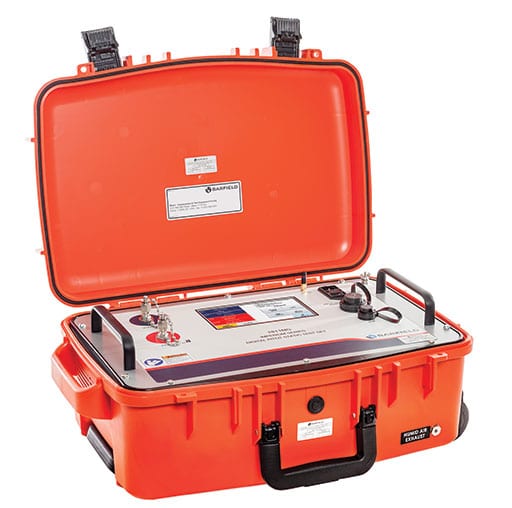
Barfield offers a full line of high accuracy Air Data testers. Their fully automated pitot static tester, shown above, supports general aviation, helicopter, UAV, non-RVSM regional and corporate aircraft. Barfield images.
Of course, there needs to be a range of test sets for different sectors of the aviation market. For example, the DPS501 NG is Barfield’s latest high accuracy air data management system test set that complies with RVSM requirements. A 10.4in backlit LCD display allows operators to switch between modes while testing without affecting operation while all the data is recorded for storage and later playback.
The DMA MPS43B digital pitot static test kit, designed for use on the flight line, is compact and weighs just 4.5kg. DMA image.
Operational realties also come into play. The DPS501 NG can be operated remotely, with the operator sitting in the cockpit monitoring the instrument displays instead of having a long cable connection from the test set in the ground. It is also usable with gloves in cold weather conditions — an AOG aircraft diverted for a speed mismatch between the pilots’ displays that needs checking may not be in a warm hangar.
The DPS1000 is another RVSM compliant air data test set but incorporates a wireless tablet communication capability. As well as controlling the unit this way, it means that using secure Wifi Direct, data can be sent to maintenance control, where an engineer can carry out trouble shooting on a difficult problem.
Further flexibility is demonstrated by the less sophisticated 1811NG, designed for general aviation, helicopter, UAV, non-RVSM regional and corporate aircraft, which has additional test functions such as cabin pressure and inlet barrier mode (intake particle separation in helicopters).
Nav-Aids
The link between the air data test set is an adapter consisting of a long hose assembly with covers at the end for pitot tubes and the static ports. Peter Moores, managing director at Montreal-based Nav-Aids, says the company has almost 60 years of experience and is considered one of the leading suppliers — it is a sole source for Barfield, for example.
As the position of the air data system components vary from aircraft to aircraft, each adapter has to be tailor made, involving early cooperation with the OEM on a new aircraft design as it will have to be tested before its first flight. As new variants are introduced, there may be small differences that require a new solution — there are several options for the Boeing 737, for example.
However, he says the OEMs can also get involved. Airbus was unhappy with a design that was inserted into the static port, on the A320 Family as it caused occasional scratching of the surface. An in-house engineering team came up with a solution that involves a bar being screwed into place on the fuselage. The adapter is moved along the bar to position it over the port. Airlines can also have a say, requesting customised kits that allow a quick test to be carried between flights.
Hose is a deceptive description. It is actually composed of a number of snap together sections that can be quickly assembled. They have to withstand considerable pressure during testing and also remain flexible in low temperatures. For the pitot tube, it is relatively easy to produce an adapter that slips over and has an airtight seal. As the static ports are flush with the fuselage skin, suction pads are generally used. Suction pads are also used to support the hose on the side of the fuselage, to avoid weight pressure if it were just to hang down — due to the size of the aircraft and the location of the pitot tubes and static ports, the hose for the Boeing 747-400 is 120ft long.
He agrees that development is slow but points out that the company is now involved with adapters for UAVs, a new market. He also says smart probes for the military have three channels of data, rather than the customary two as they can also measure angle of attack. They are now making a move into commercial aviation.
DMA
Paul Crowhurst is a Director at Evolution Measurement, sales agents for DMA, which is based in Aprilia, just south of Rome in Italy.
He says a design trend in recent years has been to decrease the weight and size of air data test sets. This has been achieved by lighter, smaller pumps, while efficiency and reliability have increased through the use of brushless electric motors. In addition, they can now often run on batteries, mains power or aircraft power. The testing process involves pressurising the system and then changing the pressure to simulate changes in speed and altitude. Exact values are calculated for each parameter and this provides the flight simulation aspect of the process. With increases in processing power, developments in sensor technology and that the data refresh rate is now much higher, providing greater levels of accuracy.
A good example is the MPS43B digital pitot static test kit from DMA. Designed for use on the flight line, it is compact and weighs just 4.5kg. All the important air data functions are displayed simultaneously, which include altitude to 55,000 ft, speed to 550 kts and rate of climb to 6000 ft/min. It is RVSM compliant. As well as a conventional keypad and a multi-coloured touchscreen display, it can be remotely controlled by a handheld control or wireless controlled by a remote touchscreen terminal. There is also an optional Bluetooth control capability for use with tablets or laptops. Up to 30 independent test profiles can be stored, each with 26 test points, as well as 300 profile results. With maintenance in mind, the internal pressure and vacuum pumps run only when required, extending the pump life.
Finally, Bontorno at Barfield says that, given the criticality of air data systems for aircraft safety, especially for RVSM, it is important that the regulatory recertification checks and maintenance and overhaul are carried out properly. That means a return to the OEM or an OEM-approved repair station, as a third party check is simply, at best, confirmation that the performance meets published specifications. What is needed is a true calibration that results not only in the equipment operating at its optimum accuracy and performance levels but also ensures it will maintain that performance until the next check.






You must be logged in to post a comment.