
by Elsie Clark | May 7, 2026 | Innovation
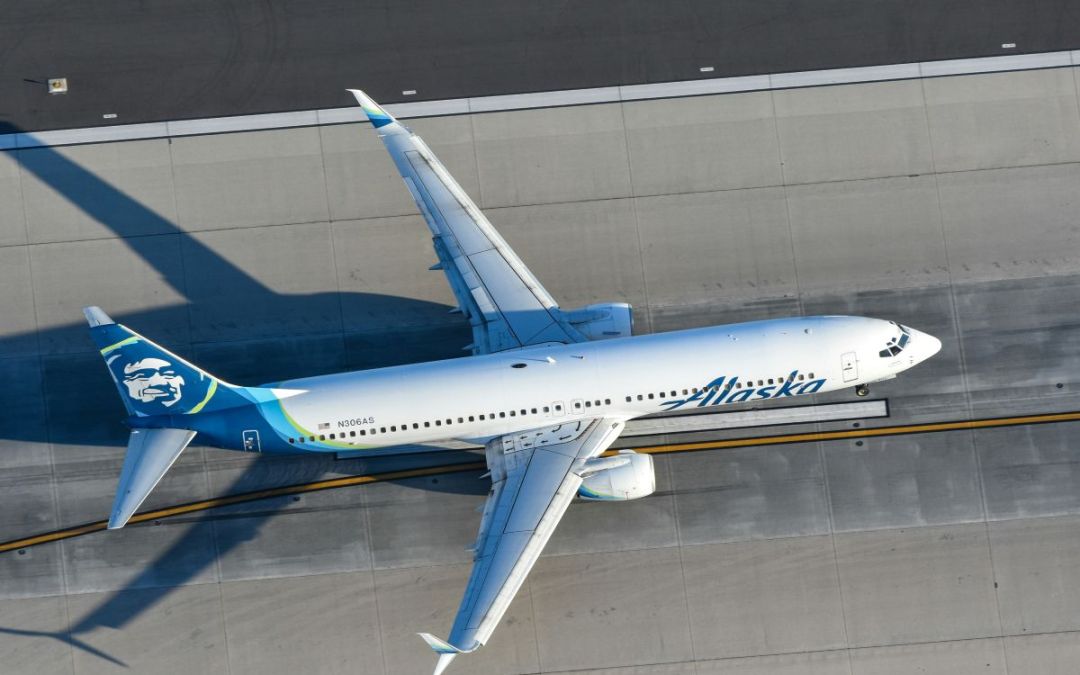
Alaska Airlines have signed a formal license agreement for the Boeing Virtual Airplane, a training solution designed to accelerate pilot readiness.
Alaska Airlines helped develop the tool, which is device-agnostic and lets pilots practice procedures within the dedicated app whenever they like. Additionally, the free-play Flight Management System (FMS) supports the standardisation of training so pilots can familiarise themselves with simulators more quickly.
Chris Broom, Vice President of Commercial Training Solutions at Boeing, commented:
Alaska Airlines’ commitment to innovation and safety has been instrumental in the development of Virtual Airplane. We are proud to see this partnership evolve as they move from beta testing to full adoption, leveraging Virtual Airplane to enhance pilot training and operational readiness.
Procedures Trainer is the first module in the Virtual Airplane’s suite of training tools. Currently available for Boeing 737 MAX training, the manufacturers say additional Boeing models will be added soon to enhance the programme. Jeff Severns, Managing Director of Flight Operations Training for Alaska Airlines, said:
Our collaboration with Boeing on Virtual Airplane has allowed us to provide our pilots with flexible, realistic training tools that complement traditional simulator sessions. We look forward to fully integrating this technology into our ground school curriculum to further improve training effectiveness and pilot proficiency.
Join us at Aerospace Tech Week 2026 to discuss the future of flight training.
For more like this, see:
by Elsie Clark | Dec 5, 2025 | Innovation
JetBlue has introduced a substantial augmentation to its training portfolio with the launch of ‘Gateway University – Tech Ops’, a brand-new programme designed to provide students with a direct route into permanent positions as aircraft maintenance technicians (AMTs).
This scheme expands upon the airline’s existing internal Technical Operations Gateways and, for the first time, extends the opportunity to individuals outside of the organisation to enter a structured, clearly defined training-to-employment pathway.
The initiative begins with two academic partners: Vaughn College of Aeronautics and Technology in New York and Cape Cod Community College in Massachusetts. Both are institutions accredited by the Federal Aviation Administration (FAA) and possess established links to JetBlue’s workforce requirements.
David A. Marcontell, vice president of technical operations at JetBlue, said:
AMTs are integral to our industry, working days, nights, weekends and holidays ensuring safety, reliability, and efficiency on every flight.
JetBlue’s home in the Northeast sits at the centre of our operations and many of our current technicians were trained at these schools. We know the skilled talent available well here and streamlining the path from early development to a full-time job at a major airline is as much a benefit to us as it is to the many candidates who are often dissuaded by the post graduate employment uncertainty.
Students accepted into the programme are guaranteed a conditional job offer, will receive mentorship from experienced JetBlue technicians, be given full support throughout the requisite coursework and FAA certification process, and move directly into an AMT role once they have finished.
JetBlue has commenced accepting the first intake of students, with the graduates expected to join the Technical Operations team in the year 2026. The carrier has indicated plans for further expansion to other partner colleges across its maintenance network.
According to Oliver Wyman, the aviation industry could face a shortage of as many as 48,000 mechanics by 2027 if steps are not taken quickly to replace ageing staff.
Join us at Aerospace Tech Week 2026 to discuss training and development pathways in aviation.
For more like this, see:
by Elsie Clark | Nov 7, 2025 | Innovation
Boeing has announced the launch of a new virtual pilot training platform powered by Microsoft Azure and Microsoft Flight Simulator.
Through highly accurate 3D simulations of Boeing aircraft, the Virtual Airplane Procedures Trainer (VAPT) provides flight crew with flexible, realistic training support. On a laptop or tablet, pilots can use the simulator to learn flows and checklists, and improve overall familiarisation before stepping into a physical simulator.
It is hoped that the new virtual simulator will reduce overall costs while standardising training. The CEO of Boeing Global Services, Chris Raymond, commented:
We’re very excited about the launch of Virtual Airplane. This new software will significantly impact how and when pilots and operators train and will provide them with much-needed flexibility. This new platform reflects Boeing’s commitment to digital innovation as we seek to leverage the latest technologies to improve our offerings and outcomes for our customers.
VAPT is currently available for the 737 MAX, with other aircraft simulators launching soon. Since the 1980s, Microsoft Flight Simulator has been a leader in the field, providing users with highly realistic environments to test their aviation skills. Virtual weather updates and air traffic control modelling have enhanced the software’s relevance to real-world scenarios.
Dayan Rodriguez, Corporate Vice President, Manufacturing and Mobility, Microsoft, added:
Microsoft is committed to accelerating learning while optimising confidence for pilots with safety at the core. Partnering with Boeing, we are advancing the future of flight by empowering the people at the heart of it.
Join us at Aerospace Tech Week 2026 to discuss the talent and technology the industry needs in the future.
For more like this, see:
by Elsie Clark | Nov 5, 2025 | Innovation
Portugália Airlines Training has been recognised as ‘Leading’ by IATA, the highest certification a training programme can receive. But why does the small airline continue to excel in this field?
At Aerospace Tech Week 2025, Hugo Oliveira, Portugália’s Training Director, discussed their innovative approach under parent company TAP Air Portugal. Key to making their training programme effective has been the introduction of new technology, including virtual reality (VR), augmented reality (AR), and the Metaverse. Oliveira believes this helps keep content fresh without compromising on important lessons.
There’s only so much we can do with the content because it’s very regulated. But we can do something about the delivery of that content.
Oliveira believes the implementation of tech has been key to maintaining staff interest during yearly training. The use of VR, he explains, sparks curiosity that makes Portugália’s programmes more engaging. However, implementing these changes didn’t come without resistance. Giving people choice between traditional methods and new tech has helped keep students happy.
If people don’t feel eager to try it, there’s no point pushing it. So we just try and make it interesting so that people want to try.
VR and AR has such promise that Oliveira believes in future costly flight simulators will be rendered obsolete. Technology has enabled a small airline like Portugálila to be more responsive and ultimately support more students at a time when the industry is in desperate need of more personnel.
I think in 10 years every pilot is going to have their own little flight simulator at home, and it’s going to be as efficient for training as the big machines at a training centre.
🎥 Watch the interview to hear Hugo Oliveira’s full thoughts on innovation in aviation training.
Questions asked include:
- What does your immersive training policy look like in practice?
- What benefits have you felt from using tech in training?
- Have you encountered any challenges when implementing new technology?
- What will training look like in the future?
Join us at Aerospace Tech Week 2026 to discuss the talent and technology the industry needs in the future.
For more like this, see:
by Elsie Clark | Oct 21, 2025 | Innovation
British low cost carrier (LCC) easyJet has launched a fresh apprenticeship recruitment drive, as research shows that an ageing workforce threatens to create significant staff shortages across aviation and aerospace.
The UK Civil Aviation Authority found that over a quarter (27%) of British aircraft maintenance personnel will retire in the next decade. With over 22 billion air passengers expected by 2053, the industry must fill these gaps if it is to maintain safety standards, manage new aircraft, and unlock the full potential of maintenance tech, including AI.
easyJet’s apprenticeship programme will give students hands-on training and pay them to learn. Applications for 2026 are now open, with the scheme to launch at easyJet’s Gatwick and Luton hubs, and plans in place to expand to Manchester, Liverpool, Bristol, Edinburgh and Glasgow.
Brendan McConnellogue, director of engineering and maintenance at easyJet, said:
Today’s young people are motivated by purpose – they want to solve problems, travel, innovate and play their part in building a more sustainable future.
Our engineering apprenticeships give candidates the chance to gain valuable experience working on our state-of-the-art fleet while helping to deliver on aviation’s commitment to decarbonisation.
easyJet survey reveals depth of aviation recruitment problem
As well as expanding their apprenticeships, easyJet conducted a survey of 2,000 16-24 year olds to understand further the challenges of replacing the ageing aviation workforce.
65% of respondents said that they had never considered a career in engineering, with many holding misconceptions around cost, qualifications, and accessibility. A significant gender gap also emerged: 52% of young men said they had considered engineering as a career, compared with only 36% of women
However, the survey also highlighted how young people’s career preferences align well with the world of aviation engineering. 44% of respondents wanted to help tackle climate change, and 43% of that group saw engineering as a good career for helping develop low-emission technologies.
The UK government’s aviation minister, Keir Mather, commented:
[easyJet’s] engineering apprenticeship scheme marks an important step in continuing to build a highly skilled aviation workforce fit for the future.
Initiatives like easyJet’s unlock exciting, flexible routes into aviation, backing an expanding sector whilst offering young people valuable opportunities and long-term careers.
Join us at Aerospace Tech Week 2026 to discuss the future of aircraft engineering and maintenance.
For more like this, see:




You must be logged in to post a comment.