
by Elsie Clark | Apr 16, 2026 | Innovation
IndiGo have invested in Sarla Aviation, a startup based in Bengaluru developing eVTOL air taxis. New data from India’s Registrar of Companies shows the airline made the investment through IndiGo Ventures, their US$52 million innovation funding arm established in June 2025.
InterGlobe enterprises, IndiGo’s parent company, had previously made an agreement with rival American eVTOL developers Archer. The deal, signed in November 2023, would have launched air taxis in Delhi, Bengaluru, and Mumbai as early as 2026. However, the partnership was non-binding and fell through when Archer could not deliver on the promised timelines.
Nevertheless, it appears IndiGo’s appetite to stake a claim in the advanced air mobility (AAM) sector is undiminished. In January 2026, the carrier contributed to a US$10 million funding round led by Accer on behalf of Sarla Aviation. Founded in 2023, the company claims to be developing ‘India’s most sophisticated eVTOL’. The aircraft is called Shunya, and can fly up to 800km at speeds as great as 250km/h.
Adrian Schmidt, Co-Founder & CEO, writes on Sarla’s website:
We are building a mobility system that empowers everyone – that empowers you. In our relentless pursuit of this goal, we have a clear strategy to transition from today to a future of ultimate inclusion, breaking the boundaries of time and space.
Air taxis could have a significant impact on alleviating traffic in India’s notoriously crowded roads. While the market on the subcontinent could be significant, eVTOLs are currently closest to taking off in the US and the Gulf, with firms including Archer and Joby Aviation nearing regulatory approval for commercial operations.
IndiGo have become India’s largest airline. The carrier joins peers including All Nippon Airways (ANA), IAG, and United Airlines in establishing a venture capital arm. Recent research from Lufthansa Innovation Hub found that airline investment in startups hit a five-year low in 2025, warning that the industry needs to get closer to disruptors or risk losing out.
Join us at Aerospace Tech Week 2026.
For more like this, see:
by Elsie Clark | Mar 10, 2026 | Innovation
Eve Air Mobility are partnering with Sydney-based startup Alt Air and Skyports to bring a commercial eVTOL network to Australia.
The three companies will collaborate to develop sustainable infrastructure that will make air taxis viable transport in Queensland and New South Wales. With Brisbane set to host the Olympic Games in 2032, Eve believe Australia provides the ideal environment to build vertiports and develop systems for ground operations, route planning, and airspace integration. Johann Bordais, Chief Executive Officer at Eve Air Mobility, said:
Through this collaboration, we are laying the foundation for a world-class eVTOL ecosystem in Australia. New South Wales and Queensland present an incredible opportunity to deliver sustainable, quiet, and efficient urban air mobility solutions that will benefit residents, businesses, and international visitors, especially as we look toward the opening of Western Sydney International Airport and the global stage of the Brisbane 2032 Games.
The consortium is prioritising development on potential high-demand routes, including Western Sydney Airport to central Sydney. Aaron Shaw, Managing Director at Alt Air, added:
Our work with Eve Air Mobility and Skyports underscores our shared commitment to building meaningful aviation innovation in Australia. Together, we are designing an eVTOL network that will significantly improve connectivity and set a benchmark for advanced air mobility worldwide.
Eve have previously signed agreements with the government of Bahrain for developing commercial eVTOL service across the Middle Eastern country. Rivals in the space, including Archer, Joby, and Vertical, are in the process of designing potential air taxi networks in metropolises including Dubai, Miami, and New York.
Join us at Aerospace Tech Week 2026.
For more like this, see:
by Elsie Clark | Feb 6, 2026 | Innovation
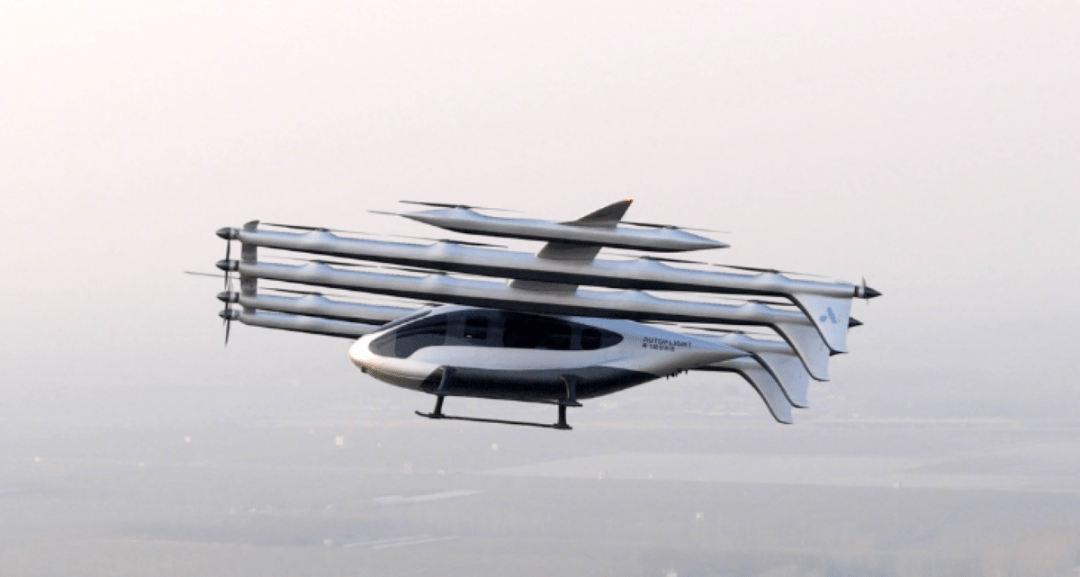
Chinese developers AutoFlight have debuted Matrix, what they claim is the world’s first 10-passenger eVTOL. Weighing five tons, the air taxi took to the skies for the first time in a public demonstration on 5 February.
AutoFlight say the design even includes washbasins and lavatories in the cabin. Most eVTOLs in development are configured for four to six passengers, meaning Matrix could represent a significant advancement.
AutoFlight’s CEO and Founder, Tian Yu, said:
Matrix is not only a rising star in the aviation industry but also an ambitious industry disruptor. It will break the industry perception that eVTOL = short-haul, low-load, and will reshape the rules of eVTOL routes.
With a 20-metre wingspan, the aircraft uses up to 20 fifth-generation lift motors, providing reliability in the event of engine failure. At the demonstration, Matrix successfully completed the full transition sequence, from vertical take-off to cruise flight and vertical landing. AutoFlight’s CarryAll cargo eVTOL also participated in the demonstration.
The pure-electric Matrix variant can travel up to 200km in one journey, while the hybrid variant has a range up to 1,500km.
Yu added:
Through economies of scale, it significantly reduces transportation costs per seat-kilometre and ton-kilometre, revolutionizing costs and embracing profitability. It covers all scenarios from urban commuting to intercity feeder routes, driving the expansion of the entire low-altitude ecosystem.
Join us at Aerospace Tech Week 2026 to discuss the future of advanced air mobility (AAM).
For more like this, see:
by Elsie Clark | Jan 22, 2026 | Innovation
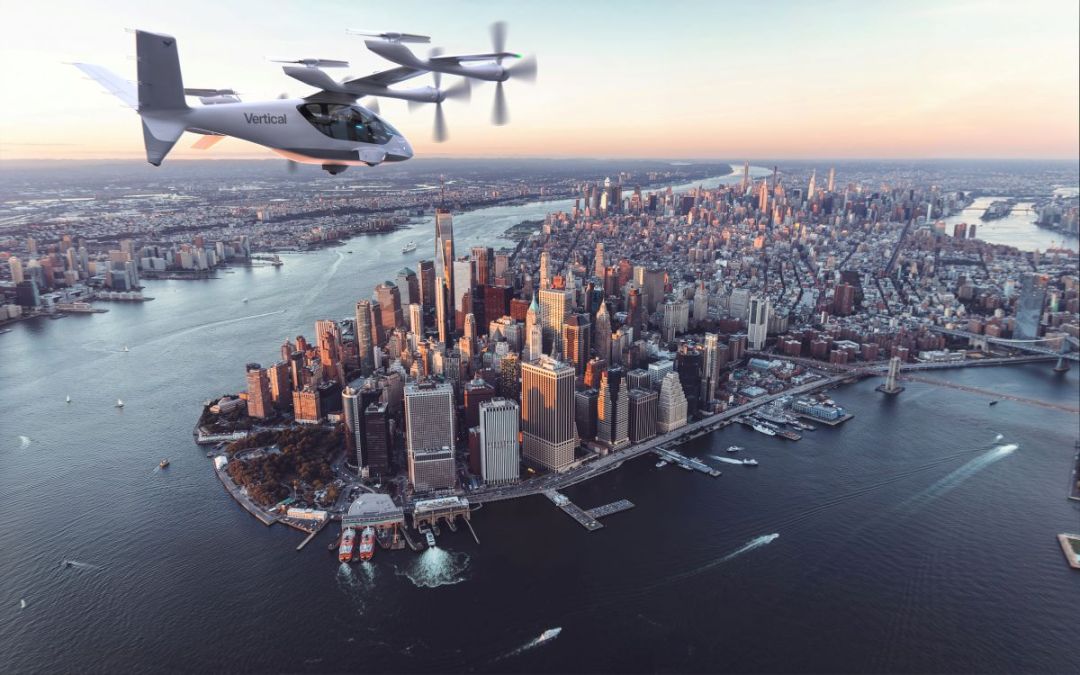
Vertical Aerospace, a UK eVTOL company, is directly taking on its competitors with plans to launch a New York air taxi network as early as 2028.
The company’s Valo aircraft will debut before American investors on January 23 in Manhattan. To align with this meeting, Vertical have announced a potential route map for commercial service across the biggest metropolis in the US. In collaboration with Bristow Group and Skyports Infrastructure, Vertical would open a hub in Downtown Manhattan to connect with the airports around the city: JFK, Newark, East Hampton, and Teterboro. Potential links could also be added to the MetLife Stadium, other heliports, and medical sites such as Westchester County Medical Center.
Stuart Simpson, CEO of Vertical Aerospace, said:
New York is a natural next step to explore how electric aviation could support urban and regional travel in the US, working with partners like Bristow and Skyports to keep safety, certification and real-world operations at the core.
The company has already unveiled prospective plans for a UK air taxi network that would see Valo connect Canary Wharf in London to Heathrow and Gatwick Airports, as well as the important academic research centres of Oxford and Cambridge.
Rivals Archer and Joby have both released their own plans for vertiport networks across New York. Both companies have also signed development agreements with countries in the Middle East, with Joby expected to launch a commercial eVTOL service in Dubai later this year. Archer meanwhile have continued US testing in a bid for certification from the Federal Aviation Administration (FAA). Their Midnight aircraft is expected to launch in time to provide connections at the 2028 Olympic Games in Los Angeles.
Join us at Aerospace Tech Week 2026 to discuss the future of advanced air mobility (AAM).
For more like this, see:
by Elsie Clark | Jan 14, 2026 | Innovation
Advanced Air Mobility (AAM) firm Joby Aviation has received the first of two CAE simulators to train its pilots.
Specifically designed for eVTOL operations, the simulators will enable Joby to train as many as 250 pilots a year. Featuring a 300-by-130-degree field of view, state of the art 3D visuals and audio cues recreate a real-world environment as closely as possible.
Alexandre Prévost, President of Civil Aviation at CAE, said:
By leveraging decades of expertise in high-fidelity simulation, we are helping Joby prepare pilots for safe, efficient operations and supporting the industry’s transition to sustainable air transportation.
Joby has worked with CAE on on the simulators since 2022. The culmination of for years of research and development, the systems will be key to advancing Joby’s certification plans in the US. Among other agreements, the company has also made significant progress in the United Arab Emirates (UAE), where it plans to launch a commercial eVTOL service later this year.
Bonny Simi, President of Operations at Joby, added:
These simulators are central to the FAA certification process and are being delivered on time to support pilot training ahead of Joby’s first commercial flights planned for this year. Developing flight fully qualified simulators takes years of work and access to aircraft data, and it is required for Part 135 operations of eVTOL aircraft in the United States.
Join us at Aerospace Tech Week 2026 to discuss the future of Advanced Air Mobility (AAM).
For more like this, see:



You must be logged in to post a comment.