
by Elsie Clark | Mar 23, 2026 | Connectivity
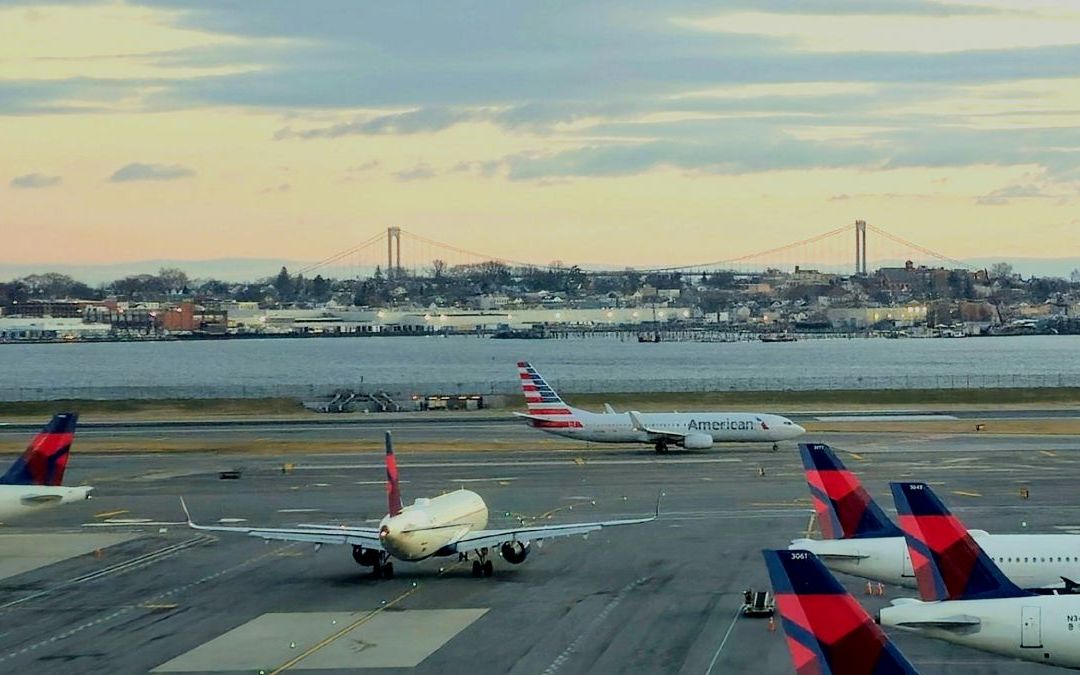
An aircraft has crashed with a ground vehicle at New York’s LaGuardia airport, resulting in multiple casualties.
The incident occurred on the evening of 22 March as an Air Canada Express landed. A CRJ-900, the aircraft recorded speeds of 39kmph as it hit the firefighting vehicle, which was on the tarmac attending to a separate incident. Both pilots were killed and several people seriously injured. As a result, the Federal Aviation Administration (FAA) announced they would close until it was safe to resume operations. The airport serves as a regional hub and handles around 30 million passengers a year, causing significant disruption to aviation across the Americas.
Photographers captured severe damage to the nose of the CRJ-900 as a result of the incident. Recent years have seen a notable uplift in ground and airborne collisions across the US, which have largely been blamed on a shortage of air traffic personnel. In October 2025, LaGuardia was the scene of another incident where two regional Delta jets collided at a taxiway intersection. Clipped wings and scrapes between aircraft have also taken place at Chicago O’Hare and San Francisco airports in the past year.
The ATC shortage has been exacerbated by the current government shutdown, which means many air traffic controllers are working without pay. Reports suggest that the controller managing the Air Canada flight was simultaneously responsible for overseeing a fire risk on a United aircraft due to a lack of staff.
Join us at Aerospace Tech Week 2026 to discuss the future of ATC, flight ops, and safety.
For more like this, see:
by Elsie Clark | Oct 20, 2025 | Connectivity
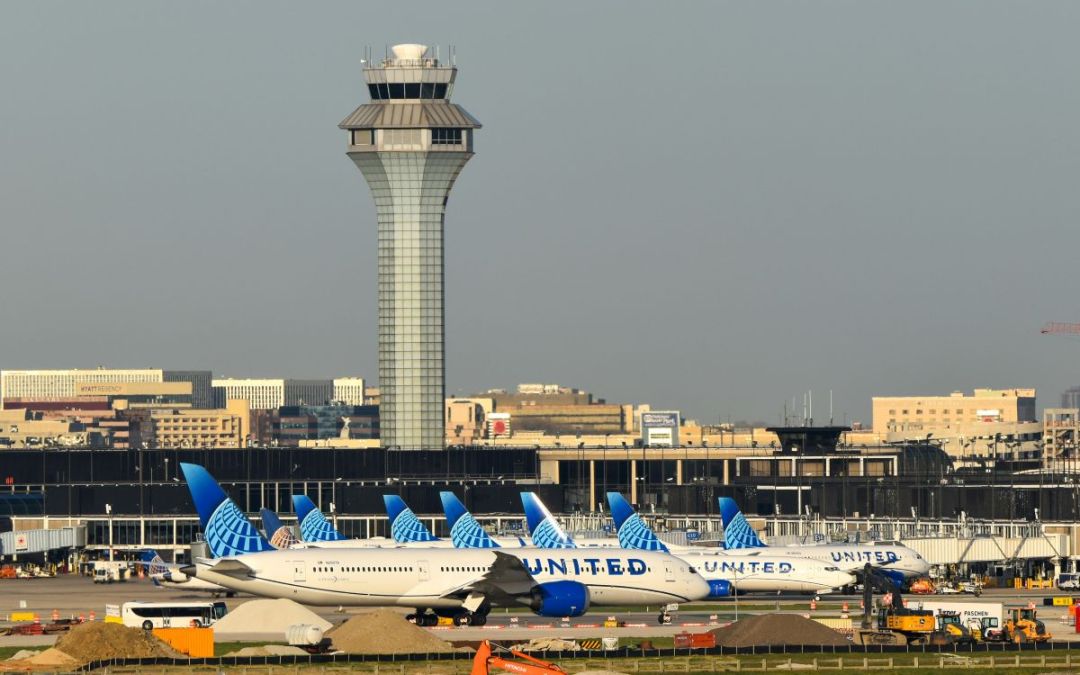
A taxiing Boeing 737 clipped a parked Boeing 767 at Chicago O’Hare International Airport on Friday 16 October.
Both planes belonged to United Airlines. As the 737, carrying 113 passengers and five crew members, passed the 767, which held no passengers, its wing clipped the other plane’s horizontal stabiliser. No one was injured, and a full inspection found no significant damage to either aircraft.
The light impact was reportedly not felt by the 737’s passengers, who were held on the aircraft for just under an hour before deplaning as usual.
The incident is yet another in a series that have affected US airport management as it struggles with a shortage of air traffic control (ATC) staff. On 1 October, at LaGuardia airport two regional Delta jets collided at a taxiway intersection. The crash, which resulted from one plane’s wing hitting the nose and cockpit of the other, injured one flight attendant.
Moreover, September saw another minor collision between United aircraft, this time at San Francisco airport. The incident mirrored another close call for United from May, where one aircraft clipped the tail of another standing stationary.
As of early 2025, the Federal Aviation Administration (FAA) was reporting ATC staff shortages of around 5,000. This year’s rapid recruitment drive has raised concerns about overwork of ATC instructors. Additionally, the US government shutdown, entering its 19th day at the time of writing, has exacerbated these problems.
The recent collision of the United planes thankfully resulted in neither casualties nor serious damages. However, that such accidents are happening at all emphasises that positioning, awareness, and communication require continual investment and improvement.
Join us at Aerospace Tech Week 2026 to discuss the future of ATC, flight ops, and safety.
For more like this, see:
by Elsie Clark | Sep 29, 2025 | Connectivity, Flight Ops IT
An incident at Nice Côte d’Azur Airport is under investigation after two aircraft came within three metres of each other on the runway, narrowly avoiding a crash.
The near-accident occurred on Sunday 21 September at around 21.30 local time during stormy, foggy conditions. A Nouvelair A320 from Tunis Carthage Airport came into land and flew metres above an easyJet flight on the runway, bound for Nantes.
Eyewitnesses said that the easyJet aircraft shook as the Nouvelair plane passed overhead. The flight to Nantes was subsequently cancelled, and the easyJet pilot was reported to have left the craft in distress. The Nouvelair plane was forced to go-around and landed safely shortly after.
The French Minister of Transport, Philippe Tabaro, has opened an investigation into the near-collision through the Bureau d’enquêtes et d’analyses (BEA).
Stormy conditions emphasise limitations of available positioning tech
The situation at Nice Airport was complicated by the poor weather conditions that forced many flights to be delayed, diverted, or cancelled. In an amusing high-profile incident, Formula One drivers Carlos Sainz and Charles Leclerc ended up driving a van back to Monaco from Italy after their plane to Nice was unexpectedly diverted on the evening of 21 September.
Possibly, the incident between the easyJet and Nouvelair planes would have occurred if visibility had been better. Yet the near-accident also highlights the shortcomings of air traffic control and the inability of aircraft to position themselves safely in relation to each other.
Recently, Aerospace Tech Review also reported on Honeywell’s testing new SURF-A technology, which the company claims will improve pilots’ situational awareness and prevent runway incidents. The test recreated two famous near-collisions at American airports and demonstrated how real-time alerts could have been used to prevent them.
Yet technology can be fallible too. The drama that unfolded at Nice last week only highlights once again the importance of ongoing safety improvements and multiple backups to guarantee the safety of passengers and crew.
Join us at Aerospace Tech Week 2026, where we’ll be discussing the latest innovations in avionics and flight ops that are improving safety in aviation.
For more like this, see:


You must be logged in to post a comment.