
by Elsie Clark | May 7, 2026 | Innovation
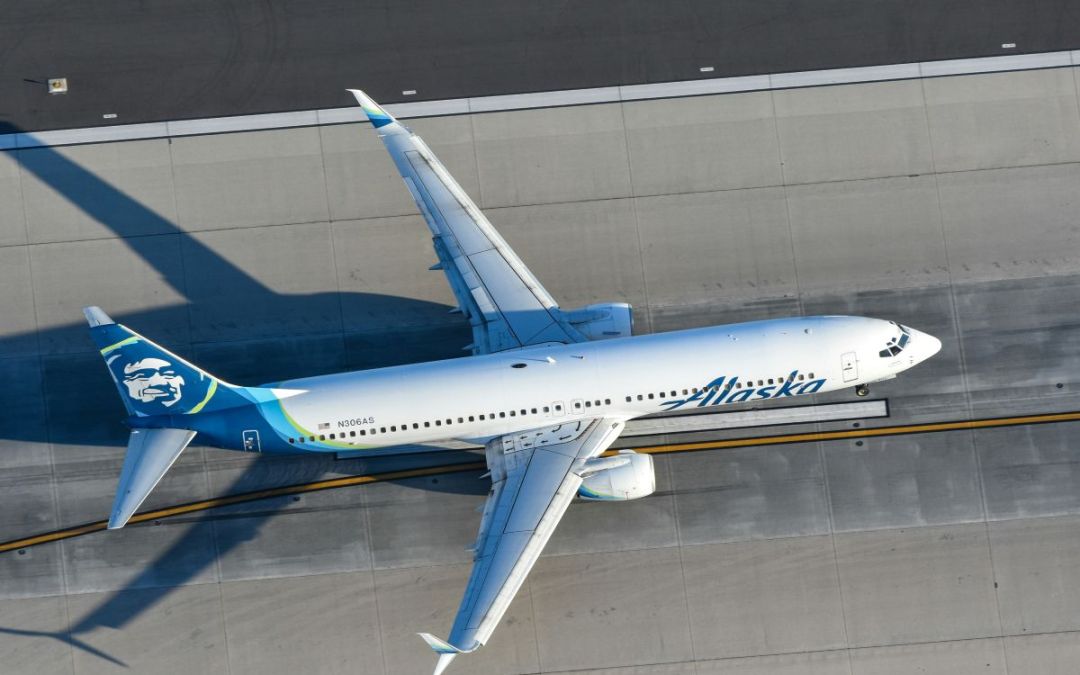
Alaska Airlines have signed a formal license agreement for the Boeing Virtual Airplane, a training solution designed to accelerate pilot readiness.
Alaska Airlines helped develop the tool, which is device-agnostic and lets pilots practice procedures within the dedicated app whenever they like. Additionally, the free-play Flight Management System (FMS) supports the standardisation of training so pilots can familiarise themselves with simulators more quickly.
Chris Broom, Vice President of Commercial Training Solutions at Boeing, commented:
Alaska Airlines’ commitment to innovation and safety has been instrumental in the development of Virtual Airplane. We are proud to see this partnership evolve as they move from beta testing to full adoption, leveraging Virtual Airplane to enhance pilot training and operational readiness.
Procedures Trainer is the first module in the Virtual Airplane’s suite of training tools. Currently available for Boeing 737 MAX training, the manufacturers say additional Boeing models will be added soon to enhance the programme. Jeff Severns, Managing Director of Flight Operations Training for Alaska Airlines, said:
Our collaboration with Boeing on Virtual Airplane has allowed us to provide our pilots with flexible, realistic training tools that complement traditional simulator sessions. We look forward to fully integrating this technology into our ground school curriculum to further improve training effectiveness and pilot proficiency.
Join us at Aerospace Tech Week 2026 to discuss the future of flight training.
For more like this, see:
by Elsie Clark | Jan 27, 2026 | Innovation
American aircraft manufacturer Boeing have reported their first full-year profit since 2018, following years of supply chain issues.
The company profited by US$2.24 billion in 2025, a significant step forward after net losses of US$11.83 billion the previous year. Q4 profits received a notable boost from the US$9.6 billion sale of its Digital Aviation Solutions business to US-based private equity firm Thoma Bravo.
These figures were supported by Boeing’s highest number of annual deliveries since 2018. 600 commercial aircraft rolled off the production lines, led by the 737 MAX. Nevertheless, a backlog of over 6,000 deliveries remains, worth US$682 billion. Delivery continues to be obstructed by issues across the supply chain, as well as pending regulatory approval of the 737 MAX 7 and MAX 10 variants by the Federal Aviation Administration (FAA).
Kelly Ortberg, Boeing President and CEO, said:
We made significant progress on our recovery in 2025 and have set the foundation to keep our momentum going in the year ahead. We completed the acquisition of Spirit AeroSystems and the sale of portions of the Digital Aviation Solutions business and remain focused on promoting stable operations, completing our development programs, rebuilding trust with our stakeholders, and fully restoring Boeing to the iconic company we all know it can be.
Join us at Aerospace Tech Week 2026.
For more like this, see:
by Elsie Clark | Jan 19, 2026 | Innovation
The South China Morning Post has confirmed that pilots working for the European Aviation Safety Agency (EASA) have been testing the COMAC C919 plane in Shanghai.
China’s rival to the Airbus A320 and Boeing 737, the C919 applied for EASA certification in 2019, but the process was delayed by the Covid-19 pandemic. Approval efforts restarted in 2023, and EASA confirmed that new ‘validation’ tests in Shanghai involved foreign pilots
The Federal Aviation Administration (FAA) is also yet to certify the C919 for US operations. COMAC aircraft are currently in service with Air China, China Eastern Airlines, and China Southern Airlines. The smaller regional C909 jet is also in use across China, with orders confirmed from Air Cambodia and TransNusa.
Lacking certification from any Western aviation authority puts a brake on COMAC’s expansion plans. Ryanair CEO Michael O’Leary told Skift in March 2025 that he would order COMAC aircraft if they were allowed into the market and priced competitively. These comments drew the attention of US Congressman Raja Krishnamoorthi, who said:
US and European airlines should not be even contemplating the future purchase of airplanes from Chinese military companies.
However, as supply chain pressures continue to cause Airbus and Boeing to underdeliver, COMAC aircraft could fill a critical gap in the market to fuel airlines’ ambitious growth targets.
Join us at Aerospace Tech Week 2026.
For more like this, see:
by Elsie Clark | Nov 25, 2025 | Innovation
GE Aerospace are investing nearly US$53 million in their manufacturing facility in West Jefferson, North Carolina. The facility is responsible for critical components in the CFM LEAP engine, which powers commercial narrow-body aircraft.
Under the new project, a 35,000 square foot extension will be added to the manufacturing site, and more equipment purchased to boost production. Funding from local government is supporting the initiative, while GE Aerospace has committed to training North Carolinians to fill 40 new job roles.
Parts made at the West Jefferson facility include rotating parts, turbines, and spools, The planned upgrades will take place over three years as GE Aerospace seeks to address directly the supply chain issues plaguing the aerospace sector.
A report from IATA and Oliver Wyman found that supply chain challenges could cost airlines as much as US$11 billion in 2025. Geopolitical instability, material shortages, and labour availability have compounded existing bottlenecks, all while increasing costs.
However, aviation’s growth plans continue to rise, with airlines ordering greater volumes of aircraft than ever. Airbus and Boeing are both struggling to meet the demand for narrow-body aircraft, with delivery slots for the A320neo and 737 MAX sold out for the next decade. The rapid growth of low-cost carriers such as flydubai and Ryanair, alongside legacy carrier’s focus on premium narrow-body experiences, has placed more pressure on manufacturers.
GE Aerospace’s investment hopes to ease some of these supply chain constraints. However, with the facility not set to open for a further three years, the industry must still address a range of production challenges to tackle the supply chain conundrum.
Join us at Aerospace Tech Week 2026, where our dedicated supply chain track will discuss how the industry can build resilience and mitigate disruption.
For more like this, see:
by Elsie Clark | Nov 7, 2025 | Innovation
Boeing has announced the launch of a new virtual pilot training platform powered by Microsoft Azure and Microsoft Flight Simulator.
Through highly accurate 3D simulations of Boeing aircraft, the Virtual Airplane Procedures Trainer (VAPT) provides flight crew with flexible, realistic training support. On a laptop or tablet, pilots can use the simulator to learn flows and checklists, and improve overall familiarisation before stepping into a physical simulator.
It is hoped that the new virtual simulator will reduce overall costs while standardising training. The CEO of Boeing Global Services, Chris Raymond, commented:
We’re very excited about the launch of Virtual Airplane. This new software will significantly impact how and when pilots and operators train and will provide them with much-needed flexibility. This new platform reflects Boeing’s commitment to digital innovation as we seek to leverage the latest technologies to improve our offerings and outcomes for our customers.
VAPT is currently available for the 737 MAX, with other aircraft simulators launching soon. Since the 1980s, Microsoft Flight Simulator has been a leader in the field, providing users with highly realistic environments to test their aviation skills. Virtual weather updates and air traffic control modelling have enhanced the software’s relevance to real-world scenarios.
Dayan Rodriguez, Corporate Vice President, Manufacturing and Mobility, Microsoft, added:
Microsoft is committed to accelerating learning while optimising confidence for pilots with safety at the core. Partnering with Boeing, we are advancing the future of flight by empowering the people at the heart of it.
Join us at Aerospace Tech Week 2026 to discuss the talent and technology the industry needs in the future.
For more like this, see:


You must be logged in to post a comment.