
by Jessica Brownlow | Apr 3, 2025 | Innovation, MRO IT
Article by Point B
Reducing disruptions’ probability, impact, and duration
“Resilience” is the word most often heard in supply chain discussions; however, Point B believes it’s about reinvention with best practices in mind. How do you build, or reinvigorate, a supply chain you can trust? This strategic imperative requires a foundational framework embedded with innovation, collaboration, sustainability, agility, and talent development to adequately address and mitigate disruptions. Given the critical nature of aerospace and defense products, any interruption in the supply chain can have significant consequences, including production delays, increased costs, and compromised national security. Such disruptions can be avoided through a reinvention focused on preparedness, readiness, and adaptability.
The disruption model
Disruptions to supply chain operations threaten performance quality, reputations, and revenue generation. Disruptions to the supply chain can take many forms, such as a weather event (e.g., hurricane), economic (e.g., trade barrier or recession), labor impact (e.g., strike, unexpected departure of a key person, or epidemic), or geo-political events (e.g., conflict or military action). These create logistical challenges and shortages in raw materials and part availability.
The foundational framework to create a resiliency plan to overcome disruptions should include:
- Preparation for the Probability – “How prepared in advance are you?”
- Readiness for the Impact – “How ready is your supply chain now?”
- Adaptability for the Duration – “How adaptable are you?”
How do these 3 things reduce or overcome disruption? Preparation reduces the chances of disruption. Readiness reduces the impact when disruption occurs. And lastly, adaptability reduces the time back to supply chain stasis.
Strategic investments for a trustworthy supply chain
Preparation is easier with quality data and built-in redundancy
Should any disruption to the supply chain occur, preparation reduces the probability that the disruption will meaningfully decrease business performance. These are proactive investments to make before a disruption arises. Ultimately, good preparation extends the time frame between the disruption and any impact on the organization’s supply. Preparation techniques include some combination of:
Data-enabled risk identification
Your high standards for your products and their delivery should extend into your supply chain data. Quality data across the supply chain ecosystem will provide insight into risks and vulnerabilities, like an early warning system.
Scenario planning
Advanced digital twin modeling, control tower, and pre-identified scoring criteria can help you anticipate the effects of a disruption.
Diverse suppliers and vendors
When disruption impacts an individual or a segment of partners, support capacity can be redistributed to unaffected partners.
Talent and processes redundancies
Clear succession planning prevents the absence or loss of leaders or subject matter experts from disrupting decision-making. The aging workforce is a big challenge for engineering in aerospace. The talent pipeline for experienced engineers is extremely low, and developing internal talent can take years. You can use a built-buy-borrow method to have a balanced approach.
Well-defined standard operating procedures (SOPs) close the knowledge gaps in the event of key talent loss to remain compliant. Since aerospace and defense is highly regulated, it’s critical to document for better knowledge transfer. Stringent requirements must always be met, even during workforce transitions.
Prevent the absence or loss of key operators from interrupting operations by employee cross-training and/or training local resources on critical operations that, if impacted, would cause a pervasive disruption.
Business continuity playbook
Proactively prescribe checklists and activities to be executed during specified disruptions including defined metrics and data that will enable and guide decisions. Creating rapid response teams that snap into place once certain criteria are met increases the speed at which emergency planning and response can begin.
If you’re a Tier 1 or 2 supplier, consider M&A activity to control upstream supply
The right part at the right place at the right time is becoming increasingly complex and challenging for supply chain leaders. Preparation that balances the management of materials, talent, and data will combat disruptions.
If you are looking for control of materials, lead times, or delivery commitments, then mergers and acquisitions may be a consideration for growth, greater control, and increase in market share.
Readiness means quickly pulling the right control levers in a crisis
Readiness minimizes the volume or amount of impact. Think of readiness as the reactive levers you can control while experiencing a crisis to mitigate damage to your operations.
Readiness techniques include:
- Stockpiling and spare management – Susceptible and/or critical inventories should be considered for stockpiling.
- Create supplier inventory agreements for key items – Contract negotiations with if/then clauses can protect certain item shortage particular for items that are historically difficult to source.
- Integrated business planning – The use of inventory management formulas and techniques allows for a rapid and more accurate inventory management response to a disruption. However, available and accurate data define these formulas and techniques. Do you have quality data and analytics to make better decisions faster
- Capitalize on those preparation investments – Utilize your business continuity playbook and workforce redundancy plans as needed.
While traditional economic order quantity (EOQ) and safety stock are good measures during normal supply-and-demand times, organizations that do best are the ones that are vigilant in examining where they have soft spots or vulnerabilities in their supply chains.
Adaptability comes from clear prioritization
Finally, adaptability is the ability to reduce the duration it takes to resume operational performance to pre-disruption levels. This often requires a quantitative and qualitative approach to understand when to revert specific actions taken during the disruption. Certain actions may not be sustainable or optimal over a long period of time and, if left in place for too long, could begin to decrease operational performance. Adaptability techniques that organizations may use include some combination of:
- Managing exceptions-based metrics based on organization’s tolerance of disruption risk
- Clear prioritization criteria. While it may seem obvious, complex or multi-siloed organizations are susceptible to losing sight of how disruptions impact the entire organization. Step back and reprioritize based on the timing of your logistics and firm-wide strategic objectives.
- Capitalize on investment in the Preparation phase
- Create supplier capabilities and flexibly skilled workforces through a build-buy-borrow workforce mentality
- Act on the relationships with partners and third-party logistics (3PL)
Available reactive options diminish once a disruption begins. The investments made for preparation reap continued benefits within the readiness and adaptability strategies. Most of the tactics in the adaptability approach rely on tactics planned in the preparation phase. Adaptive companies take precautions early and re-evaluate often.
The reality of trade-offs
Developing a resilience strategy requires making tradeoffs. Too often, supply chain leaders consider resilience planning as a nice to-have – until disaster strikes. It’s imperative to be deliberate about resiliency, which means creating capabilities in priority areas and understanding which areas to invest in. It can be helpful to think of each resilience capability alone and as a combined effort, with some options reinforcing 2 or 3 resilience capabilities. Resilience options with overlapping benefits are where supply chain leaders should prioritize investments to maximize return.
Fundamentally, building a resilience strategy requires selecting the desired balance between those options that promote efficiency versus those that will promote conservatism. Tactics that support resilience, such as stockpiling supplies and developing secondary supplier relationships, can incur greater expense and capacity, but provide some insurance against supply chokepoints. Just-in-time planning, e.g., traditional Lean activities or cross-training a smaller pool of employees, can expose the organization to more single points of failure but generate greater flexibility and speed. The answer is to find the right mix of tactics that protect your organization, supply chain and overall firm strategy.
A thoughtful supply chain resilience strategy that prioritizes and balances proactive preparation, reactive readiness and adaptability can make the difference between a company succumbing to the chaos of the next disruption or thriving.
Ultimately, can you trust your supply chain?
If the answer is “no”, then use these approaches to enable your supply chain to be less reactive and more resilient.
For more from PointB also see:
by Jessica Brownlow | Mar 3, 2025 | Innovation
Article by Point B
Learn how to harness the latest digital transformations, get ahead of workforce trends, and build a more resilient supply chain
Global competition, technological shifts, and ongoing disruptions are reshaping aerospace. Thriving in this environment takes more than adaptation—it calls for strategic foresight and innovation. In our recent webinar, “Propelling Aerospace into the Future,” Point B’s Lauren Edwards and Zameer Baber discussed how leaders can seize opportunities and overcome challenges by embracing digital transformation, rethinking workforce strategies, and strengthening supply chains. We’ve shared highlights and actionable insights from the discussion below.
Digital transformation
Digital transformation is essential for improving operational efficiency and enabling data-driven decision-making. Yet, our proprietary research indicates that 70-80% of digital initiatives fail to achieve strategic objectives. The primary culprit? Misalignment between corporate and digital strategies.
Consider common challenges leadership must address when implementing digital transformation: integrating new systems into existing technology environments, upskilling teams to adapt to customer-centric, digital-first approaches, and cultivating a culture of innovation that embraces digital change. Although there are various tactics and strategies, starting with pilot projects can help organizations demonstrate value, secure stakeholder buy-in, and build momentum. The most effective transformations equip teams with the right tools and training, while fostering a culture where experimentation thrives alongside clear objectives.
When aligned with broader business goals, digital transformation delivers measurable ROI, from increased revenue and reduced costs to improved customer and employee experiences and enhanced innovation. During the webinar, our experts emphasized how digital transformation also drives workforce innovation and bolsters supply chain resilience.
Workforce innovation and skills for the future
Technological advancements continue to reshape workforce needs. Demand for roles in engineering, cloud, data science, and AI is growing, but technical backgrounds alone aren’t enough to drive organizational performance. Employees need the right tools, time, and support to innovate and grow.
For example, training technicians on emerging tools like predictive maintenance algorithms builds familiarity with new processes. To fully realize these benefits, organizations must empower employees to apply their expanded skills and knowledge to their daily tasks. This not only enhances efficiency but also creates a better employee experience.
Tracking the impact of digital initiatives and related training is critical to achieving ROI. A culture of innovation requires giving teams the flexibility and confidence to adapt in a tech-driven landscape. Investing in upskilling is more than meeting workforce demands—it’s a catalyst for organizational performance and resilience.
Supply chain resilience—a strategic imperative
Recent disruptions—from the pandemic to geopolitical challenges—have underscored the importance of agile, resilient supply chains. While digital tools such as AI-based risk assessments, digital twins, and contract lifecycle management platforms enhance efficiency, fostering transparency and collaboration across the supply chain can yield even greater benefits.
Optimizing supply chains through digital transformations not only reduces costs and mitigates risks, but can also increase revenue and improve customer satisfaction by delivering products and services more effectively.
Building a cohesive supply chain ecosystem, where partners innovate collaboratively, prepares organizations to weather disruptions. Real-time data integration and seamless collaboration between front and back offices empower decision-making and enhance resilience. The supply chains of the future are interconnected ecosystems where agility is a critical competitive advantage.
The future of aerospace
Over the next decade, technologies like machine learning, predictive analytics, and IoT will continue to reshape aerospace operations and culture. Embracing digital transformation isn’t optional, it’s essential for survival and growth.
The path forward lies in integrating innovative tools, empowering your workforce, and fostering resilient supply chains. By aligning digital initiatives with strategic goals, aerospace leaders can navigate today’s complexities and position their organizations for long-term success.
by Jessica Brownlow | Feb 28, 2025 | Flight Ops IT
In a bid to accelerate air traffic controller hiring following concerns of staffing shortage, the US Transportation Secretary Sean P. Duffy has announced plans to “supercharge” hiring. According to Reuters, the Federal Aviation Administration’s (FAA) is approximately 3,500 fully certified air traffic controllers under targeted staffing levels.
The FAA says it plans to make it “more efficient than ever to apply and more affordable to begin training.”
The air traffic controller hiring window was opened by the FAA yesterday until 17th March, encouraging the “best and brightest” to pursue this career. With a new streamlined process, the FAA will:
- Recruit top candidates through a merit-based process
- Give candidates with the highest Air Traffic Skills Assessment Test (ATSA) scores priority to the Academy
- Increase starting salaries by 30 per cent for Academy trainees
- Reduce the 8-step hiring process at the FAA to 5-steps cutting 4 months off the process.
Speaking on the initiative, Duffy said:
“Today’s visit reaffirmed how being an air traffic controller is one of the best, most rewarding jobs in America, and that the next generation at the Academy is the best in the world. I witnessed first hand the dedication, skill, and rigor that our future air traffic controllers bring to their training and the urgent need to do all that we can to recruit more people to join in our shared mission of safety in our skies. This staffing shortage has been a known challenge for over a decade, and this administration is committed to solving it. The new streamlined hiring process is just the first step to deliver on President Trump’s agenda to prioritize the American people’s safety and modernize the federal government.”
This year, Aerospace Tech Week Europe are launching a Recruitment Zone where recruiters and talent acquisition teams can host a digital job board, meet with candidates, and hold interviews in the room. With over 2,500 people in the room from students to CEOs, make the most of the networking opportunities available and book your ticket now.
For more like this see:
by Jessica Brownlow | Jan 6, 2025 | Innovation
This month, the Federal Aviation Administration (FAA) and Washington, D.C.-based National Flight Training Alliance (NFTA) will be contacting key stakeholders and providers as they prepare to modernise flight training in the United States.
Recently, the FAA announced the NFTA as its industry partner for the advancement of flight training under 14 CFR 141 in a “first-of-its-kind partnership.”
The three-year old NFTA is comprised of ‘leading American flight training providers and industry-wide aviation stakeholders committed to producing the finest and safest professional pilots in the world.’
In the announcement, NFTA highlighted several key areas they are looking to update:
-
Reimagining a new regulatory framework that removes impediments to efficiency in a modern flight training environment.
-
Embracing new technologies and new training methods to improve student outcomes and professional qualifications.
-
Improving efficiencies that will translate into real and certain cost reductions for students, reducing barriers to entry.
-
Inviting and incentivising the majority of flight training providers to participate in modernization efforts, upending the current fragmented approach.
-
A new regulatory program that embraces the need for a data driven approach to flight training and the adoption of safety management system (SMS) – based operating standards.
-
Improving training at every level of aviation to enhance system safety.
Speaking on the partnership, Captain Lee Collins, CEO of NFTA said:
“We see this anticipated level of cooperation and collaboration as ushering in a new era of aviation, and NFTA is eager to advocate for flight training providers and our general aviation colleagues and vendors – in partnership with the FAA – to maximize the safety, quality and use of advanced technology in professional flight training for the next generation of commercial pilots.”
At Aerospace Tech Week Europe, industry experts will come together to explore Training & Simulations, Flight Ops IT, Avionics, MRO IT, Connected Aircraft, Cybersecurity, Testing, UAM, Sustainability and Supply Chain & Procurement. View the agenda here and book your ticket now for free!
For more like this see:
by Jessica Brownlow | Jan 3, 2025 | AI & ML
As the aerospace industry continues to evolve, investing in artificial intelligence (AI) has become a crucial step for enterprises aiming to stay competitive. However, the key to a successful AI strategy lies in effectively measuring and optimizing the return on investment. Read on as Yurts, a leading AI integration platform serving defense, government, and enterprise shares key concepts you must understand when navigating the complex landscape of AI investment.
Investing in artificial intelligence (AI) has become crucial for enterprises aiming to stay competitive. However, the key to a successful AI strategy lies in effectively measuring and optimizing the return on investment. In this first post, I’ll be focusing on the investment side of that calculation. I’ve spoken to many organizations that have embraced AI, and have observed what’s working and what isn’t. The key concept executives must understand is the total cost of ownership (TCO). Here’s a guide to help you navigate this complex landscape.
Understanding Total Cost of Ownership (TCO)
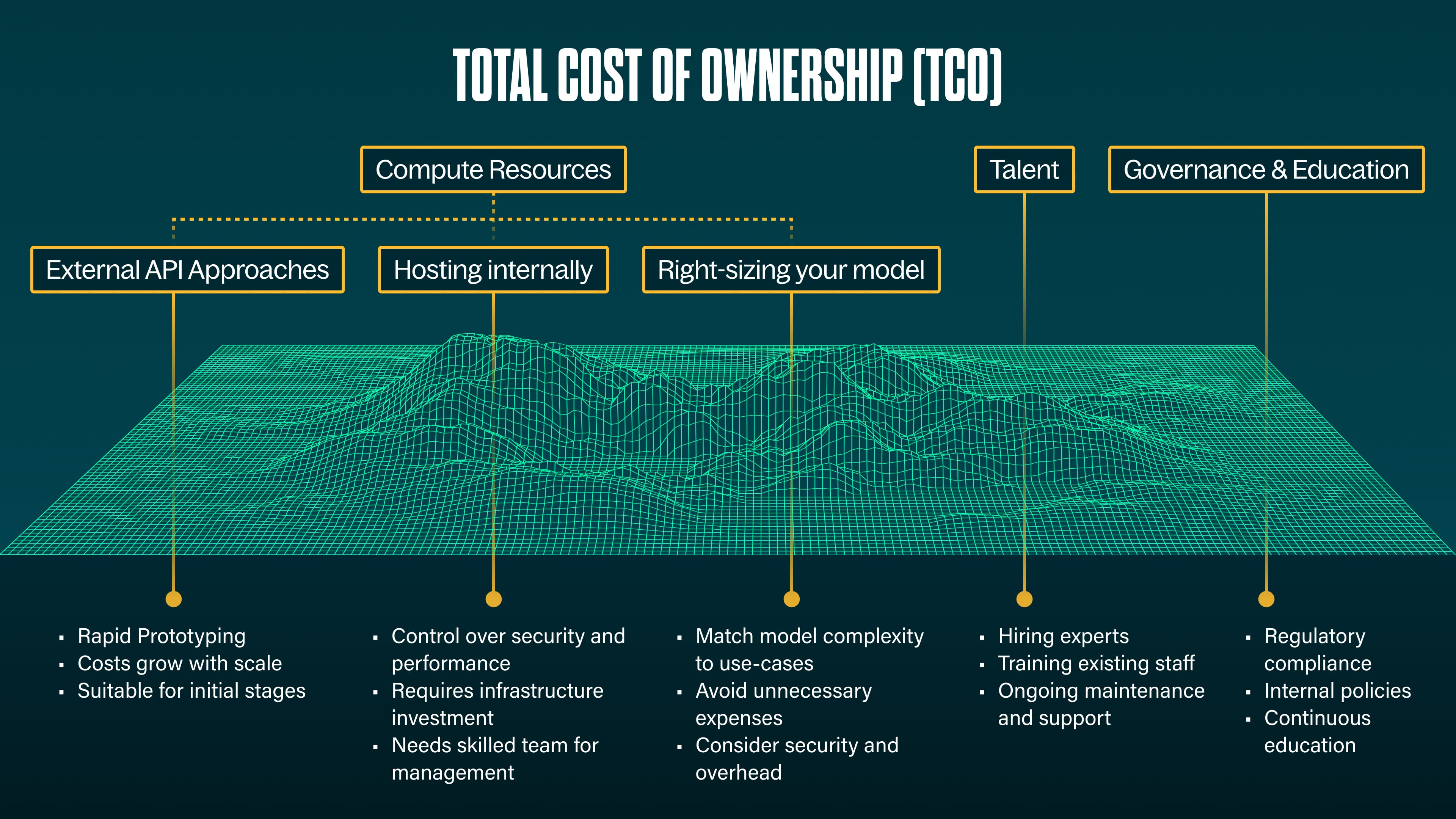
When you think about AI investments, the TCO encompasses several factors beyond the initial purchasing decision. Key among these are the compute resources you select, the talent needed to support these resources, and all those essential, albeit “unsexy,” components like governance and education.
Compute: Balancing Speed and Scale
External API Approaches: If your security posture allows it, using externally hosted models via APIs is a great way to hit the ground running. It allows for rapid prototyping and proof-of-concept work without hefty upfront investments. However, beware of the costs growing as your project scales. For instance, using methods like retrieval-augmented generation (RAG) can quickly drive up costs due to increasing input token counts. Like most managed services, while these solutions are convenient, reaching a certain scale usually makes self-hosting the more cost-effective path. But keep in mind that transitioning to self-hosting can complicate how you quantify your investment.
Host Internally: Hosting models internally gives you control over security, performance and costs, but it requires a careful evaluation of your infrastructure capacity and capabilities. This path can optimize long-term expenses but requires upfront investment and the right team to manage it.
Right-size Your Model: Always align your AI capabilities with your primary use-cases. Avoid over-investing in a complex model (think Ferrari) when a simpler one (think golf cart) could meet your needs just as effectively and at a lower cost. Security, as always, is an important factor. If you’re hosting this model, how much overhead do you want to take on? Also, how are you actually using these models? It is important to understand your use-cases and determine if you actually need all those extra billion parameters.
Funny story: Yurts recently performed a bakeoff between two competing models for a customer that needs to self host. These models have very different parameter sizes. In this case, we defined a series of tasks, and asked humans which model performed better. The smaller model won on many of the tasks, and was on par for the rest. Bigger isn’t always better, but it’s almost always more expensive.
Optimizing Headcount Investment
Support Staff for Compute: Hosting internally requires system administrators, data engineers, AI specialists, devops, MLops, and project managers to oversee development and resource allocation. Salaries and administrative staff are significant costs. Factor these into your overall investment. And please, pretty please, with sugar on top, don’t say, “we already have those people.” Opportunity costs are real.
Strategic Development: Utilize your internal AI and tech talent thoughtfully. As AI technologies become increasingly commoditized, the opportunity costs of developing undifferentiated tools internally can be significant. Focus your team’s efforts on projects that are bespoke and aligned with your enterprise’s core competencies, and consider off-the-shelf solutions for everything else. This allows your organization to remain agile and on the cutting edge without unnecessary internal development strains.
Don’t Overlook the Essentials
Finally, successful AI implementation isn’t just about the technology and people—you also need to spend real resources on:
- Internal Awareness and Adoption: Emphasize the importance of stakeholders understanding the value AI brings to the organization, ensuring they are actively engaged. According to the latest McKinsey Global Survey on AI, organizations with high levels of GenAI usage at the senior level are more likely to see widespread adoption across the business. Despite this, 70% of leaders feel their teams aren’t adequately prepared for AI, highlighting a significant gap in readiness.
- Ongoing Education: Make sure the broader workforce knows how these technologies can help, and also (more importantly) where it can’t!
- Analytics and Proof of Value: Continually measure the impact of AI investments and demonstrate value to ensure sustained support from leadership.
- Governance: This technology is for making your organization more efficient, not for training the last earnings call into a Bob Dylan song. Implement strong oversight mechanisms to manage risks and comply with regulations.
Conclusion
Investing in AI is as much about strategic planning as it is about technology. By considering the full TCO, including compute resources, human capital, and the foundational elements of a strong AI strategy, you can optimize your investments to deliver sustainable value. Keep these factors in mind, and you’ll be well-positioned to navigate the complexities of AI in the enterprise landscape, ensuring that your organization not only keeps pace with changes in technology but leads the charge. For more advanced strategies to maximize ROI in your AI investment, check out this blog.
Article by Yurts






You must be logged in to post a comment.