
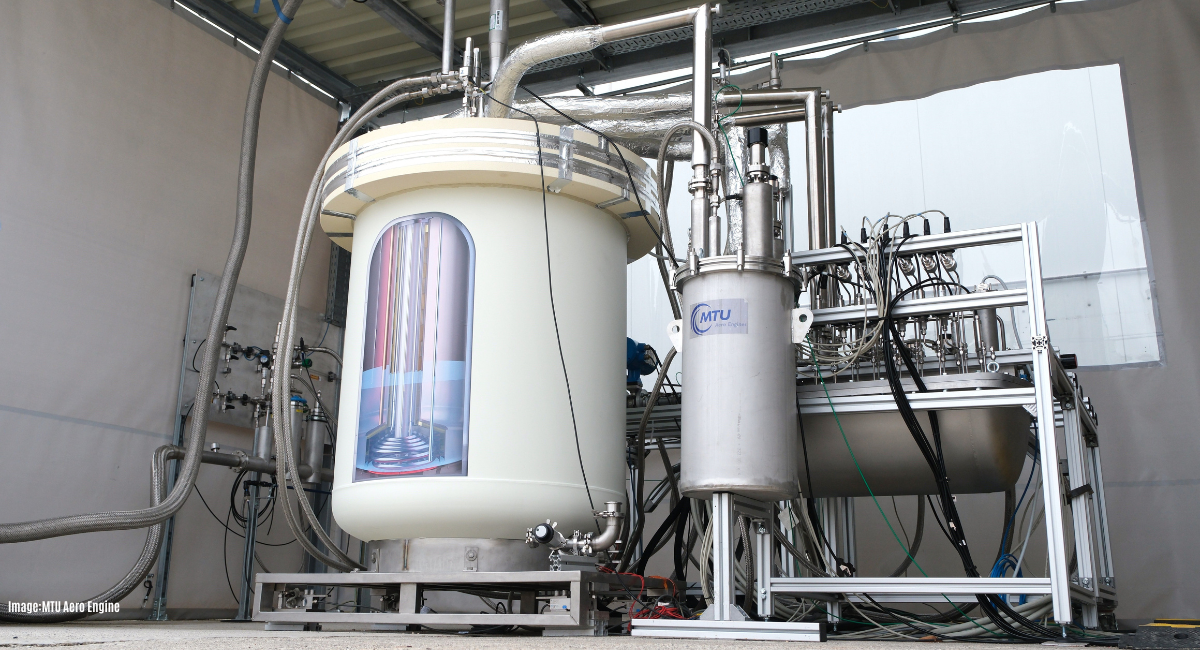
In partnership with MT Aerospace AG, MTU Aero Engines is developing a “complete liquid-hydrogen fuel system for commercial aviation that consists of tanks, sensors, heat exchangers, valves, safety systems, and controls.” This collaboration is pushing towards a more sustainable future for aviation by leveraging the power of hydrogen.
MTU Aero Engines recently completed multi-week testing of a liquid hydrogen fuel system for its Flying Fuel Cell™ (FFC) marking a key step towards making hydrogen-fuelled, zero-emission flights a reality. The recent test was conducted with liquid hydrogen and confirms the system is effective and reliable. Previous tests had only been run with liquid nitrogen.
The press released explained in brief how this work.
“Hydrogen is transported and stored in liquid form at a temperature of about -250°C. The refrigerated LH2 needs to be heated during operation and changed to a gaseous state; then a defined mass flow is fed into the fuel cell.”
Reporting the successful results, Barnaby Law, FFC Chief Engineer at MTU said:
“This concept, including all of the sensors and functions needed in the aircraft, is what we have now validated.”
Looking ahead to the next steps, Dr. Claus Riegler, Senior Vice President Technology & Engineering Advanced Programs at MTU added:
“This is an excellent starting point; it will let us offer an appropriate, reliable, and high-performing LH2 fuel system solution for a wide range of aircraft models.”
Testing of a product-specific full-system FFC will start in 2026.
For more like this also see:
- Digitalisation and SAF: Director of Sustainability on striving for net-zero at Vueling
- Disruptive sustainability technology with Grzegorz Ombach, Airbus
- Sustainability in Aviation: The Crucial Role of a Circular Economy